



Suggested Searches

Blogs

  • NASA’s SpaceX Crew-4 Space Station Departure Delayed for Weather

    NASA and SpaceX now are targeting no earlier than 10:05 a.m. EDT Thursday, Oct. 13, for the agency’s Crew-4 undocking from the International Space Station to begin the return trip to Earth completing a nearly six-month science mission in orbit. Splashdown is targeted several hours later at 5:43 p.m. Thursday off the coast of Florida. …

  • NASA’s SpaceX Crew-4 Space Station Departure Delayed for Weather

    NASA and SpaceX now are targeting no earlier than 10:05 a.m. EDT Thursday, Oct. 13, for the agency’s Crew-4 undocking from the International Space Station to begin the return trip to Earth completing a nearly six-month science mission in orbit. Splashdown is targeted several hours later at 5:43 p.m. Thursday off the coast of Florida. …

  • Webb Reveals Shells of Dust Surrounding Brilliant Binary Star System

    The latest image from NASA‘s James Webb Space Telescope is a new perspective on the binary star Wolf-Rayet 140, revealing details and structure in a new light. Astronomer Ryan Lau of NSF’s NOIRLab, principal investigator of the Webb Early Release Science program that observed the star, shares his thoughts on the observations. “On the night …

  • NASA Sets Date for Next Launch Attempt for Artemis I Moon Mission 

    Artemis Logo - red rocket trail, blue arch that represents earth, ARTEMIS text, gray half sphere on a white background

    NASA is targeting the next launch attempt of the Artemis I mission for Monday, Nov. 14 with liftoff of the Space Launch System (SLS) rocket carrying the Orion spacecraft planned during a 69-minute launch window that opens at 12:07 a.m. EST. Artemis I is an uncrewed flight test to launch SLS and send Orion around …

  • NASA TV to Air Crew Activities as Astronauts Prepare, Return to Earth

    NASA will provide live coverage of the upcoming return activities for the agency’s SpaceX Crew-4 mission to the International Space Station. NASA and SpaceX are targeting 5:41 p.m. EDT Thursday, Oct. 13, for the splashdown and conclusion of the Crew-4 flight, wrapping up a nearly six-month science mission for NASA astronauts Bob Hines, Kjell Lindgren, and Jessica Watkins, as well as ESA …

  • ISS Daily Summary Report – 10/11/2022

    Payloads: Wireless Compose-2: On Monday, a crewmember donned the SmartTex-2 shirt and performed a Ballistocardiography experiment session. The main scientific goal of the Wireless Communication Network (Wireless Compose-2) investigation is to provide a flexible and adaptable wireless network infrastructure to conduct and execute low-power, light-weight, and wireless experiments on the ISS. For this demonstration, Wireless …

  • Station Crew Prepares to Split Up While Research Continues

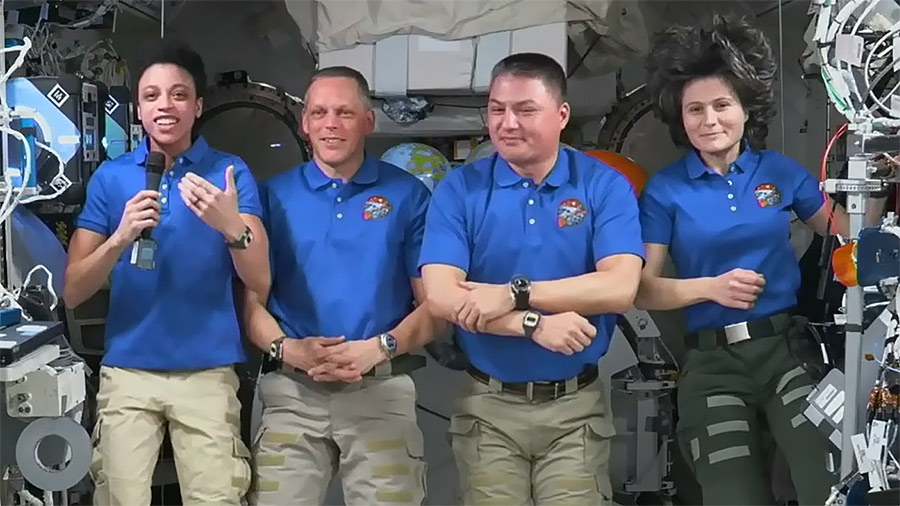
    Astronauts (from left) Jessica Watkins, Bob Hines, Kjell Lindgren, and Samantha Cristoforetti talk to journalists on Earth about the space station mission. Credit: NASA TV

    It was a busy Tuesday aboard the International Space Station as the 11 crew members split their time between advanced space research and orbital lab maintenance.  Four astronauts are also turning their attention to returning to Earth ending a mission that began in April. Two new Expedition 68 crewmates focused their science activities on growing …

  • NASA InSight’s Power Level as of Oct. 8, 2022

    On October 8, 2022, InSight was generating an average of 300 watt-hours of energy per Martian day, or sol – an increase after a sharp decline last week from 430 watt-hours per sol to a low of 275 watt-hours per sol. The decline was caused by a regional dust storm which, though thousands of miles …