












Suggested Searches

Blogs

  • Stacking Complete on Artemis II Rocket Boosters

    Engineers with NASA’s Exploration Ground Systems complete stacking operations on the twin SLS (Space Launch System) solid rocket boosters for Artemis II by integrating the nose cones atop the forward assemblies inside the Vehicle Assembly Building’s High Bay 3 at NASA’s Kennedy Space Center in Florida on Wednesday, Feb. 19, 2025. During three months of stacking operations, technicians used a massive overhead crane to lift 10 booster segments – five segments per booster – and aerodynamic nose cones into place on mobile launcher 1. The twin solid boosters will help support the remaining rocket components and the Orion spacecraft during final assembly of the Artemis II Moon rocket and provide more than 75 percent of the total SLS thrust during liftoff from NASA Kennedy’s Launch Pad 39B.

    Engineers at NASA’s Kennedy Space Center in Florida completed stacking the twin SLS (Space Launch System) solid rocket boosters inside the Vehicle Assembly Building for the agency’s Artemis II crewed test flight around the Moon. At launch and during liftoff, the boosters, which each stand 177 feet tall, will provide the majority of the 8.8 […]

  • Muscle Research, Blood Tests To Promote Healthy Crews End Week

    The sun rises above the Pacific Ocean revealing the terminator, the line between night and day on Earth, in this photograph from the Internaional Space Station as it orbited 259 miles above and about 500 miles north of Hawaii.

    Muscle stimulation and blood tests topped the International Space Station research schedule on Friday helping doctors learn how to keep astronauts healthy on long-term missions. The Expedition 72 residents also winded down the work week cleaning spacesuits and life support gear aboard the orbital outpost.

  • Blue Ghost Remains on Track, Lunar Orbit Insertion Burn Complete

    A bright Moon in the darkness of space with the Moon’s South Pole visible on the far left.

    After about a month in transit to the Moon, Firefly’s Blue Ghost lunar lander successfully completed a four-minute lunar orbit insertion burn Thursday – the longest and most challenging burn conducted to date by the lander’s main engine and reaction control system thrusters. Now that the lander is in lunar trajectory, over the next 16 …

  • Vein Scans, Muscle Study on Station Informing Ways to Keep Crews Healthy

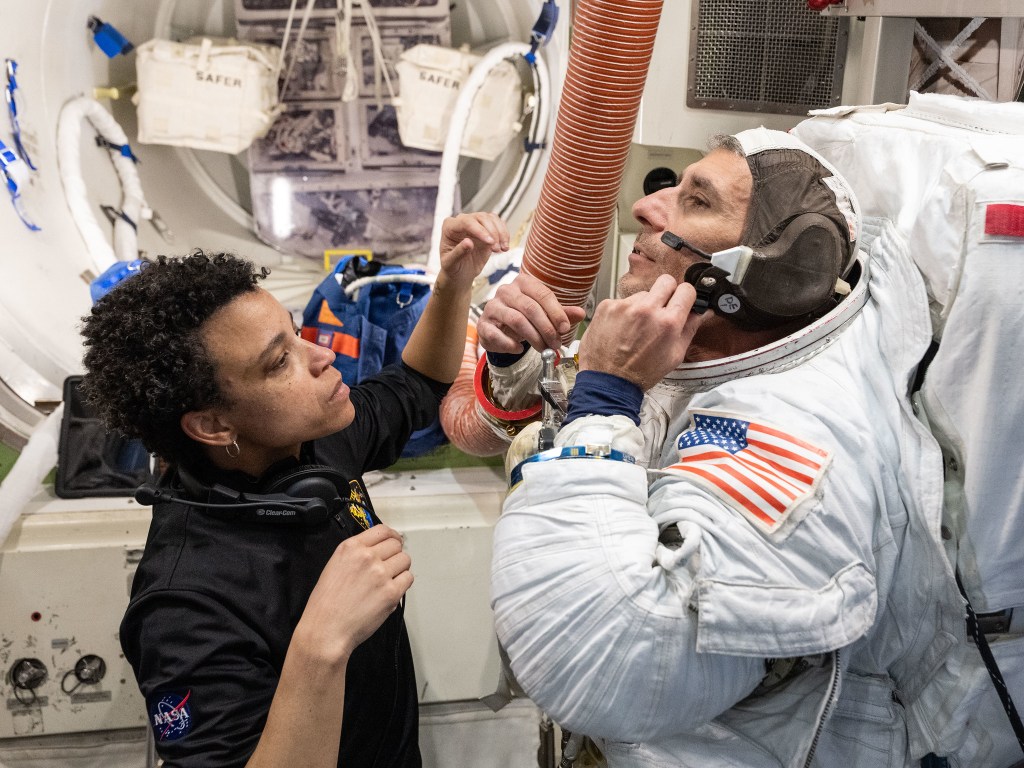
    NASA astronaut and Expedition 72 Commander Suni Williams displays production packs containing geneticallly engineered yeast and edible media for incubation to activate yeast growth. The BioNutrients investigation explores using the engineered yeast to produce on-demand nutrients and avoid vitamin deficiencies for crews on long-term missions. The samples are later frozen then returned to Earth to analyze their ability promote crew health and improve the preservation of probiotics.

    Human research, the series of ongoing investigations to understand how an astronaut’s body adapts to living long-term in space, was the main science topic aboard the International Space Station on Thursday. The Expedition 72 residents also continued packing a cargo craft for its upcoming departure and conducted an emergency drill to stay familiar with response, communication, and coordination procedures.

  • NASA’s Webb Reveals the Ancient Surfaces of Trans-Neptunian Objects

    Trans-Neptunian objects (TNOs) are icy bodies ranging in size from Pluto and Eris (dwarf planets with diameters of about 1,500 miles) down to tens of miles (Arrokoth) and even smaller. TNOs are on orbits comparable in size, or even much larger than, that of Neptune. The existence of TNOs was postulated by Kenneth Edgeworth, and …