













From Earth orbit to the Moon and Mars, explore the world of human spaceflight with NASA each week on the official podcast of the Johnson Space Center in Houston, Texas. Listen to in-depth conversations with the astronauts, scientists and engineers who make it possible.
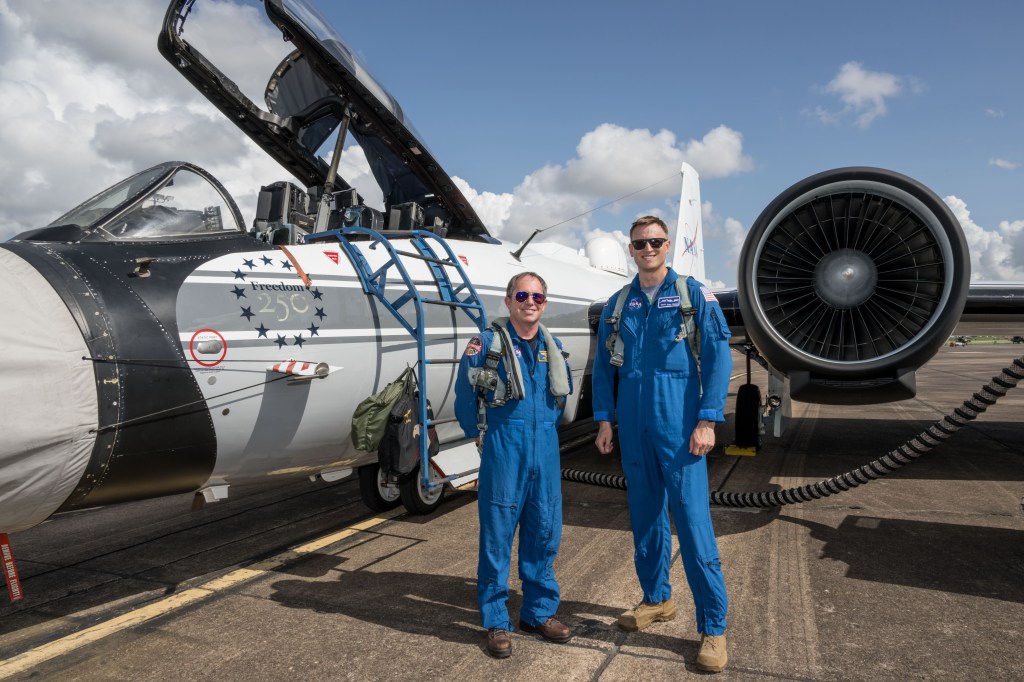
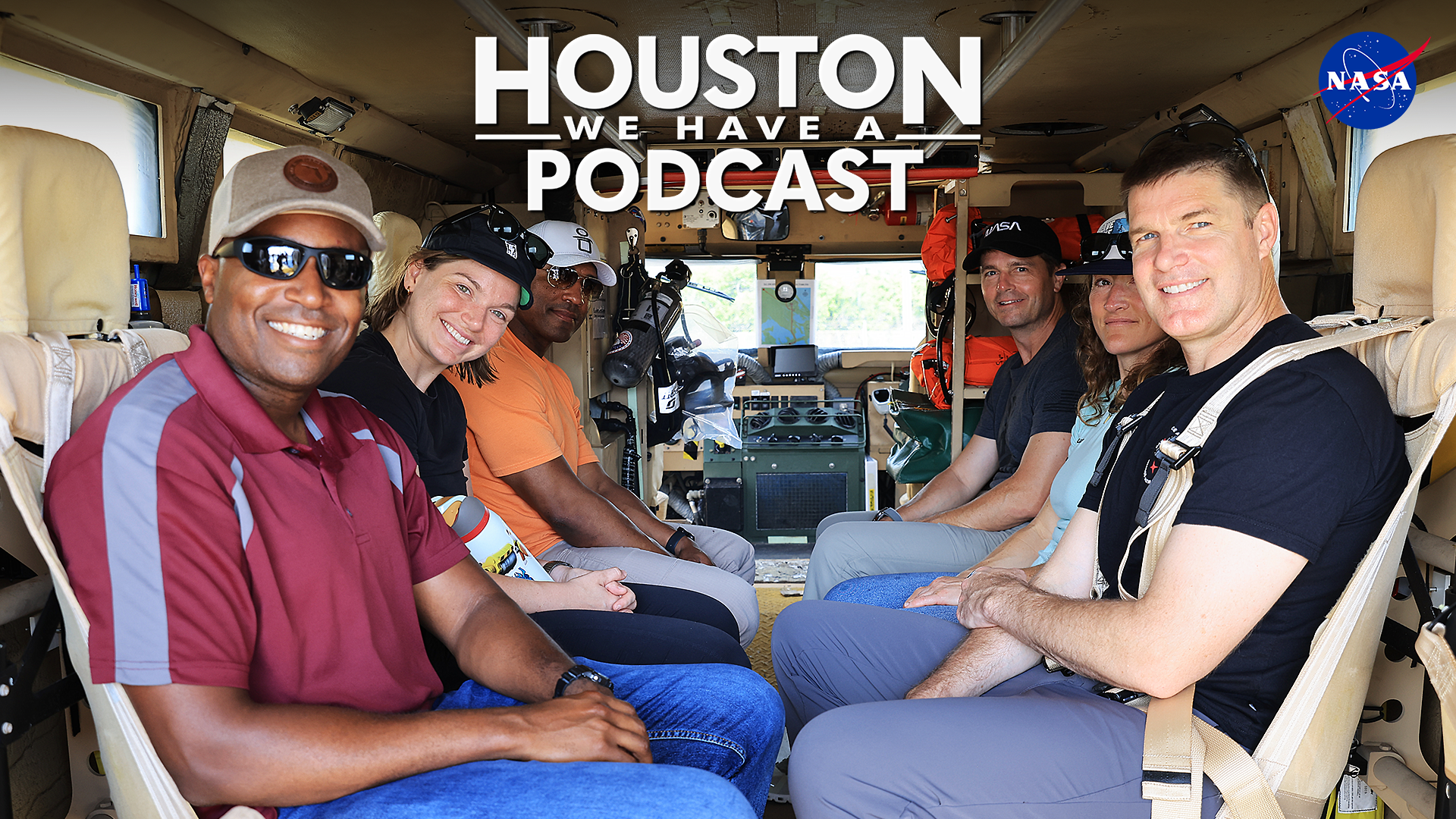
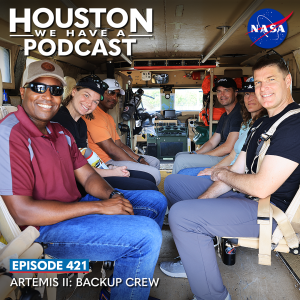
On Episode 421, NASA astronaut Andre Douglas and Canadian Space Agency astronaut Jenni Gibbons discuss their roles as the Artemis II backup crew, including their training and mission support. The pair reflects on the historic flight around the Moon. This episode was recorded in April 23, 2026.
Transcript
Leah Cheshier
Houston We Have a Podcast. Welcome to the official podcast of the NASA Johnson Space Center Episode 421: Artemis II: Backup Crew. I’m Leah Cheshier, and I’ll be your host today. On this podcast, we bring in the experts, scientists, engineers, and astronauts, all to let you know what’s going on in the world of human spaceflight and more.
You’re likely familiar with the four astronauts who flew around the Moon as part of the Artemis II mission, Reid Wiseman, Victor Glover, Christina Koch, and Jeremy Hansen. But did you know there are two more critical members of their team who were ready to jump in at a moment’s notice? That’s NASA astronaut Andre Douglas and Canadian Space Agency astronaut Jenni Gibbons, who trained with the crew and served as their backups. While they did not fly on the mission, they each had their own duties before and through the mission beyond serving as backups to help ensure success.
Joining me today to discuss selection, preparation and the Artemis II mission are Jenni and Andre themselves. We’ll talk through the training process, their roles during the flight, and their reflections now that the mission is a wrap.
Let’s do it.
<Intro Music>
Leah Cheshier
Andre and Jenni, thank you so much for coming on Houston We Have a Podcast today.
Jenni Gibbons
Thanks for having us.
Andre Douglas
Yeah, it’s a pleasure and an honor to be here.
Leah Cheshier
I’m excited to dive into a little bit about what you guys did as Artemis II backups, but I want to start kind of with your background. So, Andre you were selected in 2021 for the NASA astronaut class, and then you graduated in 2024. So can you tell us briefly about your selection, your time as an astronaut candidate?
Andre Douglas
Yeah, so that process was completely new to me, going through all the training and everything was a lot of fun. Had a lot of good classmates. It was just like, you know, go through a lot of training and learn how to do EVA, EVQ, do your robotics, do all the things you need to do to prepare for the space station. That’s what it was really about. And got to do a lot of cool things along the way, like go with my classmates to survival training, learn how to, like, live off the land, and basically figure out how to, if you eject, basically figure out how to how a way to get home, or whatever it was. It was very different, a lot of different things that we did, but the training was overall good and very different than Artemis, though.
Leah Cheshier
Yeah, I can’t wait to dive into that. I will say we did get to interview you for like, right after you had been selected, I think it was your announcement day, yes, and I remember you telling the story about how you told your wife that you’d been selected. You were just at home, and you gave her a hug. And I just remember it was so sweet to me, because it was just such a simple moment, I could envision it. And I was just like, oh my gosh, it was so touching. That’s probably kind of weird that I remember that, but I did the interview.
Andre Douglas
No, it was a special moment. I mean, I’ll never forget, you know, it was this combination of working so hard to get to where I wanted to go from an early age, and then at the same time, like trying to bring along the people that I loved, right? It was all of that came into that moment where they were there with me, and we were at the house. It was during COVID. And then the cool thing about this, everything about this, is that Reid Wiseman called me,
Leah Cheshier
Oh my gosh! Yeah!
Andre Douglas
Right? And, like, it just blows my mind. Like, this whole trip with Artemis II, and everything that we’ve done, and to have him there and to train next to him, and then, I don’t know, it’s just very special, right, to have it come full circle, where on the mission, I’m doing whatever I can to help him fly and make sure that he comes back safely. I mean, it was awesome, but like to have him call me during that moment at you know, to be selected was quite an honor. And I didn’t know him that well, but like, listening to him talk in that first sentence and just having that dialog, I’m like, Man, this guy is something else, you know, and I got to learn more about him as we’re flying through the mission. And I’m like, Man, I’m really glad he’s our leader for the crew. I mean, it was just really cool. So there’s a lot there, but I’ll stop.
Leah Cheshier
Oh no. I love that. When I got involved in NASA, in the NASA circle in like, 2014 he was on the space station. So it’s so funny. If I could go back and tell a little me, you know, someday you’ll get to see him fly to the moon, I think I’d have been like, What are you talking about? So that’s amazing.
But Jenni, you were selected in 2017 graduated in 2020 Can you tell us about your selection as a Canadian Space Agency astronaut. Is that process any different?
Jenni Gibbons
Yeah, absolutely, it is a little different. So on the Canadian side, we have fewer selections, and we select fewer astronauts. So we have a smaller space agency in general, and our selection process lasts about a year. Has multiple assessment centers where you evaluate a candidate’s ability to solve problems, you evaluate operational skill, work as a team, look at their followership skills, how they communicate, how they lead, and it’s really all encompassing.
That process, again, took about a year. I was living in the UK at the time, I was a brand new professor over there. And when I found out that I’d been selected, moved to Houston was a pretty quick turnaround, and started this candidacy program as a member of the Turtles class. So I had these wonderful classmates with me throughout all that training.
And like Dre said, your focus at that time is to just absorb as much as you can and learn the core competencies that you need during that candidate flow, which are what you need for the space station and beyond. So learning the systems of the space station. Rush in how to do space walks in the Neutral Buoyancy Laboratory, robotics, and you visit a multitude of NASA centers. You visit the Canadian Space Agency and other international partners. That was just such a joyful and wonderful learning experience, that entire flow, and then graduate and move on to supporting missions to the International Space Station and elsewhere after that.
Leah Cheshier
Well, you both mentioned how really a lot of your astronaut candidate training is for the International Space Station, because that’s really where we’ve been going for the last 25 years that we’ve had the space station in orbit with people on it. So was there something in your astronaut candidate training that ended up really paying off when you were training for Artemis II.
Andre Douglas
So I would like to kind of comment on some of the things that Jenni mentioned for our core competencies, like robotics. I thought was interesting, because there are some common architectures that occur between vehicles. So when we learn how to do flying the jet and then flying robotics, like the hand controllers that we have are designed to fit what we’re used to. And so it was kind of nice, like Jenni and I were doing some proximity operations demonstrations and in training for us, just in case we go but, you know, obviously we didn’t fly on Orion, but we did a lot of simulations together, and Jenni was really good at providing that SA. And overall, what’s going on, reading the checklist, which is also something we do in our ISS systems training. And I was at the controls and trying to control the spacecraft, you know, move the attitude indicator over a certain amount of degrees and go back. And we do that kind of stuff in the jet, where we’re trying to maintain altitude and and speed. And then also with robotics, we’re trying to, you know, control a manipulator very tightly. And so, I mean, I see some translatable skills from the past training we’ve had in ASCAN and other events that do relate to what we did here in Artemis. And that’s from like, a, like, a technical skill. And then I think Jenni had some good comments about overall, you know, communication and situational awareness that we get from other training. So I don’t know if there’s things that you wanted to add.
Jenni Gibbons
Yeah, for sure, like, like you mentioned, there’s technical and operational crossover. For sure, you learn how to be a good operator, and you learn what to focus on, what’s important when you’re in an operational environment. And that’s a translatable skill. But I would also say that that candidacy program, no matter what you’re working on, it teaches you how to learn the systems of a spacecraft, no matter what spacecraft you’re working on. And it also really teaches you to be flexible and adaptable, to change your focus multiple times a day, and really dive in, because you might go from a flight to a Russian lesson, to a systems class and have to perform in all of those arenas. And how do you maintain focus through a day like that? I think that that’s a really important skill that you can transfer to whatever you might be doing here or elsewhere.
Leah Cheshier
Yeah, I think honestly, that would be fantastic for anybody to go through for a little bit the ability to, you know, give something 100% but switch to the next task and then give that 100% and it’d be very different. So very interesting.
Now, I want everyone to understand that once you’re selected as an astronaut, and you go through the candidacy, you graduate, you may not be assigned to a mission right away. A lot of our astronauts have other roles here. You know, essentially an eight to five job, I would say, is that right? And
Andre Douglas
Sometimes.
Jenni Gibbons
Yeah, sometimes.
Leah Cheshier
What have your roles been since you graduated?
Andre Douglas
Yeah, since I graduated in 2024, one of the first things I got kind of thrown into was the JETT5 test. It’s the Joint EVA Test Team test, where we go out and we’re trying to do these analogs of, you know, people walking on the moon and trying to figure out, how do we plan for our space walk? So we went out to Arizona and did about five weeks of training, and it was a lot of fun, and we learned a lot of geology.
After that, there was a lot of things I got exposed to via Artemis, so I was involved in a lot of suit development, also the pressurized rover, the lunar terrain vehicle, and then what we were working on as Gateway, which was the space station that would go around the Moon. So I was getting very immersed in the Artemis architecture right after, kind of as can and the JETT5 experience, and doing those roles was kind of nice to kind of understand how Artemis worked at a high level. And then it was nice to get assigned like the following year for Artemis II, to kind of get a sense of, okay, this is Artemis. Now, here we’re doing an actual mission.
But there’s a lot of jobs that we do as collaterals, after we’re assigned, after we’re finishing as can before we get assigned to help the office. The whole point is to develop, you know, the systems that we’re going to be using for Artemis and become test subjects for data collection to make sure we’re building things right. But all of those experiences were pretty, pretty cool and valuable.
Leah Cheshier
It definitely sounds like it. What about you, Jenni?
Jenni Gibbons
yeah, I think that covered definitely a good portion of it, like you want to help develop these missions. A lot of suit testing was involved with that, involved in the development of some space walks for the International Space Station and served as the ground communicator for five of those. Those were the the ISS Roll Out Solar Arrays, or the iROSA arrays, and being involved with the development of that certainly took a chunk of time. But also supporting space missions that are happening while you are in the office. So I think it’s a great point that we do have these jobs that are really aside from the capstone of space flight and in the career of an astronaut, and those are supporting your friends and colleagues and the people that you work with, whether you’re in the flight control team in Mission Control, or you’re someone who’s an increment lead or a lead Capcom for an increment on the International Space Station, or you’re working for the family Support Office for a launch. And those are all duties that we kind of cycle through, and I had the pleasure of serving prior to being assigned as a backup for the Artemis II mission.
And then on top of that, there are a number of analogs that you can work on that are development focused. So whether it’s a geology trip, looking at future geology training, how are we going to train people to pick the right samples when they’re on the Moon again? Did some of that training up in Canada at Kamestastin crater. Or what are the logistics of moving cargo on the lunar surface going to be? We did that in one of the SEATEST tests that we did recently. And so all of that kind of like Dre said, sort of helps equip you for what the architecture is going to be in the future, and how you can better understand these concepts as they develop and eventually support a mission once you’re assigned.
Leah Cheshier
Yeah, that’s a fantastic. You get a whole ground level view. You get a really all encompassing view of those missions totally to support them real time. That’s cool. I have to laugh when you said, Kamestastin crater, is that how you say it? Because that is not how I said it on air!
Jenni Gibbons
Well we will accept whatever you said. We’ll take it.
Leah Cheshier
Well, uh, you’re the expert. So funny. Oh, my gosh, okay. so Andre you were selected for the Artemis II mission as a backup in 2024 Jenni, when were you selected?
Jenni Gibbons
I was selected the very end of ‘23.
Leah Cheshier
Okay, because the crew was selected in 2023. The, prime crew. What was your reaction to being selected?
Jenni Gibbons
For me? I mean, I was just very happy to be able to support, first and foremost, the Canadian seat. So Jeremy. He’s a really good friend, and has been so supportive of my career so far. So really, this assignment has been learning from him and the rest of the crew, and just being able to support something new that I was really proud to do. So first reaction was definitely joy.
It also was just this unknown. We don’t know what this backup role was going to look like. So a lot of definition and, and really, like Dre and I really finding our footing once, once we were together in this assignment, what it was going to look like and where we can contribute, and what was best. How can we best serve the mission as backups? So, yeah, I guess a lot of happiness and, and just excitement for whenever Dre was going to be assigned and were you going to be able to get to work.
Leah Cheshier
That’s awesome. Yeah. Well, how are you feeling?
Andre Douglas
Yeah, for me, it was wild. I remember it too very clearly. You know, once you- when we graduated ASCAN, there was kind of like hidden expectation, or not hidden, but just implied, like they wanted all of us to go to station right away. And then, you know, we’re kind of message this, like, you know, we’re training for station and training for station. And then, you know, I remember it was like, May 10, going to the office, and then I got the news, and I’m like, Oh, wow, what?! Like it was to me, it was kind of out of left field. But at the same time, I was very happy to to be like, I mean, this is, this is awesome. I’m already kind of, you know, understanding some of the architecture. And then, you know, my background is in development and engineering and building things in architecture. So I was like, Oh, this is a nice fit. So it was really exciting to be a part of that. And I was just trying to figure out, again, like Jenni said, How can I contribute? And then also, like, having some some background in geology, from the stuff that I had just done with JETT5 and trying to help the crew, like with geology, I was thinking, Oh, this is a great way to contribute, too. So overall, it was definitely a surprise, but also a lot of joy. And I feel very honored to be a part of it as a rookie, just from ASCAN. So, very, very privileged in that way.
Leah Cheshier
That’s so cool. You guys are great picks. So you talked Jenni a little bit about it wasn’t defined what a backup crew member would necessarily be. I mean, this was the first time we flown humans on Orion. I think there was a lot of building from the ground up, like, how do we fly humans? And and how do we have them operate these systems? And so then there’s another level of what is a backup required to do, to prepare so can you walk me through some of those duties for you guys?
Jenni Gibbons
Yeah, I think most fundamentally, the place you start is what it is on paper, which is just you have to have the same understanding and knowledge base as a crew member that’s going to, going to fly. So Should anything happen where you are required to go on that flight, you have to be ready. So spent a lot of time in classes and with the technical understanding to be able to fulfill that role if it was needed. And also a lot of time with the crew, obviously. We were all together for many of our trips and many of our trainings and mixed up and Sims to an extent, hopefully that we would build some expectation of a crew dynamic and Crew Resource Management altogether.
So I would say that’s kind of the what it is on paper, but beyond that, you always have this understanding that your most likely role is not to fly on this mission. So how else can you support it? And something I was really grateful for and working with Dre, is we really were able to embrace that. And it wasn’t always easy, because, again, we don’t, we don’t know what that would look like, like. How best do you fill that role? And there were a couple of avenues that kind of came up as ways that we could contribute to- One I’ll definitely let Dre talk about it was as the astronaut support person helping Exploration Ground Systems work with the crew pre-launch, re-learning that, what’s that going to going to look like? We really dug into that. Another area was Capcom. So on the other side of the voice, link to the crew, how you communicate with them and what that expectation should be. How do you kind of use your crew training there? and then, How do you just support the mission from our office? Like, what is our office going to do when this mission flies? How are we all engaged with it? How do we bring people into the Artemis world with us and support families on this mission too. Like this is really different, and it feels different, and what do those differences look like? How can we set ourselves up for success for this mission and pass that?
Yeah, and I’ll pass it to Dre because I’m sure he has some good input.
Andre Douglas
Oh yeah, it was great. I mean, the big role I had focused on was the astronaut support person. And it’s interesting, because from what I understand, that current role in other programs is very different than what we’re doing now here for Artemis. So I know in other programs on commercial crew, the astronaut support person is kind of with the other staff, like for SpaceX or whatnot, that are kind of being there for the crew, but they’re more hands off. Whereas the astronaut support person, we are very involved with the launch process and working with the Exploration Ground Systems teams. So you know, the first, I would say, important thing that we should be ready for, and we do spend a lot of time training for, is any sort of emergency egress in getting the crew out of the vehicle if there’s an issue with the Space Launch System, SLS rocket, right? And that’s when it’s on the ground.
So, you know, Jenni and I both were preparing for this role, because it’s great to have redundancy and backups. And we would do these, you know, very big verification validation tests, where we’d fly to KSC, and we would run through how we go to the mobile launcher, which is the system that is holding the SLS rocket up, right? And we’re trying to figure out, what will we do if we have to do an emergency egress to get the crew out of the vehicle, if there’s some sort of leak in the system, or some sort of hazard to the crew, you know, get them into the baskets. And we also get in the baskets and go down. And it depends on if there’s, you know, just the crew themselves, or if we’re in the process of putting them in, and that’s a different mode than if they’re already up there, and then, you know, we’re gone, that’s a different mode, right? There’s all these different permutations of configurations. And also, like, what happens if we’re up there and then we go down, the Closeout Crew goes down, and the crew then pad rescue, which is another organization has to go up, and then rescue everybody, and then bring them down, right? So, like, we’ve trained so many hours in doing that. And the cool thing about it is, like, we never had to see any of that on launch day, right? But a lot of people don’t understand that there’s a lot of things that go on in the background to make sure things go right. And even if things don’t go well, we have processes in place to make sure we can handle it, and that’s fantastic.
But like, you know, we were doing that to help build up what this looks like working with the people at KSC, the Closeout Crew, Taylor, Christian, Ricky, and Bill, those guys are great. They also have different roles up there in the White Room where we kind of strap the crew in, the astronaut support person is supposed to work with that team to make sure that we’re going to the pad. We’re getting everybody up into the vehicle. We have all the boxes. We even have these self contained breathing apparatuses that we wear. They’re like firefighting gear so that we can breathe in case we do have any sort of oxygen displacement or any sort of gaseous release, which we did have during wet dress rehearsal. So when we were trying to do the rocket countdown sequence in the launch and the fueling, there was some issue where some oxygen got displaced, and we had to put those on and actually, like, egress out and make sure we were okay, and everything was fine, but it was just good that we had that training, right? But there’s all that stuff in the background that we don’t really get to talk about, and I guess it’s helpful to have this podcast to bring it out. But Jenni and I are both really well versed in it.
And then what happens is, is in the launch countdown sequence. And launch day, there’s actually two roles that we support. There’s an astronaut support person that goes early in the wee hours of the of the morning that Jenni helps support to set up the crew module and do the communication checks to make sure that all the seats and the straps are basically ready for the the other astronaut support person to come in when the crew is there. So that took a lot of load off of me, which helped so I could focus on some of the details between the suit connections in the vehicle, and do a lot of last minute configuration items. So like, even though Jenni wasn’t there during the actual launch, she was there supporting the mission and making sure that I had what I needed to help the crew. So we really like a team. So that was really nice.
And then, you know, because we’re well trained, if something happened to me, she could also help out and work with the Closeout Crew and everything else. So that was a really nice role for the astronaut support person. And what we’re trying to do is set that tone with the mission and EGS to make sure that the people that come after us know exactly what’s expected of them, right, and what they need to do to make sure the other crews, 3, 4, 5, and 6 are ready to go.
And then, as far as other things, you know, supporting for me in MCC, learning what’s going on in MCC, and doing Capcom. And then also, like I was saying before the geology, having some background. I was trying to do what I could to pass some techniques on, like when we practice EVA’s on the ground for geology, we have certain techniques when we do for traverses. And it was interesting when we were doing our training for observations, you know, we had these kind of mini visual traverses where you have to, kind of- you only have three hours to do all your science collecting, and you’re trying to follow a certain path that the science team has laid out. And so, you know, how do you smartly talk about a certain feature for a certain amount of time without going over time? And we’re going under time and what’s important? And how do you, how do you flexecute? Right? Flexecute is when we see something that’s not expected, and we focus our time on that, versus what was planned and all that stuff we had learned that the JETT5 test I tried to share with the crew on what we had done as best practice both Kate Rubins and I into what we would apply for Artemis II. So those are some of the ways that we were trying to contribute from our official and unofficial roles for Artemis II.
Leah Cheshier
There was so much great stuff in that I think that you nailed it like that’s why we need this podcast to dive into the background, because I didn’t realize the depth of that astronaut support role. Yeah, and everything that you did with Exploration Ground Systems and the mobile launcher and getting the capsule ready, even on launch day, you know, to see she see you there, you know, on the screen, watching from home is one thing, but just to understand the depth of Jenni, you having to go out early and ensure that everything is ready. That was fascinating.
And I remember, I don’t know if you’ve gotten to watch the launch broadcast, knowing that you’re both at Kennedy, obviously, and occupied, but if you watch it, it is fantastic. The moment the rocket lifts off and you see the slide wire basket starting to go away, what a crazy shot. Yeah, and I just remember seeing it, and I was like, thousands and thousands of hours went into making sure that this works correctly, yeah? And thank goodness. How cool it is to see that we don’t need it, you know, yeah? But, I mean, it was just in that moment, I was like, wow, somebody’s entire job was dedicated to making sure that we, If we needed this, it was ready, and we didn’t. But it was just so cool to see. But I love that you touched on all of that. You know, it’s, it’s not just backing up the crew and being ready to fly, but really, it goes so much deeper that is fascinating.
Andre Douglas
And I’ll also add that I don’t know, I’m not sure, and Jenni can correct me if I’m wrong here, like, I think that, you know, we were kind of the guinea pigs for all of this. But going forward, we’ll probably split up those roles a bit more as we have new crew come in. Like, I don’t know if the backup crews for the next missions will be astronaut support person, right? So we really had, like Jenni had said, This developmental role as the people to figure out how this works, and then we can probably divide that out amongst people and then share that knowledge across various astronauts in the office. And, you know, it’s tough. Our office is small, but I think it’s, it’s good to have people involved and see how that all comes together.
Leah Cheshier
Yeah, I think it’s a great point too, that this is, I mean, what you did was for Artemis II, you know. But it really is for Artemis III, IV, V, like this. This, you were writing the textbook, essentially for what it looks like for those future missions. I mean, it’s incredible.
Andre Douglas
In the nautical community, sometimes it’s kind of referred to as being the plank owner of a ship, like one of the first crews to ride a ship. There’s some history in there, and it’s kind of nice where I feel like we didn’t necessarily fly, but we’re kind of plank owners of some of these roles on the ground, and then we hand that over, as you know, we move on to other things. So it’s been kind of nice.
Leah Cheshier
A thousand percent. So when you did need to step into the crew, aside from those other duties, with being an astronaut support person or even a family support person or Capcom, when you’re stepping in for the crew, what are the times that you would need to do that? Because I think a lot of people think only on launch day, you know, or, Oh, you didn’t need to fly. But I remember coming to a sim and there was not one of the NASA prime crew wasn’t there, and Andre I saw you, you know, in there, in the sim, and it looked like you’d done it a million times. And so aside from, you know, your other roles, what are some reasons you needed to step in for the crew throughout the training?
Jenni Gibbons
I would say it, we were, we tried to be, and this was intentional, mixed up through training. And there was some extent, like some some times, where, certainly it was the four prime crew members who needed to be together to work through something or figure something out. And as we got closer to launch, those that became more frequent, as you would expect. But the need to train and the need to sim was real and significant.
I mean, like Dre and I, we talked about how we were developing these roles and these checklists, and what is this going to look like to support the mission. But our primary focus for the amount of time that we were assigned was to be a backup crew member ready to step in. So that involved working with the team, the ground team, or some of the other prime crew members training alongside them for the specific seat to which you’re assigned. So for me being Jeremy’s seat, for Dre being Christina’s seat, how do we best prepare for that? And in a lot of ways, that was simming with other crew members, so getting to know what you’re going to need to perform and when, how to respond to things that are off, nominal emergencies or caution and warnings, or even just interactions with the ground crew. Like, what is this going to look like, and how are we going to be efficient if we do need to to swap in? So sims was a big one.
We were in classes together, trips together. Like, it definitely felt like there was a niche on this team where you could interact with people who are even just like working on portions of future capsules or rockets that we’re going to use in the future, like whether it was Artemis III or beyond. Interacting with the teams at KSC, at Lockheed, other contractors who are building these pieces of hardware as well. I felt like that was also an important niche where we could kind of like come into the prime crew, work together, to interact with them and learn what they’re doing, and just kind of broaden and widen our exposure to those sorts of teams and their exposure to us, other crew members, and get used to what that might look like in the future.
So I felt like we were right alongside them for a lot of our training, really. It was just as we get closer to the actual launch and the flight, that’s when those roles start to change, and you start to focus more and more on what is your most likely role for the mission.
Andre Douglas
And something I’ll add to that, I kind of chuckle about it, looking back in hindsight, is I kind of felt like Jenni and I were the Artemis II prime crew’s like bodyguards, test dummies… Because we got a lot of comments from the flight control team that we did a lot of the guinea pig classes, you know. So, so what they would do is they’d say, All right, you know, we’ve kind of dry run this with a few folks, but you guys are our first, you know, crew that are going to go through this. And then we would go through the class, and we would do all these things, and then we’d find things and make some observations, corrections or whatnot, or some feedback. And then the trainers would kind of redo the class or shuffle it around, and then they would give it to the prime crew, and then prime crews like, up, yep, no big deal. And I was like, okay, good. We helped them out! And that’s not like every time, but a lot of the times we were told, you know, you guys are gonna be the first going through.
And I remember one training we had, which was the, again, one of these things we practice for and we hope never happens, but we have something called stable one, stable two, stable three, right? So the capsule can be right side up, it could be upside down, it could be sideways. And a lot of times we’re doing that first in the NBL and trying to figure out, you know, with the divers, and making sure we have a good egress plan from, like, a training safety perspective. And so, like, we’re one of the first people to go in and try to make sure we got everything squared away. But I’m like, You know what? Okay, I’ll, I’ll be the, you know, test dummy on this one and have some fun. But you know, it’s good that we can be that buffer for the crew and make sure they’re safe and ready to go. So it was pretty cool to go through that and be a part of it.
Jenni Gibbons
So we always joked that we were like, I would always say we’re the first pancakes to go through the Artemis II flow. We’d be like, we’d start a class and be like, what’s the history on this class? And they’d be like, this is the certification run. And then we’d kind of look at each other like-
Andre Douglas
Alright, here we go!
Jenni Gibbons
We’re ready. Happy to be the first pancake, though. It was cool. It’s just so cool to work on, like, a nascent program where you’re still figuring it out. And you can be like, Hey, I think there’s a better way to do this or that worked really well, or maybe we should think about it this way. That was cool for both of us.
Leah Cheshier
Yeah, it was, Oh, I think that the training teams are lucky to have you guys too, because you’re flexible and adaptable. And I mean, that takes a special person to come in and say, I know that this is the first time you’re running through things. And hey, we’re here, and we know it could be bumpy, but we’re all gonna figure it out together.
Jenni Gibbons
It really fostered that sort of like teamwork developmental mindset. We’re doing it together. And, yeah, let’s learn.
Leah Cheshier
That’s amazing. Well, you talked a little bit about launch day and you were very busy. But for lift off, where did you watch lift off from? And also, I would love to know, how did that feel? You know, this thing that we’ve been working on and looking toward for a couple of years, a few years, really and honestly, our whole lives in a way, because we haven’t gone to the moon in our lifetimes. What is that? What does that feel like to see your friends lift off?
Andre Douglas
Yeah. So as far as where I was, you know, the Closeout Crew, we closed up the crew, got off the pad, and then we drove back to a place near OSB II. So it’s where the public affairs folks were kind of sitting. We had a really good view. And I’ll never forget that day. I mean, it was super clear. I could see the rocket, and I just remember as that thing was going up, I was so excited and I was so terrified at the same time. It was the weirdest thing, because I was like, man, we put all that work and energy… And it was also tough, because, you know, we had been in this cadence of, hurry up, go, come back, hurry up, go, come back, right? Launch in February, launch in March, April, and then the whole April Fool’s joke, right? And then, you know, we all got fooled. And hey, you know, it lifted, right?
And so I’m sitting there like, Man, this is happening. This is great, wow. And I was just like, you know, go, go, go uphill, go uphill. Everything worked. I was just very, very into it. And, you know, just holding back tears, like I had all these emotions just coming out of the woodwork, that I had been compartmentalizing because I just wanted to make sure they were good. But then it became like, hey, those are my best friends, going like, let’s make sure-
And then it was, I was thinking about the hardware, and like, Okay, we had some bumps and whatnot, because we were developmental program from from every aspect of every vehicle, but now they’re up there. And like, let’s make sure only the little things or are having issues, which it did. I mean, that the mission was great, but the whole launch for me was an experience.
And it was just so loud, you could hear it. You were right there, the crackle and the rumble. I mean, it was, it was great. So I really enjoyed that, and it’s just seared in my memory. But, yeah, I’m just in nostalgia right now talking about it.
Jenni Gibbons
I love hearing it. It makes me feel like I was there. Crazy.
Jenni, what about you?
Jenni Gibbons
Yeah, I to echo what Dre said. It was just unforgettable. I mean, so that experience, we were running toward that launch date, and we knew that, you know what, we might have to try a couple of different potential launch windows in that period, or maybe a different launch period. And that’s just the nature with something that is developmental in your learning. But we gave it everything that we could.
We- like like Dre said that my support role pre launch was doing some com activation around 40 hours prior to launch. And then I did all of the switch configuration in the Orion capsule and all of the cabin configuration prior to crew ingress, and that was around 16 hours prior to launch. So those ended up being pretty early in the morning both of those days, both on the L minus one day and the launch day.
So on the actual launch day, after I completed my checklist, went to bed pretty early in the morning, took a bit of a nap, and then was woken up with when prime crew were woken up and it and it was Sean Duvall knocking on the door saying, we’re go for launch. And in that time period, they had fueled, and it went well, and just woke up. I didn’t get a ton of sleep, but was so excited to see what had happened and where we were headed and how far we could get. I mean, that was our mentality, like, let’s do this.
And so I spent that day, that morning with the crew from crew walk out onward. I was supporting Jeremy’s family. So for the launch itself, I was on the roof of the Launch Control Center, and they had a speaker playing the loops and the Orion to Earth loop, and yeah, when we got to terminal count, that’s when it starts to feel real leading up to that. But you’re always ready for whatever could change the plan. But once we got to terminal count, we were like, Okay, we’re running at it still. We’re going to do this.
And I’d seen friends launch to space before. I had seen Christina’s first launch, actually her Soyuz launch, and I had seen a couple Dragon launches supporting kind of in that capacity from that rooftop, but that rocket, it just jumped off the pad. It was quick. And just happiness and joy for the crew. So much happiness, so much work had gone into this. Jeremy’s journey to being on that pad in that rocket like just imagining what he must have felt in that moment, what the rest of the crew must have felt, what all of the ground support teams, everyone who had been working so hard at this for so long. Years. Just the pride and happiness and tears of joy. And to see the families experience that too, like there is fear there, but there’s also like the joy of seeing your loved ones do what they were born to do and made to do and live their dream. And that was just a level of happiness that I have never experienced elsewhere.
So tons of tears, happy tears, smiles, hugs, just this joy. And hearing Stan and Reid communicate over the loop on the on the ascent, that just seemed flawless. It just seemed like it was such a clean, powered flight that was beautiful to witness from a technical perspective as well.
And then once it was done, it was like, now the work starts. Like, I have to get back to Houston! So I think I got back. Just had a bit of time with the families, got back to crew quarters, and then went straight to the launch landing facility, the former Shuttle Landing Facility, to get ready for the plane to take me back to Houston, to get back for TLI. That was the goal. So I was watching prox ops on my iPad with- in in the little the building at the launch landing facility, like just completely in awe of that, like the rest of the world, watching that crew execute that in that way, and seeing the vehicle perform. And then, yeah, straight back to Houston, get as much sleep as I can, and then like, like, do what we have been rehearsing to do, execute the mission from there on. And it just, it was wild.
Leah Cheshier
Wow, that’s crazy. That’s amazing. Thank you both so much for taking us along, what it felt like on that day. Because, I mean, it’s one thing to get to see it, but to be so invested in it and have worked so closely and so hard on it, I know that brings an entire different level of emotion. So very cool.
But neither of you have launched before. Personally, you haven’t flown to space. Neither had Jeremy Hansen! So do you feel like during the training process, was there any hurdle that you had to overcome to think about it in a space sense, you know? Because, I mean, I’ve obviously never flown to space, and it’s hard for me to remember that everything is storage. The ceiling has storage, the floor has storage. You know, you can just reorient yourself if it’s hard to access, if you’re working on this one way. And so was there something that you feel like because you hadn’t flown there was just like a little mental hurdle there in your training, as you were preparing?
Andre Douglas
I would say, like, at least, from what I experienced in the flow, it was more like, not necessarily a hurdle, because I didn’t know what I didn’t know. It was like, you know, there was a class where we did this, this suited, pressurized suited, getting your seats type thing. And I think Nana was there, so Christina was there, and she just made these comments like, oh, by the way, like, this will be floating in front of you. You won’t have to go to the ground and pick it up and work extra hard. And it was like, ah, that’s great. Like, so that to me, like, it’s more of a oh, this is great knowledge from our our colleagues who’ve flown to let us know. But, and I guess that would be like, okay, work smarter, not harder, but if you don’t know how things are in space, then you can’t take advantage of it. So I felt like in those classes, having the people who’ve flown are very helpful to give us that tutelage of, okay, like, think about your strategy, but still, sometimes you still have to get it when it’s in 1g and you still have to work, you can ask for an assist for somebody, but at least you’re getting that knowledge passed from other people who’ve flown to kind of figure out, how would I do this in an efficient way? But that’s one of the things I remember that stuck out. It’s very helpful to have past flyers.
Jenni Gibbons
yeah. I think this whole crew were really great about mentoring one another, and we definitely benefited from that as well. There’s so much experience, both in the office and in space on this crew. Like the roles that these people have filled in this office, they have just such a knowledge base of how to develop this program. And we’ve learned that in part together, but also their space flight experience, like Christina’s experience on this crew was just such a wealth of knowledge for all of us, and they had different experiences too, like certainly Ike’s- Victor’s experience launching from the Cape was unique on our crew. So we learned from that, and Soyuz was a different thing, and just different lengths of time and space and different experiences while you’re there. So I think that certainly helped us. There were certainly moments we benefited from that, having not flown and Jeremy did as well. And it was definitely a very positive dialog. I think the unknown thing that we kind of dealt with a little bit, and Jeremy the most, because he actually experienced this, is what are you going to feel like when you’re first up there? Are you? Are you ill? Do you need a minute? You really have to get straight into work. So like, what are you going to do to make sure that you are oriented and focused? And how can you rely on your teammates to help you? And I thought Jeremy just did an outstanding job, like he had a great plan for that, but so did the rest of the crew, kind of, they talked about this understanding of like we’re doing this together, and it’s a small capsule. The timeline is shared. In some ways. We all have our individual tasks, but I thought they did a great job executing that. So there certainly were moments where we benefited from that experience, and then hopefully the unknown, just like became a little more known, at least for Jeremy, because they planned for it.
Leah Cheshier
That’s great. That’s really good insight. So I want to talk a little bit more about during the mission serving as Capcom. Jenni, we talked a little bit about this during Lunar fly by on console. We had you on the broadcast, which was really fun to talk about how you prepare for something like that. So obviously, being close with the training helps. What are some other ways?
Jenni Gibbons
Being close with the training, that’s a great starting point. So helping the flight control team understand what the crew knows, what the crew is going to do, the training that you have should match the prime crew training and your understanding should match. So that’s a really great asset to bring to the flight control team. Like, hey, Flight this is what the crew is going to be looking for or looking at this is the information that they need. I relied on that a lot, but I would say the other thing that helped me a ton was the relationships that we had built with that team. So a lot of the flight controllers in that room were instructors that we’d had for certain lessons we needed to prepare for flight, and we spent a ton of time with them, either through sims or those crew lessons, or even just through developmental meetings where we needed to interact and figure things out together, kind of problem solve. And so I relied on those relationships a lot in that room as well.
And when it came down to it, even just speaking to the crew, I didn’t really know how I would feel, having been through this whirlwind of launch that we talked about, but it was just so fun and enjoyable. They’re like, just still your friends, and you just get in there and you tell them what they need to know. And those shifts were incredibly busy, like the busiest Capcom shifts I can imagine, but just such a positive experience. I felt very well prepped for that through the crew training and the sims and the relationships that that I’d formed throughout the flow.
Leah Cheshier
Well Andre, I saw you at the Capcom desk a couple of times. I was on orbit one, and so I feel like I was sleeping for the rest of orbit two and three, and missed half the mission. But I also know you had a T-38 Flight during the mission?
Andre Douglas
Oh, yeah.
Leah Cheshier
So was that a currency flight? Like, how does life keep moving on and you keep working on your other tasks during something like that?
Andre Douglas
Yeah, it was interesting. I wasn’t sure how things were going to be like during the mission for me, because even before we all launched, there was no, you know, nobody really needed me to be anywhere in particular. So it was kind of like a choose your own adventure. And so as I’m trying to prepare for, you know, what’s to come, I’m trying to make sure I’m maintaining whatever currencies and things that I have to do throughout that 10 day period. And so, you know, also trying to kind of get some relief after doing a lot of the ASP, the Astronaut Support Person, strap in roles and the back and forth. So it was tricky. I was like, Well, how do I, how do I manage that time there? Because I want to be glued to everything, like Jenni was saying, but then have some breaks and then get ready for the next thing.
So there was a combination of, right when we launched, I kind of had to get back, but not as soon as Jenni, because my shifts that I had signed up for were towards the end and more on the planning side. So I actually stayed in Florida, and I didn’t want to fly back to Houston, like during TLI and stuff, because I wasn’t on the G5 with the immediate folks like Jenni was. So I had some time where the family and I just spent some time for the next few days watching the mission over in Tampa, where my dad was and so that was great to kind of, like, catch my breath, but then also be glued and like, have the family watch what was going on. And then as I got back to Houston after TLI, and like, okay, everything’s good, we’re still going. I had to throw on some currency flights to make sure I kept my proficiency in the T-38 but I, like, tried to time it so I wasn’t missing major milestones on the on the mission.
And then I had some shifts on like planning shifts, orbit three, orbit one, with some folks for MCC to kind of stay in the loop. But then at the same time, I was already looking at the office, was looking to me to do some other responsibilities. And so I was kind of doing small meetings in between the mission for the next thing that I was preparing for while doing that. And that was hard for me, because I’m like, I’m still focused on the mission. I’m also still, like, comprehending what’s going on, and it’s hard to think about the next thing. But at the same time, I wanted to be a team player and make sure that, you know, there are people who are waiting to, you know, get help from us, as they- as we might take over some duties. So I was trying to do a little bit of a hybrid approach. So I was busy with a lot of those things, but then still trying to follow along with the mission. And then, you know, of course, on entry day, I mean, the world like stopped to make sure we were all watching that, of course. And then the return was, was great to see everybody coming back when we went to Ellington.
But, yeah, the overall 10 days was just a very busy, emotional, just place to be. And I think I’m still processing what happened even, you know, weeks after the whole launch, but it’s been quite a ride.
Leah Cheshier
I think a lot of people are still processing everything. It was a lot to take in because it was so fast and it was so busy that 10 days.
Andre Douglas
And it was good! I mean, I was so cool to see how they were just doing everything. I mean, they really set the bar high. It was awesome!
Leah Cheshier
They did. With all the training and preparation. Was there still anything that surprised you?
Jenni Gibbons
I think that for me, it’s something that would be obvious, if you, like, sat down and really thought through it, but like the cumulative busyness of that mission, we had simmed different flight days. We done a couple of long sims where we go from ascent to all the way through to TLI. So we had practiced the choreography of that. And like the handover at the consoles. What would that actually feel like when we were supporting the mission. And we did a couple of those as crew as well, like from the crew side, at least, following along, what that would feel like. But the busyness of the initial the initial flight days of the mission, and that, honestly, that did extend to even past fly by, because you’re learning as you go. That was something that we were prepared to handle. But I didn’t like explicitly think through what that would feel like.
And really we had also kind of in my mind, I had segmented the preparation for launch, which you could do multiple times. Because, as we know, like, there is some, in a sense, there is some unpredictability with when you’re actually going to go, because there’s so many things that have to go right. And they all just went right. And then, as like, that feeling of like, Oh man, I have to get back now, like, this is starting, we’re doing this and then rolling from like one shift to the next. Like I- the amount of rest I got in that initial period was so low, but we were just fueled by this ambition and running at this dream of going to the moon, and we’re in it together, like that teamwork that you felt in MCC… was huge. Like, I just did not see my family for a big chunk of time, and they were so, so generous with me and understanding that I needed the support. But it’s almost like once launch happened, that work started, and we just went from thing to thing.
So we were prepared for it, but I don’t think I explicitly thought through that, until it happened.
Leah Cheshier
Andre anything for you?
Andre Douglas
Oh, no, I think she, she said it very well. You know, it’s, for me, I’ll go back to what I said before. You know, there was this, this feeling of watching the mission and just, you know, everything went well, and it was like a knee jerk to go back to, let’s do this. And so I supported where I did, and it was a good time. But man, like, I’m still on a Artemis II high, and trying to figure out, like, processing just everything. And I, I feel like I haven’t talked to the crew even since they’ve been backed as much. So we’re getting ready to do our debriefs and everything soon, and looking forward to catching up with them.
Leah Cheshier
Well, I would love to hear if you have any favorite memories, either from training or from the mission, just anything that you’re willing to share. I know it’s kind of a very special experience that obviously very few people in the world get to be part of. So if there was any time that you were like, I cannot believe we’re doing this right now. I would love to hear about it.
Andre Douglas
I always kind of go back to our geology training in Iceland. We all went up there. And it wasn’t even just our, our crew, right, the backups and the primes. It was, you know, our trainers and other people that are supporting us in the geologist it was really cool to just spend time with them out there, learn about rocks. But then just, you know, do some hiking across, like, 24 miles in two days, and spend time in this unique little cabin, and got to really know the crew pretty well. Then we kind of just figured out some of the tasks they gave us together. It was just, it was, it was very different.
It felt like, for me, I guess, otherworldly, because, you know, Apollo said that that experience for them was the most lunar, like that they’ve had on Earth. And I was like, Oh, this is neat. And so the be there was kind of like our little space mission, you know, analog on the ground for a little bit, just a little bit. A little preview, you know, even if we didn’t get the fly, which is fine. So I really enjoyed that time, you know, getting to know them. And because every other crew we, I think we try to do at NASA, send them out into the wilderness and spend some time on the on a NOLS trip, which is, you go out there and you, you spend time with people, get to know how they how they work, how they tick. And so that was really nice. I really appreciated it. But it was really, really cool.
Leah Cheshier
That’s awesome. Jenni, anything?
Jenni Gibbons
Yeah, I also am feeling like I’m still processing so the actual execution of the mission felt wonderful. So that that feeling of being truly cohesive as a team, communicating with the crew, and just feeling that execution phase happen and learning, so we’ve been wondering for so long about how things would work, and now we have so so much information on how things went and what we can improve on and what went well. What are our trains and sustains. And to feel that happen was a highlight, certainly, but I kind of look that, look at that as a bit segmented from the training and backup experience, because it did feel like a new phase where we were we were executing, but certainly a highlight for me, if you can just generally say, like the backup experience, I felt like That was rare and really cool, like it was hard, certainly, like there Dre and I talked for a long time about how we navigate this unknown together, and what does success look like, and what does support look like through this phase as well.
And I think I’ll just cherish it, like navigating that in times of challenge, or through everything through the trips Iceland was certainly a highlight, but like so was executing like a certain phase of training, or having like a joyful return flight from somewhere with the crew and laughing, or getting to know the people on the Exploration Ground Systems team, interactions with the Closeout Crew, interactions with the flight directors, and just all of that, I think I will really cherish, and it’ll take some time to process. But on the whole, the backup experience is rare and special, and I think we made a lot of it, and it’s just really positive. So, what a nice thing.
Leah Cheshier
Yeah, that’s so special. I love hearing about the Iceland trip too, because to be actually in the field and get to work as a team in the field, and I feel like it’s such a learning experience for everyone, because nobody, either on the prime crew or the backup crew were geologists. So everybody kind of starts at that level where you all get to learn these incredible new things together. That’s very fantastic.
How do you think that this mission prepared you for any future flights that you’re on?
Andre Douglas
Yeah, I think Jenni had really good words with the concept of like learning the spacecraft and learning the operations and how to operate on the team and communicate. Like those basic principles are seen throughout many different vehicles and concept of operations and missions. So I think for me, at least, I’m trying to leverage what I had learned in that vein, especially from like the stellar crew that we have, the prime crew, right, the most experienced folks in our office and even working with Jenni, I mean, she’s been awesome, you know, lot of great techniques and advice, just for me being the newest person in the office, quote, unquote, from the new class, I learned from everybody on the mission. So I’m hoping to take those principles and apply them right to the next thing, whatever it is. Whether it’s having, you know, I would say at this point, we’re probably one of the most trained folks available for Artemis. So if there is Artemis paths, that’s great. But even for ISS, there are principles that we learned that can benefit on ISS right. And keeping that developmental mindset, I think, will be important too, because even though our like you had said in this podcast before, Space Station has been around, and we kind of have this routine type of mentality the space station is going through general changes that we still need to be ready for. And how do we operate, right? There’s maybe more things that get stowed up there, and we’re trying to figure out stowage. And how do we organize the basic procedures we have that mindset we got from flying new vehicle can then translate to that, and then we can bring some value to the crews that are going through ISS.
So it’s been a really nice, like, midpoint for me, I guess right after ASCAN, before any first flight to be like, here’s some other tools you can use to leverage and also reinforce the skills that you had from ASCAN and in previous backgrounds. So it’s like Jenni said, it’s been quite an awesome journey to have this experience. And so I’m hoping that just bring that to the big team of of the astronaut office in whatever way that I can.
Jenni Gibbons
Yeah, those are great words by Dre so thank you for those. I think if I can sum up some of the big lessons from this assignment going forward, I learned a lot about what to pay attention to when you’re developing something like a nascent program, or you also even see it when you’re developing new procedures for spacewalks or new hardware for the space station. Like the International Space Station is our lab. It is where we learn things and test things for long duration, or deep space missions that are upcoming. So it is developmental in that in that phase, too, even though we have been there for a long time, very successfully. So I think learning to ask the right questions was really great on this mission, like when you’re presented with something new or you’re developing a concept, what are the most important things that you really need to drive down into? What’s the difference between the level of simulation that you’re experiencing or working with and the real flight hardware? That’s a really important one. How can we get to the bottom of that and make sure that we all have the correct starting assumptions about what we’re going to fly when we’re developing something. What is just something with the sim versus what is real?
And then just how to to navigate, like an extended period of time where you’re learning together, you’re learning together, you’re facing challenges, the stamina that’s required for that, whether it’s a developmental mission, a new mission or not, that’s something that I’ll definitely carry forward. Like that, that grittiness that it helps you develop, and the need to stay switched on for a long period of time. To talk with your teammates, to help everyone prepare that level of camaraderie and teamwork. So there’s, there’s a ton to pick out of this mission that I’m sure we’ll continue to kind of process and learn from as we go forward. But that’s those are the things that are at the top of my mind as you ask that question.
Leah Cheshier
Well, we are running out of time, so I just want to say, did you have something else?
Andre Douglas
No, I just enjoy talking to you.
Leah Cheshier
Oh my gosh! Well, I’m enjoying talking to you too! Actually, you both are phenomenal. I’ve been hoping to have you on the podcast for a while, and I’m actually glad that it happened after the mission, so that we’re getting this full view of everything that you were doing before, during and through the mission. And I am so excited to see both fly someday. You have just been fantastic, obviously, here today, but throughout the mission and watching you guys execute has been really, really cool. So thank you both so much for being here.
Jenni Gibbons
Well, thanks for having us. This was a lot of fun.
Andre Douglas
Definitely we appreciate it. So awesome.
Leah Cheshier
Thanks for sticking around. I hope you learned something new today.
You can check out the latest around the agency at nasa.gov. Our full collection of episodes and all of the other wonderful NASA Podcasts can be found at nasa.gov/podcasts.
On social media we are on the NASA Johnson Space Center pages of Facebook, X, and Instagram. If you have any questions for us or suggestions for future episodes, email us at nasa-houstonpodcast@mail.nasa.gov.
This interview was recorded on April 23, 2026.
Our producer is Dane Turner. Audio engineers are Will Flato and Daniel Tohill. And our social media is managed by Leah Cheshier and Kelcie Howren. Houston We Have a Podcast was created and is supervised by Gary Jordan. And of course, thanks again to Andre Douglas and Jenni Gibbons for taking time to come on the show.
Give us a rating and feedback on whatever platform you’re listening to us on, and tell us what you think of our podcast.
We’ll be back next week.
3… 2… 1… This is an official NASA podcast.