
















Historical Resources
The Dawn of the Space Age
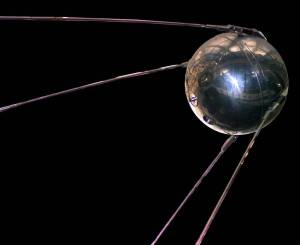
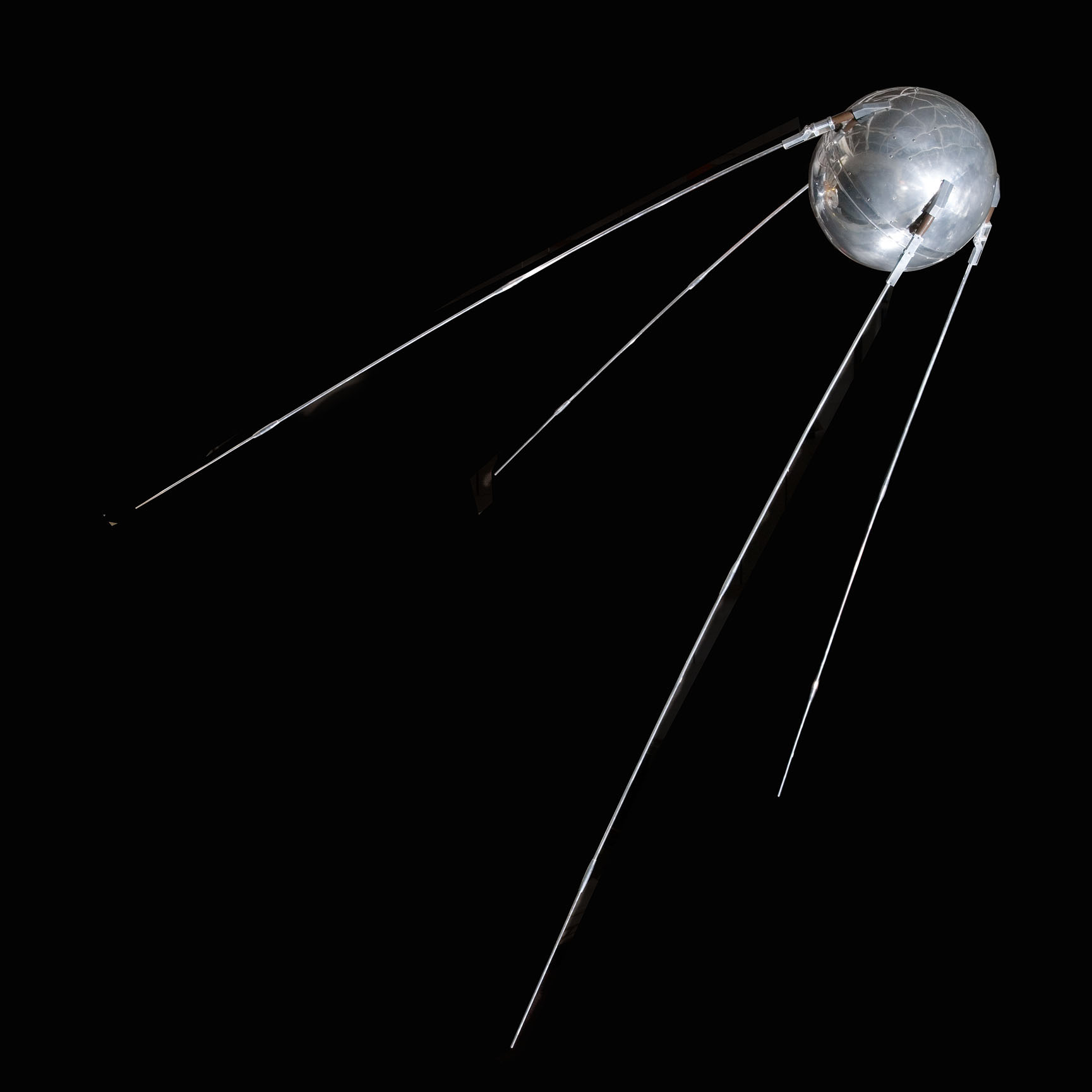
The course of history changed on October 4, 1957, when the Soviet Union successfully launched Sputnik 1. The world’s first artificial satellite was about the size of a beach ball (58 cm or 22.8 inches in diameter), weighed only 83.6 kg or 183.9 pounds, and took about 98 minutes to orbit Earth on its elliptical path. That launch ushered in new political, military, technological, and scientific developments. While the Sputnik launch was a single event, it marked the start of the space age and the U.S.–U.S.S.R. space race.
0:00 / 0:00
Background
The story begins in 1952, when the International Council of Scientific Unions decided to establish the International Geophysical Year (IGY) from July 1, 1957 through December 31, 1958. Scientists knew that solar activity would be at a high point during that time. In October 1954, the council adopted a resolution calling for artificial satellites to be launched during the IGY to map the Earth’s surface.
In July 1955, the White House announced plans to launch an Earth-orbiting satellite for the IGY and solicited proposals from various Government research agencies to undertake development. In September 1955, the Naval Research Laboratory’s Vanguard proposal was chosen to represent the U.S. during the IGY.
The Sputnik launch on October 4, 1957, changed everything. As a technical achievement, Sputnik caught the world’s attention and the American public off-guard. Its size was more impressive than Vanguard’s intended 3.5-pound payload. In addition, the public feared that the Soviets’ ability to launch satellites also translated into the capability to launch ballistic missiles that could carry nuclear weapons to the U.S. Then the Soviets succeeded again: On November 3, Sputnik 2 was launched, carrying a much heavier payload, including a dog named Laika.
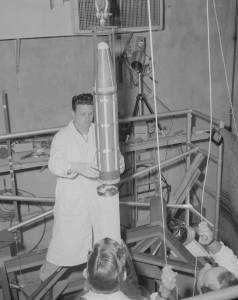
Immediately after the Sputnik 1 launch in October, the U.S. Defense Department responded to the political furor by approving funding for another U.S. satellite project. As a simultaneous alternative to Vanguard, Wernher von Braun and his Army Redstone Arsenal team began work on the Explorer project.
On January 31, 1958, the United States successfully launched Explorer 1. This satellite carried a small scientific payload that showed the existence of the magnetic radiation belts around the Earth, named after principal investigator James Van Allen. The Explorer program continued as a successful ongoing series of lightweight, scientifically useful spacecraft.
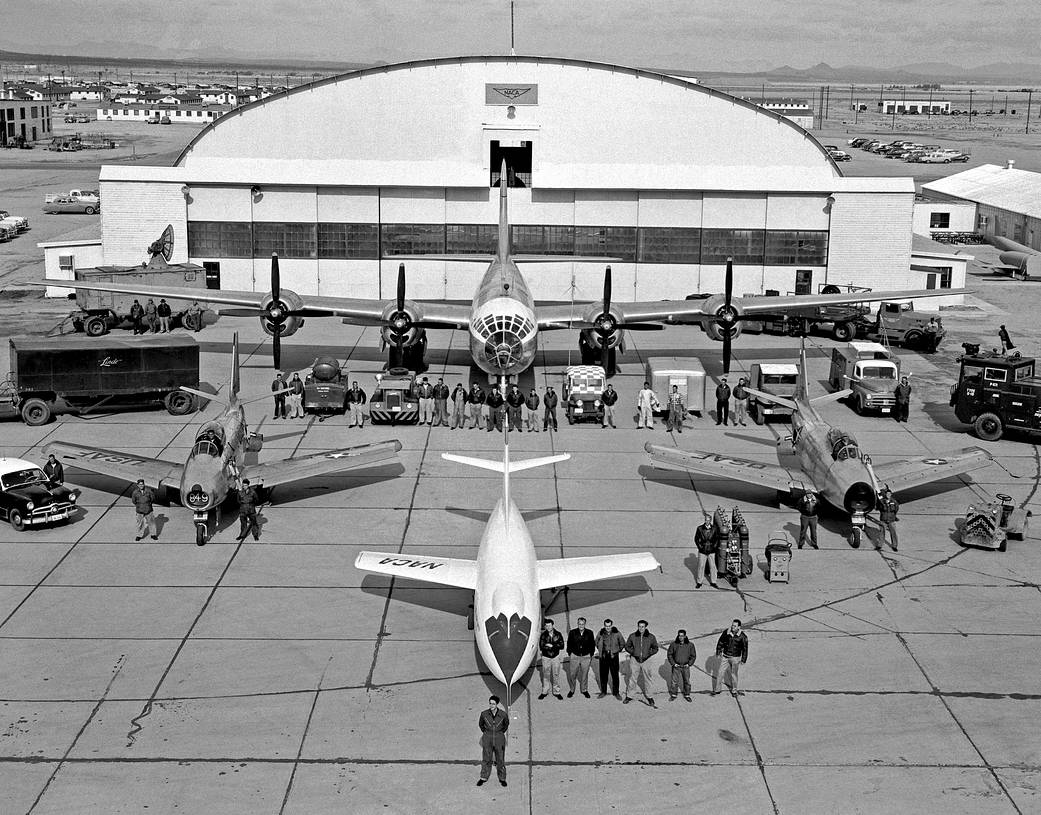
The Sputnik launch also led directly to the creation of NASA. In July 1958, Congress passed the National Aeronautics and Space Act (commonly called the “Space Act”), which created NASA from the National Advisory Committee for Aeronautics (NACA) and other government agencies.
Timeline
1957
- July 1: Beginning of International Geophysical Year
- Oct. 4: USSR – Sputnik 1 (83.6 kg) launched
- Nov. 3: USSR – Sputnik 2 (508.3 kg) is launched with a dog named Laika aboard
- Nov. 13: USA – Eisenhower makes his first public statement calling for the establishment of a civilian U.S. space agency
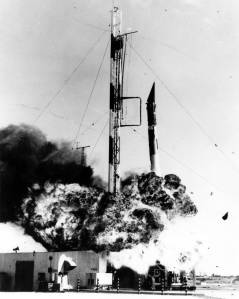
- Dec. 6: USA – Vanguard TV-3 explodes on launch pad
1958
- Jan. 31: USA – Explorer 1 (14 kg), America’s first satellite, discovers the Van Allen radiation belts
- Feb. 3: USSR – First try to launch Sputnik 3 fails
- Feb. 5: USA – A second Vanguard try fails
- Mar. 5: USA – Explorer 2 fails to orbit
- Mar. 17: USA – Vanguard 1 (1.47 kg) successfully orbits, takes geodetic measurements of Earth
- Mar. 26: USA – Explorer 3 orbits, collects radiation and micrometeoroid data
- Apr. 28: USA – Another Vanguard fails to orbit (third failure)
- May 15: USSR – Sputnik 3 (1,327 kg) orbits, carrying large array of scientific instruments, but tape recorder fails, so it can’t map Van Allen belts
- May 27: USA – Vanguard fails for the fourth time
- June 26: USA – Vanguard fails for fifth time
- July 26: USA – Explorer 4 orbits and maps Van Allen radiation belts for over 2 months
- July 29: USA – Eisenhower signs the National Aeronautics and Space Act of 1958
- Aug. 19: USA – T. Keith Glennan is sworn in as NASA’s first administrator
- Aug. 24: USA – Explorer 5 fails to orbit
- Sep. 26: USA – Vanguard fails for the sixth time
- Oct. 1: USA – NASA opens for business
- Dec. 31: End of the IGY
Explorer 1: Beginnings of the Space Age
In this documentary from the Jet Propulsion Laboratory, learn about the events surrounding the development of Explorer 1 and the role JPL played in building the satellite and enabling the first space science discovery.
Learn MoreNASA Publications and Articles
- Bilstein, Roger E. Orders of Magnitude: A History of the NACA and NASA, 1915-1990. NASA SP-4406, 1989.
- Green, Constance McLaughlin and Milton Lomask. Vanguard: A History. NASA SP-4202, 1970.
- Launius, Roger D. “Sputnik and the Origins of the Space Age.”
- Launius, Roger D. NACA to NASA to Now: The Frontiers of Air and Space in the American Century. NASA SP-2022-4419, 2022
- Logsdon, John M., ed., with Linda J. Lear, Jannelle Warren Findley, Ray A. Williamson, Dwayne A. Day. Exploring the Unknown: Selected Documents in the History of the U.S. Civil Space Program, Volume I, Organizing for Exploration. NASA SP-4407, 1995.
- Logsdon, John M., ed., with Dwayne A. Day and Roger D. Launius. Exploring the Unknown: Selected Documents in the History of the U.S. Civil Space Program, Volume II, External Relationships. NASA SP-4407, 1996.
- Newell, H.E. Beyond the Atmosphere: Early Years of Space Science. NASA SP-4211, 1980.
- Portree, David S.F. NASA’s Origins and the Dawn of the Space Age. Monographs in Aerospace History, No. 10. NASA SP-4510, 1998.
- Siddiqi, Asif A. Challenge to Apollo: The Soviet Union and the Space Race, 1945–1974. NASA SP-4408, 2000.
- Siddiqi, Asif A. “Korolev, Sputnik, and the IGY.”
Documents
These collections are not meant to be exhaustive; they are meant to get researchers started in the right direction. Normally, we only include NASA-created material, but because Sputnik predates NASA and was instrumental in the creation of NASA as an agency, the papers at the Eisenhower Library are a vital part of the story.
Translations of Soviet Documents
Documents edited and translated by Dr. Asif Siddiqi
- “Announcement of the First Satellite,” from Pravda, October 5, 1957
- A Report on an Artificial Earth Satellite, 1954
- A Report on the Feasibility of Development of an Artificial Earth Satellite, May 26, 1954
- Synopsis of Report on Development of Conceptual Design of an Artificial Earth Satellite, September 25, 1956
- Proposals of First Launches of Artificial Earth Satellites, January 5, 1957
- Preliminary Considerations of Prospective Work on the Development of Outer Space, July 5, 1958
U.S. Documents
- “Discussion at the 258th Meeting of the National Security Council,” Thursday, September 8, 1955
- Percival Brundage, Director, Bureau of the Budget, to the President, “Project Vanguard,” April 30, 1957
- “Draft Statements on the Soviet Satellite,” October 5, 1957
- “Discussion at the 339th Meeting of the National Security Council,” October 11, 1957
- Discussion at the 347th Meeting of the National Security Council Thursday, December 5, 1957
- J.R. Killian, Jr., “Memorandum on Organizational Alternatives for Space Research and Development,” December 30, 1957
- President’s Science Advisory Committee, “Introduction to Outer Space” March 26, 1958
- American Reactions to Crisis: Examples of Pre-Sputnik and Post-Sputnik Attitudes and of the Reaction to other Events Perceived as Threats,” October 15-16, 1958
- “Impact of U.S. and Soviet Space Programs on World Opinion,” July 7, 1959
- Hugh Odish:, Executive Director, US National Committee for IGY, “The Meaning of the International Geophysical Year,” December 4, 1959
- “Discussion at the 443rd Meeting of the National Security Council,” May 5, 1960
More U.S. Sources


Oral History Transcripts
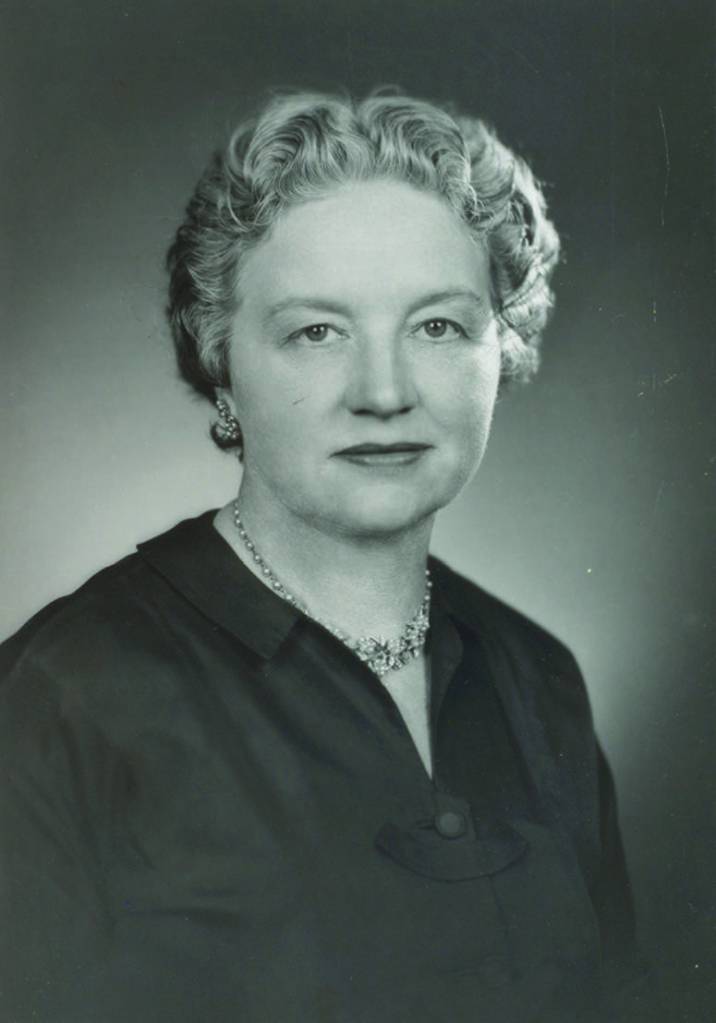
Eilene Galloway
After the launch of Sputnik, Eilene Galloway was asked by Senate Majority Leader Lyndon B. Johnson to assist in the summarization of Congressional testimonies regarding Sputnik. Her work was influential in the creation of NASA and subsequent space policy.

Ruben F. Mettler
Former CEO of TRW Inc. and a leader in the development of the U.S. ballistic missile program, Ruben Mettler gives his perspectives from the early days of the space race.

Paul E. Purser
During the early 1950s, Paul Purser was chosen to be part of the NACA's Space Task Group. Purser, who developed the Little Joe rocket used for unmanned tests of the Mercury capsules, discusses his experience after the launch of Sputnik.
Simon Ramo
Simon Ramo, important in the development of Intercontinental Ballistic Missiles (ICMBs) and cofounder of Ramo-Wooldridge (later TRW and now a part of Northrop Grumman) discusses the International Geophysical Year and his response to the launch of Sputnik.
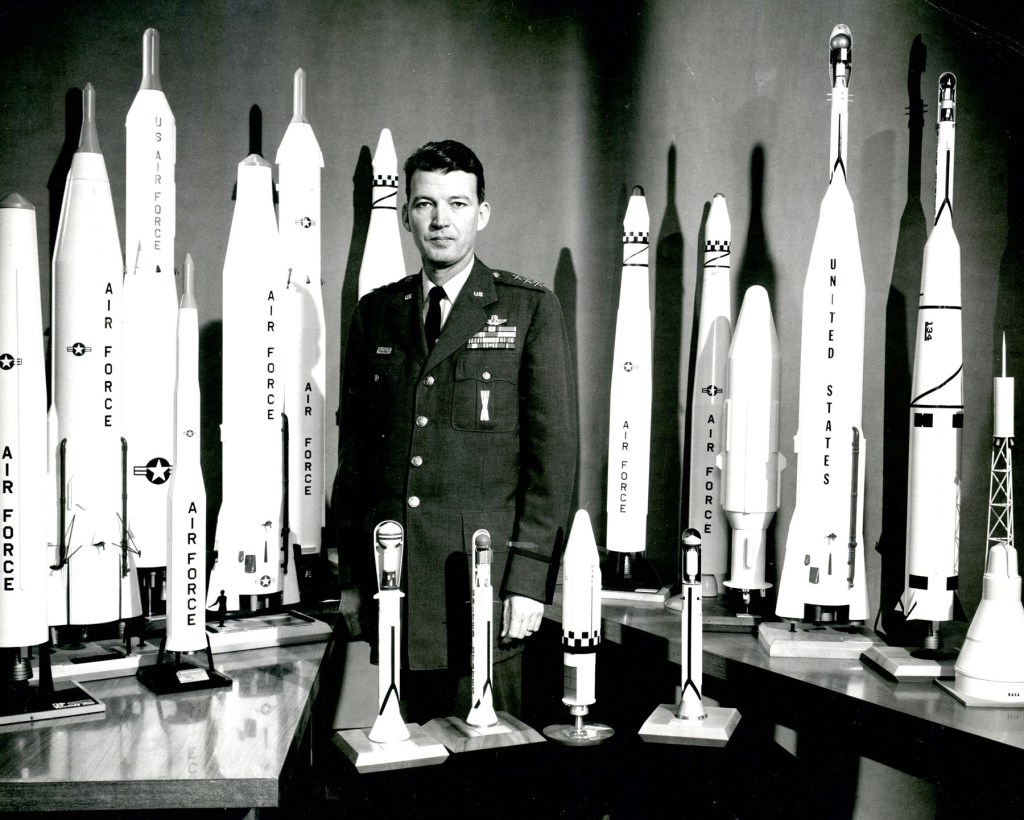
Gen. Bernard A. Schreiver
The "Father of Air Force space and missiles" discusses the repercussions of the launch of Sputnik and the development of America's space program.