












X-57 Maxwell
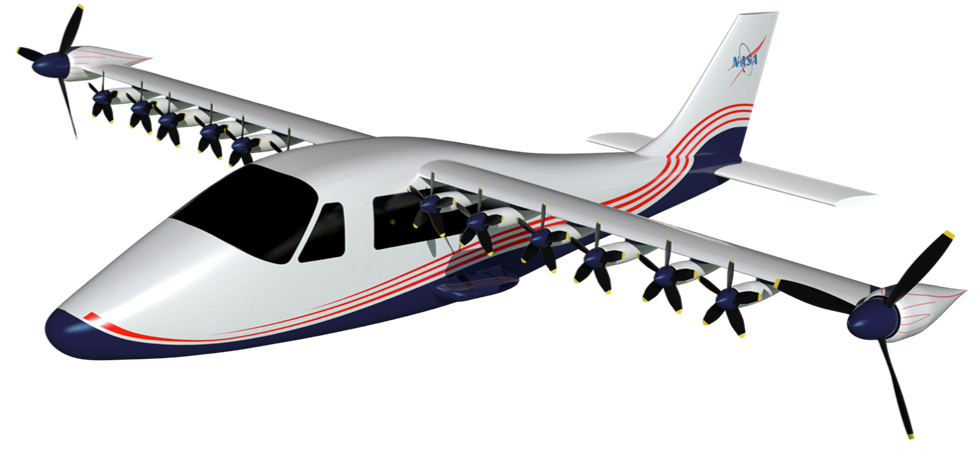
NASA’s X-57 Maxwell was an all-electric experimental aircraft designed to demonstrate multiple cutting-edge technologies. The goal of the X-57 was to demonstrate that an all-electric airplane can be more efficient, quieter, and more environmentally friendly than airplanes powered by traditional gas piston-engines.
The X-57 sought to demonstrate the use of a high-power distributed electric propulsion system for use on an aircraft, including a 460 volt battery to power 14 motors and propellers. In addition, the X-57 sought to demonstrate that vehicle cruise efficiency can be optimized by integrating the versatility and efficiency of electric propulsion into the vehicle design.
The X-57 began as a gas-powered Tecnam P2006T General Aviation aircraft in a phase known as Modification I. The wing, which was reduced to 42% of the original wing area to significantly reduce drag, featured wing-tip propellers to reduce the wing-tip vortex at cruise. At low-speeds, the distributed high-lift propellers nearly double the wing lift, allowing the X-57 to land as slowly as the original Tecnam P2006T. A test program was planned through a series of modifications, to allow researchers to take a step-by-step approach to demonstrate the technical improvements.
When complete, the X-57 Maxwell test program hoped to have demonstrated how to safely operate an all-electric, zero-emissions aircraft, including its battery and power distribution systems. That knowledge would be helpful to future engineers interested in designing all-electric air vehicles that might be used for everything from urban air mobility to moving passengers and cargo between nearby cities.
Although the X-57 Maxwell subproject was closed in March of 2024, prior to achieving first flight, the lessons learned from the aircraft systems, including battery and electrical system testing, wind-tunnel testing of the aircraft and high-lift propellers, and extensive computational fluid dynamics modeling, have been invaluable in shaping the future of aviation and electric flight.