












Audience
Educators, Students
Grade Levels
Grades K-4, Grades 5-8, Grades 9-12
Subject
Space Science, Solar System and Planets, Earth's Moon
Type
Hands-on Activities, Lesson Plans / Activities
Introduction
Visitors step into the role of Artemis II astronauts, using real NASA imagery to study the Moon’s surface, identify features, and simulate astronaut observations. They gain insight into how the Artemis missions will advance science and exploration and lay the groundwork for future crewed missions to Mars.
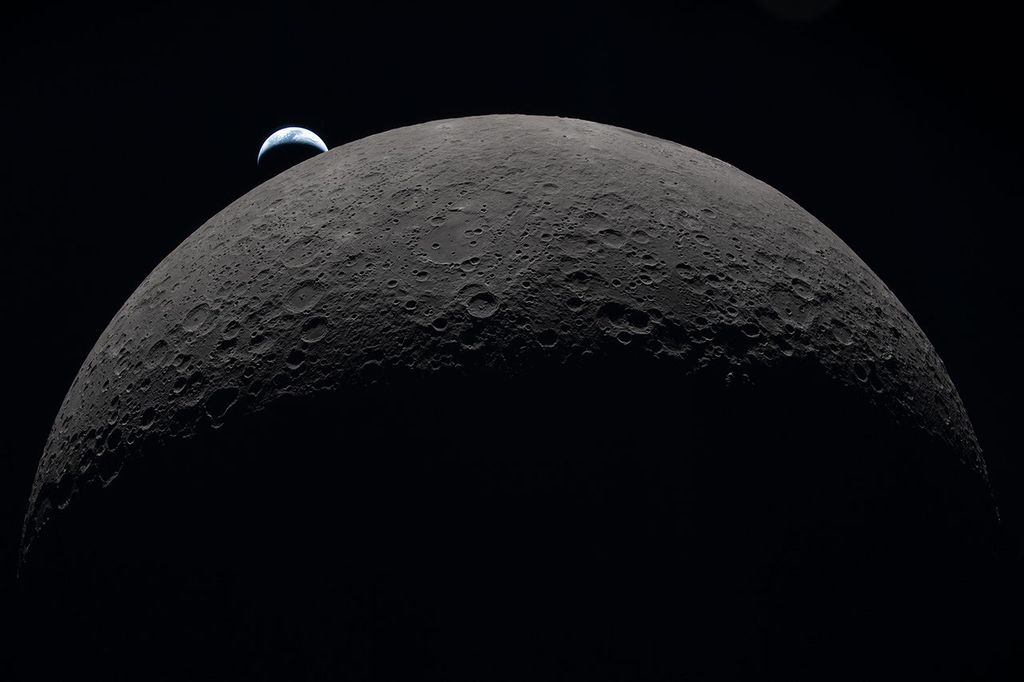
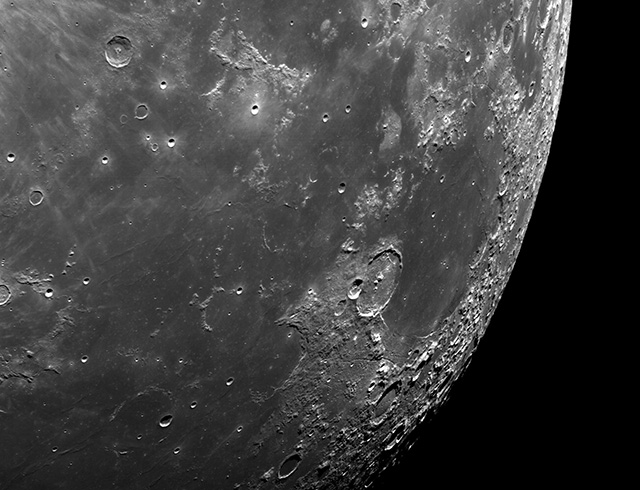
Get ready to explore the Moon like an Artemis II astronaut! In this activity, you’ll use real images from NASA’s Lunar Reconnaissance Orbiter to spot craters, mountains, and other features on the lunar surface. Imagine you are part of the Artemis II mission and practice making your own astronaut observations from lunar orbit. Along the way, you’ll discover how NASA is getting ready to send people to the Moon—and eventually all the way to Mars!
 Grade Range: All Ages
 Time Needed: 2-5 minutes per participant
 Materials List
The following materials are recommended for this activity:
-
- Moon Image Cards (print with “Flip on short edge” option selected; laminated; cards with text on them are for facilitators)
- Lunar Feature ID Guide (laminated)
- Lunar Log Cards (print double-sided as take-home handouts)
- Labeled Moon Map (laminated)
- Certified Artemis II Moon Observer Badges (optional; print as take-home handouts)
- Activity Table Sign
- Pencils
- Spyglass/pirate telescope (optional)
- Orion cardboard/paper window cutout (optional)

Activity Procedure
-
- Inform participants that they are Artemis II astronauts looking out the Orion spacecraft window as they fly around the Moon.
- Invite participants to choose a Moon Image Card to observe.
- Note: There are corresponding cards for the facilitator which contain additional information about each lunar feature.
- Attendees should use the Lunar Feature ID Guide to help them identify different features (e.g., craters, lava plains, mountains, valleys, etc.).
- Invite guests to hold up the Orion window cutout to frame their view.
- You can also have them peer through a spyglass/pirate telescope to simulate the zoom lens on the astronauts’ camera.
- On a Lunar Log Card, have them write down and sketch what they see:
- What features can they identify?
- What shapes do they notice?
- What colors + shadows do they see?
- What do they think happened there in the past?
- They should continue with their observations until they have completed a Lunar Log Card for 3-4 different Moon images.
- Hand each participant a Certified Moon Observer badge upon activity completion (if desired).
Optional Activity Add-Ons
-
- Touch-and-feel lunar surface textures (3D prints, Moon Braille book)
- See the following 3D print resources: NASA collection, Lunar Reconnaissance Orbiter Camera collection
- Terrestrial rock analog samples or Astromaterials 3D website
- Lunar meteorite sample
- A guestbook or whiteboard: “Where on the Moon should the Artemis IV mission land?”
- Touch-and-feel lunar surface textures (3D prints, Moon Braille book)
Talking Points
-
- Through Artemis, NASA will send astronauts to explore the Moon for scientific discovery, economic benefits, and to build the foundation for the first crewed missions to Mars.
- Artemis II will prepare astronauts for future Moon landings by training them to make scientific observations from lunar orbit.
- The Moon’s surface tells stories of ancient impacts, volcanic activity, magnetism, and more.
- During the Artemis II mission’s closest approach, the Moon will appear roughly the size of a basketball held at arm’s length through the Orion spacecraft’s window.
- The Artemis II crew will be able to zoom in to the lunar targets using two separate zoom lenses on their handheld Nikon camera.
- The Artemis II crew conducted orbital observational training of 15 key lunar features (labeled “Part of the ‘Lunar Fifteen’” on the Moon Image Cards in this activity).
- These are scientifically interesting sites and will help orient the astronauts at the Moon.
- The astronauts will be using a Cue Card to guide their orbital observations (similar to, but more in depth than, the Lunar Log Card used in this activity).
- They will be providing both verbal and written descriptions of lunar features.
- Illumination plays a key role in science observations.
- Under low illumination conditions, surface morphology becomes accentuated, especially near the terminator (line between lunar night and day) where long shadows are cast on the surface.
- Higher illumination is ideal for observing color and albedo variations, as changes in hue and reflectance across the surface become more apparent when there’s less obstruction by shadows.
- The lighting conditions at the Moon will alter a feature’s appearance from lunar orbit.
- E.g., If launch is on xxx date, a specific part of Orientale may be especially interesting to capture/focus on given those specific lighting conditions.
- Some features that the Apollo astronauts were unable to see due to lighting conditions may be visible by the Artemis II crew.
Other Resources
Earth’s Moon Resource Package
NASA’s Artemis Blog
NASA’s Artemis Website
NASA’s Artemis II Lunar Science Operations to Inform Future Missions
Artemis II Crew Both Subjects and Scientists in NASA Deep Space Research