
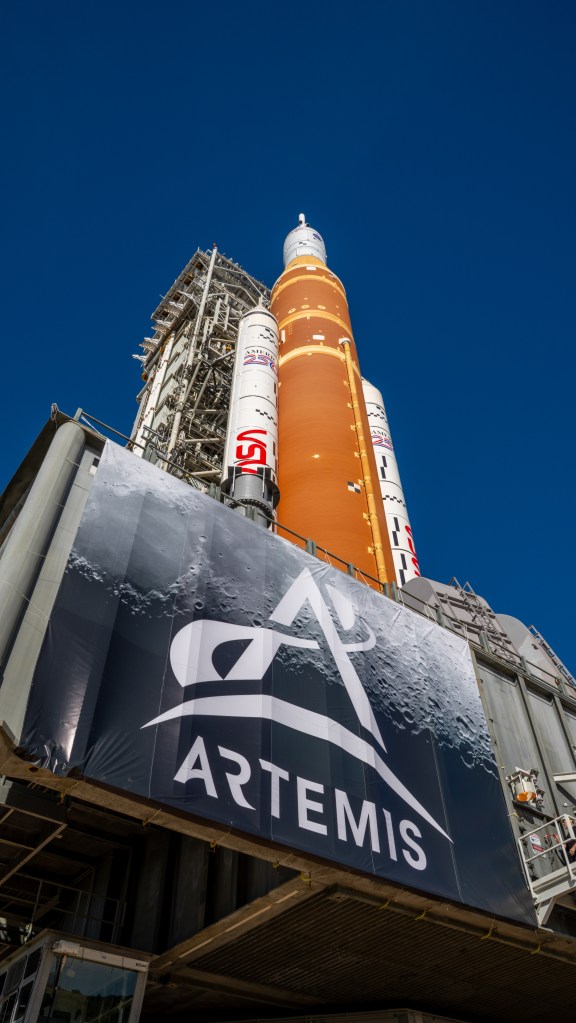

























Host Andres Almeida: How do you get to the Moon? The quick answer is “on a rocket.”
But how we do stay on the Moon’s surface sustainably and build a future where astronauts can also live and work on Mars? NASA is working on that. But we aren’t doing it alone.
Our guest this episode is Nujoud Merancy, NASA’s Deputy Associate Administrator for the Strategy and Architecture Office. Her role is part of NASA’s Exploration Systems Development Mission Directorate. Let’s talk about it in this episode of Small Steps, Giant Leaps.
[Intro music]
Welcome to Small Steps, Giant Leaps, the podcast from NASA’s Academy of Program/Project and Engineering Leadership, or APPEL. I’m your host Andres Almeida.
An engineer, Nujoud is part of a larger team designing the roadmap for human exploration of deep space.
Host: Nujoud, great to hear from you.
Nujoud Merancy: Ah, good to see you again. Thank you.
Host: Can you tell us a bit about your role at NASA?
Merancy: My title is the Deputy Associate Administrator in the Strategy and Architecture Office, and that’s within the Exploration [Systems Division] Mission Directorate.
And it’s really about how do we study what is it going to take to get to the Moon and Mars, and really break it down to how do we field the systems to achieve the objectives for NASA? So, it’s a big integration challenge.
Host: Yeah, it’s certainly a big endeavor. How has that architecture evolved, now that we have documented lessons learned from Artemis I, and now that all eyes are on the Artemis II mission around the Moon?
Merancy: I think there’s a lot going on. And people’s, you know, their touchpoint is Apollo, which was really a sortie, no more than three days on the surface of the Moon at the equator. Very short missions, ultimately, but still nonetheless incredibly challenging.
When we talk about our future lunar missions, the ability to live and work for extended periods of time is going to take a whole lot more systems. Just the surviving dark periods where, you know, nighttime on the Moon at the equator, lasts two weeks. In the South Pole, at a minimum, it still lasts for days at a time.
So, being able to have the power systems, the supplies, the food, the moving and manipulating, all the logistics you’re going to need, the habitats – we really are going back to the Moon to stay, and that ultimately means a lot of infrastructure has to be built up around the Moon to make that successful for the crew.
So, the lessons learned are really trying to take that step out of just short sortie missions into the permanent infrastructure, the permanent systems you’re going to need to enable that really robust exploration.
Host: And that likely requires some innovation. Is that fair to say?
Merancy: Lots of innovation! I mean, we’re going to need all sorts of manipulators, rovers, power systems. Nuclear power, right, has a huge benefit, because it persists through darkness, right? There’s a reason we have a lot of pull on these things right now, because the challenges are there.
So, the fielding is not just, you know, you’re not going to be able to do it with just the things we have today. There’s a lot of research and investment money going into this to get to the systems, so you need to be able to support the crew.
Host: So, your background is in engineering. You’re a systems engineer by training. For listeners who may not live in that world, can you explain what systems engineering entails?
Merancy: Yeah, so systems engineering is really the ability to look across multiple systems. So, that could be the power systems, the thermal systems, the vehicle, and putting the pieces together. So, it’s having that broader picture, rather than a deep expertise in one area.
So, the ability to actually know that, well, if the power system does this, that increases the thermal heat rejection. And, oh, but the Sun is pointing at that so how do we align the vehicle?
So, it’s, it’s that coordination across all of the pieces that ultimately makes the overall vehicle successful, because the systems all interplay, and being able to understand where you push in one area ends up affecting somewhere else.
And actually, in the architecture world, we have a little informal icon. Our mascot is a balloon animal. Because the joke is, you know, you squeeze the balloon animal’s leg in one area and it’s just going to, the air is going to pop out somewhere else.
And so, that’s like, systems engineering is trying to make sure you still have a balloon animal when you’re done, because you can’t squeeze the leg to save something here without it affecting and now it costs more somewhere else.
So, so that’s like sort of [what] systems engineering is, how do you balance all the pieces to make the vehicle successful?
Host: Can we talk a bit about your career in flight safety? Because you’ve contributed to flight safety aboard the International Space Station. You’ve been recognized by leadership, including the Astronaut Office, the crew office. Can you share something notable you’ve worked on?
Merancy: Yeah, so my first job was on the International Space Station [program], and I was doing guidance & navigation control systems engineering, which is integrating GNC, as we call it, with the rest of the vehicle.
And one of the things that I had observed, and why I got recognized was that at that time, the way – if the crew lost attitude control (means it’s no longer flying upright, so to speak) and it’s in a tumble, the way to actually confirm it was the crew looked out the window to validate that it actually truly wasn’t pointing the direction it should have been.
It’s very difficult when you consider all the number of failsafes we had. Both the U.S. control systems, Russian thrusters, you know, all of those pieces are very complicated. Lots of redundancies, which is great, but there can be a situation in which things haven’t worked out the way they are, and it’s called a loss of attitude control.
So, I actually figured out how to build a software item that could check all of the different steps and actually confirm you’d lost attitude control and trigger a warning, which could then wake the crew up and notify them that they’d lost attitude control fully.
And so, I got recognized for actually creating that piece of software to do that detection, which provides that safety net for the crew.
And then, actually, several years after I quit working on the ISS, it actually happened, and my warning went off, and it triggered that we’d lost attitude control.
So, I mean, it validated that (yay!). I mean, and the crew wasn’t in any danger at the time, but it actually occurred and worked.
And so, like, that’s, it’s really nice to see something you do pan out like that.
But it’s that type of thing, and especially with systems engineering, right? It took that understanding of, how do all those things play together, and all of those things ultimately are, how are we keeping the crew safe? So, you know, this vehicle operating correctly is what keeps the crew safe.
So, being able to understand all of the pieces, figure out, you know, well, okay, well, if we do it this way, you’re going to put the crew in danger, right? That’s exactly what you’re trying to prevent at all times. So, yeah, so that was one of those real highlights out of my career.
Host: I mean, talk about being proactive, right?
Merancy: Yeah, there’s a lot of that need to be proactive in things, right? And, like, I’ve done that, I’ll just say a lot in my career, right? You see a problem, and you need to go, actually identify it and elevate it.
And I mean, in this case, you tell your managers, “Hey, I think there’s a thing here we need to work on.” And then you go solve it. It’s not just waiting to be told what to do, because a lot of times managers, right, they don’t, they’re not in the details every day. They don’t have every answer.
So, your responsibility, and that’s what I treat it as, is your responsibility when you’re working in human spaceflight, is every day to be looking for the things that are falling through the cracks and fixing them because that’s where problems come from, and that’s where the danger lies.
Host: How do you think about acceptable risk?
Merancy: Yeah, it’s a great question, because, I mean, in the end, all spaceflight is dangerous. It’s inherently risky.
So, the real question is, how much risk can you take and have maybe enough redundancy or aborts or things like that? Because ultimately you need to fly. The safest place to be is still sitting on the ground, but then you’re not actually doing the exploration.
So, it’s always a “make sure that you have an out,” right? We need to make sure we can get the crew to the Moon, and if something happens, they can leave.
Or if you get halfway there and you get that failure, how do you get home early? And if you’ve had the failure, do you still have enough oxygen, water or things [like] that?
So, making sure you can always take the next step and then have the path to get out of it if something happens is really how you’re managing the risk through the mission. Because, you know, the longer you fly in space, it is ultimately true that something will happen.
So, making sure you have enough scenarios to manage it, and I guarantee you will never think of the thing that actually is the thing that happens.
So, a lot of times the risk measures you’re putting in place – aborts, things like that – they are very generic, and they can cover all sorts of things that go wrong. So, we know very quick, easily.
You know, you can predict, if I have three oxygen tanks, one can fail, I need to be able to get home on the two those types of things you can plan into all along.
But it’s also just making sure you have that generic abort capability for all the things that you haven’t yet thought of.
That’s how you’re really managing the risk through the mission is that there’s always a, an alternate way to keep the crew safe.
Host: And surely, you’re working off lots of lessons learned from the past.
Merancy: Certainly. And we actually just had our, you know, Day of Remembrance a couple weeks ago, right? I was here at JSC [Johnson Space Center] when Columbia happened. That was the first year of my career.
So, that’s, that’s a very founding, foundational item for me, is knowing that this is real. And those are real challenges, and we have to be sure that we are being careful, because those are real people’s lives on the vehicles we’re building.
Host: And now, the crews flying to space are also your colleagues. They’re people you see every day in and out of work.
Merancy: It has. I mean, when Columbia happened, I mean, like I said, it was my first year, I didn’t know the astronauts at the time, but now today, like these really are people that I see in the grocery store. It’s people we see around the office. It was, you know, my daughter’s soccer coach, right?
So, it’s a real thing, I mean, and it really grounds it for you. And if you don’t understand that responsibility you have, then you’re in the wrong business, because these, these are people we need to make sure we’re keeping safe.
Host: Yeah. Going back to engineering culture, what does that look like on initiatives as large and lengthy as Artemis in the overall Moon to Mars architecture?
Merancy: Yeah, I think it’s just really challenging. And I don’t think even most people can internalize how big this is, how big the scope is, right?
You look at Apollo, and you know, ultimately, Apollo was one rocket launch, complete mission, gets to the Moon, comes home again, and that was incredibly challenging. But when we talk about the Moon and Mars, it’s many launches.
And the Moon, right, even to get to the South Pole, it’s multiple launches to fly the logistics, the habitats. You know, you’re talking tens of launches.
When we start talking about Mars and this is really regardless of whose vehicle you’re talking about, you’re talking about dozens, if not hundreds, of launches.
So, the amount of systems we need to build and aggregate is very challenging, but at the same time, a huge amount of opportunity, because there’s lots of space for different ideas, multiple suppliers, lots of vendors, and there’s no one right answer.
The best thing about this is, it’s whatever you can get flown is helpful in a way. So, let’s work on all the best ideas. Get everyone up there working together. It’s going to take an “all of us” (not a “one of us”) approach, to achieve these goals.
Host: Yeah. And by that, you also mean government and industry together?
Merancy: Yes. This is not an “either-or,” right? It is both the government for the things the government is best at, and industry, and not just one industry, but all of them.
There’s so many areas we need that there’s room for companies to specialize. There’s room for multiple providers, and that’s good for both us to have multiple options and the competition that it breeds in industry to help get the best solutions out there.
I hate the scarcity mindset, right? If you come into this thinking that there can be only one provider, you know, there’s only one answer. We’re never going to get there. It’s going to take all of these things to get it done.
Host: Nujoud, what was your giant leap?
Merancy: Wow, I don’t know! In some ways you’re, when you are in grade school, and you really want to work on space stuff, and you want to be an astronaut – and I did too, like many others – you know, it seems so far away, so distant. I got down here and started working just the year after I graduated from college.
And so, some of that is just finding your way into the field, whether it’s through a contractor like I did, or, you know, academia and working on, you know, analyzing the Moon, the regolith, these things. There’s so many ways to contribute.
And so, for me, I think the giant leap was when, just finding a way down here right out of college, and then being exposed to it.
I always wanted to be an astronaut. Still do, probably too old at this point, but it’s all good. So, yeah, it’s a great thing to be in and to actually just get to be a part of it. That’s the giant leap.
Host: That’s great. Well, it’s been great talking with you, Nujoud. Thanks for being here today.
Merancy: Thanks, glad to talk to you.
Host: That’s it for this episode of Small Steps, Giant Leaps. For a transcript and to hear previous episodes, visit nasa.gov/podcasts. While you’re there, you can check out our other podcasts like Curious Universe, Houston, We Have a Podcast, and Universo curioso de la NASA. As always, thanks for listening.
[Outro music]
Outro: This is an official NASA podcast.