























Host Andres Almeida: Today, we’re talking with aerospace engineer Jennifer Lu about what her job is like at NASA’s Kennedy Space Center. From her experience working with the Commercial Crew Program, which sends astronauts to the International Space Station aboard commercial spacecraft, and the Artemis missions to the Moon, she’ll share how working with a variety of teams has helped her see the bigger picture.
But Jennifer’s journey to NASA wasn’t always part of her plan. In fact, she was once a professional circus performer. A series of small steps led her to NASA.
Let’s get into it on this episode of Small Steps, Giant Leaps.
[Intro music]
Welcome to Small Steps, Giant Leaps, your podcast from NASA’s Academy of Program/Project & Engineering Leadership. I’m your host Andres Almeida.
Host: Jennifer Lu is with us today. Hey, Jennifer, thanks for joining us today.
Jennifer Lu: Hi Andres, it’s nice to see you.
Host: Can you describe your role and what you do at NASA?
Lu: Okay, my official title is Aerospace Engineer for the Commercial Crew Program. I also work with HLS, which is the human lander system, and LSP, which is the Launch Services Program.
If I were to give myself a title, it would probably be mechanical analyst is a more accurate description. But I also do some civil as well as some systems engineering, too.
I am in a unique position where I get to participate in a lot of different programs. I wear a lot of hats, and due to some of the influx of people and personnel we’ve had, I was requested by various programs to assist in some capacity here or there.
My previous positions were with helping out with operations with Artemis I, and then I transitioned to the Commercial Crew Program, where I help with Starliner, with Boeing as the mass properties representative. I also occasionally help out with our other commercial partners, with some things like the Dragon vehicle.
And then I would say not quite 50% of my time, but the majority of what my efforts are placed into is toward the human lander system. I work closely with Marshall Space Flight Center. That is particularly on the Starship variant of the HLS.
There’s also a commercial partner that’s working with us for the human lander system. Blue Origin is developing the Mark 2.
And then for Launch Services, I am usually responsible for MGSE, which is Mechanical Ground Support Equipment. I help out with mechanical analysis for some of the GSE that they own.
Host: And when you say Launch Services, that’s LSP, the Launch Services Program, is that right?
Lu: That is correct. There’s just a lot of wonderful people over in that program, and occasionally they reach out for mechanical or aero-acoustic help from me.
Host: You work on a lot of projects, have worked on a lot of projects. Can you share any lessons learned from your career, maybe a moment when you had to pivot because of some unexpected outcome?
Lu: Oh, there’s, there’s always unexpected outcomes. I think if I were to recommend generic advice that applies to a lot of different situations, it’s “go talk to the people.”
I have been a designer and realized that I did not design something that was easy to manufacture. So then I had to go talk to the manufacturing floor and say, “Oh, this is why we have to make sure we weld before we bore to make the hole alignments considerably better,” or end up going to talking to procurement, because I do not know the prices of every single bolt and slab of metal that goes up there, or some of the DAX (the data acquisition systems).
And I’m like, “Well, we just need this for accelerometer data.” And it turns out, well, I didn’t realize that some of the frequency capabilities of those data acquisition systems were not quite what we needed and, therefore, we needed a larger frequency range, which means we also need to be able to dampen up to that frequency range.
So, then those designs change. So, talking to production. That also means which vendors are we going to? Or, hey, our anchors for this particular mounting system need to be rated up to “this thing” to satisfy the ASCE [American Society of Civil Engineers] code. So, then I work with a lot of civil engineers and so on and so forth.
So, I started purely in mechanical and as I grew in capabilities, I became more and more of like a systems level engineer to understand the bigger and bigger things.
So, I constantly have to pivot my design or my analyses or my project objectives so that I can adapt to a bigger and bigger integration role.
Host: Yeah, it sounds like there’s these small things, like you mentioned, nuts and bolts, things you take for granted, and suddenly you learn, so to speak, the hard way, right? Even though it’s not a, something catastrophic, but it does impact the project. That’s interesting.
Lu: It really is! I’m amazed by our chief engineers in our program. They tend to start in a specialty.
I know, like, Teresa Kinney, James Wood, they talk about how they started in one dynamics area, or mechanical or electrical, and then by the time they moved up to where they took, like, a deputy chief engineer role, they had to learn a full life cycle of a vehicle.
Like, now, they have to learn more about the operations, reductions, the electrical; the chemical, the corrosion, the human factors; the interface, the systems, the software, the dynamics. There’s so much that goes into vehicle services, and it’s just – no one can understand them all. So, you just have to keep talking to people and learn more and more.
Host: How do you ensure knowledge gets captured and transferred? You can talk to your people, but team members come and go and programs evolve. How do you ensure that knowledge gets captured?
Lu: I would say, there are three levels that I look for when it comes to knowledge capture.
The first one is personal knowledge capture. So, this is like I do things in like OneNote or Word, where you’re putting things into a documentation so you personally can review it and look at it later.
Then the next one is for, like, your group. So, these are like your staff meetings or your PM, your project managers taking care of it. These are meeting minutes. These are being captured at a review board or an internal product review-type level, where you’re able to gather more people together.
And then you have the systems level. So, we end up having a lot of systems level software, system modelers. Our software packages are, like, our code for launch vehicles. We end up having to, to publish and release and push the code, and then those ones are just heavily commented. So, you know, “Why did you decide to name this ‘this’ or this ‘this’?”
File naming at that point becomes really, really important, because it’s like, ”Hey, this was named the ACFL2,” and you’re like, “What’s that” “It’s the Aft…I don’t know!”
[Laughter]
You’re like, “I don’t know which accelerometer this is!” So, you really have to, like, start keeping things. This is when we have ERBs (engineering review boards), flight readiness reviews. Those just get documented left and right, so that those are able to be pushed above and beyond.
And then above that from an engineering away from engineering more for the administrative level, we have, like, the NPR the procedural reviews, the STDs (the standard documents), um, as well as our ICDs (our ICDs or interface control documents). Those are the types of things that now at a program level we pass back and forth so that we fully understand what one contractor has to satisfy and the engineers have to satisfy in order to be able to work at the system level.
So, it goes up through a bunch of, like, individual contributor levels as well as the program level, to try and understand the information that we have and how do we pass it between each program.
Host: We had a recent guest, David “Nils” Larson, who said, “Lessons learned aren’t lessons learned until they’re learned, until they’re applied.”
Lu: [Laughter] Yep!
Host: So, do you find yourself referencing this documentation in your work, in your career?
Lu: Oh, yeah! There’s no way you can remember these things. Like, you really have to go back, and you check them through all the time. So, when we’re doing something like standards documentation for, say, tubing runs, we’re looking at STD-Z-0008 (I think is one of the standards).
There’s the 5000 series, which is a lot of engineering for the NPRs. I think you had somebody else on that was risk management, which were the NPR 8000s.
Like, you constantly go back, because even if you helped contribute [to it], like, some of the K0000138s, (there’s one for launch induced environments) those are, those are things you’re just not going to memorize. You have to constantly go back and check to see what was the acoustic profile, or what was the key profile applied, and those are the data you use in order to be able to do your engineering and your analysis.
Host: What qualities do you think makes a successful engineer?
Lu: It’s probably understanding the fundamental engineering principles. We go to learn about circuits and statics, dynamics, thermodynamics, fluid dynamics, vibration, those are the things we all went to engineering school for to get the fundamentals, to know how the world works.
So, a good, strong understanding of mechanical, chemical, industrial, human factors, principles, the technical side of things that really bring it together. So, you can understand and design things very, very well.
A team member is a different set of skills. To be a good team member, you need communication, good note taking skills. I know a lot of engineers that might not be the best communicators and vice versa. That’s when you talk to people, stay in contact, be compassionate, build your relationships, learn more about people. Take the time to say, “Hello.”
Remember their birthdays. If you don’t remember their birthday, at least write it down, right? Like, it’s not that hard to put in a calendar invite saying, “Hey, this is going to be Andres’ birthday.” This is, his kids’ are this one, and this is his pets’.
Like, you can have, like, little note systems that enables you to make a better connection with people or reach out to people. I know when [Microsoft] Teams came out, I ended up just making small little scripts that helped me, like, talk to everyone in my division.
So ,we were in a conversation like, “How do you manage to contact everyone?” I’m just, “I have a list.” I have it run down through and say, “Hey, you are going to contact everyone within the 3400 division,” or the whatever. And then you just maintain good contacts.
You know what’s coming in. Like, one of the best ways of staying informed about what projects coming in, or what’s important, or what’s hot, or design elements that might be coming forward through the pipeline, or launches or software freezes – those come from talking to all the various different departments. And then once you do that, you better, you gain a better holistic view of the whole program.
Host: What’s a program or project that’s been rewarding for you recently? What’s something you’re working on or have worked on that is memorable to you right now?
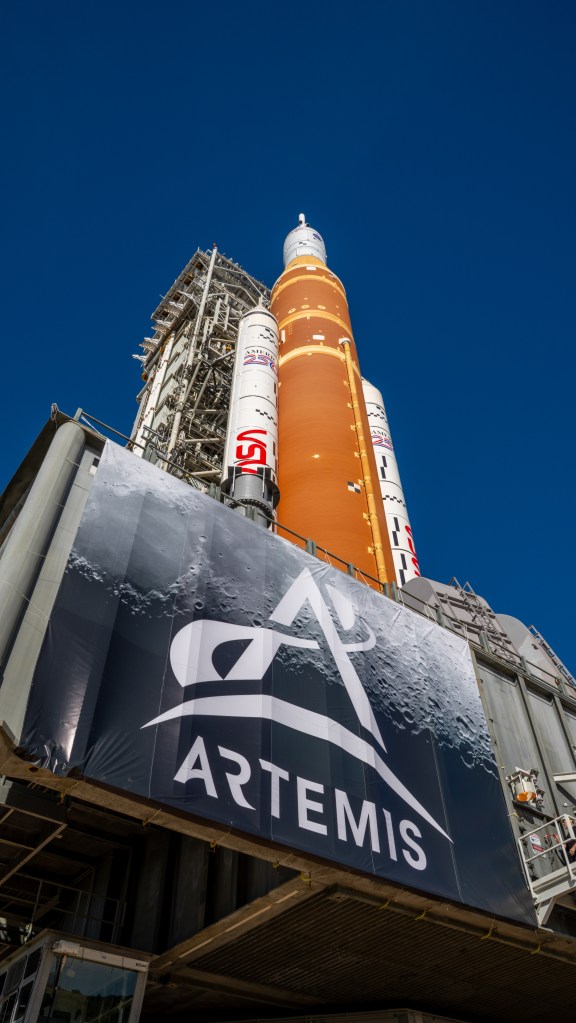
Lu: The biggest one for me is Artemis. It touches my heart. I have the SLS [Space Launch System] SRB, so, the five-segment solid rocket booster, tattooed on my arm. And I also have the Artemis I mission logo patch tattooed on my arm, because it’s just something I’m super, super proud of.
Host: I love that, but it doesn’t stop there because I know you also have motorcycles—
Lu: I do! I have several motorcycles.
Host: —named Artemis.
Lu: Yeah, one of them. It’s my GSX-R Suzuki 750. I named it Artemis. It was my dream bike. It was one step up for, I think, the GSX-R600 was, like, one of the winningest bikes on the Moto circuit. And I got to the dealership, and they’re like, “Hey, do you want a few extra horsepower for the same frame size?” And I’m like, “Oh, that’s so tempting.” So, I upgraded to the 750. I’m still, like,168 [miles per hour] top speed. I think it’s zero to 60 in 2.9 seconds.
Host: Wow.
Lu: It’s just, I really wanted this bike, and then I wanted to customize it. So, then I customized it, put on custom fairings, a custom design paint kit so it’s nice and pink and white, which are, I just love pink as one of my favorite colors. And then, then I put the Artemis logo and the Artemis name across the bike.
Host: That’s so great!
[Laughter]
Do you ever take it onto Kennedy Space Center?
Lu: Oh, yeah, all the time! It’s real obvious whether or not I’m in, like, one building or another. If I’m either at headquarters, the Space Station [Systems] Processing Facility, the, like, jumping between buildings, when you see my motorcycle out front, then you definitely know that I’m there.
Host: Love it. What was your giant leap?
Lu: Oh, there’s so many, like, big leaps of faith that I had to take. One, going for a master’s degree. Like, I’m like, “Oh, I’m going to go and continue education.”
Another giant leap was going into industry. I was thinking of doing a PhD and decided that I want to get into industry early. I had a few hiccups in my career, and I decided to quit engineering to go join the circus. So that was quite a big, scary one.
While I was in the circus, I had a big, giant leap, being able to perform for the 2012 Indianapolis Super Bowl. So, that was a huge…
Host: Wow.
Lu: …huge leap. Of course, when, like, COVID happened and I’m no longer being a performer, I took a big leap and decided to apply for, to NASA to come here, work here at Kennedy Space Center.
And then, when, like, management positions opened, or these things you’re just like, “Okay, this is terrifying, but I’m going to do it.” Or when my boss said, “Hey, we need somebody to help out with this part of the program for, like, SPHEREx needs this analyst on it.” Like, this is not quite my wheelhouse. I’m technically part of a different program, but they really wanted me to be part of it, so I jumped in on that.
Or my boss also asked me if I wanted to be the POC SME (the point of contact, or the subject matter expert) when it came to weight and CG [center of gravity] for spacecraft. I’m like, “I don’t know what this is. I am not familiar with the process, but I will accept this role so that I can learn more about it,” and there was so many more things involved in mass properties for space vehicles than I could have ever imagined.
Host: Do you find parallels with your work now and what you’ve done? And do you do this on the side too, your circus arts performance?
Lu: Yeah, I still perform. I still perform. I’m like, down to like, maybe a couple times a month, like, I’ll perform locally. I’m based out of Florida, so I perform in Orlando, in [the] Central Florida area. But I also end up traveling to like London, or to Las Vegas or California or New York to perform at events all across all across the US.
So, I’ve gotten to use a lot of the knowledge that I have, like mass properties, to engineer certain fire props a little bit better, certain circus props, understanding how weight distribution works.
A lot of the same physics and engineering principles can be applied to any type of manufacturing, whether it’s manufacturing for automotive, agriculture, aerospace, or circus.
Host: You have a whole universe of talents, it seems.
Lu: Oh, thank you. I appreciate the compliment.
Host: No problem. Thank you, Jennifer, for sharing your insights and your expertise. Thanks for being on the show.
Lu: Of course, thank you so much for having me. I appreciate the talk.
Host: That’s it for this episode of Small Steps, Giant Leaps. For a transcript and to hear previous episodes, visit nasa.gov/podcasts. While you’re there, you can check out our other podcasts like Curious Universe, Houston, We Have a Podcast, and Universo curioso de la NASA.
As always, thanks for listening.
Outro: This is an official NASA podcast.