





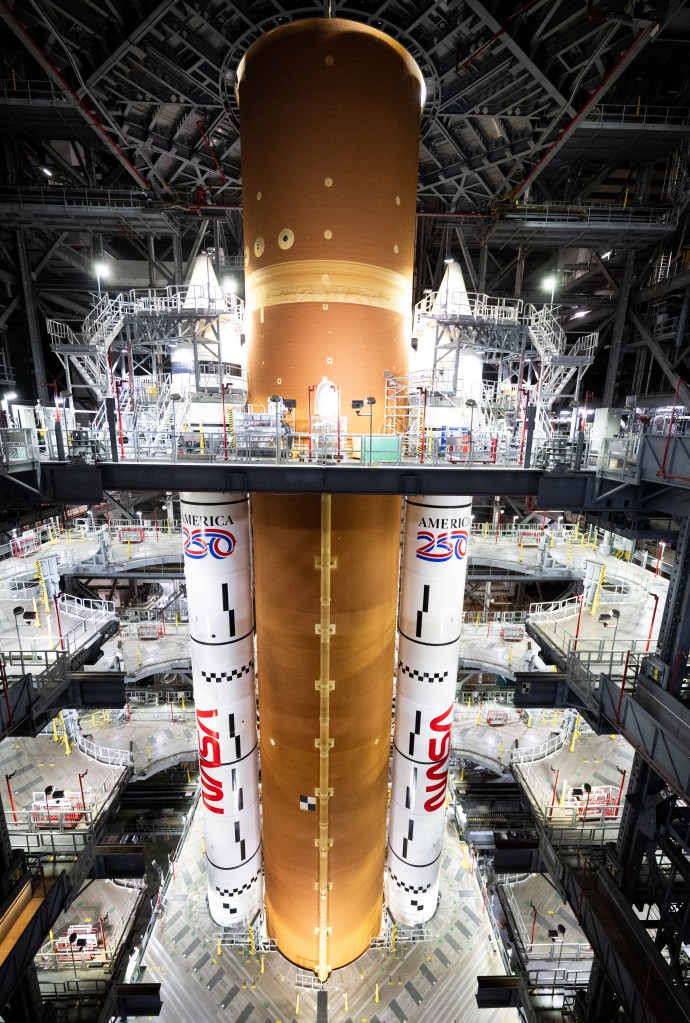
NASA’s technical workforce put boots on the Moon, tire tracks on Mars, and the first reusable spacecraft in orbit around Earth. Learn what’s next as they build missions that redefine the future with amazing discoveries and remarkable innovations.
NASA’s technical workforce put boots on the Moon, tire tracks on Mars, and the first reusable spacecraft in orbit around Earth. Learn what’s next as they build missions that redefine the future with amazing discoveries and remarkable innovations.
We don’t yet know what dark matter is, yet it makes up 85% of all the matter in the universe. The Roman Space Telescope will aim to unravel the mystery. With a field of view 100 times wider than the Hubble Space Telescope’s, Roman will study in near-infrared light the atmospheres of planets orbiting other stars, making other exoplanet discoveries along the way. The mission is named after Dr. Nancy Grace Roman, NASA’s first chief of astronomy and advocate for the development of the Hubble Space Telescope.
Robots inspired by nature? A novel realm of engineering called soft robotics is being studied at NASA’s Langley Research Center. Engineers are working to understand how soft robotics could one day support space exploration, including missions to the Moon’s surface.
Cleaning scum from bathtubs and pipes can be a costly chore. It’s even more challenging aboard spacecraft. NASA researchers are looking at ways to keep astronauts from having to deal with fungal or bacterial buildup, known as biofilm.
The Internet of Animals, a collaborative research project with the U.S. Geological Survey along with several universities and institutions is giving insight into the intersection of animal movement patterns and climate. By combining remote sensing data with wildlife tracking tags, experts can get a better idea of scientific needs to manage conservation at the federal level.