


















From Earth orbit to the Moon and Mars, explore the world of human spaceflight with NASA each week on the official podcast of the Johnson Space Center in Houston, Texas. Listen to in-depth conversations with the astronauts, scientists and engineers who make it possible.
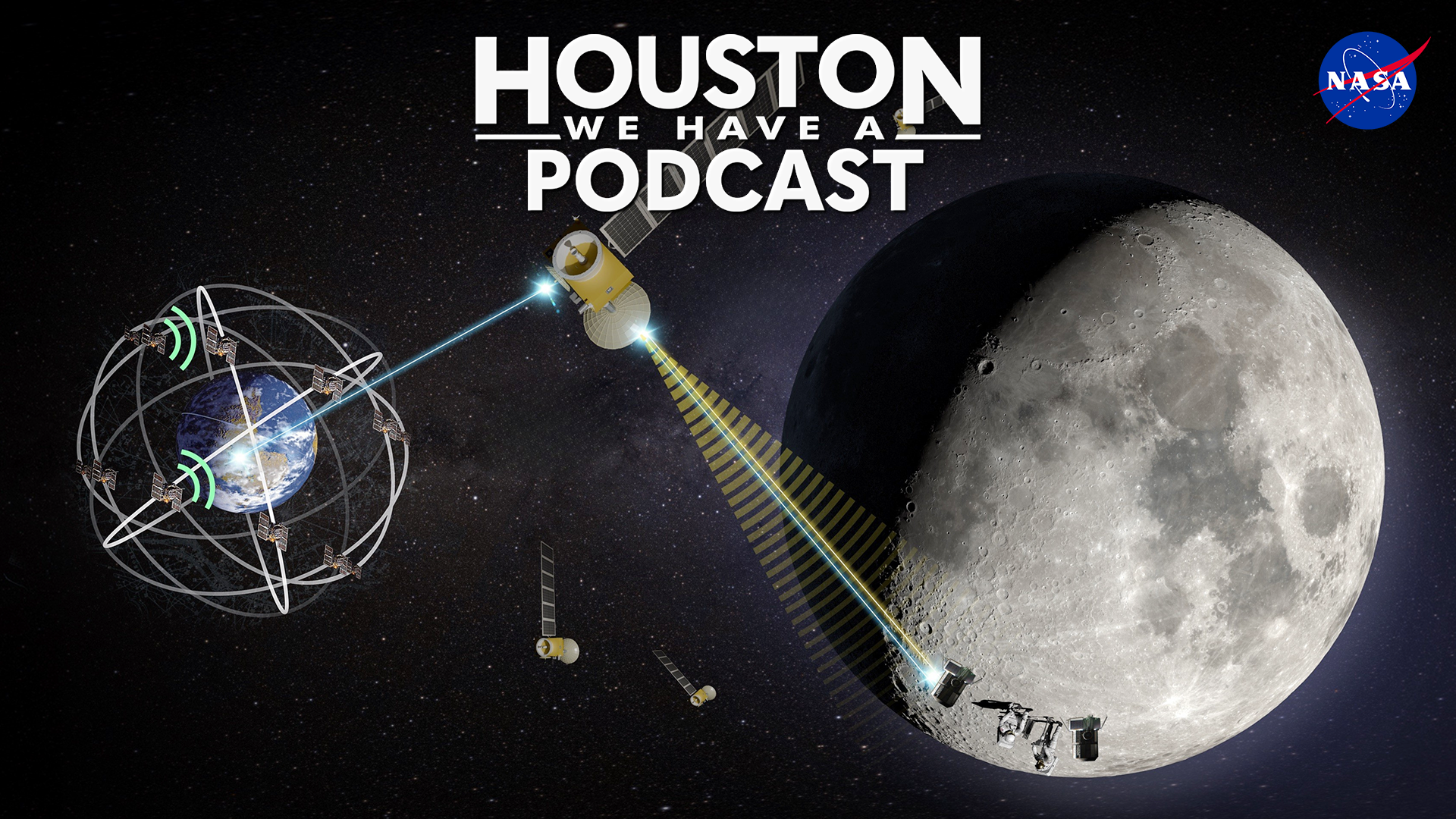
On episode 425, NASA SCaN Deputy Program Manager Greg Heckler discusses the future of deep space communications and the technology supporting NASA missions in Earth orbit and the Moon. This episode was recorded in May 5, 2026.
Transcript
Gary Jordan
Houston We Have a Podcast. Welcome to the official podcast of the NASA Johnson Space Center, Episode 425: The Future of Deep Space Communications. I’m Gary Jordan, and I’ll be your host today. On this podcast we bring in the experts- scientists, engineers, and astronauts all to let you know what’s going on in the world of human space flight and more.
How great was the Artemis II mission? I’m still riding the wave of excitement about the mission, myself. The crew captured stunning images of the Earth and Moon and shared what life was like for four individuals, sharing 330 cubic feet over ten days, we got peeks inside the spacecraft and connected with people around the globe through still photos live stream video and interactive events between the crew and people of Earth as well as the International Space Station. For all of these fantastic images to reach us and be shared throughout the mission, we were relying on the current space communications infrastructure. This includes assets that supported the Near Space Network and Deep Space Network, traditional radio communications networks that are shared with other users. These assets have been used for decades and help to support missions from low Earth orbit to the farthest stretches of our solar system.
During Artemis, we in Public Affairs are responsible for distributing the live streams, the videos and still photos publicly, and we were among the dozens of disciplines hungry for data. Engineers, scientists and flight controllers were all wanting data as quickly as possible, and rightfully so. Data helps to resolve technical issues, provide context for scientific observation and gives insight for flight controllers to make real time operational decisions. And if you can send more data to the ground, that’s less that you have to store on board. So naturally, we’re all saying more, more, more. The demand for data delivered quickly is insatiable.
Developing the infrastructure for how to get more data and establish overall better and more diverse capabilities is a complicated task. Thankfully, we have teams in NASA’s Space Communications and Navigation program or SCaN looking at capabilities development, which happens to have his own branch of the organization. Greg Heckler serves as the deputy program manager for capability development, and already has the future of deep space communications on his mind. We were able to catch some of his time to speak with us on Houston We Have a Podcast to share the efforts underway to support humanity’s return to the lunar surface with that, let’s hear from Greg Heckler on what we’re exploring to support these future endeavors.
Enjoy.
Gary Jordan
Greg Heckler, thank you so much for coming on Houston We Have a Podcast today.
Greg Heckler
It’s awesome to be here. I know it’s drizzling outside, but always try to take the opportunities come down to Johnson and connect what we do in the Space Comm and Nav network to the real users, right? The astronauts.
Gary Jordan
Yes!
Greg Heckler
Right.
Gary Jordan
Where are you coming from? You based in headquarters?
Greg Heckler
Yeah, yeah. So I’ve worked at NASA Headquarters for about seven years. I often call myself a Goddard baby. I started at NASA Goddard and there in Maryland as an intern, way too long ago, and so have always been working for NASA one way or another my entire career.
Gary Jordan
Wow. How early did it start? Let’s, let’s learn a little bit about Greg. Where did you always want to pursue space as a kid?
Greg Heckler
Yeah, no. So I was always probably an engineer, science, you know, math nerd. You know, grew up in Toledo, Ohio, and then moved to Indianapolis when I was 12, right. In Indianapolis, had the opportunity. I went to math science magnet schools. Had a lot of good teachers in Indianapolis public school systems, hey, I have to give a call out. There’s one, one teacher, Dr Blatchley. He was, he was a PhD physics, right? Had a PhD in physics. His wife was the doctor, but he chose to work at inner city school. And, you know, I think that was his public service. And so not only me, but a lot of my friends I still have today. Dr Blatchley kind of molded us into what we are, which are law engineers, but also some physicists, mathematicians. I have to give a shout out for him and what he did for us.
Gary Jordan
Very cool. In that, in that regard, math, physics, you ended up pursuing aerospace engineering, did everybody or kind of they took that and went their own path, whatever they were passionate
Greg Heckler
about, yeah, yeah. So coming out of high school, we, you know, in Indiana, you either go to IU or Purdue, right? If you’re going to be an engineer, of course, you go to Purdue. So there, my entire like cohort basically ended up at Purdue. Lot of engineers. We all kind of chose different disciplines, and actually chose aerospace because it seemed to be the hardest and most interesting, right? Not a strong pull. I was never someone who, like, I have to be at NASA, but just found aerospace engineering very interesting, and jump into it, and through a lot of people I met ended up at NASA Goddard as an intern right after my after my sophomore year in college.
Gary Jordan
Very cool. It says, I think in your early Goddard years, you were in telecommunications?
Greg Heckler
Yeah, actually started in, actually navigation. Okay, so, when I was a freshman at Purdue, there’s Dr James Garrison, who became my graduate advisor. It was his rookie year as a college as a college professor. He had worked at the agency at NASA Langley and NASA Goddard for many years, and, you know, I think he wanted a career change, and so he chose to go back into academia. And my guidance counselor basically told me, Oh, you’re going to work for Jim and be on his his research team. And so how I got into telecommunications, that first summer after freshman year, actually stayed at the Purdue campus in West Lafayette. And Professor Garrison’s background is in using GPS signals to do remote sensing. And the challenge he gave me that first year was he handed me a book about GPS receivers, and then he handed me a CD, and on that CD was a recorded GPS signals, that someone actually from Johns Hopkins APL put into, you know, antenna received and recorded GPS signals. And he said, make this work.
The cool thing about GPS, if you ever watch any movie with aliens in them, right? You know how the scientist discovers the aliens are actually coming or about to invade the earth, right? They’re sitting in front of a gigantic antenna with maybe their earphones on, right? But they’re also looking at what’s called a spectrum analyzer, right? It’s looking at the spectrum of radios, right, or microwaves. And when there’s nothing there, it looks flat. Just looks noisy, right? Flat. But when the aliens are talking to you, there’s a signal peak, there’s a spike, right? And they know we’re about to be invaded. The cool thing about GPS is it’s designed in a way where there’s no signal spike. The way that it works is that it’s actually underneath what’s called the thermal noise floor. So you don’t know those signals are there unless you know how to build a receiver to pull them out of the noise.
And so he’s threw me into this deep end, right? He, you know, he taught me some stuff. He taught me about some of the signal theory and everything. About four weeks later, I came back, I said I found 13 peaks in this noise, right? It’s just noise. And the first time I saw that first signal peak, after I coded stuff in MATLAB and other things, I was hooked. That was my moment. That was the moment that I fell in love with, not just aerospace engineering, but what I do today, which is like telecommunications and navigation, and it’s been 20 years of a wild ride ever since.
Gary Jordan
Wow, yeah, I think asking about your why you pursued aerospace, it was you answered that it was the, and I’m paraphrasing, The Road Less Traveled. It was a harder path, right? It seemed like you, part of the reason you fell in love with it is you were presented a challenge, something very, very hard, difficult to figure out, and you had to tackle it. Here is this, here is this area where we need that level of, you know, there’s challenges, there’s gaps in our understanding, and let’s figure out how to make this work, right? Yeah, fell in love with it.
Awesome. All right, so you went the telecommunications path. You started at Goddard and and went down that path, and now you are in your Cap Dev, Capability Development, yes. Okay, yes. So tell us a little bit about about that.
Greg Heckler
So I’ll give you the 101 on the Space Comm and Nav program, right? We, we, we operate the Solar System, or now potentially the galaxy’s network, right? Talking aerospace missions. We have assets all around the earth. You may have heard of the Deep Space Network, those large, 70 meter and 34 meter antennas all over the earth, talking to the missions like Voyager right? Technically, outside the solar system.
We also have assets in space. We have constellation near the earth, called the Tracking Data Relay Satellite system, TDRS, built to support like the shuttle and then the ISS and science missions. So we operate that network, and that group is called network operations, and that’s led by Ms. Jenna Gary. She’s been doing that for a couple years. They keep the network we have going today, and so. Um, they had a lot of work to do for Artemis II, right? Artemis II supporting Orion that used TDRS, that used the Deep Space Network, that used some of our smaller assets, we call the Near Space Network. It was basically flown on the things we have today.
Cap Dev is actually the more enjoyable part of the program, I’ll say, right? It’s the fun thing. We get to build the new things, right? And it’s split into two, two parts. We do some technology development investments to make sure we have new capabilities, and then we have what we call delivery projects where we’re building new infrastructure or partnering to deliver new infrastructure to provide real services to the Orions, the Human Landing Systems to the future science missions.
And so I am building antennas all over the earth, relay systems around LEO, relay systems around the Moon, relay systems around Mars. It’s fun being part of at least an interplanetary enterprise at this point, but, yeah, it’s a crazy time right now.
Gary Jordan
Very much so. You’re thinking about the future, and really going back to some of the assets you talked about that are, I don’t want to necessarily call them legacy, but they’ve been around for a while, right? We’ve been using these radio frequency assets for a while, ground stations, antennas, you talked about the Deep Space Network ground stations. There’s for near space as well, TDRS, Tracking and Data Relay Satellite. We talk about that constantly, because that’s what we use on the International Space Station, right? The geosynchronous satellites.
Greg Heckler
Astronaut lives depend on every day, right?
Gary Jordan
Very much so.
Greg Heckler
And we take that responsibility very seriously.
Gary Jordan
So in terms of, you know, thinking about these assets have been around for a long time. Part of the thinking is the we shouldn’t think about these assets as being our forever solution. They’re not going to last forever. Also, technology develops, right? We talked about radio, radio frequency, but, you know, we might, we might be exploring other different- I know we’re going to explore op com as part of this, as part of this conversation as well. So there’s different kinds of- I’m very excited to dive into this!
Before we do though, just you talked about network operations as one, one branch of SCaN. We talked to Kevin Coggins as well, talking about Lunar Coordinated Time. So there’s a there’s a time keeping aspect to to SCaN. There’s a current operations, there’s development. How are you all working together to think about, you know, what’s what do we know now, and what are we doing in the future? What’s the what’s that integration look like?
Greg Heckler
Yeah, well, it’s not just SCaN, right? We have to do that with the rest of the agency. SCaN, you know, almost has an easier job than a lot of different organizations in NASA. We don’t have to make up our own mission, right? It’s hard deciding whether we should go to the Moon, right, or Mars, or redirecting an asteroid. It’s, it’s hard to define or say, hey, what science I need to prioritize with my budget this year. For SCaN, everything we do is what I call derived requirements. We just need to understand where the NASA missions are going and when and what they need, and then we can architect and formulate solutions around those, right. And so we work closely all across the agency, with the Science Mission Directorate, with the Exploration Mission Directorate, with the Space Operations Mission Directorate, to understand their long term plans. We do that in a lot of different ways.
One way we do that is we build manifests What missions are going where in what year. That’s something we’re doing right now with the Moon Base team. A lot more missions, a lot closer than what we originally planned. And so what kind of data rates do we need for all those missions? When you add those up, how much data in aggregate do we need to potentially transport between someplace like the Moon back to the Earth, what type of navigation accuracy and timing accuracy do they need to meet their mission needs? And so we’re constantly integrating across the agency, the long term plans, the medium term plans, the short term plans, and formulating our approaches around those. And so that’s never done, and we constantly have to update our plans to match changes in what the agency is focusing on overall.
Gary Jordan
It’s got to be a full time job, right? You just mentioned Moon Base, right? That is a relatively new aspect to the Artemis profile. You know, that was announced as part of the ignition event that we had quite recently, right? We’re talking here in May. So, so we’re not very far removed for when that was announced. And these are things you have to plan to and I’m sure that everybody has their has their needs, right? So, so thinking Artemis related, we’re talking Orion, Moon Base, space suits, rovers, the HLS, the landers, right? All of these are capabilities that would ultimately be users of what you are working on. So you have to sort of get that feedback.
And when you, when you look at that, and you talk across the all these different disciplines, let’s go through the problem solving, the Investigation Phase of “all right, well, you need this, and you need this.” How am I going to build a network that will ultimately support all of these different elements to make the mission work? Whether it’s a landing, you know, let’s just say we’re landing on the moon to go to a Moon Base, and we’re going to drive on rovers and do some space walks, right? That’s the sort of the profile that you have to think about. So how do you how do you bring that all together and come up with a comprehensive solution?
Greg Heckler
Right? So there’s a there’s another element of SCaN I need to bring into this part of the conversation. It’s our Mission and Stakeholder Engagement Group led by Dr. Ben Ashman. He’s actually an old colleague of mine with the same advisor, but ended up in the SCaN program. He has a team where he does that engagement with these different users, and there’s a lot of different ways we can extract that type of information to understand what they need from a telecommunications and navigation perspective.
Sometimes you talk to them. You sit down with the mission managers, some of the senior engineers right within HLS, and you talk through what, what really do you need? Are there different types of data, right? Astronaut video data for PAO is different than astronaut health data, which is different than maybe telemetry from a vehicle that astronaut is in. What are the different types of data? Do you need to transport those mainly from where they are on the vehicle back to the earth, or is it the other way around? Do you really need to get something from the earth to that vehicle in space?
So a lot of talking, discussion, interviewing, but you have to all distill that into products, right? Engineering products. That’s where the numbers come in. That’s where, okay, we need 4k video everywhere. What does that mean? Is that one camera on each lunar lander? Or is that seven? Do you need all seven video streams to all come back to the earth, or do you get one second snaps and you have someone on the earth choosing which stream gets streamed back in real time. You have to translate all this into numbers, and it’s very- those numbers are really driven by, or analogous to what you do on the earth. How fast of an internet connection do you need at your house? Right? Do you download up gigantic updates to Battlefield one every weekend, and you don’t want that to take seven hours. You want to take that for 15 minutes. On your cell phone, how much TikToking Do you do? Right? Those types, we call those often use cases as well, right? What are the activities you’re doing, and how do those translate into some of these needs or requirements?
So Ben operates the needs funnel, and then we have to do a lot of filtering of that. Like, what does that mean? Do all these missions need comm all at the same time? That’s a huge driver for our networks. When you talk about a Deep Space Network antenna, it’s usually pointed to one thing, and it talks to one thing at a time. If we need to support 20 CLPS landers all at the same time, operating simultaneously, all with their own different data needs. That’s a much different architecture than kind of a point to point architecture. And so that’s why we’re talking more about networks and using some of the technology that we use on the Earth for some of these new environments, like the Moon and Mars.
Gary Jordan
Yeah. And we’re gonna, we’re gonna definitely get into it, and you’re kind of alluding to some of it, right? Like you talk about cell phones, I know there’s, there’s efforts that are analogous to 4g, 5g networks and things like that. So I’m very curious to get into it.
But you talked about, you know, everybody wants 4k right? So I’m sure if, when you’re talking to all these different disciplines, the answer, inevitably, I think a lot of times, would be, give me all the data I want as much as I can get. Or is it? Maybe it’s more reasonable than that? Maybe, maybe when you’re having the conversations, they’re willing to concede, like, all right, well, that’s maybe not reasonable to get as much. So how can we make this work? It sounds like it might be a two way.
Greg Heckler
Yeah, it’s definitely two way. I think one tension we navigate in our element of the business is that comm has to work right. Comm to remote vehicles, the only way you’re going to operate that, if you’re a science mission, it’s the only way you’re going to get the science data back to Earth, to the scientists, the real consumers. If you’re flying a crewed mission. It’s the way you protect astronaut health and safety. I had one colleague who said, SCaN provides the air to the astronauts. The missions can’t fly without it, and so it has to be rock solid. It has to work. In this business, we talk about technology readiness levels. I assume someone has used that term on this podcast.
Gary Jordan
TRL! All the time.
Greg Heckler
“TRL 9 or die,” I think is, is the terminology, right? It has to be rock solid. It has to be flight proven. And so there’s a tension right, where there’s a need for more data, but the people managing these programs and missions comm has to be zero risk. And so that’s something we navigate. And I think some of that tension you’re seeing in the evolution of the SCaN network, where it’s a much easier, call it safer choice, just to use what we did last time,
Gary Jordan
Cause it’s proven.
Greg Heckler
It’s proven right? And think, if you’re managing a Science Mission Directorate mission, you want to invest your money, you want to manage your risk on the instrument, not the comm sub-system, not the power sub-system, right? Those just need to work. You need to focus really on what’s driving your mission, which is, you know, the science instruments. And so we understand those perspectives. But I think there’s a lot of really good conversations in the agency, realizing that we need to evolve both the networks faster and the users need to take a little more risk than they historically have to deliver on these new expectations, both for exploration and science.
Gary Jordan
Yeah. I mean, like, you know, we could have just stuck with telephone lines and land lines, but, you know, we decided, I think it’s a good investment to work on these 4g, 5g towers, to get that fiber internet, right. But we see dropouts every once in a while. It’s very normal to our lives. We see it and we get frustrated, of course, right? But the benefit is, you know, amazing connection really, really good data rates and capabilities that we kind of take for granted, I think, nowadays, right? Being able to doom scroll on Tiktok for hours and hours and hours.
Greg Heckler
One day on the Moon, right? One day on the Moon.
Gary Jordan
Let’s hope they’re, they’re paying attention a little more, right? So, so, thinking about some of the technologies, let’s dive into that. So going to, let’s, let’s start with Artemis II.
Greg Heckler
Yeah, let’s talk about that.
Gary Jordan
Artemis II, we saw some of the data rates. You know, we were on the Deep Space Network for a while. We’re on TDRS for a while. We were using those assets that we’ve used many, many times. But we also had technology demonstration of optical communication, too. I know that’s one of the things that you guys are working on.
Greg Heckler
Yeah, so, yeah, optical comm. It didn’t just happen. There’s a story we started, actually our first optical comm technology demonstration on a little mission called LADEE, over a decade ago, and we put an optical terminal on that mission. It was the first space demonstration of optical communications that NASA flew and then actually proved you could do it at the Moon, right? LADEE went to the Moon, and it’s we’ve had a bunch of different optical demonstrations over all regions of space, on the ISS right, a LEO mission, low Earth orbit mission. We have a demonstration relay satellite called LCRD in geosynchronous orbit. It’s still there. And we actually had an optical terminal on the Psyche mission called it’s called DSOC the Deep Space Optical Comm demonstration. And they were all wildly successful, but that sequence built up into what I call the crown jewel of the series, which was really Artemis II and the OpCom demonstration we had on that.
Orion uses old, what we call RF microwave technology, tried and true, right? DSN, TDRS, it’s all been there. We know it works single digit, megabits per second, 2, 4, 6 megabits per second, trying to get all the Orion telemetry, plus video, plus audio. That’s not a big enough pipe to do all those things, and so we flew O2O. It had a terminal, laser terminal, you can think of it. It’s about the size of a cat. There’s a long story about why we like cats in the optical com business. And you can think of it if you ever have a like a hobbyist telescope, right? Like a 10 centimeter diameter terminal, it kind of looks like that. So it’s a gimbaled telescope that would point back to the earth, and it connected to several ground stations, 50 centimeter, 70 centimeters in size, and it was able to communicate it up to 260 megabits per second. You know, if that, if that were your home internet connection, you’d probably be pretty, pretty happy with that.
I think what we learned during the mission is there’s a new expectation. We’ve gotten tremendous feedback. You know, there’s a whole science team, right, that was interacting with the astronauts in real time as they’re going on the far side of the moon, trying to ask guide them on what pictures to take. What are you observing? Those pictures would not have gotten back to the earth as quickly as they would have on the old system on Orion. They were almost able to have that interaction in real time, because the high photos would come off the cameras down to the ground to the science room, and they’d had that real back and forth that otherwise would not happen. It was great seeing every evening the new pictures coming out, the videos on YouTube. People talking about those put people putting those on their computer or their cell phone backgrounds, all the tweets. All those videos, those pictures, the interactions with the astronauts, they have to have, they have to have relevancy. And in our era, right the way everything moves. If those pictures came two weeks later, no one would have cared. They had to happen the day they had to get to the people of the earth, right the day they were taken. And you need these new communication technologies to actually deliver on expectation. So O2O was amazing. The team was amazing, and we’re working hard to make sure that sort of technology gets into the rest of the Artemis enterprise and Moon Base from here on up.
Gary Jordan
Amazing, amazing! With that you know you talk about, just to stay on OpCom for just a second, thinking about future capabilities, right? You talked about this capability that is mounted to a spacecraft that has to point towards the Earth. Towards, you said, 50 centimeter dishes that are on the-
Greg Heckler
Yeah, well, I won’t call them dishes. They’re telescopes, right? This is optical. This is using wavelengths of light. You can’t see it. It’s actually, eye-safe. It’s in the near infrared, 1550 nanometers, but it’s using light, right? Radio technology, microwave technology, everything has a wavelength. The wavelengths we work with with like the Deep Space Network or TDRS, 10 centimeters, a meter, one centimeter.
Moving to using light allows you to move a lot more data over systems. We talk about size, weight and power, a swap envelope systems that are actually a lot smaller than what we use on microwave technology. So there’s not just a capability development, like more data moving more quickly, but we actually reduce size, weight, and power, which is very important for spacecraft, right? Those are very limited. And so there’s a lot of technology benefits, just as a mission designer, engineer, to make your mission actually execute as well. So there’s other benefits to using this technology.
Gary Jordan
Oh, fantastic. I know. So, you know, like, Okay, this, this worked great, great feedback. We want more, you know, I wonder, okay, making it smaller, reducing mass, that makes sense. How about like, having more locations on the Earth where you could point that laser, you know? Because I know, I know weather is a consideration through clouds. You know, the rotation of the Earth, right? Like, when you can actually point towards the Earth, you know, could that be an investment to improve the number of chances and locations that you have to actually, to actually send communications through OpCom?
Greg Heckler
Yeah. So, you know, OpCom, the physics of it, are well known. I think you’ve pointed out really, really well that you cannot communicate through, through a thick cloud?
Gary Jordan
Yeah.
Greg Heckler
Our microwave technology, you can do that, right? And so we don’t really worry very much about weather. Our Deep Space Network, there’s only three locations, right? We have multiple antennas in each but they’re kind of spaced equally around the Earth. So as the Earth rotates underneath, you can think of those further out bodies, the Moon or Mars kind of being stationary in the sky. The Earth is actually rotating underneath them. And if you have a station, every kind of third of the pie, you’ll always have visibility between the Earth and where you’re trying to talk to, if for optical communications, if you’re trying to do that same architecture, you need to have what we call weather diversity. If you cannot communicate through a cloud, you need to have much more stations across the world to make sure you always have a connection. That’s well studied. It’s understood. People talk about eight or nine different locations, potentially, but those are some of the architectures which we’re going to have to investigate as we rise to this challenge of making sure we get all this data back from the Moon.
There’s other there’s other things going on too, right? We all know about Starlink, right? Starlink, the mega constellation being built by SpaceX. You can strap a dish on on the top of your your your RV or van, and get in internet everywhere. That system is actually network in space. And the way it’s network in space is because it has optical cross links between all of those many 1000s of satellites. So if you think on the ground, right, how’s the Internet work? We have fiber right using actually 1550 nanometer optical technology communicating through those fiber lines. That’s the backbone of the internet. These mega constellations are building a new backbone in space using optical communications. And so there’s actually an opportunity, when we have a terminal on the Moon, does it actually have to come down to the earth and deal with that, that weather problem? Or maybe it just comes back to a relay constellation around the Earth, and then you can get it down through tried and true microwave technology.
And so there’s some architectural trades. We talked about, right, gathering needs, requirements. What are the potential solutions, trading those for cost and schedule and all those, all these things you wait and coming up with, with optimal, optimal solutions. And the cool thing about optical comp, NASA made investments. Right? Those investments are dwarfed by what’s going on in the commercial market, and with international space agencies and other federal agencies. We have a real opportunity to benefit from those investments and potentially scale our solutions in a new way by leveraging those, relying on commercial partners. And so we’re gonna have to work through those things quickly. But I think SCaN is in a really unique position, and was done with our segment of the space industry to get things rapidly into operations.
Gary Jordan
I love that you’re you’re working on complex problem solving, right? Because you see where my head is. That was like, okay, laser goes to ground, you’re like, but what if, yeah, right? So you have to, you just trying to work around the weather problem, make it more reliable, more flexible, right? Wouldn’t that be nice? Okay, so you’re thinking about that. We alluded to this earlier in the in the podcast, but you know, developing assets around the Moon too, this is very, very exciting. And there’s multiple projects I know that are that are looking at this, relay satellites around the Moon, right? What you know, wireless capabilities on the surface of the Moon. Can you talk about some of those efforts?
Greg Heckler
Yeah, so one of the projects that in my portion of SCaN is our Lunar Relay project. I always have to give a shout- shout out to Marshall Smith. But he, talking about communicating, right? Yeah, we communicate with the public. That’s a key thing that I think SCaN helps deliver on. We need to communicate with leadership.
And our venture back to the Moon is much different than Apollo, right? We’re not going to the near side. We’re going to the South Pole. Much different. The lighting conditions are different, much more challenging to navigate there. The other challenge when it comes to communication is, if you land on the South Pole, you don’t always see the Earth. And so you can’t just rely on antennas on on the Earth to talk to the astronauts. You need to have assets they can actually see and communicate with. And so you do that by just like TDRS around the Earth, putting lunar relay communication and navigation satellites around the Moon so they are, the rover the human landing system will always have continuous connectivity back back to Mission Control and the users of that data. So Marshall Smith, he helped us build the case in the agency to communicate the importance of this and build a very crisp argument. Right? If you do not do this, you cannot fulfill your dreams with Artemis. And so once leadership locked into this, they realized that SCaN had a new job to do, and have been very supportive ever since. And first lunar relay satellite from our partner, Intuitive Machines, is on plan to potentially launch in November of this year. And so one of the reasons I’m down here in Texas is to take a visit to intuitive and to see how they’re progressing.
Gary Jordan
Very, very cool. Yeah, that’s a big deal, right? So, so in terms of, I mean, just to to take a tangent for just a second, is not only the technology, but there’s an urgency to it too. So that has to be a challenge. You have to do newer technologies that are reliable, that high TRL, we were talking about, also fast, right? Quite a challenge.
Greg Heckler
Yeah, well, you know, again, I talked about with optical communications. I used a term, I think, with the administrator the other day. We’re in the platinum era of satellite communications. You know, there’s multiple, just US companies building these amazing systems, in LEO, in MEO, and GEO, Low Earth Orbit, Medium Earth Orbit, and Geosynchronous Earth Orbit, international space agencies. There’s so much investment and capability. I think we have the opportunity right that we did not have 10 years ago, that we did not have 20 years ago, of adapting these commercial capabilities and applying them to different problems and areas. Lunar relay is one of those.
By leveraging the commercial capability, yeah, we need to work with a partner. Doing that in the lunar environment is a little bit different than doing it in low Earth orbit. So we need to have that good partnership to exchange information. But they can move quickly, and we have confidence in them. Another thing I think that we’re doing is trying to use commercial technology where it’s a, what I call one to one use case. You talked about having a surface wireless network on the Moon. Lunar relays, think of them as above you, right? If you’re on the South Pole, you’ll be able to communicate to them. But really, if you have multiple elements on the surface, multiple rovers, multiple Eclipse landers, we know the scientists want to deploy like science instruments just independently, right? They pull them out of the garage of HLS, and then they go drop them down in the place that the astronauts drop them where they need to be. All that data has to flow over this network. And so having a surface wireless network where you aggregate all that traffic, just like a cell phone tower does today, and then it goes up to the lunar relays. That’s the type of architecture we’re seeking and trying to fulfill, and I use the cell phone tower analogy directly, because 3GPP, that entire ecosystem, they solved a problem here on the Earth. It is no different on the Moon, what we’re trying to do, other than we have to make sure the equipment we use is rated to survive, you know, the environment on the lunar surface. But don’t change the technology. Don’t mess with the standards. Don’t mess with the intellectual property, the code, the software. It’s the same job. Let’s just use it true COTS, Commercial Off the Shelf technology, you have to put in a different hardware platform. But this, this problem has been solved. Let’s go leverage it forward. And so that was some of the reasons we got to cell phone technology being the baseline for the future lunar surface wireless network with with good old Wi Fi, right? That’s what we do every day, right?
Gary Jordan
We know it works.
Greg Heckler
We have Wi Fi in your house, but when you get in the car, or when you’re on your run away from your house, you use cell phone technology. And so that’s where we are. That’s the architecture we’re trying to build for the surface wireless network as well.
Gary Jordan
Very cool. So, yeah, it gives you that jump start. You know, we know the technology works, but of course, and we could probably spend a large amount of the time talking about this, but we’ll just kind of hit it high level, is the surface of the moon is not super friendly. Sure, it has very you know, it is, some of it, especially in the permanently shadowed regions, can be like very, very cold, single digit Kelvins, right? So, but you know, you have to find the right place. You have to find the right place for it, you have to have the right power generation. You have to protect against the radiation environment, you know, it’s not so. So that’s where you’re taking. That’s the next steps you have to take. You know, the technology works, but how do you fit it into a piece of hardware that will survive on the moon? That’s the-
Greg Heckler
Exactly. Yeah. And that’s where our focus, our investments, are in.
Gary Jordan
Got it.
Greg Heckler
And you know, talking about leveraging commercial partners, we’ve been working with Nokia, right? We all know Nokia, right? They’re experts in cell phone technology. We’ve been working with them, with with NASA, not just SCaN, Space Technology Mission Directorate, with Moon to Mars over the last several years, to make those investments to make sure that technology can be in those proper space rated platforms to deploy.
Gary Jordan
So we were spending a lot of time talking about the Moon with these relay satellites, surface communications, we talked about optical communications. Jumping a little bit to the near space capabilities as well. Are there efforts to, you know, thinking about what’s next after TDRS or something like that?
Greg Heckler
Yeah, that’s, oh, that was one of my biggest challenges when I started at the program. Before I came to the program at NASA headquarters, I had actually spent the last six years at NASA Goddard building the last three Tracking Data Relay Satellites, the third gen. Learned so much, right? We all have really rare opportunities in the agency to have really special teams. And that TDRS project, it had been there since I always say, 1976 in one way or another, and very, very excellent high performing team delivering national capability through that system. I was really proud to learn from them. A lot of my mentors I still talk to today were on that project.
And so, yeah, it was, it was just one of those fascinating things in life, right? Spent six years really dedicated to that mission, build the last three of them, and then came to NASA Headquarters. And I didn’t know at the time, right, but there was really a decision made kind of the same time I was working on that project to say, hey, we’re not going to build that. There’s not going to be a fourth generation of TDRS, we’re not going to build anymore. We need to migrate off of the system. And yeah, that was first, one of the first jobs I got at the SCaN program.
So worked with our teams at NASA Goddard, NASA Glenn, across the agency, to come up with a strategy. And it’s hard to evolve the networks. One of the hardest thing is, we’re not going to let a mission end because it doesn’t have comm, right? Yeah, like, missions need to phase out because they run out fuel, because their power sub system fails, right? Their instruments fail, not because they don’t have comm. And so our networks, we have a lot of missions. We’re really good at NASA building missions that last a long, long time, right? I talked about Voyager. They, they, they aren’t turned off. And we, we take it’s our responsibility to make sure they keep going right from the common app perspective. So on TDRS, on the DSN, we have a lot of missions that are decades old, and you can’t go change their radios. You cannot change the equipment on those satellites. And so they have no ability to move to maybe a new, modern system that uses different technology. And so part of managing the retirement of TDRS was getting to an agency decision to say we’re not going to allow any new missions to use that legacy system right. Right now, we have seven operational satellites. They’re going to fade out. They’re going to die of natural causes, as I say, over time. Those last three I worked on will be there until probably the end of the 2030s. But we had to make a big decision, the agency, we don’t need the next round of science missions on the system. The commercial LEO destinations right that follow on to the ISS? No, you can’t use TDRS, because we wouldn’t have enough of them to actually meet all of that demand. And so we made that decision as an agency, at the same time we’ve been investing in maturing and demonstrating commercial satellite communications capabilities, including optical comm, showing that these systems actually far outperform TDRS, I think in almost every metric. And I think in the long term, they’re going to be a lot more affordable to the agency, when you start talking about the costs of getting these services. So a lot of changes you talked about technology and engineering. A lot of what we do in the program is what’s going on with our market condition in the space industry. Where are those places where NASA should be leveraging other investments versus, hey, there’s no investments here. There’s not a commercial business case. We NASA, we still need to stand up and do a job here thinking about those things. How do you partner with companies to understand their incentives and align incentives? And call it a relationship, call it a contract, right? Very important-
Gary Jordan
Oh, yeah.
Greg Heckler
-to make sure we’re all we get what we need as NASA, but those companies get what they need, maybe to make a business case, but it’s not always about that. And so there’s a lot more that goes into these decisions that from the outside, oh, there’s a cool capability called optical comm. There’s a lot more that goes into some of these major decisions. And then just the engineering aspect of it.
Gary Jordan
Yeah, it’s yeah, you want it ultimately, if you’re going to make an investment in a technology, you don’t want it to the the market to fade out right now. You can’t use that technology. It has to be like the market itself. Has to be sustainable if you’re going to invest in it. You want to make sure it’s going to work in the long run, right? You said RF technology said in the teacher, since 1976 that’s a long time RF has done is really, really well. So yeah, yeah.
Thinking about upcoming. What comes next? So just to help us to wrap up here, thinking about the nearest steps is, is we’ve talked a lot about a lot of different technologies. We talked about the technology and a sense of urgency as well. So in terms of that, we were talking about a lot of different things. What’s the nearest thing that that is on your mind, that you’re like, this has to be ready ASAP.
Greg Heckler
Well, it’s the Artemis III, right? Yeah, it was going to be landing now it’s in LEO. Talking about the investments we made in commercial satellite communications. You already mentioned the limitations of just our TDRS system supporting Orion. We need to do better, right? And so we’ve reached out to industry. We released an RFI, I think literally, yesterday, asking industry do they have new or potential end to end solutions to put on Orion for the Artemis III mission to deliver the 4k video? We in SCaN, we think there’s capabilities out there, but we’ll have to work with the Orion program to make sure there’s a good match, right? It’s not just about the technology. It’s can you put this terminal on the spacecraft in the time allotted, right? Schedule drivers.
Gary Jordan
Oh, yeah.
Greg Heckler
Making sure you can integrate it, making sure there’s not just a terminal, but there’s a net. There has to be a network, too on the other side, and a lot of people are in different places in terms of fielding these next generation of satellite communication systems. But we love working with our commercial partners. I think they’re going to rise to this challenge. It’s been great seeing everyone want to be part of Artemis and what NASA is doing, and I think we’re going to have a tremendous response and really, really confident we’re going to deliver on that new expectation in an amazingly short amount of time.
Gary Jordan
I love the confidence, because we certainly need it right the- I think a lot of us are still riding the excitement of Artemis II how amazing that mission was, and knowing that optical communications was a contributor. You talked about phone backgrounds. Check this out!
Greg Heckler
Oh, there you go. That’s, that’s, that’s a great shot, absolutely.
Gary Jordan
Yeah. So, so I just showed Greg my the background of my phone is Earth-Set from the Artemis II mission. Just those inspirational things that we got to be a part of and witness to know that you guys are working on delivering it faster, delivering it more, right? I think everyone is on board with more video, more more capabilities. So appreciate all the work that you’re doing, Greg.
Greg Heckler
I just want to add one note to close on, oh, you showed that amazing picture, right? We’re all looking at the pictures. You know, communication, it’s not about the about the bites, right, between the different machines. It’s really communicating to people. And we all watch the YouTube videos about Artemis II. And I think the one thing I learned, it wasn’t about the moon or the amazing pictures, it was about the crew, right? That crew, obviously, if you’re an astronaut crew, you’re not just colleagues, right? You’re not just showing up for your coffee at 9am. But I think they were more than a crew. I think they’re a family. And that’s what I took away from the Artemis II mission, that that human moment where you knew those people had a bond that would never be broken after this life changing event. And, you know, I think they, they they loved one another, right? And they showed that, and they demonstrated that, and how they communicated with each other during that mission. So that was amazing thing to see, and I look forward to helping bring those future moments on Artemis III, on Artemis IV, on Artemis V, and every Artemis after that. It’s amazing.
Gary Jordan
It’s so critical, because you talk about them being a family, and I think a lot of us here on the Earth, while they were circling around the Moon, felt a part of that family, because we could be with them. You know, we supported 24/7 coverage. You can turn tune on the TV at any point in the mission and maybe, maybe get a peek inside the capsule, and just be a part of that family. So to know you’re working on the capabilities to help us get even closer to the next family that’s that’s pretty cool, Greg.
Greg Heckler
Thank you for having me.
Gary Jordan
Absolutely. Thanks.
Gary Jordan
Hey. Thanks for sticking around. I hope you learned something today.
You can check out the latest from around the agency at nasa.gov. You can also find more about NASA’s Space Communications and Navigation program at nasa.gov/scan. And you can find our full collection of episodes and all the other wonderful NASA podcasts at nasa.gov/podcasts.
On social media we’re on the NASA Johnson Space Center pages of Facebook, X, and Instagram. If you have any questions for us or suggestions for future episodes, email us at nasa-houstonpodcast@mail.nasa.gov.
This podcast was recorded on May 5, 2026.
Our producer is Dane Turner. Audio engineers are Will Flato and Daniel Tohill, and our social media is managed by Kelcie Howren. Houston We Have a Podcast was created and is supervised by me, Gary Jordan. Special thanks to Emily Johnson and Caitlin O’Neil for helping us to plan and set up this interview. And of course, thanks again to Greg Heckler for taking the time to come on the show.
Give us a rating and feedback on whatever platform you’re listening to us on, and tell us what you think of our podcast.
We’ll be back next week.
3… 2… 1… This is an official NASA podcast.