
















From Earth orbit to the Moon and Mars, explore the world of human spaceflight with NASA each week on the official podcast of the Johnson Space Center in Houston, Texas. Listen to in-depth conversations with the astronauts, scientists and engineers who make it possible.
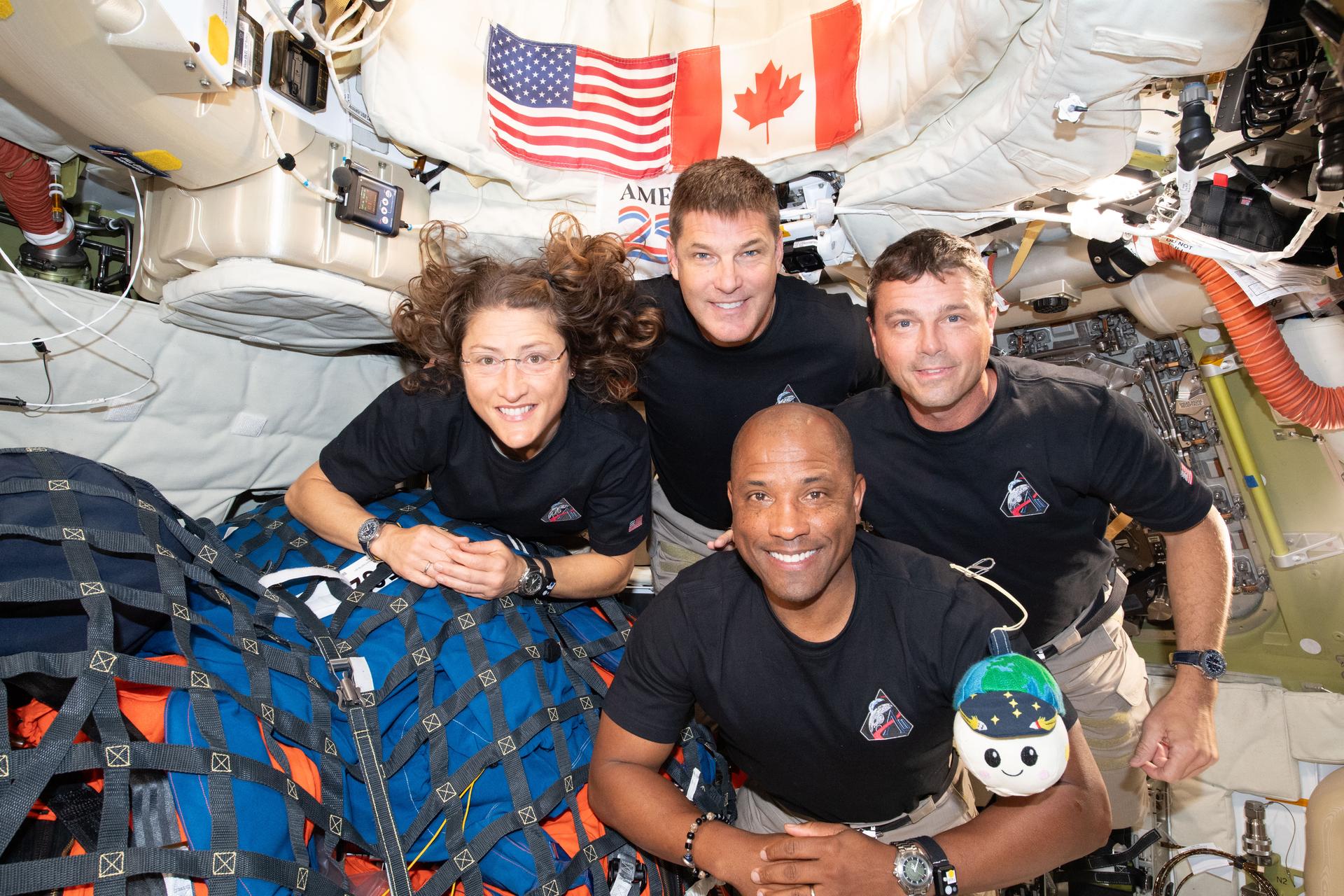
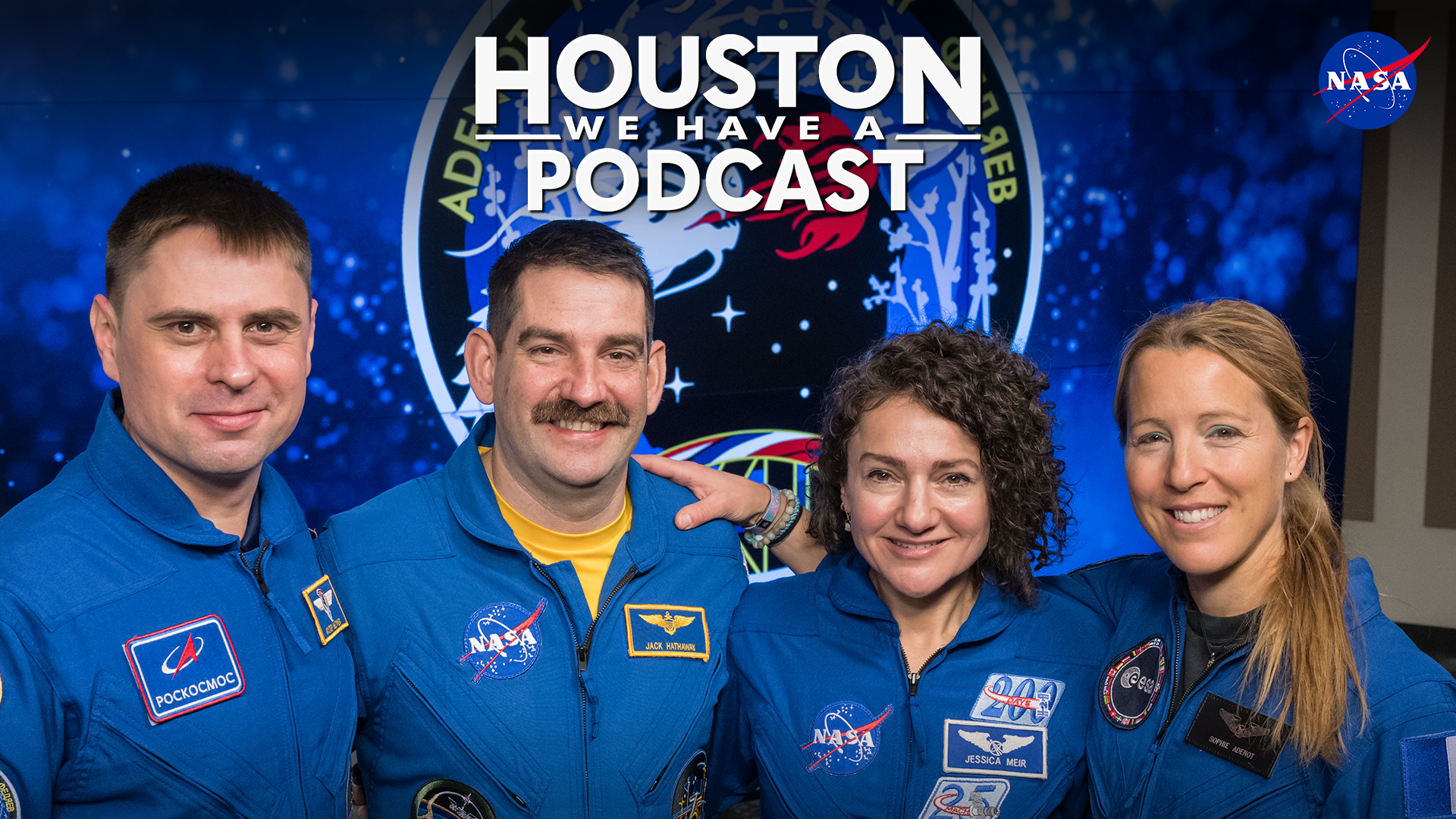
On episode 410, The four crew members of NASA’s SpaceX Crew-12 discuss their backgrounds, training, and upcoming mission to the International Space Station. This episode was recorded November 2025 through January 2026.

Transcript
Leah Cheshier
Houston We Have a Podcast. Welcome to the official podcast of NASA’s Johnson Space Center. Episode 410: Crew-12. I’m Leah Cheshier, and I’ll be one of your hosts today. On this podcast, we bring in the experts, scientists, engineers and astronauts, all to let you know what’s going on in the world of human spaceflight and more.
A new crew is about to make its way to the International Space Station. Four crew members are set to launch on NASA’s SpaceX Crew-12 mission headed to the station, ready to join expedition 74 and 75 and bring the total number of crew members up to seven ahead of their mission. Fellow hosts, Joseph Zakrzewski, Dane Turner, Kenna Pell and myself sat down with the crew to discuss their flight. With a mix of seasoned veterans and first time flyers, this well rounded crew is ready for lift off.
First up is Crew-12 commander Jessica Meir. Meir grew up in Caribou, Maine and has a Bachelor of Arts in Biology from Brown University, a Master of Science in Space Studies from International Space University, and a Doctorate in Marine Biology from Scripps Institution of Oceanography. Prior to being an astronaut, she studied the physiology of animals in extreme environments, including the diving behavior of Emperor penguins in Antarctica and the high altitude flight of Bar Headed Geese over the Himalayas, Meir joined the astronaut corps in 2013 and first flew to the space station on Soyuz MS-15 in 2019 she spent 204 days in space during expeditions 61 and 62 and completed three space walks, including the first all woman space walk with Christina Koch. I was very excited to speak with her ahead of this mission. So here’s my conversation with Jessica Meir.
<Intro Music>
Leah Cheshier
Jessica Meir, welcome to Houston We Have a Podcast.
Jessica Meir
Thank you. It’s wonderful to be here.
Leah Cheshier
I’m excited to dive into your upcoming mission, but also a little bit about what you’ve done before, how it’s different this time. But let’s get started at the very, very beginning. So tell me a little bit about your story. Where did you grow up? What really made you want to become an astronaut?
Jessica Meir
I grew up in a small town in northern Maine called Caribou. It’s the north eastern most city in the United States. So all the way up there in the northeastern corner of Maine, Canada actually wraps around there on the other side. So about 15 miles from the Canadian border, there are a lot of trees in Maine, of course, and especially up there. So I think that might have something to do with why I really fell in love with biology and nature and science and had this curiosity and desire to explore. My mom is Swedish, and I think that helped drive it too, because Swedes have a very strong connection to nature, and I think she really fostered that. My father was from Israel, and we grew up again in Caribou with I had four siblings. So I’m the youngest of three sisters and one brother. So I had a lot to strive toward and a lot to look up to, a lot of things. I wanted to do everything that they did. So I involved myself in everything, maybe starting everything a little bit earlier than they did, because I was the younger one and I and I wanted to catch up. So really an idyllic childhood, you know, growing up in a time and in a place where we could run around, play outside, ride bikes to our friend’s house, and I had a really happy childhood.
Leah Cheshier
That’s so sweet. And I feel like, in northern Maine, you probably had pretty dark skies too.
Jessica Meir
Yeah, absolutely and of course, I didn’t appreciate it at the time because it was just how it was. I didn’t realize. And now going back to places like that, when you look up, wow, like you can really see such density of the stars and of the Milky Way. And so perhaps that was something too. You know, we there was a park called Thomas Park, which had really great stargazing. And maybe that was one of the things that sort of sparked my imagination and desire to be an astronaut. My mom tells me, I started saying it when I was five years old, and I pretty much never stopped since then, even in college, people called me Space Girl. Everybody knew I had this dream to become an astronaut, and my first distinct memory of it was drawing a picture in the first grade, we were asked what we wanted to be when we grew up, and I drew a picture of an astronaut standing on the surface of the moon in a space suit next to the American flag, that kind of iconic Apollo image. And yeah, just kept saying it ever since then.
Leah Cheshier
That’s an incredible dream, and to see the fulfillment of it on the other side is pretty sweet. So we fast forward a little bit to 2013 that’s when you were selected, correct? Yeah, that’s right, all right. So 2013 comes along. You become an astronaut, and then you come in to NASA, here in Houston, definitely a lot different than Maine, but you start training, so you have your approximately two years of astronaut candidate training, and then one. You’re assigned to a mission, you go through additional training. So can you tell us the differences between your initial training and then, once you’re assigned to a mission, how does that look different?
Jessica Meir
Sure so the first two years are what we call astronaut candidate training, and that’s kind of like basic training for astronauts. What do you need to know fundamentally to be an astronaut? So those are things like flight training, flying our NASA T38 aircraft, learning how to use the space suit. That’s probably the most challenging thing that we do, mentally and physically. So we do that in the Neutral Buoyancy Lab here at the Johnson Space Center, working underwater to learn how to operate in that very big, cumbersome space suit. We do international space station systems training, so understanding all the the core systems of the space station, the thermal control system, the power system, that kind of thing. Of course, we need to have a good basic understanding of that knowledge, since we’ll be working up there and living up there, and we can’t call a plumber or an electrician when, when something goes awry. We also have Russian language training at the time, from the time that you start here as astronauts, because everybody on the International Space Station has to be at a certain level of proficiency of both English and Russian. And then we had things like robotics training as well, so learning how to fly the robotic arm that we use to help capture and bring in the visiting vehicles that deliver cargo to the space station. Sometimes you’re using the robotic arm with your friend, doing a space walk on the end of it, flying them around. So the different types of uses, we also do things like leadership training, survival training, team type building, you know, we have this newer buzz word called expeditionary skills, kind of learning how to play nicely with others. All those things are really built into those first two years. And then after that, after you graduate, and you drop the candidate portion. Now you’re just an astronaut, that means you’re ready to be assigned a mission. So you work different jobs on the ground, supporting different groups here at NASA, maybe the team that’s helping develop the lander for landing on the moon, or the spacesuit team, or you’re working in mission control as a capsule communicator, the person that talks to the astronauts. You have a smattering of all those different jobs and experiences until you start your mission specific training. And that mission specific training for the International Space Station, historically, has been about a year and a half to two years before space flight. So now you’re really getting ready for the actual mission. It still involves a lot of those same fundamentals that you had in the candidate period. But then you’re also starting to do things that are more mission specific. If there are space walks that we know you might be doing, you might get a little bit more knowledge on those. Then we train more for any big contingency scenarios and those general skills, because we don’t necessarily know for sure what’s going to happen when you’re up there and what you’ll have to do so you want to be able to be kind of ready to do anything. And then you’ll have things like baseline data collection for the experiments that you have for the particular mission, any kind of familiarity with specific pieces of hardware that you have your emergency training that really steps up. And you do that all in conjunction with your actual crew. So it’s not just about the technical skills and the operational skills. It’s also about the teamwork type skills with the actual people that you’ll be flying up there with and working there with. So you delve into all of that flow. You have training in with our international partner agencies as well. I was in Japan recently with the Japanese Space Agency learning everything about their module and some of the experiments that we’ll be doing there, we have trips to Russia, of course, for the Russian segment, and to Europe as well for Columbus, so the European module. So we get all kinds of different aspects of training. A majority of occurs here in Houston. And then a lot of our training is also for the specific vehicle that you’re flying. So that’s one thing for this training flow. It’s, of course, very different for me from my last mission, my last mission I flew on a Soyuz spacecraft. So all of that that training was happening in Russia at the Gagarin training, the Gagarin Cosmonaut Training Center. And now for this one, I’ll be launching with SpaceX. So a lot of that training is happening in Hawthorne, in California, with the SpaceX team and personnel and their simulator. So really different aspect in terms of that training preparation.
Leah Cheshier
I’m glad you went into that, because that was my next question of you’re now flying on a completely different spacecraft, but you also touched on spacewalks, and I wanted to bring that up for a second. So you have had a long duration mission on the International Space Station before you’re getting ready to go back. Do you have any space walks planned that you know of so far?
Jessica Meir
So I was super fortunate on my previous mission to do three space walks. And you know, we don’t ever know for sure if we’re going to get to do one. I think almost everybody is dying to do one. To me, that’s really the highlight of the mission. But I did three previously. We don’t know for sure whether you never know for sure, because even if you think you will, and they’re supposed to be in the plan, things change all the time, depending on whether or not the hardware you need for the spacecraft made it up there on a previous vehicle, depending on what might happen to brake while you’re up there. So it looks like it’s pretty likely that we will have some. On spacewalks during our mission. We are at the time of the space station life now, where, you know, we’re still doing some for science, things like AMS, the Alpha Magnetic Spectrometer, doing some repairs and upgrades for that, doing some upgrades to the space station, like the irosa to augment the solar arrays and the power channel for the space station, but then we’re also have to start thinking about the long term planning for the end of Space Station and getting space station into a configuration that will support de orbiting it safely. So I think the space talks that we do still has not been completely determined, but may be a mix of any of those, some of the science, some of the maintenance, definitely some contingency repairs, if anything happens during the mission, and maybe some of that pre planning for the end of life of Space Station.
Leah Cheshier
Well, I really hope that you get to do a space walk. They’re some of the most exciting days, even here on the ground, and so I’ll keep my fingers crossed for you.
Jessica Meir
Thank you. I hope I do as well. And I also really hope that my crew mates at Jack and Sophie have the opportunity to do space walks, because, of course, for them, it’s even more important because they’ve never done one. So I really hope that they get the opportunity to do that. And I hope that if I get to go with them on any of them, you know that mentoring aspect will really be very rewarding for me, and we’ll be continuing into that world as well.
Leah Cheshier
And you talked about your crew for a second, so let’s dive into that. You are flying with two other NASA or two other astronauts. One is NASA, one ESA and a Roscosmos cosmonaut. So can you tell us about your crew?
Jessica Meir
Yeah, absolutely. I am so excited about the crew that I have. I was so fortunate to have an incredible crew on my last mission, and the same is true for this one. And if you look at the four individuals, we bring such different things to the table. It’s such a diverse set of background and experiences, and we really complement each other’s strengths. And so that’s something that I really like about our crew. My pilot is Jack Hathaway, call sign Radio. He’s a Navy Test Pilot from his previous career. He was one of the Flies, so the second most recent class of astronauts that was selected, and that’s really special for me, because I was a member of that selection committee. So I have this personal investment in Jack and all of his classmates, and perhaps this personal responsibility. So it’s extremely rewarding to be flying with him and to be able to mentor him as well, and with his background as a test pilot and then my background as a scientist, we have these different skill sets and experiences that really complement each other in the cockpit, and I think that helps make us a successful commander and pilot team. Jack is also super competent in everything he does, super trustworthy, so I really enjoy working with him, and he has a great sense of humor as well. He makes it fun. We get along really well, so that has been a really, really pleasurable experience through the training flow so far. Sophie Adenot is a French astronaut. She is also a new astronaut like Jack, so she has not flown before, and she was a test pilot in the French military. She was actually the first female helicopter test pilot in France. So She also brings this, you know, similar background to Jack, this test pilot experience, and she brings this really fun, loving excitement and enthusiasm and this energy that’s so positive to the crew, which I really enjoy, you know, especially if it’s something you’ve done before, sometimes you forget how awesome it is like when I give somebody a tour here at NASA for the first time. You know, you come into your everyday workplace and you see it again through their eyes, like how you saw it for the first time. And that’s so good for us, I think personally, for our own attitudes, to remind ourselves of how cool it is what we’re doing. And Sophie has that. She embodies that in everything, where she’s just so excited and enthusiastic for everything that we’re doing, really brings that positive vibe to the team and our MS two is Andrey Fadeyev. He has he’s a flown cosmonaut as well. He flew on crew six, so he actually has more experience in Dragon than any of us do. So he brings that level of experience. He is smart, confident, super capable, and also a very entertaining individual brings this also this kind of positive vibe and energy to the crew. So I’m really looking forward to working and living with these four individuals off the planet for a while.
Leah Cheshier
So you were last on the space station in 2019, 2020, and you were still up there when the Covid 19 pandemic really began on Earth. Is that right?
Jessica Meir
Yeah, we launched in September of 2019 so no knowledge of Covid 19. And when we got up there, that’s when, throughout the mission, everything started happening, and things started getting worse and worse and worse. So it was a really strange time to be off the planet. It was very surreal when we were, you know, hearing the news and talking to our loved ones and seeing that the entire planet was changing, and that it was literally something that was affecting the entire planet, and we were the only individuals that were unaffected by it. So it was very strange to have that perspective and to also feel that everybody is lives were changing very dramatically. It was impacting everyone and it wasn’t impacting us. Our daily operations were the same. We continued with our mission. Interestingly, our ground support. The Mission Control Center had completely changed. We had set up separate rooms that we didn’t have people coming in contact with each other during separate shifts. But the amazing thing, and I think a real testament to how NASA really rises to the challenge is that we were completely oblivious to any of that, because it was seamless for us. We had the same support level that we ever, ever had, and we were still conducting all the work that we were doing in exactly the same way so that. But there’s also this weird dichotomy, because you knew that everybody’s lives were so severely disrupted, and we were just doing the same thing. So I remember really well when Chris Cassidy arrived. So you know, things were getting worse and worse throughout the flight. And when the previous Soyuz, with our three crew members, with Luca Parmitano, Christina Koch and Sasha Skvortsov, left, it was just the three of us up there. It was my commander, Alex Skripochka, and drew Morgan and I, just three of us. And that’s when things started getting really bad. And we were like, this is just getting worse and worse and worse, and we don’t even know, you know what’s going to happen anymore. Chris Cassidy came up to replace us. So toward the end of our mission, Chris arrived, and he looked at us and said, You guys really need to mentally prepare that you are going back to a different planet like this is, this is a totally different scale of anything that any of us have ever us have ever experienced. And it was true, you know, going back to Earth after an extended stay in space is difficult psychologically for anyone. But we were going back, literally to a different planet than the one that we left. So there was this added level of of really everything that we were experiencing and we came back, and I was looking forward to, you know, my mom and some friends were supposed to come for landing. I was I couldn’t wait to go to all my, like, fancy restaurants in Houston, and a lot of little friends in the in the food industry that I was excited to see, like, all of those things, of course, like, were completely shut down at the time. I wasn’t married, I didn’t have my daughter, and it was just me at home alone, and I couldn’t even go anywhere. Had come from the isolation of the space station for seven months, and I was more isolated when I came back down to earth. So it was a very strange time, obviously for everybody on the planet.
Leah Cheshier
I could talk about that all day long, and it feels like a lifetime ago, but the fact that it was only five, almost six years ago, is mind blowing, and we’ve come so far since then, thankfully. So you’re going back to the space station, and you just mentioned that you’re a mom this time. I’m a new mom, and something that people have really encouraged me is to think about the things that your child sees you do, and how you can show that is helping other people in the world. And so is that something that you’ve talked about with your daughter? I know she’s young, but how have you have you talked to her about this space mission and shown her how important it is to follow your passions but also make sure that you’re contributing in a beneficial and really important way in the world?
Jessica Meir
Well first of all, congratulations. It’s really life changing, isn’t it becoming a mom and a parent and so, yeah, that has been definitely a huge change for me as a person, in a wonderful way, but in a totally different way professionally. You know, I’m looking at this mission now in a totally different way than I am, obviously in a different role as a commander, but and even more so in in being a mom and knowing that I’m leaving these people behind on the planet when I’m going. I mean, of course, we always leave people behind when we go, friends and family, but this is a little bit different when it’s, you know, especially at her age. She’s only three years old, so I try to look at it as, you know, hopefully, when she looks back on it, yes, it’ll be an absence, and we’ll be apart for a while, but hopefully it’ll be a positive thing, because she can look back on it as a special and unique memory. And I’m trying to do everything possible to have her involved in it, you know, to have some specific things that we can share real time, and she might not remember it when she’s since she’s only three, but like, she’ll have something tangible to look back on, whether it’s a video or an object or something that we share together. And I hope, just like you said, that you know, she sees the value in it and understands why we’re doing what we’re doing, and why we’re exploring and why it’s important that, yes, I have to be away for her for a while, but it’s for a good reason. So I hope that she does appreciate that one day as well. And you know, I think it is true. Obviously, otherwise I wouldn’t be doing it. I think it’s important for us to do what we do in order to push the boundaries of science and exploration, but also to inspire and to provide that for our children and for everybody else’s children, to show them, you know, what we’re capable of.
Leah Cheshier
That’s fantastic. And I think that you are giving her a legacy that she can be really, really proud of that you’re her mom. So congratulations. I can’t wait to see you in space and all the amazing things that you will do, living and working on the International Space Station.
Jessica Meir
All right, thank you so much. Thank you for telling our story.
Joseph Zakrzewski
Jack Hathaway. Welcome back to Houston, We Have a Podcast.
Jack Hathaway
Yeah, it’s wonderful. Thanks for having me again.
Joseph Zakrzewski
It’s good to see you, the last time we got to catch up with you was during astronaut graduation, is a part of the class of 2024 and for those curious to listen to Jack and his classmates, that was episode 325, The Flies. A lot has happened for you, obviously now getting prepared to join Crew-12 and head up to the International Space Station. And again, it’s been a wild ride since that time when I last saw you walk across the stage and receive your astronaut pin. What has life been like for you going from that moment now, moving forward to today?
Jack Hathaway
Yeah, it’s been. It’s been a really crazy two years since then. Actually, my classmate, Nichole Ayers, she’s been up and back from space already in that intervening two years is pretty cool. And and Chris Williams, he’s about a week from launching in a Soyuz vehicle to head up to the space station on the day that we’re recording. This has been really an incredible like time for our classes. We’re all getting assigned to missions and getting into the training and really kind of becoming full fledged astronauts.
Joseph Zakrzewski
You hit on a point that I wrote down in my notes that I wanted to dive into the Flies that that astronaut class is really having a moment right now. You mentioned Chris Williams about to go up, or going up on on Soyuz, MS28 you have Nichole Ayers, who already went up with crew 10, and has since come back down. We got to catch up with some of your classmates in an ask an astronaut episode, Episode 392. By the way, with Chris Burch, Denise Burnham and Anil Menon, which Anil is getting ready to prepare for a flight. And then you have Andre Douglas supporting the Artemis II campaign, which has come up here in the nearest future. So reflecting on that, and I know when you go through training as a class over though that length of time, you build a bond, and it’s fun to see your classmates succeed and have those experiences. What has it been like as a member of the Flies in this moment, seeing so many of your fellow classmates and now, including you heading to microgravity?
Jack Hathaway
Yeah, it’s, it’s a real wonderful experience, right? You get to, you show up on the first day of ASCAN and you, you probably haven’t. I think I met one or two of them in the couple days before we actually started our first day here, and then everyone else, you kind of just, you kind of meet right for the announcement, and you’re like, you look at these people, and you’re like, I got some new best friends, you know, for the next, you know, rest of our lives, and we’ve got to know each other. It’s been really great. It’s just an incredible group of people, and they’re so fired up and excited, and you mentioned Andre and he walks around the office, and he’s just so happy all the time. And he’s just, he’s just having such a great experience over, over at Artemis, you know, being the backup and just doing the development of all that Artemis crew training, work with that, with that crew, and I, every one of my everyone, every one of my classmates, is just having a great experience, and it’s been wonderful to be along for the ride and share stories about the stuff that we’re learning. I’ve learned so much from vapor, from Nichole about what it was like for her to be a pilot on Dragon before me, and getting that passed down on things that are important to think about, like you need to pick this t shirt or this clothes to wear. These are the these are the types of decisions that are really important and you want to take the time to to get those right. You want to try this stuff on and make sure it’s the stuff that you want. And this stuff over here, it doesn’t matter. Like, just, they’re going to recommend something and just take it. It’s not worth your time of picking the left pencil or the right pencil. Like, just, just take whatever their advice is. But this stuff over here is really important, so it’s been cool to to learn from from your friends, from your colleagues, and then be able to pass along to as you as you learn things like what it was like and what this experiments was, and it’s, it’s, you know, it’s, it’s a real, it’s just an honor and a privilege to be part of this office and have the opportunity to train with these people like it. It’s it’s really cool.
Joseph Zakrzewski
Well, before we dive into your mission again with NASA SpaceX Crew-12, kind of wanted to go back and get the the Jack Hathaway origin story, a native of Connecticut and and someone that you know went through training to get to this point, to where we are today. And I know we touched upon some of your NASA training. But when did you know you wanted to become a part of human spaceflight and be a part of this special moment in time? And when did that really become a realistic path for you?
Jack Hathaway
I think, like most, most kids, I you know, I was interested in a lot of things as a child, but space was always exciting and an inspiration. But really, from a young age, I was interested in becoming a pilot, and as I grew up and started to look at different options in front of me, kind of settled on hey, I want to, I want to be a military jet pilot. And I went around and and visited the different academies and talked to different people that I knew, and I asked people to introduce me to people from the Air Force and people from the Army and the Navy and then, and to kind of see what, was the right fit for me and my personality, and it turned out the Navy was perfect for me. I was really lucky and blessed that they I was accepted to the Naval Academy and went there and then went off to flight school, and really just fell in love with with Navy fighter pilot culture and the type of people that are there, like. They’re they’re some of the most hard working humans that are trying to they’re doing a very difficult job, and they’re doing it extremely professionally and developing the next generation that comes behind them. It’s at the limits of that type of technology and that type of capability, and they’re always looking for the next edge, and they’re looking to be just a little bit better every time they go flying. And I really loved being a part of that. It was, it was incredibly challenging to, like they hold to a high standard, and to to come back and to have not met that standard on some flights, you know, is, is difficult to work your way through, but there was the resources and the capability, and if you were willing to put the time and they were willing to work with you to get you to that level they wanted you to be at. And that was a was, and continues to be really great part of my life, being a naval aviator. And so I was super happy doing that. I always wanted to be a test pilot, too, beyond just flying like I’ve always had kind of an engineering science background, and I didn’t want to just fly the airplane around and put it in the right piece of sky to do the mission that I was doing. But I also wanted wanted to understand why it worked the way that it worked, and why this high order flight control system could move this flight control surface to move the airplane this way, and if you were at this speed or this altitude, it would move this other flight control surface. Or like I really wanted to understand why airplanes are designed the way they are, and how they work, and going down the test pilot route was kind of a good match for me. And as you know, a lot of astronauts have a test pilot background, and you know that wasn’t lost on me either, that that’s a future career opportunity as well. So I did that. And in the Navy, unlike a lot of other services, you do the test pilot thing for a bunch of years, and then you go back operational, and then you have the opportunity to come back and be back in the test world as well. So it’s kind of a long as a pilot. It’s kind of a long, ambling route to get to the Astronaut Office. You can have quite a lengthy career. I had 18 years in the Navy before NASA picked me up to come here. it was, and I would do another 10 or 15, if they would have let me. But NASA was like, no, if you want to come, you got to come. Now. We’re not, we’re not going to hold a spot for you. So of course, that’s not, also not a hard decision. But yeah, so I kept doing the test bot thing. Went back flying. And then, you know, every couple years, a class opens up and and you apply, and sometimes it works and sometimes it doesn’t. And for me and the fly class, it worked. And so I ended up here.
Joseph Zakrzewski
Well, we’re glad. You’re here as we’re getting ready to launch, and you your first flight to the International Space Station. Is a part of NASA’s SpaceX Crew-12. I went on your Instagram and was kind of seeing what some of the experiences you’ve had from starting as an astronaut graduate to being a part of Crew-12? And I saw that, you know, you were suiting up in EVA suits and form fitting gloves and also doing some robotic arm training, but I wanted to hear from you now focus primarily on Crew-12, what has been some of the more exciting and challenging moments of training and getting prepared for this mission.
Jack Hathaway
Training to go to space, to go to the International Space Station for eight months is, is kind of awesome. I mean, no matter which way you cut it, there’s, there’s all sorts of really cool stuff about it. We do all the ISS training and then kind of separate, but of course, related is the Dragon and specific training that we do as well, getting into the pool in a in in the Neutral Buoyancy Lab, in the pool, as we call it, in an EVA space suit, is just cool. It’s hard, it’s difficult, it’s challenging, but it’s cool. Like, it’s whenever you do that, whenever you’re on that stand, getting ready to go in the water. It’s that, like, Yeah, this is real. I’m not in a dream, like, I’m really doing this. And this is, this is a cool opportunity, and I’m glad that we have the staff and instructors that hold us to the standard that we’re good enough to get in the water and do the training that we need to do. So when we go out the door for real, that we’re prepared for all the all the eventualities and to do the upgrades and as necessary for the station. But beyond that sort of stuff, there’s also all sorts of school training. It’s been a really great opportunity being a Dragon crew member, to go out to Hawthorne and work with the SpaceX team. We also went out to Cape Canaveral. They have, obviously their Falcon 9 refurb. And Dragon refurb facility is there as well. And one of the great things I think about being an astronaut is you get to meet a bunch of cool people, and the people that are building and maintaining and developing and pushing forward on on all that technology at SpaceX and at NASA, like it’s really cool to meet them, because they’re all super excited. They’re all passionate. They have their little piece of it, and they they just love it, and they have so much fun doing it. And it’s fun to meet them and see how excited they are, how excited they are to meet you, or, you know, other astronauts, and to share what they’re doing with you. So you know that when you go up to space, that the widget. That person worked on is going to work the way that it’s supposed to. And that’s always that’s been a cool part of the training as well. The amount of people, first of all, the amount of people that that are working on this and then meeting them individually, and the type of passion, excitement they bring, bring to the table, is is really cool. I could amble on forever and talk about different parts of training and stuff, but I’ll pause there and let you throw something at me.
Joseph Zakrzewski
No, well, and speaking of people, that was going to be my next one, because you’re going to be flying with some key people with you, and I’d love to learn more about your crew mates and being able to work with them, and what it’s been like to go through this process with them, and their experiences that maybe rub off on you and your experiences rub off on them. Can you tell us a little bit about working with the crew that you’re going up to the International Space Station with?
Jack Hathaway
Yeah, we have a great crew. It’s, it’s been a real awesome experience. Jessica and I have been been together from from the first moment that I got assigned. And it’s, it’s been a real blessing. Like Jessica Meir, you know, accomplished astronaut, you know, been to the space station, done several EVAs. You know, done, done all, all of the things that an astronaut needs to do, and has been successful at all of them. Totally different background than me, and it’s been real interesting to see the way that she looks at problems and solves problems and accomplishes things. She’s also a Soyuz flyer, right? And the way they operate that spacecraft is different than the way that we operate. Dragon. And seeing that background and knowledge has been has been cool. It’s, it’s, I would have it no other way. I love having a an experienced astronaut as as my commander, as our commander, to provide the leadership and mentorship that is going to set us up for success in the future, like she’s she’s been key, I think, to to the success that, if I’ve had any success that over the last year or two, it’s been great working with her. Sophie’s, our MS one from France, her European astronaut class started roughly the same time that we did as the Flies. Not a whole lot of overlap because of the kind of different pipelines that we go through, but a little bit of overlap as well. So we’re both rookies together, and she’s awesome. She’s a helicopter pilot, and so we we poke fun at each other as fixed wing and helicopter pilots do and and that’s a lot of fun, but she’s incredibly talented, incredibly knowledgeable, and cannot stop moving like she loves to find a problem and just solve it. And having someone like on that crew, on a crew like that is just incredible, because by the time you realize you’ve had a problem, you look back and she saw it three months ago, solved. It had three different options, and it already has all the solutions in place, or even small things inside the capsule, like just immediately ready to put a hand and help out, and that’s that’s just a wonderful thing to have on the crew. So another I maybe the most important thing, is that neither Sophie or Jessica likes desserts and treats as much as me, so the dessert bob on the station just gonna go straight to me and that that, you know, being able to make sure that we eat different foods so we can share appropriately. You know, that’s pretty key, too. So I’m really excited to spend eight months with them up on the Space Station and Crew-12 and Expedition 74 and 75 Yeah, didn’t even make didn’t even mention, you know, Chris Williams and Anil. And they’re, they’re going to be up there with their Russian crew mates as well. And it’s, it’s super exciting. I can’t, I can’t wait.
Joseph Zakrzewski
This is your first space flight. And you kind of touched upon earlier of your fellow colleague and classmate, Nichole Ayers, being the pilot for crew 10. Right in your wheelhouse. You mentioned some of the things that she shared with you, but for yourself, what are some of the milestones and experiences that you’re looking forward to here on your first space flight?
Jack Hathaway
It’s hard to like list a specific thing. Maybe lots of people can answer that question easily. For me, like, I just want to get up there, and I want to do my job every day, and I want to do it well, and I want to not let down the people that have trained us, all, the people that have spent, you know, they were going to do a science experiment for someone that spent half their life developing all that, and they need an astronaut at the tail end of it to do the last three minutes of it. But that last three minutes of it is pretty key. And I like, I want to do enough training and enough preparation so I’m ready to do honor to that person and their life’s work to make sure that I can give them the best result that they can get. So I’m excited about, about that type of opportunity. You know, it’s a, it’s a real life race, right? Like, we’ve had humans in space for 25 years now, and we haven’t had, we’ve had humans in space for 25 years, but six months at a time, and it’s a different set of humans each time. And it’s a different set of like, Well, where did this guy put the wrench? You know, four missions ago. And. Yeah, you know you gotta just, you gotta do your piece in the right way, so that a crew that comes after you, or the crew that comes for crews after you, can be like, open the open the storage box that you were the last person to touch, and everything’s right where it’s supposed to be in the way that it’s supposed to be there, and you’ve left it in a way that’s ready for the next crew to do their piece of the mission. So hopefully that’ll be the greatest compliment. Is if three or four crews from now, someone was like, Yeah, everything was where it was supposed to be, that that would, that would feel like success for me.
Joseph Zakrzewski
and you touched upon ISS and 25 years of continuous human presence that they just celebrated that milestone here recently, and and that’s the destination for NASA SpaceX Crew-12, and yourself and your crew mates. I did some mathing and recognized that when the first element of the International Space Station was flown, you were about 16 years old, pretty formative years for a young Jack Hathaway. And I would love to know your what the ISS in the International Space Station means to you. And now that you’ve seen it in the sky, you’ve seen photos of it, you’ve seen videos of it, growing up as a teenager to today, now being able we talked earlier about crossing that hatchway and being a part of that human space flight history. What does the space station and its microgravity research mean to you, and why is it so important?
Jack Hathaway
Yeah, the space flight question, the flight question, right? I was stuck on the, you know, if I was sixteen 25 years ago, how old does that make me now? And that’s what I was thinking.
Joseph Zakrzewski
I stopped mathing at that point.
Jack Hathaway
Human Space Flight is a powerful experience, right? And you watch little pieces of it growing up from the shuttle, you know, there’s a photo floating around. My mom showed me of we were, we were in Florida. I don’t know how old I was, eight or nine, and there’s a picture of me and my dad. And I don’t know where we were, but one of the space shuttles was stacked on the pad, and you could see it behind us in the distance. And, you know, that’s cool. That’s a you know, it was inspiring back then. And you could see the big smile on my face, and you could see the big smile on my dad’s face as he was taking me there to see that. And it’s a, it’s a cool photograph. It’s a cool experience. And it’s a, you know, it’s just a moment from when you were a kid, but, you know, a lifetime is made up of these moments, of these inspirational moments like that. And I remember at the Naval Academy seeing the names and the photographs of the of the previous Academy grads that became astronauts. You know, I heard stories while I was flying in the Navy of astronauts, current astronauts that people knew because they grew up, they went to flight school with them. And from a generation or so before of the, you know, the more senior people when I was young that that they knew those people and and the type of work that they did, and it’s just, it’s, it’s a real, it’s just, it’s a it’s huge honor, right? You Can’t you try to live up to the expectation of what, what the people before set you the standard that they set, and the and the trust and the responsibility that the country and the people and every one of the NASA teams, SpaceX teams, and our partners around the world, that everyone goes to work, there’s, I don’t know, hundreds of 1000s of people around the world that go to work to develop the hardware and the software and the science experiments, and be the operational team and the control team, and be the Cape Canaveral launch team. You know, be the SpaceX diver that gets to climb on the capsule and hook it up before it like there’s people all over the world doing really cool jobs every day. So a small number of us, four, in our case, can climb into a Dragon capsule and go to the space station for a few months. So, yeah, it’s inspirational. It’s powerful. I’m just trying to be worthy of all that.
Joseph Zakrzewski
Well we’re definitely excited to see you up there on the International Space Station, and that’ll be a fun then and now, with that photo you mentioned, with your mom and the space shuttle behind you, and yeah, we can sneak one with you and Dragon and Falcon behind you here in your in your suit, that’s gonna be an exciting opportunity. NASA astronaut Jack Hathaway, it’s been a thrill to catch up with you today, and we’re excited to see you fly on NASA SpaceX Crew-12. And thank you so much for spending some time and sharing your insights with us on Houston, We Have a Podcast.
Jack Hathaway
Yeah, absolutely anytime. I’d love to be here. Thanks.
Dane Turner
European Space Agency. Astronaut Sophie Adenot will be a mission specialist for Crew-12, a helicopter pilot from France. Adenot holds an engineering degree from the Higher Institute of Aeronautics and Space of France, and a Master of Science from the Massachusetts Institute of Technology. She’s a lieutenant colonel in the French Air Force and Space Force, where she’s logged more than 3000 hours in 22 different types of helicopters, and is a helicopter test pilot. Her credentials include military parachuting, light aircraft piloting, glider piloting, scuba diving, yoga instruction, and she also speaks five languages. Adenot was selected as an ESA astronaut candidate in 2022 and this will be her first space flight. Here’s my conversation with Crew-12 Mission Specialist Sophie Adenot.
Sophie Adenot, welcome to Houston We Have a Podcast.
Sophie Adenot
Hi Dane. Very happy to be here today.
Dane Turner
So let’s start with your story. Where did you grow up, and what inspired you to become an astronaut?
Sophie Adenot
So I was raised in the countryside in the middle of France, and to be honest, I don’t know what inspired me to become an astronaut, because I think since I was a little girl, I wanted to become an astronaut. So I read a lot of books about spaceflight, about biographies of the first French astronauts, initially, because this is where I was from, and this really, I was hooked with all those stories of adventures I wanted to explore the world and and later space. But yes, I was very inspired by the launch of Claudie Haignere. She was the first French woman astronaut launching to space. And when she launched, I was 14 years old, and for me, it was really a big trigger in terms of positive mindset that, well, maybe she managed to do it. So maybe I could, I can manage to.
Dane Turner
So I know your a helicopter pilot. How did you get to being a helicopter pilot? Can you take us through your career path?
Sophie Adenot
So I started my career, actually as an engineer, and so I studied human factors engineering at superhero and MIT, and there I learned to contribute to the design of helicopters. And so my first job was to be an engineer at Airbus Helicopters. And then for one year, I fell in love with helicopters, and I thought, okay, I really want to learn how to fly them. And so I joined the French Air Force, and there I started my career as a helicopter pilot, and for me, all this was with the mindset of trying to do everything that could get me one step closer to becoming an astronaut. In France, there were many astronauts who had the background of test pilots. So I really wanted to explore all the way until test pilot, so that I could have more chances of becoming an astronaut.
Dane Turner
You’re really focused on being an astronaut? That’s really cool.
Sophie Adenot
Yeah I mean, it’s, it’s been my whole life like this, and I’ve heard numerous times. Oh, Sophie, this dreaming is too big. You’ll never manage or, I mean, except for, for my very close family, who were very encouraging me on this path, it’s very often that when you say that you want, or you dream of becoming an astronaut, people say, hey, just come back on earth like it will never happen. Statistically, there’s the chances are so low. But you know what? Whatever they said, it made me happy just to build all this, this journey towards becoming an astronaut. And whatever they said, I was happy gaining the skills and trying and tackling challenges. So, yeah, in the end, it happened,
Dane Turner
That’s fantastic. And you made it. You are an astronaut now. Now you had mentioned to me that you got to fly for the French president. Is that right?
Sophie Adenot
Yeah. So as a helicopter pilot, I started my career as a search and rescue pilot. So for four years, I did search and rescue operations in peace time in France, but as well in war times, I went to Afghanistan two times and rescued wounded soldiers. Did some logistics operations over there. And then after, I changed Squadron and I went to the VIP squadron to fly the French president and as well on the head of states, European head of states, as well, throughout France and Europe. That was very interesting mission and completely different from my background as a search and rescue pilot. And I’m very grateful I did on those two different experiences.
Dane Turner
Which is more pressure, flying the President or flying in wartime?
Sophie Adenot
Actually, like everyone would think, that flying in wartime is more pressure, but in the end, flying the president, I mean, you have to be successful 100% and I mean, of course, all missions have to be successful, but when you are expected to be at one time, one destination, and you know that there are all the TV cameras of the world waiting for you, you really don’t want to. Be a second late. So it’s, it’s a different type of pressure. I would say both have to be successful, successful rescuing people under war and hostile environment. It’s a lot of, a lot of pressure too. But all in all, what I would say is we are very well trained for all types of situations, and what matters is how you welcome uncertainty as a crew, and how you manage to lower the stress of the whole crew to make the success of the mission.
Dane Turner
On this flight, you’re flying with two NASA astronauts and a cosmonaut. Can you tell us about your crew and what’s training with them been like?
Sophie Adenot
So training together has been an incredible experience. So what I like about Crew-12 is the balance we have. We are two men, two women, two pilots and two scientists or engineers. We are two experienced and two rookies. So all in all, it’s a diversity of people learning to work together from different cultural backgrounds, and it’s amazing. So we’ve trained on systems operations, spacecraft itself, all the phases of launch, docking, undocking and re entry. We’ve trained on medical emergencies. We’ve we’ve done a ton of safety drills, but I would say the most important thing we’ve built together is trusts. If you are going to spend eight months in close quarter, 250 miles above the Earth, you have to understand about the others, humor, strength, weaknesses, how they react when they are tired. You have also to to know yourself very well, so that you can express in case you have a weakness, and now you can make the whole crew be more successful as a team, and just taking all weaknesses together and and transforming everything to strength.
Dane Turner
This is your first space flight. So what are you most looking forward to?
Sophie Adenot
That’s a very interesting question. I am looking forward to everything. I also try to not raise too much that level of expectations, because I want to welcome the new and the beauty of everything, every little step of this adventure that said, I think it’s going to be very humbling to see the Earth from above, to see the unity, no borders, just unity of this whole spacecraft that we call Earth, the spacecraft of humanity through the vastness of space. I think it will change me, as I’ve heard, it has changed so many different astronauts, and I’m I’m looking forward to it.
Dane Turner
That’s wonderful. So you’ll obviously be very busy working when you’re up there, but how do you think you’ll spend most of your free time?
Sophie Adenot
Spending free time is an interesting concept. I think I don’t know how I will be inspired in my free time. Of course, I’m sure I will want to connect to my beloved ones, to keep some connection with with people I’m close to, from, from the earth. I think I will also want to connect with my crew mates, because eight months together in a metallic shell together is going to be long. So I’ve prepared some surprises for them, and I’m I’m looking forward to see how they like it. You know, French culture is a lot about gastronomy also. So I’ve managed to, with the help of a very good French Cook, to prepare some French dishes and meals so that we can celebrate together. I’ve also prepared some other little gifts for them, and what I want is to trigger a big smile on their face and see how it increases the good vibes of the crew up there.
Dane Turner
Oh, that’s fantastic. Are there any of the meals that you’re particularly looking forward to?
Sophie Adenot
Yeah, so the meals that we have selected are a mix of very refined and high gastronomy, but also a mix of very day to day French food, so that they have the whole range of foods that will reconnect us to earth. Because so the chef I’m working with is we are. Have been working with us, with a European Space Agency is called Anne-Sophie Pic, and her cuisine is very rooted with Earth. I mean she, she’s very good at cooking with like spices, vegetables and and savers. So it so that when you eat her food, it’s not only calories for the body, but it’s also connection to the earth. So it’s an emotional experience, and we’ve done a lot of testing, and we spent a lot of hours just making sure that we have this good meals and good connection to the earth, and sharing this with my crew mates.
Dane Turner
Oh, that’s incredible. I’m sure everyone’s going to be so excited to eat that food. Yeah, do you have a list of things that you want to see or do while you’re on station?
Sophie Adenot
So on station during my free time? Yes, I think I’m going to be very impressed by all the landscapes. You know, on earth, I love being outdoor. I love adventure. I love going on hikes expeditions. So I’ve crossed the Pyrenees on my bike. I’ve I’ve done many adventures in the mountains in the Alps, and I’ve done a lot of trekking expeditions in Africa. So I am sure I will be so amazed at looking at the beautiful landscapes from from above. And I hope I will have good photography skills so that I can capture some some of the beautiful landscapes.
Dane Turner
In your opinion, why do we explore?
Sophie Adenot
Exploring is very important, because human being have curiosity running through our veins. Exploration drives innovation. So it’s not only about understanding or trying to figure out what’s out there. You know, big question that we all ask when we’re little boys and girls like, hey, what’s behind this door? What is, why do we do this? Why so many? Why questions and what, what is out there. So this is the whole root thing of of exploration. I think we have curiosity in our genes and and then by trying to answer this question, we are forced to find innovation and to find new solutions to tackle challenges. Going to space especially, is so challenging. Space is, is a hostile environment, and in order to send a crew up there, you have to find very efficient technologies, new technologies that hopefully will be used back on Earth and are already used back on Earth. I mean, if you if you’re using day to day GPS, then you’re using space systems into your day to day life. If you’re using memory foam pillows, then you’re using technology from space and so on. I mean, there are so many discoveries that are brought back from the push to innovation in order to succeed in a space mission.
Dane Turner
Well, Sophie, thank you so much for coming on Houston, We Have a Podcast today. I really enjoyed this, and good luck on your mission.
Sophie Adenot
Thank you very much, Dane and yeah, looking forward to talk when we are back on Earth.
Kenna Pell
Last up, we have Roscosmos cosmonaut Andrey Fedyaev selected to become a cosmonaut in 2012 Fedyaev is a major in the Russian Air Force and has an engineering and air traffic control degree from the Balashev military aviation school. He recently flew to the space station in 2023 with Crew-6 for Expedition 68 and 69.
Here’s Andrey Fedyaev.
Andrey, thank you for joining us. You are no stranger to the podcast. You were on episode 277, you flew on Crew-6 and stayed 186 days in orbit. This is your second mission. I’m curious, and I think maybe our listeners would be curious too. What have you been doing since Crew-6?
Andrey Fedyaev
Immediately after the flight, Cosmonauts usually go through the rehabilitation after the flight. It takes about six months or so, then we have some time to rest, get a break, because we have accumulated pre flight, during the flight and after the flight, we have accumulated certain number of vacations, so in cost minutes, usually take the time off, and the most in the last year year, I’ve been going through training, and the flight has been approaching getting closer and closer in the last several months, I have been only doing the training, training for the next flight.
Kenna Pell
What are you most looking forward to on the second flight? I’ve been watching it.
Andrey Fedyaev
First, any cosmonaut or astronaut has the responsibility that weighs, I could say, heavily on the astronaut and cosmonaut of the assignments and the tasks that I need to complete. I am hoping that I’ll be able to complete all the experiments very well, so all of the experiment leads on the ground can get the results they are expecting and looking forward to receiving. I’m also looking forward to looking at Earth from the height of 400 kilometers, to enjoy and admire Earth, which looks wonderful, and look at sunsets and sunrises more than once, because this is an incomparable feeling. And another instance I wanted to share with you is we are flying, and there is nothing interfering, and I can push off the wall, and I can fly and fly wherever I want within the station. Of course, it is an unforgettable feeling, and this, this is what I’m looking forward to being on board the station, also working with my crew, crew mates. We very often get together on the Russian segment, on the US segment, we have dinners together, we watch movies, and we spend our free time together, and it allows us to spend time together and get to know each other as a crew, and that is also an enjoyable experience.
Kenna Pell
You knew exactly what I was going to ask. I was going to ask, now that you’ve, you’ve gone to space station before, and now that you’re going back, kind of doing things that maybe you had wished that you did the first time, and you mentioned, you know, looking out at the Earth but let’s go back to, I know you’ve been on the show before, and so just a reminder, can you tell us a little bit about your background and getting to Roscosmos?
Andrey Fedyaev
After I graduated from high school, at the end of my high school, my junior and senior years, I decided I want to become part of The Space Exploration Program. Wanted to become a cosmonaut. At the moment, I knew back in the day, there was no Internet, or it wasn’t so widespread, and we were able to get the information by word of mouth from the libraries. And back in the day, I knew one thing that only pilots or engineers can become cosmonauts or military pilots, to be exact. So I decided to become a military pilot. I applied for and entered the military pilot Academy and graduated in 2004 and I served as a pilot as part of the anti-submarine fleet, and then I was selected as part of the Cosmonaut Corps from that military pilot corps.
Kenna Pell
As you know, of course, the International Space Station just surpassed 25 years of continuous human presence on board, and you’re part of that huge milestone to you. Why is the ISS and microgravity research important?
Andrey Fedyaev
I always mentioned that undoubtedly, it’s undoubtedly so is, you know, Tsiolkovsky, who was one of the founders of space science and who designed and the precursors of the means we use to get to Space, was all designed and thought of by Tsiolkovsky. He said that Earth is the cradle of the humankind, but the humankind is not going to stay in its cradle forever. So the importance of research of space and studying how people can live in microgravity in space. It is the purpose that serves, the goal of us finding a new home in the future. Because Earth is not eternal. The humankind will have to depart from its cradle. So people who are currently studying space and are engaged in space exploration, working for the benefit of the humankind as a whole, any astronomer or space explorer, scientist, engineer working in space exploration is paving the road for the humankind to reach Azure galaxies, Azure star systems, and I think, to future homes for the humankind.
Kenna Pell
That was a fantastic answer.
Andrey Fedyaev
It’s not fantastic. It’s a reality. Absolutely
Kenna Pell
Whoa. Maybe we don’t we don’t need an interpreter. That was good. Andrey thank you so much for joining us. Thank you.
[Music]
Kenna Pell
Thanks for sticking around. I hope you learned something new today.
You can check out the latest from around the agency nasa.gov and you can catch the Crew-12 launch broadcast on NASA+.
If you’d like to hear more from Jessica Meir, she was previously on the show on episode 110. Jack Hathaway spoke to us on episode 325 and Andrey Fedyaev was on episode 277. Our full collection of episodes and all the other wonderful NASA Podcasts can be found at nasa.gov/podcasts. On social media we’re on NASA Johnson Space Center pages of Facebook, X, and Instagram. If you have any questions for us or suggestions for future episodes, email us at nasa-houstonpodcast@mail.nasa.gov.
These interviews were recorded from November 2025 through January 2026.
Our producer is Dane Turner. Audio engineers are Will Flato and Daniel Tohill, and our social media is managed by Kelcie Howren and Leah Cheshier. Houston We Have a Podcast was created and is supervised by Gary Jordan. Special thanks to the astronaut schedulers for helping us set up these interviews, and of course, thanks again to Jessica, Jack, Sophie and Andrey for taking time to come on the show.
Give us a rating and feedback on whatever platform you’re listening to us on, and tell us what you think of our podcast. We’ll be back next week,