














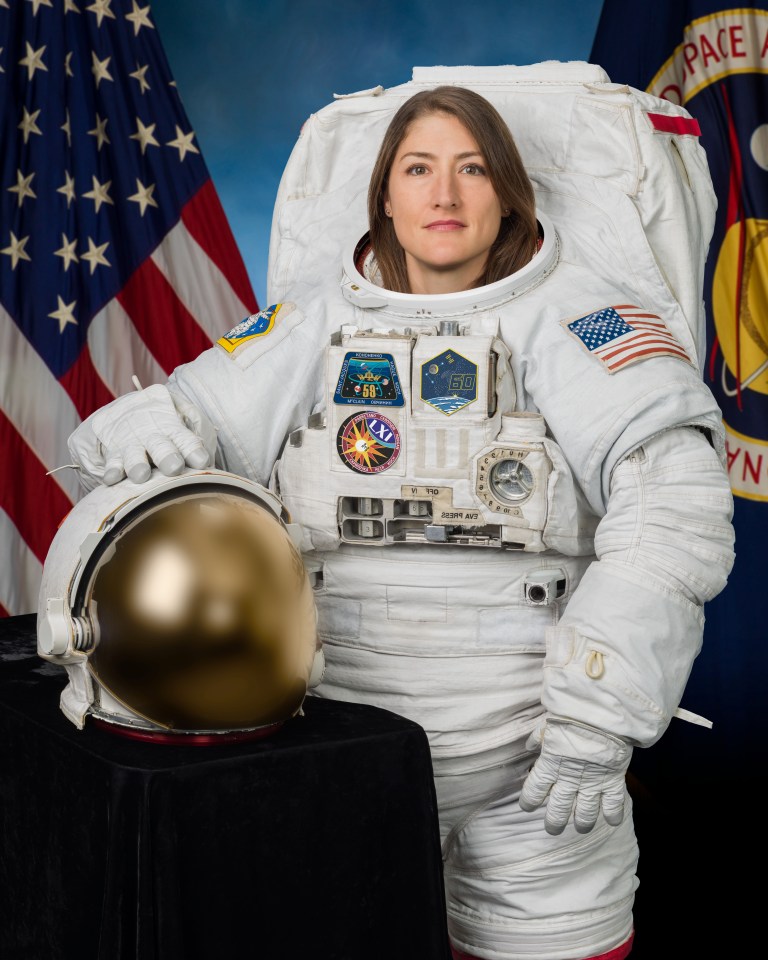
Christina Koch
NASA Astronaut
Follow Christina
Quick Bio
Christina Koch is an explorer and engineer who became astronaut in 2013. She served as mission specialist of NASA’s Artemis II mission in 2026. Her previous experience in spaceflight was living and working on the International Space Station for almost all of 2019 in Expeditions 59, 60, and 61. For this mission, she flew on the Russian Soyuz rocket and trained extensively in Russia. Christina spent a total of 328 consecutive days in space and participated in the first all-female spacewalks. After this spaceflight and before being assigned to Artemis II, she served as Branch Chief of the Assigned Crew Branch in the Astronaut Office and did a rotation as Assistant for Technical Integration for the Center Director at NASA’s Johnson Space Center. Prior to becoming an astronaut, Christina’s experience spanned both space science mission instrument development and remote scientific field engineering in the Antarctic and Arctic. Her hobbies include surfing, rock and ice climbing, programming, community service, triathalons, yoga, backpacking, woodworking, photography and travel.
Summary
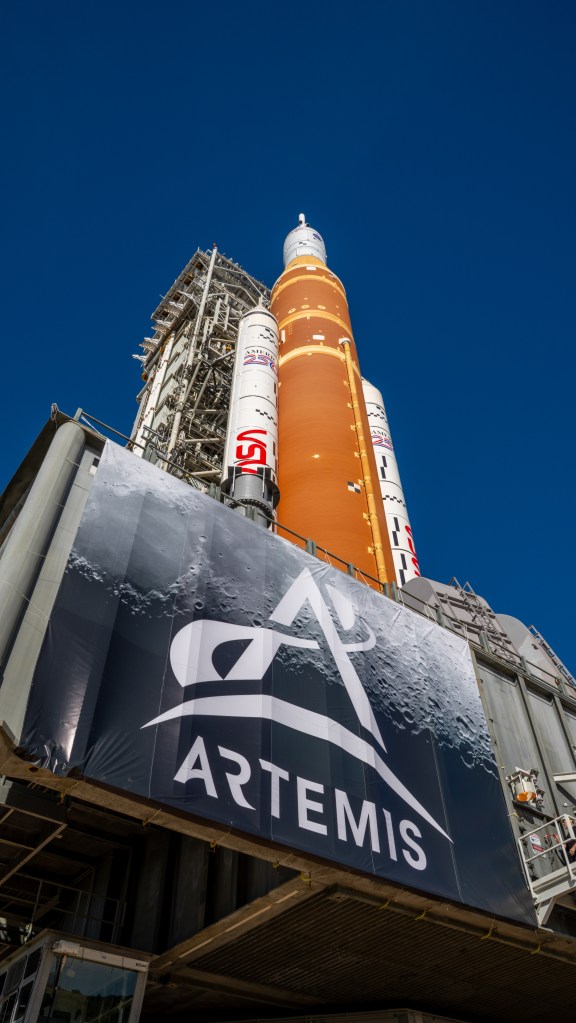
Christina Hammock Koch [pronunciation: “Cook”] was selected as a NASA astronaut in 2013. She served as flight engineer on the International Space Station (ISS) for Expedition 59, 60 and 61. Koch set a record for the longest single spaceflight by a woman with a total of 328 days in space and participated in the first all-female spacewalk. She served as Mission Specialist I of NASA’s Artemis II mission. The crew launched on NASA’s Space Launch System rocket at 6:35 p.m. EDT April 1, 2026 from Launch Pad 39B at the agency’s Kennedy Space Center in Florida. With 8.8 million pounds of thrust at liftoff, the American-built rocket propelled the crew inside the Orion spacecraft to space, delivering it to orbit with pinpoint accuracy. NASA astronauts Reid Wiseman, Victor Glover, and Christina Koch, and CSA (Canadian Space Agency) astronaut Jeremy Hansen splashed down at 8:07 p.m. EDT April 10, 2026 off the coast of San Diego, completing a nearly 10-day journey that took them 252,756 miles from home at their farthest distance from Earth.
Personal
Koch is a native of Grand Rapids, Michigan, grew up in Jacksonville, North Carolina and resided in Livingston, Montana when she was selected to join the Astronaut Corps. Growing up spending summers on her family’s farm in Michigan, she was instilled with a passion for hard work and challenges. Her hobbies include surfing, rock climbing, community service, running, yoga, backpacking, photography and travel.
Education
Koch attended North Carolina State University in Raleigh, North Carolina, where she earned Bachelor of Science degrees in electrical engineering and physics and a Master of Science degree in electrical engineering and studied abroad at the University of Ghana. She attended high school at the North Carolina School of Science and Math in Durham, North Carolina and White Oak High School in Jacksonville, North Carolina. She later received an Honorary PhD from North Carolina State University.
Experience
Koch’s experience prior to becoming an Astronaut spanned both space science instrument development and remote scientific field engineering. Her career began as an Electrical Engineer at NASA Goddard Space Flight Center (GSFC) where she contributed to instruments on several NASA space science missions. Koch then became a Research Associate in the United States Antarctic Program which included a yearlong stay with a winter-over at the Admunsen-Scott South Pole Station and season at Palmer Station. While in this role, she served as a member of the Firefighting and Search and Rescue Teams. Koch then returned to space science instrument development as an Electrical Engineer at the Johns Hopkins University Applied Physics Laboratory’s Space Department, where she contributed to instruments on missions including Juno and the Van Allen Probes. Koch then returned to remote scientific field work with tours at Palmer Station in Antarctica and Summit Station in Greenland. Next, joining the National Oceanic and Atmospheric Administration, she continued work at remote scientific bases, serving as a Field Engineer in Utqiagvik, Alaska and as Station Chief of the American Samoa Observatory. Throughout her career, she has done technical instructing, volunteer tutoring and educational outreach.
NASA Experience
Koch participated in the NASA Academy program in 2001 and worked as an Electrical Engineer at GSFC early in her career. She was selected in 2013 as one of eight members of the 21st NASA astronaut class and completed Astronaut Candidate training in 2015. In 2018, she was assigned to her first space flight, a long duration mission on the ISS. After her spaceflight, Koch served as Branch Chief of the Assigned Crew Branch in the Astronaut Office. She then went on a rotation as Assistant for Technical Integration for the Center Director at NASA’s Johnson Space Center. Koch served as mission specialist of NASA’s Artemis II mission.
Spaceflight Experience
Koch launched on March 14, 2019 from the Baikonur Cosmodrome on the Soyuz MS-12 spacecraft with Roscosmos Cosmonaut Alexey Ovchinin and NASA Astronaut Nick Hague. She returned to Earth on February 6, 2020 on the MS-13 Soyuz spacecraft with Roscosmos Cosmonaut Alexander Skvortsov and European Space Agency (ESA) Astronaut Luca Parmitano. Serving as a Flight Engineer on the ISS for Expeditions 59, 60 and 61, she and her crewmates contributed to hundreds of experiments in many kinds of science and technology development. Some of the scientific highlights from her missions include doing robotics for upgrades to the Alpha Magnetic Spectrometer, growing protein crystals for pharmaceutical research, and testing 3D biological printers in microgravity. Koch conducted six spacewalks, including the first three all women spacewalks, totaling 42 hours and 15 minutes.
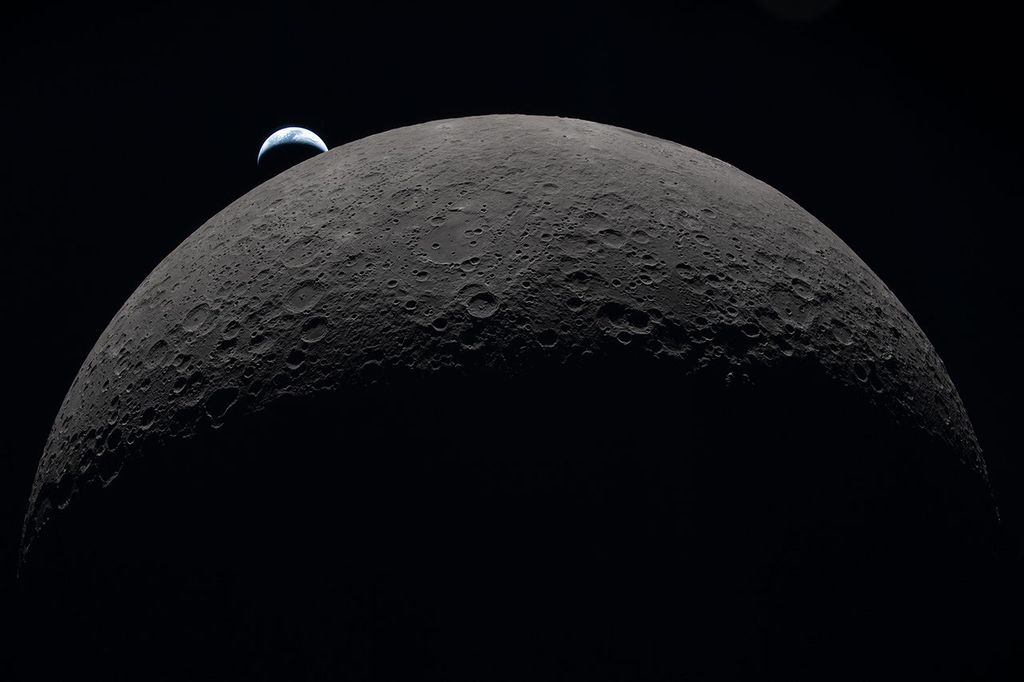
She then launched April1, 2026 from Kennedy Space Center in Florida on a Space Launch System rocket as part of the Artemis II mission. During the mission, the astronauts completed a historic lunar flyby, marking humanity’s return to the vicinity of the Moon for the first time in more than 50 years. The crew splashed down on April 10, 2026 off the coast of San Diego, completing a nearly 10-day journey that took them 252,756 miles from home at their farthest distance from Earth.
She has spent a total of 338 days in space across her two missions.
Awards/Honors
Neil Armstrong Award of Excellence, Astronaut Scholarship Foundation, 2020; Astronautics Engineer Award, National Space Club & Foundation, 2020; Global ATHENA Leadership Award, ATHENA International, 2020. NASA Group Achievement Award, NASA Juno Mission Jupiter Energetic Particle Detector Instrument, 2012; Johns Hopkins University Applied Physics Laboratory, Invention of the Year nominee, 2009; United States Congress Antarctic Service Medal with Winter-Over distinction, 2005; NASA Group Achievement Award, NASA Suzaku Mission X-ray Spectrometer, 2005.