







Significant announcements:
23rd November 2020
- Ved Chirayath was awarded the Charles S. Falkenberg Award of the American Geophysical Union – The Falkenberg Award recognizes: “. . . an early to mid-career scientist who has contributed to the quality of life, economic opportunities and stewardship of the planet through the use of Earth science information and to the public awareness of the importance of understanding our planet.”
Bell, R., and L. Myles (2020), Announcing the 2020 AGU Union medal, award, and prize recipients, Eos, 101, https://doi.org/10.1029/2020EO151573. Published on 11 November 2020. - The Airborne Sensor Facility (ASF) instrument team was highlighted for their achievements contributing the MASTER and PICARD payloads during the September/October 2020 “Western Diversity Time Series” flight campaign in California – Jack A. Kaye, Associate Director for the Earth Science Division praised the successful mission, a collaboration between JPL, AFRC, and Ames, in a letter to the AFRC center director David McBride on 17 Nov 2020.
- NASA Ames is in Stage 3 in the NASA Response Framework to pandemics – Staff are continuing work with adjustments in work style, focus and schedules due to the COVID-19 distancing protocols. ESPO-managed NASA airborne missions and other programs and projects at Ames are experiencing major schedule delays due to COVID-19. Ames Earth Science Division staff are focusing on data analysis, publications/proposals/reports writing, and computer-aided design work. The division is actively engaged with the directorate/center and with HQ on identifying mission-critical research and activities and is preparing return-to-onsite-work (RToW) implementation plans.
• The Sub-Mesoscale Ocean Dynamics Experiment (S-MODE) Earth Venture Suborbital-3 (EVS-3) investigation managed by ESPO, recently delayed from this fall until spring 2021, received approval to RToW from Ames (https://espo.nasa.gov/s-mode/content/S-MODE).
• Instrument payload development activities at Ames for the Asian Summer Monsoon Chemical and Climate Impact Project (ACCLIP) also received approval last week to proceed with RToW in preparation for the field campaign now planned for summer 2021 in South Korea. Teams are on center as of this week, preparing the laboratory and the COMA instrument for pressure and thermal testing, in anticipation of test flights on the NASA WB-57F research aircraft in spring 2021.
• The Investigation of Microphysics and Precipitation for Atlantic Coast-Threatening Snowstorms (IMPACTS) Earth Venture Suborbital-3 (EVS-3) investigation managed by ESPO received center RToW approval, signed by the Center Director on Thursday October 8th, 2020 (https://espo.nasa.gov/impacts/).
• The SCIFLI-Hayabusa Airborne Re-entry observation Campaign (SHARC) investigation managed by ESPO and operating out of Adelaide (Australia) to observe the re-entry of JAXA’s Hayabusa Sample Return Mission received center RToW approval, signed by the Center Director on Thursday 8 October 2020 (https://espo.nasa.gov/sharc/)
• The Airborne Sensor Facility (ASF) has submitted a RToW plan which is now under center review for approval, to ensure adequate mission-critical staffing for airborne field campaign support. (https://asapdata.arc.nasa.gov/)
• Several ARC Earth Science travelers are on trips or have completed trips to provide mission-critical support for SMD field deployments at AFRC-Palmdale, Dobbins Air Reserve Base in Georgia, and Adelaide, Australia. All non-essential/-critical travel is on hold.
- The ObseRvations of Aerosols above CLouds and their intEractionS project (ORACLES) held its closeout review (Key Decision Point F) meeting on 12 November 2020 – The ORACLES EVS-2 investigation, led by ARC on science and managed by ESPO, deployed to Namibia in 2016 and São Tomé in 2017/18. The review focused on science deliverables and programmatic factors. The review was a success and ORACLES was deemed ready for closeout. The official project end date is 31 January 2021. The SMD Earth Science Division director Karen Saint Germain, the ORACLES PIs and project managers, and several NASA HQ program officers participated.
16th November 2020
- Atmospheric Science Branch Chief, Dr. Charles K. Gatebe, started at Ames on 9 November 2020 – Dr. Gatebe, originally from Kenya, comes to us from the Goddard Space Flight Center, where he was an Associate Director with the Universities Space Research Association (USRA). He is the principal investigator of NASA’s airborne Cloud Absorption Radiometer (CAR), a member of the Surface Biology and Geology Designated Observable study team, and the 2016-2017 SnowEx Deputy Project Scientist. He was recently awarded a Science Activation grant over $6.7 M, for the Student Airborne Science Activation (SaSa) project for minority-serving institutions, which will start in 2021. Dr. Gatebe is the recipient of several prestigious awards including the Young Scientists Award by the World Meteorological Organization (WMO) in 2000 for his Ph.D. dissertation, and the NASA Robert H. Goddard Award for Outreach (2013) for founding, implementing, and leading a spectacularly successful “Maniac” series of talks at NASA/GSFC. He holds a Ph.D. degree in atmospheric physics from the University of Witwatersrand, Johannesburg, South Africa (1999).
Please visit the StoryCorp website below to learn more about Dr. Gatebe:
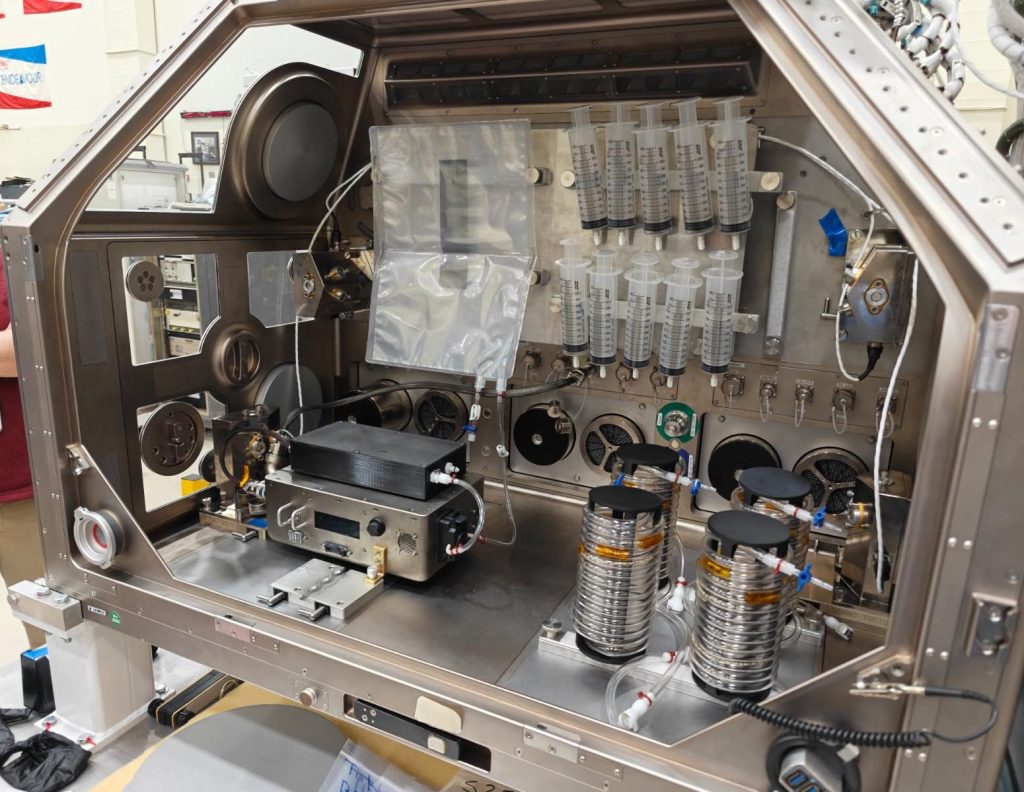
https://archive.storycorps.org/interviews/charles-gatebe-and-kassie-perlongo/ - A patent has been issued for the synthetic biomaterials system developed by Diana Gentry (Biospheric Science Branch) and her team – This is part of research into novel approaches to reducing mission upmass requirements. (U.S. Patent No. 10,815,474; System for the 3D Construction of Biologically Derived Materials, Structures, and Parts.)
- NASA Ames is in Stage 3 in the NASA Response Framework to pandemics – Staff are continuing work with adjustments in work style, focus and schedules due to the COVID-19 distancing protocols. ESPO-managed NASA airborne missions and other programs and projects at Ames are experiencing major schedule delays due to COVID-19. Ames Earth Science Division staff are focusing on data analysis, publications/proposals/reports writing, and computer-aided design work. The division is actively engaged with the directorate/center and with HQ on identifying mission-critical research and activities and is preparing return-to-onsite-work (RToW) implementation plans.
• The Sub-Mesoscale Ocean Dynamics Experiment (S-MODE) Earth Venture Suborbital-3 (EVS-3) investigation managed by ESPO, recently delayed from this fall until spring 2021, received approval to RToW from Ames (https://espo.nasa.gov/s-mode/content/S-MODE).
• Instrument payload development activities at Ames for the Asian Summer Monsoon Chemical and Climate Impact Project (ACCLIP) also received approval last week to proceed with RToW in preparation for the field campaign now planned for summer 2021 in South Korea. Teams are on center as of this week, preparing the laboratory and the COMA instrument for pressure and thermal testing, in anticipation of test flights on the NASA WB-57F research aircraft in spring 2021.
• The Investigation of Microphysics and Precipitation for Atlantic Coast-Threatening Snowstorms (IMPACTS) Earth Venture Suborbital-3 (EVS-3) investigation managed by ESPO received center RToW approval, signed by the Center Director on Thursday October 8th, 2020 (https://espo.nasa.gov/impacts/).
• The SCIFLI-Hayabusa Airborne Re-entry observation Campaign (SHARC) investigation managed by ESPO and operating out of Adelaide (Australia) to observe the re-entry of JAXA’s Hayabusa Sample Return Mission received center RToW approval, signed by the Center Director on Thursday 8 October 2020 (https://espo.nasa.gov/sharc/) - The Indigenous Peoples Capacity Building Initiative, led by Cindy Schmidt and Amber McCullum, in partnership with the United Tribes Technical College just completed the all-virtual Introduction to Remote Sensing for Tribal Lands training series, held each Tuesday and Thursday in October. Each week, it focused on a different tribal region in the U.S. with guest speakers from the Navajo Nation, the Sault Ste. Marie Band of Chippewa Indians, the Rosebud Sioux tribe, and the Tulalip Tribes. The training had 276 registrants, from a variety of organizations (130 academic, 77 tribal, 40 government, 19 private, and 10 NGO). 100% of the survey respondents said the course either met or exceeded their expectations. One respondent noted: “Cynthia and Amber have excellent presentation skills, knowledge and through explanation on each of the webinar. Thank you both and for NASA to make this program possible for real world application!”, and another respondent mentioned “ virtually training is so good to get involved without physically in the united states, this means a lot to our tribe […] thank you so much for offering this, the course explain very well and it is very useful in real-life setting particularly for tribal land management!”
Link: https://appliedsciences.nasa.gov/join-mission/training/english/introduction-remote-sensing-tribal-lands - A new NASA Post-doctoral (NPP) scientist, Diane Huebner from the University of Alaska Fairbanks, has started to work in Code SGE on 1 November 2020. The NASA mentor is Christopher Potter and the NPP research project is titled “Assessing resilience in Alaskan boreal forest to climate-wildfire interactions”. The summary of this project is as follows:
Alaska’s boreal forest (taiga) is facing unprecedented challenges under rapid anthropogenic climate warming, including increasingly severe fires, droughts, floods, permafrost changes related to thaw-subsidence (thermokarst), pests and diseases, that may destabilize its function as a global carbon sink. To date there have been few studies using a combination of ground-truthing (GT) and remote spectral imaging to make an assessment of the resilience of boreal forest disturbed by recent wildfires. Using GT of recent (2017-2019) AVIRIS-NG images collected by the NASA ABoVE Terrestrial Ecology program, we will assess ecosystem structure and function of five recently burned sites (2001-2013) in Alaska’s interior near the city of Fairbanks, by measuring five characteristics of resilience identified in the literature: 1) postfire tree seedling recruitment, 2) understory cover, 3) thermokarst, 4) pest/disease/boreal browning, and 5) annual woody tree growth. 28 paired plots burned and unburned (1/30 ha radius) nested at three spatial scales will be used (4-12 plots site-1) for GT measurements in AVIRIS flight paths to quantify overall ecosystem structure and function. We expect this study to reveal important relationships between prefire and post-fire stand resilience characteristics that can improve predictive power of current climate change models.
9th November 2020
- NASA Ames is in Stage 3 in the NASA Response Framework to pandemics – Staff are continuing work with adjustments in work style, focus and schedules due to the COVID-19 distancing protocols. ESPO-managed NASA airborne missions and other programs and projects at Ames are experiencing major schedule delays due to COVID-19. Ames Earth Science Division staff are focusing on data analysis, publications/proposals/reports writing, and computer-aided design work. The division is actively engaged with the directorate/center and with HQ on identifying mission-critical research and activities and is preparing return-to-onsite-work (RToW) implementation plans.
• The Sub-Mesoscale Ocean Dynamics Experiment (S-MODE) Earth Venture Suborbital-3 (EVS-3) investigation managed by ESPO, recently delayed from this fall until spring 2021, received approval to RToW from Ames (https://espo.nasa.gov/s-mode/content/S-MODE).
• Instrument payload development activities at Ames for the Asian Summer Monsoon Chemical and Climate Impact Project (ACCLIP) also received approval last week to proceed with RToW in preparation for the field campaign now planned for summer 2021 in South Korea. Teams are on center as of this week, preparing the laboratory and the COMA instrument for pressure and thermal testing, in anticipation of test flights on the NASA WB-57F research aircraft in spring 2021.
• The Investigation of Microphysics and Precipitation for Atlantic Coast-Threatening Snowstorms (IMPACTS) Earth Venture Suborbital-3 (EVS-3) investigation managed by ESPO received center RToW approval, signed by the Center Director on Thursday October 8th, 2020 (https://espo.nasa.gov/impacts/).
• The SCIFLI-Hayabusa Airborne Re-entry observation Campaign (SHARC) investigation managed by ESPO and operating out of Adelaide (Australia) to observe the re-entry of JAXA’s Hayabusa Sample Return Mission received center RToW approval, signed by the Center Director on Thursday 8 October 2020 (https://espo.nasa.gov/sharc/)
2nd November 2020
- The Earth Science Project Office (ESPO) hosted the 2020 DCOTSS (Dynamics and Chemistry of the Summer Stratosphere) Science Team Meeting. The two-day meeting on 19-20 October 2020 was hosted virtually using WebEx. This meeting was originally planned to be held at Texas A&M University in College Station, TX, the home institution of the DCOTSS PI, Ken Bowman. The meeting included 41 presentations — a mix of short 5-minutes instrument updates and 28 individual talks. The two days were well attended by a total of 74 persons. Managed by ESPO, the DCOTSS investigation is an Earth Venture Suborbital-3 investigation examining the chemical and dynamical impacts of intense thunderstorms over the U.S. on the climatically-relevant composition of the summertime stratosphere.
Link: https://espo.nasa.gov/dcotss/content/DCOTSS_2020_STM_Virtual_ - The NASA Airborne Sciences Program just published its Fall 2020 biannual Newsletter – The Airborne Sciences Program (ASP) has a significant footprint in the Ames Earth Science Division through the Earth Science Project Office (ESPO), the Airborne Science management office (Matt Fladeland), and the Airborne Sensor Facility (ASF). The newsletter reports on staffing, current mission status, development and collaborative or SBIR activities, support program updates (Mission Tools Suite and Science Operations Flight Request System, both at Ames), and platform capabilities.
Link: https://airbornescience.nasa.gov/sites/default/files/documents/ASP_Fall_2020_Newsletter.pdf - NASA Ames is in Stage 3 in the NASA Response Framework to pandemics – Staff are continuing work with adjustments in work style, focus and schedules due to the COVID-19 distancing protocols. ESPO-managed NASA airborne missions and other programs and projects at Ames are experiencing major schedule delays due to COVID-19. Ames Earth Science Division staff are focusing on data analysis, publications/proposals/reports writing, and computer-aided design work. The division is actively engaged with the directorate/center and with HQ on identifying mission-critical research and activities and is preparing return-to-onsite-work (RToW) implementation plans.
• The Sub-Mesoscale Ocean Dynamics Experiment (S-MODE) Earth Venture Suborbital-3 (EVS-3) investigation managed by ESPO, recently delayed from this fall until spring 2021, received approval to RToW from Ames (https://espo.nasa.gov/s-mode/content/S-MODE).
• Instrument payload development activities at Ames for the Asian Summer Monsoon Chemical and Climate Impact Project (ACCLIP) also received approval last week to proceed with RToW in preparation for the field campaign now planned for summer 2021 in South Korea. Teams are on center as of this week, preparing the laboratory and the COMA instrument for pressure and thermal testing, in anticipation of test flights on the NASA WB-57F research aircraft in spring 2021.
• The Investigation of Microphysics and Precipitation for Atlantic Coast-Threatening Snowstorms (IMPACTS) Earth Venture Suborbital-3 (EVS-3) investigation managed by ESPO received center RToW approval, signed by the Center Director on Thursday October 8th, 2020 (https://espo.nasa.gov/impacts/).
• The SCIFLI-Hayabusa Airborne Re-entry observation Campaign (SHARC) investigation managed by ESPO and operating out of Adelaide (Australia) to observe the re-entry of JAXA’s Hayabusa Sample Return Mission received center RToW approval, signed by the Center Director on Thursday 8 October 2020 (https://espo.nasa.gov/sharc/) - Kassandra Perlongo interviewed Meloë Kacenelenbogen for STORYCORPS on 15 October 2020 – In this interview, Meloë Kacenelenbogen talks about her expertise in ‘aerosols,’ suspended particles in the atmosphere. These small particulates can affect air quality and human health and can also impact the Earth’s radiation balance. We also discuss why she decided to move from fluid mechanics to environmental science, challenges and opportunities she has encountered, and how studying atmospheric science can help inform us about the Earth’s health and shifting climate.
Link: https://archive.storycorps.org/interviews/meloe-kacenelenbogen-and-kassie-perlongo/ - Kassandra Perlongo highlighted her latest interview that she conducted with Christopher Potter on 24 October 2020 entitled “Measuring global change from satellites. An interview with Chris Potter.” – Chris Potter is a Research Scientist in Earth Science at the NASA Ames Research Center. In this interview, we discuss his research that is part of the collective project, the rapid response and novel research in earth science, which explores connections between COVID-19 and the environment. We also chat about field campaigns and working as a scientist at NASA Ames.
Link: https://archive.storycorps.org/interviews/kassie-perlongo-and-chris-potter-2/