



















This article is from the 2025 Technical Update.
The NESC has invested significant time and resources to better understand composite overwrapped pressure vessels (COPV) performance and more importantly, how these complex, high-pressure storage systems can fail. These vessels, which store high pressure propulsion and life-support system fluids on launch vehicles and spacecraft, are ubiquitous at NASA, and failures have the potential to be catastrophic.
This year the NESC finalized work on a set of guidelines intended for use by NASA civil servants and support contractors in their development or assessment of damage-tolerance demonstration data for COPVs. These guidelines are based on the NESC’s experience in assessing agency-wide COPV applications and compiling the best practices for complying with the damage-tolerance requirements of AIAA S-081, the standard for COPVs used in human and robotic spaceflight, and NASA-STD-5019, Fracture Control Requirements for Spaceflight Hardware.
Previously referred to as “safe-life,” damage tolerance life assumes detectable cracks exist before service and demonstrates that such cracks, in worst-case locations and orientations, will not grow to failure over the service life. A 4x life factor is applied, requiring that cracks do not reach failure (leakage or unstable growth) within four times the expected service cycles.
These guidelines are meant to support NASA personnel in applying S-081 requirements and also to clarify areas that historically have had varied interpretation. And by leveraging NESC assessments where approaches to damage tolerance were found to be unconservative, the guidelines offer best practices for minimizing risk based on supporting data—and do so without introducing new standards. The guidelines touch on numerous aspects of damage tolerance life including:
- COPV mechanics and model correlation,
- Identifying worst case locations for damage tolerance,
- Nondestructive evaluation (NDE),
- Addressing crack aspect ratios,
- Defining load spectra,
- Addressing autofrettage crack growth,
- Performing damage-tolerance life demonstration by analysis using a crack-growth analysis software like NASGRO,
- Performing damage-tolerance life by coupon or vessel testing, and
- Addressing sustained-load crack growth and environmentally assisted cracking.
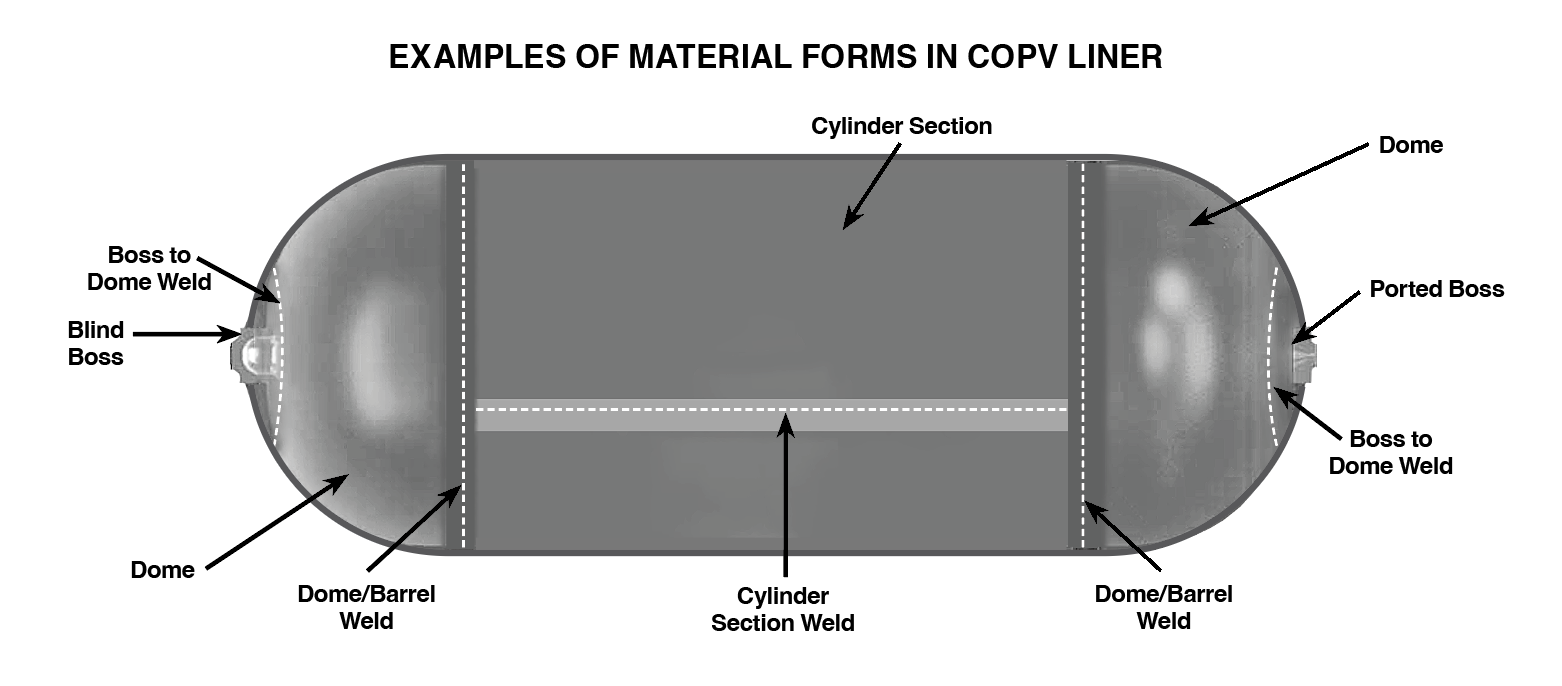
In determining the worst-case locations for damage tolerance evaluation, the guidelines offer a method for evaluating the contributing factors—stress/strain, material properties, thick-ness, and initial crack size. The identified regions show different liner material forms and welds, and within each form, the initial crack size based on the NDE method used, the minimum thickness, and the peak stress/strain level are determined for that form. The guidelines then provide best practices for addressing damage tolerance with each material form and worst-case location in the COPV.