























Week Wraps with Cargo Packing, Tech Research as Crew-12 Discusses Mission
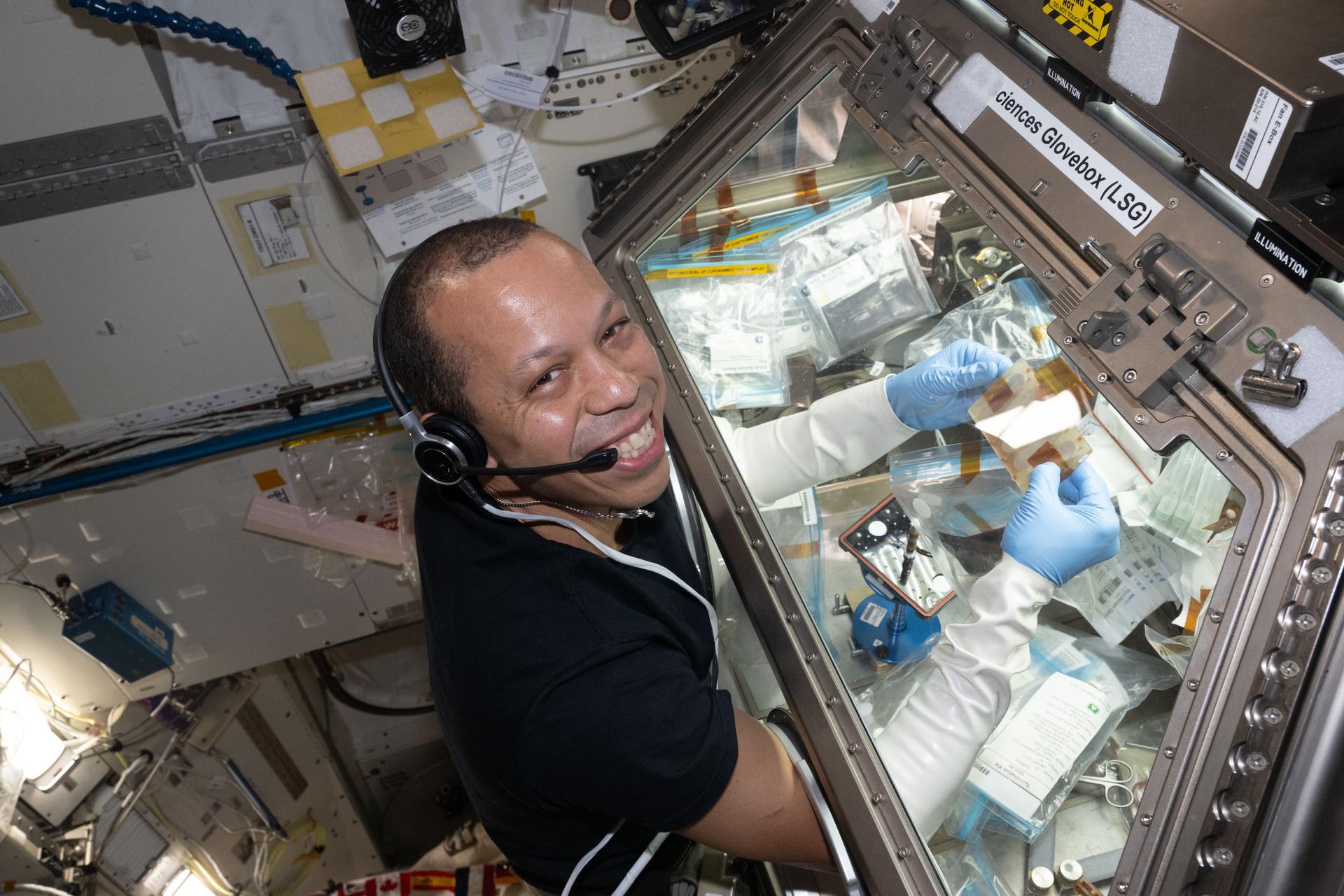
The Expedition 74 trio wrapped up the week packing cargo for return to Earth and exploring artificial intelligence to benefit crew operations. Earth observations and lab gear maintenance rounded out the shift aboard the International Space Station on Friday.
NASA Flight Engineer Chris Williams ended his shift on Friday loading gear inside a SpaceX Dragon for return to Earth next month. Williams, with assistance from station Commander Sergey Kud-Sverchkov of Roscosmos, has begun packing some of the completed experiments and their associated research samples, as well as used hardware and trash, inside Dragon for retrieval and analysis on the ground. Dragon delivered a host of science experiments, crew supplies, and more on August 25, 2025.
Williams spent the first half of his shift working in the Tranquility module servicing a variety of life support systems. He first swapped out orbital plumbing gear that helps recycle wastewater aboard the orbital outpost. Next, he cleaned the ventilation system inside the Harmony module’s overhead crew quarters then measured the airflow from Harmony into the Destiny laboratory module to ensure a safe breathing environment.
Kud-Sverchkov, on his second spaceflight, worked on a pair of different experiments, the first one documenting the effects of natural disasters across the Earth’s surface, and the second exploring plasma physics. He pointed a camera out different windows in the Zvezda service module and photographed landmarks near water bodies and mountains from northwest Africa to eastern Europe. Next, Kud-Sverchkov studied procedures for the upcoming Plasma Kristall-4 physics investigation that explores complex plasmas possibly advancing spacecraft designs, leading to a better understanding of planet formation, and improving fundamental physics research.
Roscosmos Flight Engineer Sergei Mikaev uninstalled Earth observation gear completing an overnight automated photography session that captured multi-spectral imagery of wildfires from Africa to Southeast Asia during the crew’s sleep session. Next, Mikaev configured data management and control hardware that supports experiment platforms from materials research to space physics, and artificial intelligence systems. Finally, the first-time space flyer turned his attention to another artificial intelligence study studying tools to convert speech-to-text and improve data handling and communications between the crew and ground controllers. Researchers seek to use the new technology to speed up and increase the accuracy of crew documentation benefitting operations aboard spacecraft.
The four members representing NASA’s SpaceX Crew-12 mission discussed their upcoming flight to the space station during a Crew News Conference on YouTube. Commander Jessica Meir and Pilot Jack Hathaway, both from NASA, and Mission Specialists Sophie Adenot of ESA (European Space Agency) and Andrey Fedyaev of Roscosmos are targeting a launch on Feb. 11 to begin a space research mission aboard the orbital laboratory. Mission managers from NASA, ESA, and SpaceX also discussed the research objectives of Crew-12 during the Mission Overview Conference today.
Learn more about station activities by following the space station blog, @space_station on X, as well as the ISS Facebook and ISS Instagram accounts.
Get the latest from NASA delivered every week. Subscribe here.
