
























Life Science Fills Day as Expedition 74 Nears Thursday Spacewalk
Exercise research and biomedical science promoting healthy humans on and off Earth topped the schedule aboard the International Space Station on Tuesday. Meanwhile, two NASA astronauts are preparing for the year’s first spacewalk, scheduled to begin Thursday.
Expedition 74 Commander Mike Fincke of NASA spent Tuesday exploring how exercising in weightlessness affects a crew member’s musculoskeletal system. Fincke first set up specialized video gear and calibrated the hardware to monitor how his body responds to working out on the Tranquility module’s advanced resistive exercise device (ARED). Next, he performed a series of squats on the ARED—a device that mimics free weights on Earth—as researchers on the ground monitored. Insights from this study will allow doctors to adjust and improve spaceflight workouts, ensuring astronauts maximize muscle and bone health. Potential Earth benefits include improving athletic training and advancing recovery and rehabilitation techniques.
NASA Flight Engineers Zena Cardman and Chris Williams partnered in the Columbus laboratory module for a pair of eye checks for human research. Cardman led both checks, first operating hardware that sent light signals to electrodes attached around Williams’ eyes. Biomedical software then recorded how his retinas and the cells in the back of his eyes responded to the flashes of light. For the second eye exam, Cardman operated medical imaging gear that Williams peered into for a different look at his retina, cornea, and lens. The downlinked data will help researchers understand and treat potential space-caused changes to eye anatomy and function.
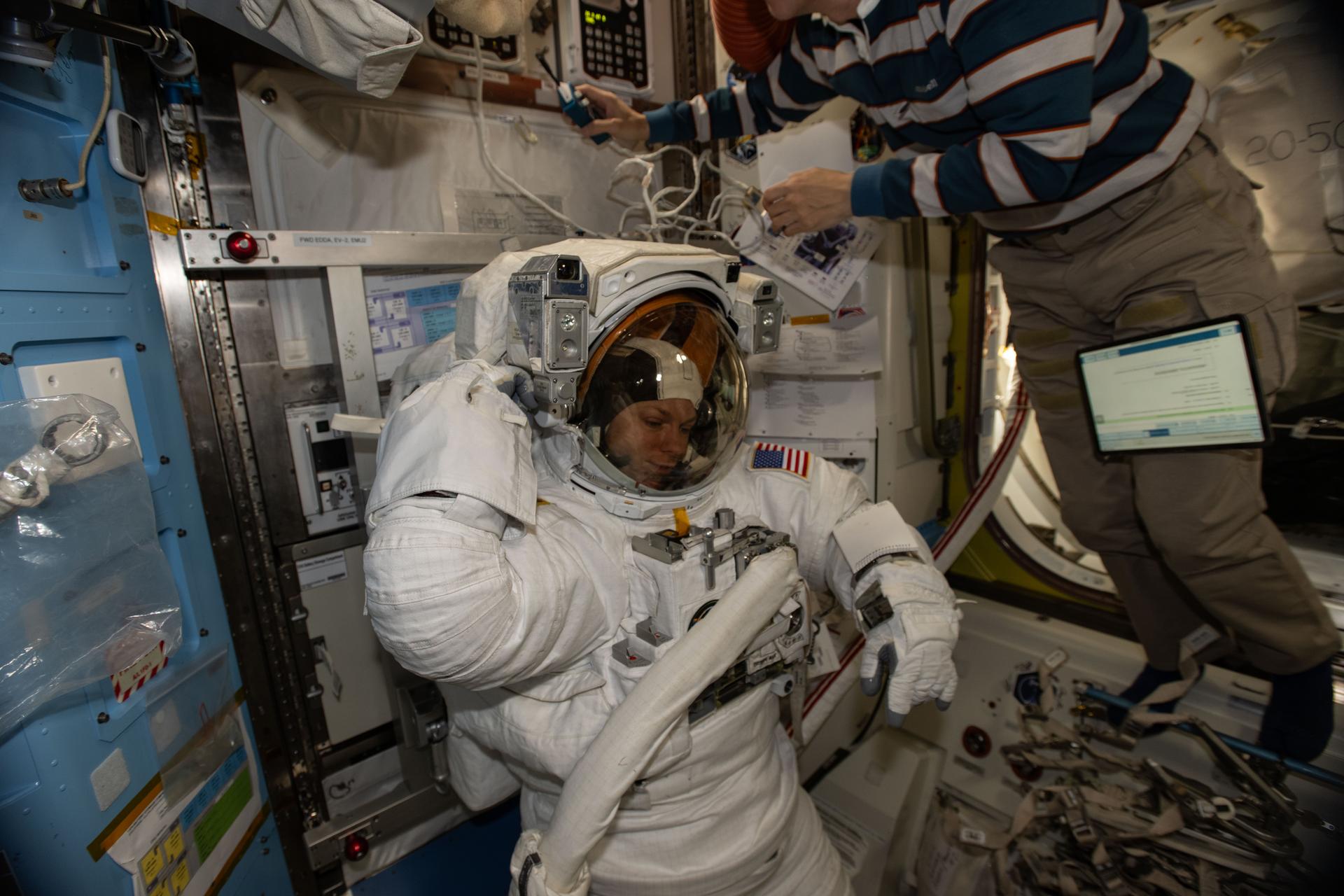
Fincke and Cardman are scheduled to begin a six-and-a-half-hour spacewalk at 8 a.m. EST on Thursday, with live NASA+ coverage starting at 6:30 a.m. The duo will finalize their preparations on Wednesday by organizing tools, checking spacesuits, and reviewing spacewalk procedures with assistance from Williams and Flight Engineer Kimiya Yui of JAXA (Japan Aerospace Exploration Agency). During the spacewalk, they will install a modification kit and route cables to set up the station’s port-side truss structure for a future roll-out solar array. NASA managers previewed on X Thursday’s spacewalk and a second spacewalk planned for Jan. 15.
Yui began his day Tuesday practicing robotic maneuvers planned for the Jan. 15 spacewalk, which will involve installing and relocating hardware on the orbital outpost. Afterward, Yui collected water samples from an oxygen generator for ground analysis, then cleaned a filter and screen on the life support device.
Roscosmos Flight Engineers Sergey Kud-Sverchkov and Sergei Mikaev studied how living and working in microgravity affects the respiratory system. The cosmonauts took turns wearing an acoustic sensor around their tracheas to record sounds as they forcefully exhaled. Results will help doctors and crews monitor the respiratory system and provide early signs of possible space-caused breathing disorders.
Roscosmos Flight Engineer Oleg Platonov started his shift photographing his cosmonaut crewmates as they conducted lung research activities. Next, he cleaned, inspected, and photographed fans and ventilation system components in the Nauka science module.
Learn more about station activities by following the space station blog, @space_station on X, as well as the ISS Facebook and ISS Instagram accounts.
Get the latest from NASA delivered every week. Subscribe here.
