






Significant announcements:
27th February 2020
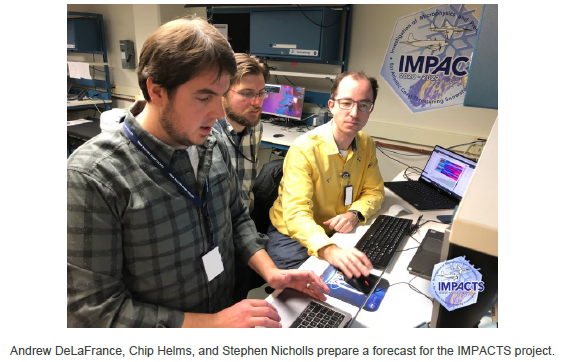
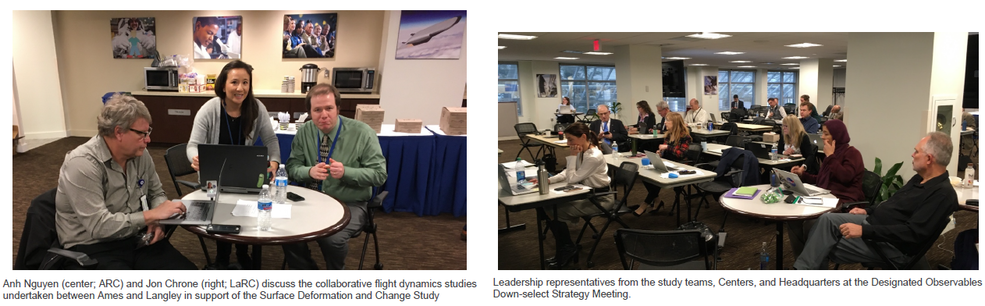
- IMPACTS (Investigation of Microphysics and Precipitation for Atlantic Coast-Threatening Snowstorms) – The chief objective of this Earth Venture Suborbital-3 (EVS-3) investigation managed by ESPO is to improve predictive capability for East Coast snowstorms. IMPACTS completed two more flights this week using the NASA P-3. These flights sampled the warm sector of a low-pressure system over the North Atlantic coast, and a strong system with elevated convection and wave features over North Carolina. This second system dropped 1-5 inches in the study area. On 25 February 2020 both the ER-2 and P-3 will be sampling a developing system over the Northern Illinois area. The P-3 flew to Wright-Patterson AFB on Monday to be better positioned to sample this storm.
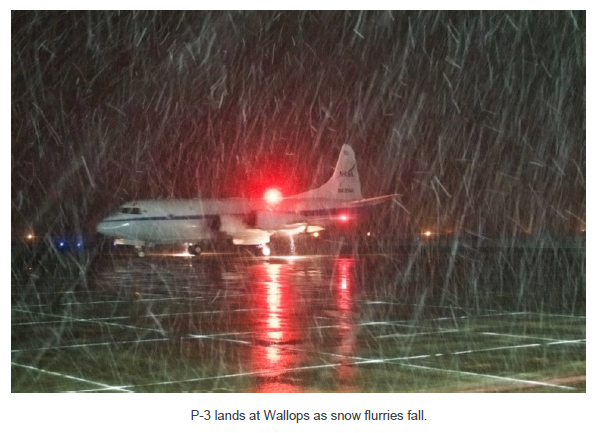
- Designated Observables Down-select Strategy Meeting – Ryan Spackman, Ian Brosnan, and Anh Nguyen attended the Designated Observables Down-select Strategy Meeting at NASA Headquarters on February 26th. The purpose of the meeting was for HQ to define for the study teams how the architectures presented to HQ would be winnowed to a final selection and discuss what products the teams should prepare for HQ. The first team to submit architectures will be The Surface Biology and Geology team at the end of FY20.
21st February 2020
- IMPACTS (Investigation of Microphysics and Precipitation for Atlantic Coast-Threatening Snowstorms) – The P-3 flew an additional two flights this week for IMPACTS. The first flight took place very early on February 13 over the state of New York and lasted 6.7 hours. The second, over New England, was flown on February 18 and lasted 5 hours. The P-3 is prepping today, February 20, to fly a winter storm system over North Carolina and southern Virginia.
- Don Sullivan appointed as Chairman of INCITS/L1, Geographic Information Systems (GIS) Donald Sullivan was appointed for his first term as Chairman of INCITS/L1, GIS, by majority vote of INCITS. Donald Sullivan’s first term begins immediately and will expire in February 2023. INCITS is the InterNational Committee for Information Technology Standards. The work of L1, GIS consists of adopting or adapting information technology standards and developing digital geographic data standards. This technical committee is the U.S. Technical Advisory Group (TAG) to the International Organization for Standardization (ISO) Technical Committee (TC) 211 (ISO/TC 211). ISO/TC 211 – Geographic information/Geomatics aims to establish a structured set of standards for information concerning objects or phenomena that are directly or indirectly associated with a location relative to the Earth. Donald Sullivan will be the head of the U.S. Delegation to ISO/TC 211 meetings. Link: http://www.incits.org
- NASA Earth Observatory features Ames’ NASA Earth Exchange review paper in Nature. A recent review paper in Nature Reviews which including Ames Earth Science authors Rama Nemani and Taejin Park from the NASA Earth Exchange (NEX) has been featured on NASA’s Earth Observatory: Link: https://earthobservatory.nasa.gov/images/146296/global-green-up-slows-warming
14th February 2020
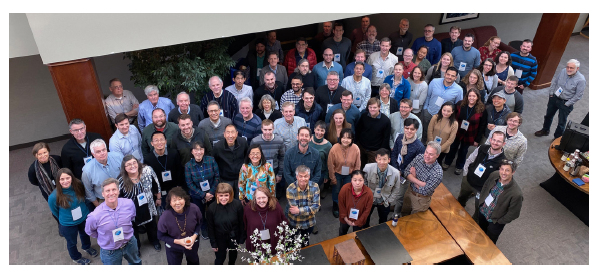
- ACCLIP (Asian Summer Monsoon Chemical and Climate Impact Project), 4-6 February 2020 – Rei Ueyama (meteorological forecasting), Jim Podolske and Laura Iraci (COMA instrument), Paul Bui (MMS), Jhony Zavaleta (ESPO), and Ryan Spackman (Division Chief) returned from a very productive ACCLIP Science Team meeting in Boulder last week. Ames has several important roles in this mission including meteorological forecasting for daily flight planning, in situ trace gas and meteorological measurements on board the NASA WB-57F aircraft, and campaign project management. ACCLIP is a joint NASA/NSF campaign with the NASA WB-57F and NSF/NCAR Gulfstream-V aircrafts to investigate the impacts of Asian pollution on global chemistry and climate associated with the Asian summer monsoon circulation to be based from Okinawa, Japan in August 2020.
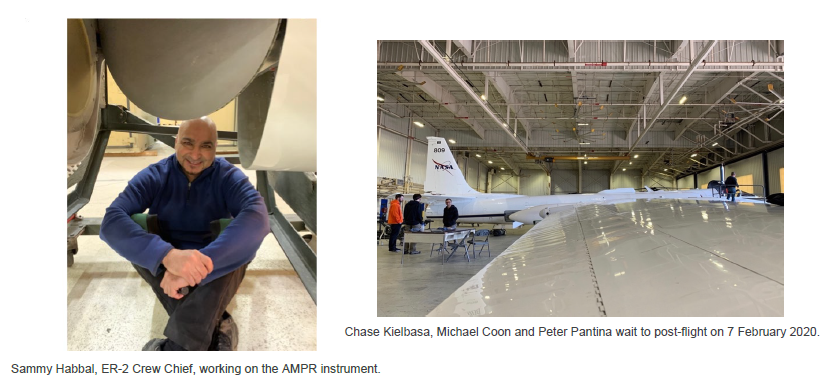
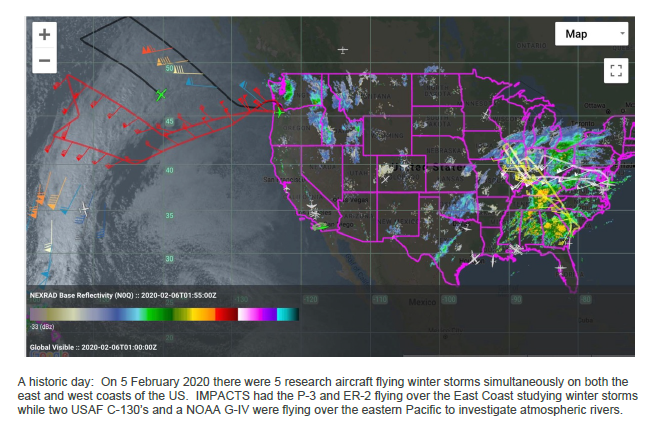
- IMPACTS (Investigation of Microphysics and Precipitation for Atlantic Coast-Threatening Snowstorms) – IMPACTS logged an additional 27.1 flight hours this week. The P-3 and ER-2 flew IMPACTS flight #4 over a winter storm system in the Midwest (Indiana, Illinois, Ohio) on 5 February 2020. They flew again the morning of 7 February 2020 over the state of New York. The chief objective of this Earth Venture Suborbital-3 (EVS-3) investigation managed by ESPO is to improve predictive capability for East Coast snowstorms. Link: https://espo.nasa.gov/impacts
7th February 2020
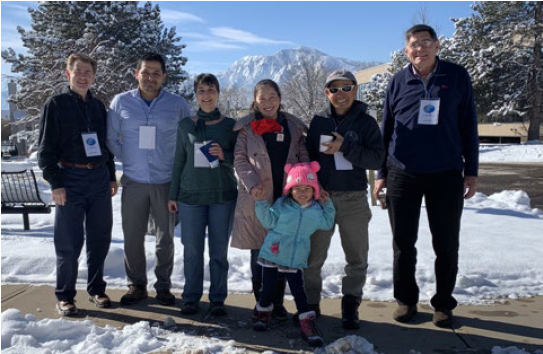
- ACCLIP (Asian Summer Monsoon Chemical and Climate Impact Project) – Rei Ueyama (meteorological forecasting), Jim Podolske and Laura Iraci (COMA instrument), Paul Bui (MMS), Jhony Zavaleta (ESPO), and Ryan Spackman (Division Chief) are attending the science team meeting at National Center for Atmospheric Research (NCAR) in Boulder, CO. Ames has several important roles in this mission including meteorological forecasting for daily flight planning, in situ trace gas and meteorological measurements on board the NASA WB-57F aircraft, and campaign project management. ACCLIP is a joint NASA/NSF campaign with the NASA WB-57F and NSF/NCAR Gulfstream-V aircrafts to investigate the impacts of Asian pollution on global chemistry and climate associated with the Asian summer monsoon circulation to be based from Okinawa, Japan in August 2020.
- IMPACTS (Investigation of Microphysics and Precipitation for Atlantic Coast-Threatening Snowstorms) – The NOAA P-3 and ER-2 flew IMPACTS flight #3 in the early morning of 1 February 2020 over a developing low pressure system off the coast of North Carolina. The project achieved an underflight of the GPM (Global Precipitation Measurement) satellite, with GOES-16 Mesoscale-2 Sector images available. Later this week, the project may fly science flights over northern Pennsylvania and southern New York, across an elongated trough and precipitation region. The chief objective of this Earth Venture Suborbital-3 (EVS-3) investigation managed by ESPO is to improve predictive capability for East Coast snowstorms. Link: https://espo.nasa.gov/impacts