










Debris Protection
Orbital debris protection involves conducting hypervelocity impact tests to assess the risk presented by orbital debris to operating spacecraft and developing new materials and new designs to provide better protection from orbital debris with less weight penalty. The data from this work provides the link between the environment defined by the models and the risk presented by that environment to operating spacecraft. Based on this research, recommendations are then presented on design and operations procedures to reduce the risk as required. This data also helps in the analysis and interpretation of impact features on returned spacecraft surfaces. The primary facility for this research is the Hypervelocity Impact Technology Facility (HITF) at the Johnson Space Center in Houston, although there are other facilities at JSC, New Mexico, and various DOD laboratories.
Learn More
Hypervelocity Impact Technology Facility
The dots in the above animation represent actual cataloged objects (payloads and debris) in orbit around Earth. The cataloged objects are generally 4 inches (10 cm) or larger, but there are many more debris objects too small to be tracked which pose a threat to operational spacecraft. Relative distances and rates are shown to scale, but the orbiting objects themselves are greatly exaggerated in size. The objects would be much too small to be visible if drawn to scale.
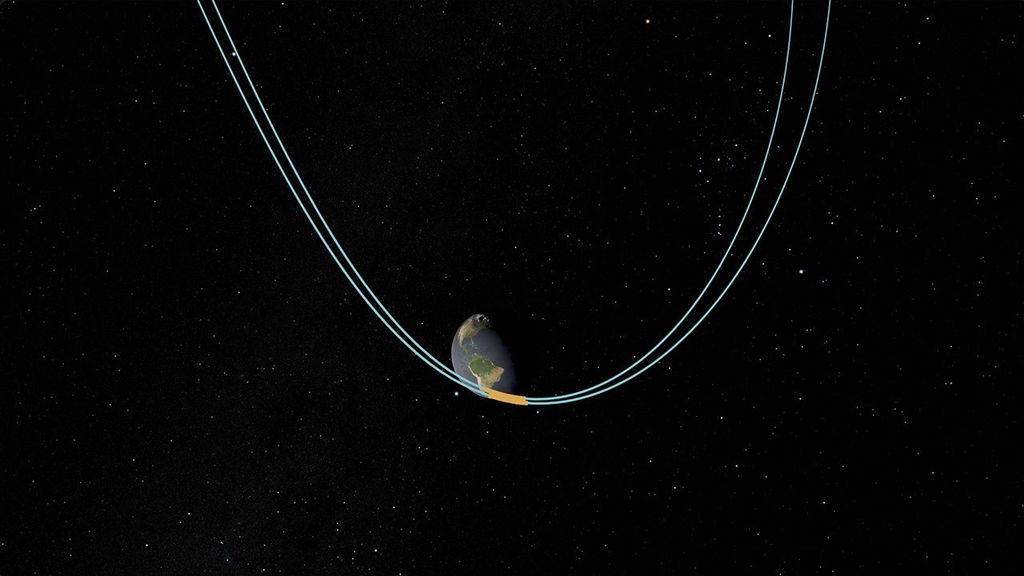
The animation begins high over Earth’s North Pole. The ring of objects in geosynchronous Earth orbit (GEO) is clearly visible and Earth is hidden by a swarm of dots. The viewpoint approaches the North Pole, then rolls down to a lower inclination before zooming in toward lower orbits. An arc of GEO objects is visible in the background. The view then pans upward over the North Pole and back down to the equator. The point of view next moves to the South Pole, zooms out to a high altitude, and rotates back to the North Pole.