











Audience
Educators, Students
Grade Levels
Grades 5-8
Subject
Technology
Type
Hands-on Activities, Lesson Plans / Activities
Advanced Air Mobility (AAM) is a new future for air transportation where both people and packages will take to the air on smaller and autonomous (self-flying) aircraft. These drones will be used as air taxis and package delivery vehicles, provide emergency response, perform rescue missions and medical drops, conduct aerial photography, and much more.
These small aircraft will use onboard sensors to monitor flight conditions and create a digital 3D roadmap of the sky to ensure safety. Aircraft will also use programs such as Safeguard, which keeps drones from traveling outside their scheduled flight paths by setting up a geofence—an invisible fence around a specific area. There are many potential benefits and challenges of new sensing technology, and NASA and other AAM researchers want to ensure their new sophisticated systems are sustainable, secure, and safe.
Introduction
In this activity, students will gain a better understanding of the types of sensors installed on drones, how the sensors work, any advantages or limitations of the sensors, and how a drone’s sensors can provide benefits to society while improving safety features for sharing the airspace with other aircraft. Students will imagine innovative solutions to real-world problems facing their local communities and demonstrate how those problems could be solved by designing a sensor.
 Time Needed: 90-120 Minutes
 Materials List
Ensure that students have:
-
- Pencils
- Computers with internet access
- Simple sensors (smoke detector, thermometer, ultraviolet (UV) beads)
- Materials to showcase student ideas (will differ for each student)
 Safety
-
- Students should be aware of their surroundings and move carefully throughout the room when viewing other teams’ work.
- Before using sharp instruments, discuss safety issues surrounding proper use.

Activity Procedure
Discuss
-
- Share the “Use Household Supplies to Make Sensors with NASA” video.
- Share with students some examples of simple sensors or instances of sensors within the classroom (e.g., smoke detector, lights activated by a motion sensor, or an infrared sensor on a TV).
- Have students discuss the following questions as a group:
-
-
- What other everyday items have sensors in them?
- How can sensors make your life easier?
- Are there ways sensors can make life more difficult?
-
Research
Have students begin to research sensors used in drones, the purpose they serve, and how they work. Students can use the following resources:
-
- Volcano-Observing Drone Flights Open Door to Routine Hazard Monitoring.
- High Altitude UAV for Monitoring Meteorological Parameters.
- Eagle Eyes in Treacherous Skies.
- Sensors Detect Icing Conditions to Help Protect Airplanes.
- Wildfire Workshop Accelerates NASA Firefighting Solutions.
- It’s Raining Drones! NASA Drops 100 Drones Tiny Enough to Fit in Your Hand (video).
- NASA’s Reliable Geo-Limitation Algorithm for Unmanned Aircraft (video).
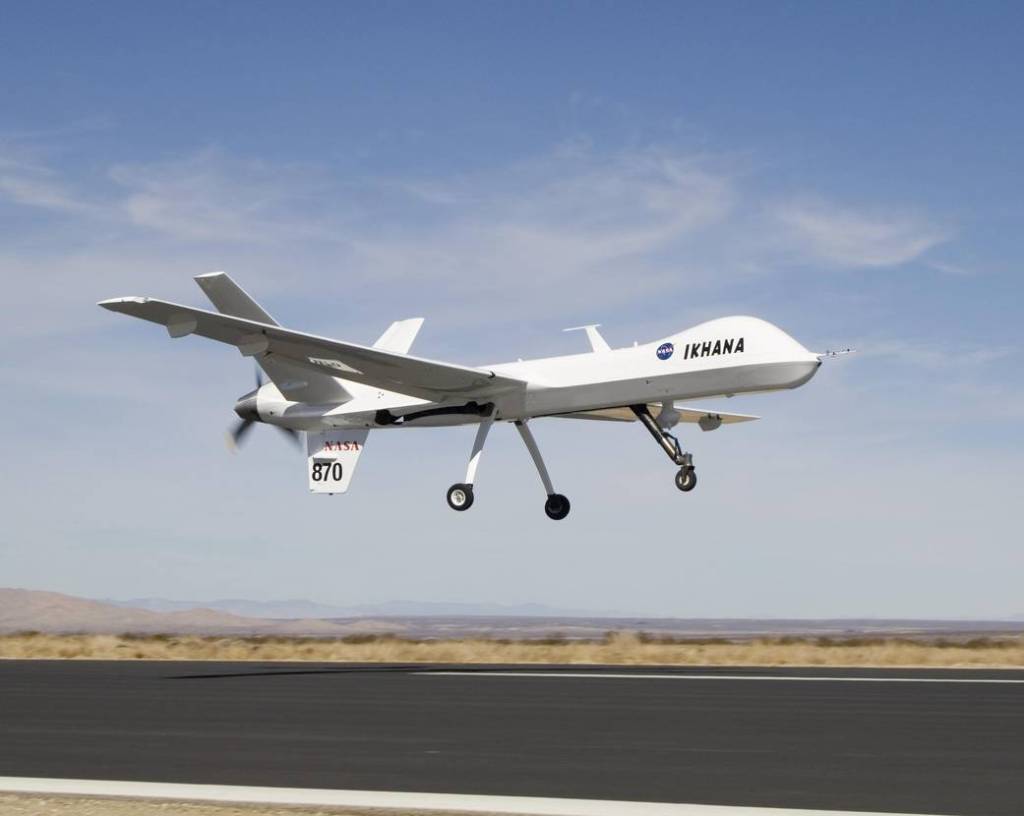
- Orion and Ikhana UAS (video).
- Detect and Avoid (video).
- NASA’s Advanced Air Mobility Playbook: Automation (video).
- NASA’s Advanced Air Mobility Playbook: Emergency Response (video).
- NASA’s Advanced Air Mobility Playbook: Healthcare (video).
- NASA’s Advanced Air Mobility Playbook: Vertiports (video).
Ask students “What are some other ways you imagine drones helping in the future?” and discuss as a group.
Brainstorm
Now that the students have researched different types of drones and their functions, have students work individually or in groups to imagine innovative solutions to real-world problems. Have them discuss the following questions:
-
- What is the problem? What is the solution?
- How will the sensor help solve the problem?
- What is the type of sensor and how does it work?
- Where else could this sensor be used? (e.g., in an aircraft, a vehicle, or on its own)
- Who or what will benefit from this sensor?
Demonstrate
Have students come up with their own method to share their individual or group idea. Below are a few examples of how students may share their ideas:
-
- Build and test the actual sensor.
- Film a short (1-minute) video or commercial about the sensor and the role it plays in solving the problem.
- Illustrate a comic book describing the sensor and its role in solving the problem.
- Write an essay or short story about the sensor design and the role it plays in solving the problem.
- Create an artistic representation of the sensor design and the role it plays in solving the problem.
- Create a mock patent of the sensor design, including detailed descriptions on how to make it.
Career Connection
Developing sensors for unmanned aerial vehicles (UAV) requires a team of people with diverse expertise and specialized skills working together. Below are a few examples.
Pilots operate the drones during testing procedures to demonstrate that sensors are functioning correctly. Their work helps prepare the drones for future autonomous flight.
Electrical / Mechanical Engineers design and develop systems within the drones to create a high-functioning machine that will gather information, perform tasks, and deliver goods in critical scenarios.
Software Engineers develop the programs that instruct the drone on how to respond to information gathered by its sensors, such as navigating airspace or surveying land.
Technicians / Mechanics are essential in constructing and arranging the mechanical parts and electrical systems within a drone. Their unique skills and adaptability help drones develop and improve during testing, to ensure they function properly and efficiently in the future airspace.