
















Host Andres Almeida: Nuclear propulsion engineering could play a key role in sending spacecraft to deep space, enabling faster and farther journeys for robots and humans. How does it work? How safe is it? And how have we applied lessons from the past to shape the future of exploration?
Kurt Polzin, chief engineer for the Space Nuclear Propulsion Office at Marshall Space Flight Center, is here to tell us. This is Small Steps, Giant Leaps.
[Intro music]
Welcome to Small Steps, Giant Leaps, the podcast from NASA’s Academy of Program/Project and Engineering Leadership, or APPEL. I’m your host Andres Almeida.
This is an exciting topic, so let’s get into it.
Host: Hi, Kurt, welcome.
Kurt Polzin: Thank you.
Host: What is space nuclear propulsion and why is NASA investing in it?
Kolzin: Sure. In nuclear energy for propulsion, and even for power, there’s nothing magical about it. A lot of people think nuclear and they think this big kind of, kind of very “black box,” you know, very hard to understand concept.
But really, nuclear power, it’s just a source of heat. It’s a very big source of heat. It’s a very high-density source of heat.
You know, in our project, when we talk space, nuclear propulsion and power, we’re normally talking about fission systems. So, taking uranium atoms and breaking them apart into their, you know, constituent atoms through that process, as opposed to radioisotope, where you take, say, plutonium and it falls apart over time.
Fission is really critical because it’s scalable. It’s high-power density, it’s scalable, and it provides us with a couple of really key things that are really important for working in space.
One: Very high power on demand. I can get high power, I can get it quickly. And the second is power where other power sources may not be useful or may not be big enough.
So, for example, in the shadows, like on the Moon when it’s in shadow or when you’re very far from the Sun, these are areas where nuclear really shines.
And it’s why NASA is investing in it, because what it allows us to do then is consider missions and applications that you simply can’t do any other way.
And I like to talk about in an analogy to, like, the nuclear Navy.
We have nuclear aircraft carriers and nuclear submarines. Well, why do we have those? Well, because we had diesels, but diesels were limited. You had to pull up oilers to fuel them. You had to come up with your submarine every once in a while to exchange the air.
Nuclear allowed those submarines to stay underwater indefinitely. They allow aircraft carriers to go on for months at a time without needing refueling for the ship itself.
And so, you know I asked my team, “What are the analogies for us? What are the things you can do with nuclear that you just can’t do any other way?”
And that’s the reason why NASA is investing in it, because there are real applications that nuclear can do certain things, do certain missions that you just can’t do any other way.
Host: And it differs in chemical propulsion where the supply is…
Polzin: Oh, absolutely. So, chemical propulsion, the energy for the propulsion system is stored in the chemical bonds, right?
I need a fuel and an oxidizer. I need some kind of chemistry there to break those bonds, release that energy in the form of heat. And then I take that hot gas and I accelerate it out a nozzle to generate thrust.
In nuclear, I’ve decoupled my power source, which is now nuclear, from my propellant choice. So, I can choose a much more optimal propellant.
In this case, it turns out that for a thermal engine, hydrogen is very good. So, I could take hydrogen, for example. I can flow it through a nuclear reactor and I can get very, very hot gas coming out the other end, which uses the propellant more efficiently.
Now, there’s a bunch of gas dynamics and physics reasons for that, why hydrogen is the best propellant. I’m not going to get into those, but if I can use pure hydrogen, very low molecular weight product coming out the end, it turns out there are real advantages to that.
On the other side, I can take that heat and I can generate electricity and I can use those to power electric or plasma thrusters, if you will. And I can use applied electric and magnetic fields to accelerate a plasma out of my engine at very, very high velocity (use my propellant very, very efficiently).
But all these are enabled because I have an independence of choice because my power source is no longer tied up with the chemistry of the propellant I have to choose.
Host: And that supply, that nuclear supply is longer lasting, typically?
Polzin: Yes, absolutely. It’s much longer lasting. Really, it’ll last as long as you design it to. It is limited by the nuclear process.
Obviously, at some point, you will fission enough of the system where you won’t have enough uranium there anymore to support criticality, but that could be a very long time. I mean, we have submarines that are going for years and years and years before they need to do any servicing or refueling.
Host: What lessons from earlier efforts are being applied to the work we’re doing today?
Polzin: Yeah, so there’s several, actually. If you go back even, although, I mean, we’ve been talking about doing nuclear propulsion and power since the 1950s seriously.
From that time forward, we’ve had a lot of things we’ve learned, lot of challenges that we’ve encountered. How do you develop these materials? These materials are different than what you would have in a terrestrial reactor.
And so, we’ve had to figure out how do those materials behave in this environment? How do they behave under these conditions? You know, the reactor for space runs a lot hotter than it does for a terrestrial nuclear reactor. And there’s reasons for that. There’s reasons why it has to run hotter in space.
But because of that, the nuclear fuel that you have to use, the materials of the core itself, the ability to shield that reactor and do it in a lightweight manner, right? I can’t just pour lots and lots of concrete around it if I’m trying to fly it in space. Mass is at a premium for us.
These things are all really, really critical in terms of developing these systems. And getting them light enough mass to be able to actually realize a competitive and realistic system.
We’ve taken in our project a nice iterative stepwise approach. We said, “There are certain fundamental problems that have remained unsolved. Let’s go solve those. Let’s go look at the fuel, the fuel chemistry, the materials at the most basic fundamental level because it’s great if I can build something really big, but if it’s not going to survive when I expose it to these conditions, then it’s no good, right?”
So, let’s build it at a small level. Let’s make sure that we’re crawling before we walk, we’re walking before we run, but that we’re doing the hard work, right? That we’re doing the hard work that will get us not just a capability that’s part of what we want, but that’s actually the full spectrum of what we want and what we need to really, as I said earlier, to do missions that are just not otherwise possible without nuclear.
I’ve liked to pull in expertise from other areas, (technologies and developments, that weren’t necessarily developed for this application, but that can be applied really, really well to it with just a little bit of a push.
One example is the electric aircraft work that NASA is pursuing, right? You have these aircraft, you’re putting, pushing, you know, high levels of power, high levels of current across an airframe.
Well, that looks a lot like a nuclear electric system in that I’m pushing high levels of power, high levels of electrical current across a spacecraft. And so, are there components and subsystems I’m developing for this aeronautics project that can be applied to this space project?
And so, looking at where those synergies are, even if they weren’t developed for the space nuclear application, being able to apply it to it with, like I said, just a little bit of an extra push.
And finally, we don’t necessarily have to require that our initial systems are the best. We kind of get into a trap here a little bit of saying, “You know, this first nuclear system, it’s gotta be the best. It’s gotta be better than anything that it’s competing with.” And I don’t think that’s right.
You know, I think that in order to make progress, you need to field the system that’s reasonable, but that has a reasonable path to further improvement.
I like to point to SpaceX and Falcon 9 just because it’s a really good recent example of this. Falcon 9 is not the same rocket today that they first flew on that first mission. They’ve improved it, they’ve block-upgraded it, they’ve increased its capabilities over time to make it what it is.
And I see kind of a similar thing for space nuclear power and propulsion. You want to field something, get experience with it, and then as you get that experience, block-upgrade it and make it better.
Host: what are some of the milestones that that have happened recently over the past couple of years that don’t get the headlines?
Polzin: Sure. And we’ve had quite a few actually.
So, one of the things that we’ve done recently, in fact (and this did get a press release, this was in the headlines), We did a cold flow test campaign for many months here at the Marshall Space Flight Center. That was all brought about because in the 1960s, some of the nuclear thermal propulsion systems, these are the ones where the flow would go through the reactor and pick up the heat directly.
They would be subject to uncontrollable and catastrophic vibration. We call this flow induced vibration because even without the heat source on, just the flow itself would cause the reactor to shake. This is [obviously] not good.
And so, for more recent designs, we had done a lot of analysis of various designs to see: Are these susceptible to the same failure mode? But nothing substitutes for a test.
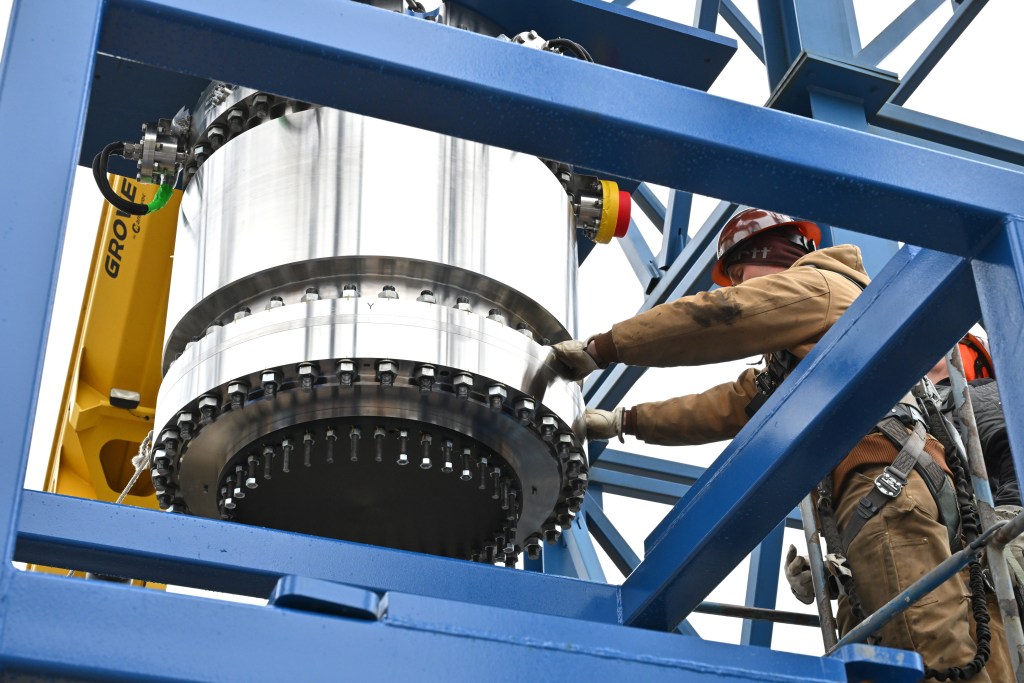
And so, we had a test article built that we ran out at the Marshall Space Flight Center test area to see if we were in fact safe from this flow-induced vibration phenomenon. And we were, right?
So, it turned out that we were able to confirm our design tools and our analysis and show that, in fact, we are able to capture really well with our analytical and modeling tools the phenomenon that are happening. But also…
Host: Did you do these tests also in collaboration with Department of Energy and other organizations?
Polzin: So, sometimes, and we have some other successes here where we have done tests with other agencies.
For example, we’ve been developing nuclear fuels for these NTP [nuclear thermal propulsion] engines. They’re really hot. You know, we’re talking the propellant has to get to 2,700 degrees Kelvin, which means the nuclear fuel has to get even hotter to be able to push the heat into the fuel. That’s really hot for any kind of nuclear fuel.
We’ve gone through multiple iterations with Department of Energy, several of our industry partners, our colleagues at other NASA centers, trying to develop these nuclear fuels and the other materials you would need inside a reactor to build that system.
And a few years ago, I wouldn’t have been able to make this statement: But at this point, given where we are and given the multiple iterations and multiple formulations we’ve tried, we have finally hit upon a few separate paths, a few separate fuel candidates that, through preliminary tests, at least show they will survive that really, really high temperature environment.
And oh, by the way, they’re exposed to hydrogen, which is very, very corrosive to materials at really, really high temperature. And so not only to survive the temperature, they’ve got to survive the chemistry and chemical attack of that environment.
And so, this work has really allowed us to develop these materials. We don’t get a lot of press on this because we don’t talk about it as much in the in the popular literature. Certainly, it’s in the scientific literature, but in the press, for example, this doesn’t get as much play.
But it is a really big deal to be able to solve what were in fact longstanding problems from the 1950s and 1960s, it had gone on for that whole time between then and now.
We had a big lithium-fed MPD thruster test that stands for magnetoplasmadynamic. This is a very high-powered plasma thruster. We funded JPL to build a first test unit. It’s the first real domestic work in this area at that power level in at least 15 or 20 years.
And they recently had their first successful firing of that thruster a couple months ago. So, we’ve made some real progress in some real key areas.
Host: This might be a jump, but we send plenty of spacecraft that have plutonium, correct? That’s their main power source.
Polzin: We sure do. That’s right.
Host: Are we taking lessons from that as well?
Polzin: So, to some extent, the difficulty there, and this was a challenge for me to, because I originally thought that from a safety basis and from ah an integration standpoint, there’d be a lot of overlap between those two.
It turns out there’s not as much as I had hoped. There’s some, but not as much as I would hope. The difficulty, the challenge is plutonium is starting to produce power and is starting to be radioactive. Basically, from the moment you make it, it’s starting to decay.
Host: Right.
And as it decays it’s transforming into a different element. It’s releasing neutrons. It is creating heat. But it’s radioactive from the moment it’s made, right? Because it is a man-made element in the first place. And so, that’s very critical in terms of how you handle it.
It’s also typically one of the last things integrated into a spacecraft, right? So, the entire spacecraft is built, and then at the last moment, the plutonium source is integrated before it’s launched. A nuclear reactor, and in these types of systems, it’s really the heart of the spacecraft. It is part of the spacecraft. And so, everything kind of has to be assembled around it.
So, when you get especially to integration, the reactor is going to go in there. It’s going to go in early because a lot of things are going to be connected to and hanging off of it. And because of that, you’re going to have people in the presence of the reactor for a much longer period of time during that whole integration process.
Now, the good news is that these reactors are not radioactive until we turn them on. So, throughout that whole integration process, it’s still very, very safe because it’s never been turned on. It’s not radioactive. You can approach it very safely until you actually start that nuclear chain reaction, which we don’t plan to do until we get off the Earth and into what’s called a nuclear safe orbit, which is essentially an orbit where that spacecraft is never coming back to Earth.
Only then would we turn it on and start to generate, you know, radioactive products in the reactor. So, in some respects, it’s much safer in terms of being able to be exposed to the reactor because it’s essentially a dead weight until you turn it on.
Host: So, what are we looking forward to in this next couple of years? Artemis III is getting ready. What are we looking forward to in terms of development?
Polzin: So, obviously, you know, we had the Ignition event a few months ago with the administrator. And since then, the space reactors office is being stood up. SR-1 was announced at the Ignition event. LR-1, which is Lunar Reactor 1, as opposed to Space Reactor 1, which is SR-1, have both been announced within the next four-year timeframe.
LR-1 is very interesting. It is a power system for the lunar surface. It is going to leverage a free-flying power and propulsion system in SR-1, but nuclear is really key for a sustained lunar presence.
You have 14 days of night in pretty much every location on the Moon. It’s very, very cold. There’s been whole problems, whole issues with what’s called survive the night because it is so long and it is so cold.
And so, having nuclear power is really enabling for having a sustained presence anywhere. Just in general, having an excess of power is enabling for a lot of things.
But to be able to keep your instruments warm to make sure they don’t freeze up, to have enough power to sustain human presence, to sustain the work they’re going to be doing, it’s really, it’s almost very critical to that path.
Obviously, we’ve landed on the Moon back in the ‘60s and ‘70s. Those were very short stays, and those were all pretty much in sunlight.
We’ve left some radioisotope systems behind as instruments, but those are all very, very small things. So, if you want to do something that’s big, that’s meaningful, that’s new, you really, you really are talking nuclear to be able to enable you to have kind of global presence on another planetary body.
And then you look forward beyond that, right? A lot of those technologies are going to be useful and applicable when you go beyond that to Mars, right?
So, it is very, very useful to use the Moon as a proving ground for a lot of these technologies.
And it has its own utility in its own right on the Moon as well. I don’t want to say that the Moon is just a proving ground for it. It is very useful for that as well.
Host: Yeah. So, Kurt, on a personal level, what was your giant leap?
Polzin: So, this is an interesting question. So, when I first got to NASA, I was kind of wet behind the ears (just finished PhD) when I first got started here at NASA. I was in the lab, was publishing papers, was getting to be recognized in my technical community.
But it was really when I started to get beyond my technical community a little bit, I started to get involved in my professional society as a volunteer and as a volunteer leader. And at that time, or around that same time, because I started to make connections with people that I wouldn’t have otherwise connected with in my in my regular day job,
I started to notice my profile rising. I started to notice that I was getting invited into meetings and into discussions that I wouldn’t have otherwise been invited to, and that my opinion was starting to be asked about various topics, sometimes beyond the scope of what I was working on.
And then other positions started to become available. You know, the position I had before this, the position I’m in now, these were not necessarily things – it’s not that they were necessarily hidden, it’s just that I was more actively sought out to apply for them.
And so, that was the really the big switch, is when all of a sudden I started to get invited into those rooms that I might not have otherwise been invited into and started to have people well above what was my level asking my opinion and taking it very seriously.
That’s kind of when it hit me that, you know, I had made a transition in my career. I was no longer just somebody toiling in the lab doing research and development in my field. I was starting to become more of a visible leader in the field. And that was a big switch for me.
That was kind of where something flipped where I realized this is different, right? This is new. And so, I would say that more than anything else was really my big, giant leap, if you will.
Host: That’s great. Well, thank you, Kurt. We’re looking to the future of space nuclear power of propulsion.
Polzin: Alright, thank you.
[Outro music]
Host: That’s it for this episode of Small Steps, Giant Leaps. For a transcript, and for all other episodes, visit nasa.gov/podcasts. While you’re there, check out our other podcasts like Houston, We Have a Podcast, Curious Universe, and Universo curioso de la NASA. As always, thanks for listening.
Outro: This is an official NASA podcast.