























Tried-and-tested deep space radio frequency communications systems are approaching their bandwidth limit. Yet future space missions are expected to transmit huge volumes of science data, including high-definition images and video, that will require significantly more bandwidth. An upgrade is required.
Much like fiber optics replacing old telephone lines on Earth as demand for data grows, going from radio communications to laser, or optical, communications will allow increased data rates throughout the solar system with 10 to 100 times the capacity of state-of-the-art radio systems currently used by spacecraft.
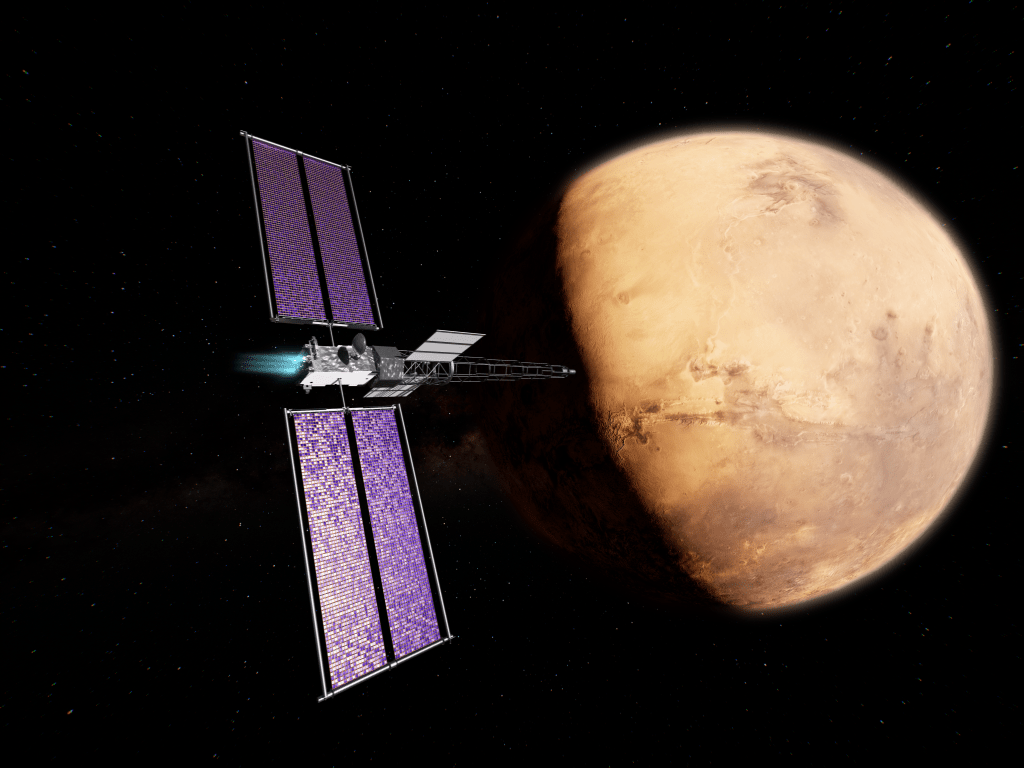
NASA’s Deep Space Optical Communications (DSOC) experiment is the agency’s first demonstration of optical communications beyond the Moon. DSOC is a system that consists of a flight laser transceiver, a ground laser transmitter, and a ground laser receiver. New advanced technologies have been implemented in each of these elements.
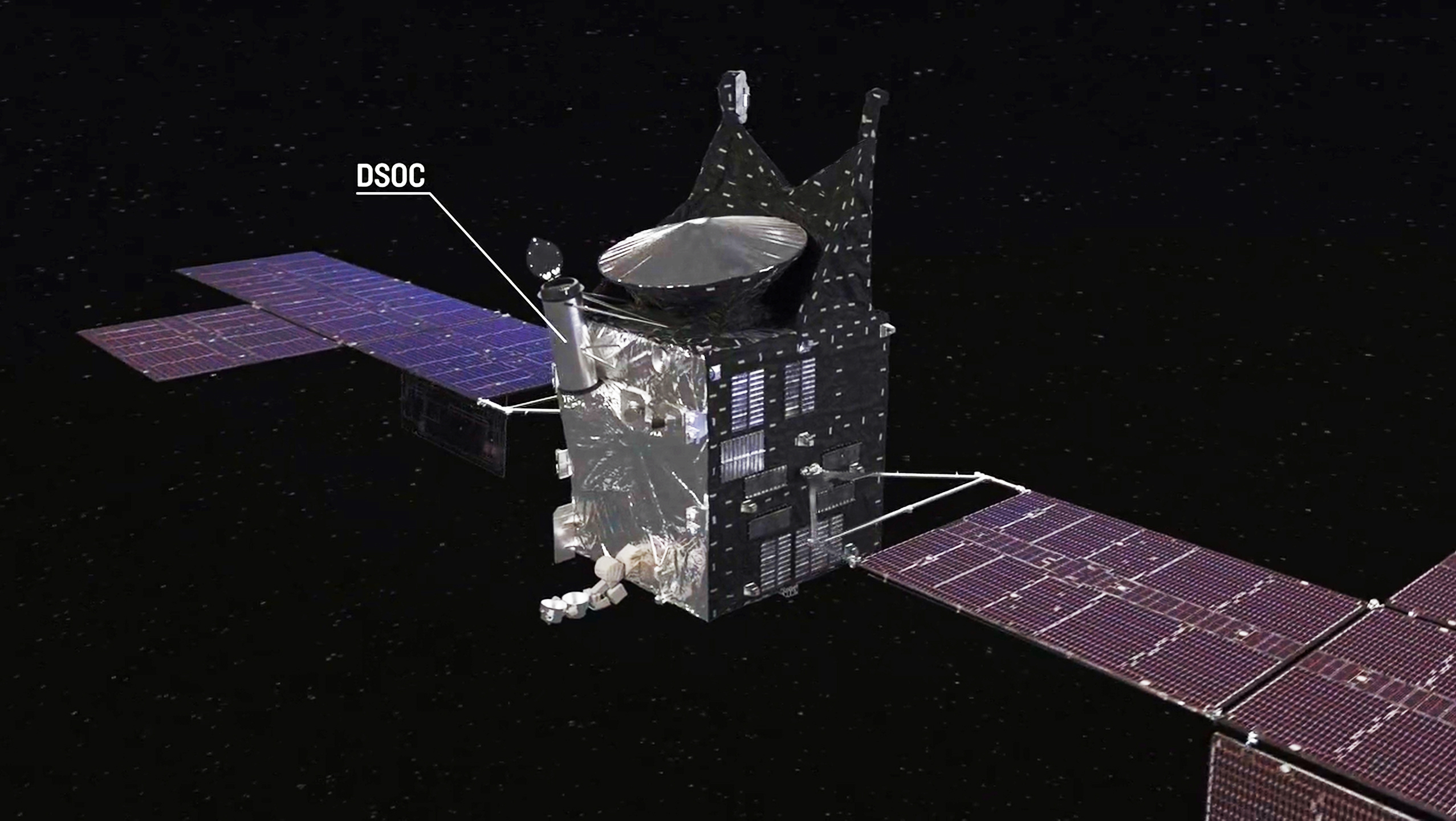
The transceiver will “piggyback” on NASA’s Psyche spacecraft when it launches in October 2023 to the metal-rich asteroid of the same name. The DSOC technology demonstration will begin shortly after launch and continue in two phases for about 2 years. The first phase of operations will last until June 2024 while the second phase is planned from January to October 2025.
Key Goals

- Demonstrate that flight laser trans- ceiver and ground systems are able to lock onto each other’s laser signals during DSOC’s calibration and com- missioning phase.
- Demonstrate specified downlink data rates as the Psyche spacecraft travels farther from Earth. These data rates will decrease as the distance from Earth grows.
- Demonstrate a data uplink up to a distance of 1 astronomical unit (the average distance between the Earth and Sun – 93 million miles, or 150 million kilometers).
- Demonstrate operations for nearly two years after the Psyche mission launch, making one contact per week for the duration of the technology demonstration.
Timeline
- October 2023: Psyche spacecraft is scheduled to launch from NASA’s Kennedy Space Center on a SpaceX Falcon Heavy rocket.
- Roughly 20 days after launch: DSOC calibration and commissioning phase is expected to begin, preparing the tech demo for operation.
- Roughly 50 days after launch: First expected contact opportunity between DSOC ground systems and the flight transceiver aboard Psyche.
- June 2024: First phase of this technology demonstration ends.
- January 2025: Second phase of the tech demo begins.
- October 2025: DSOC tech demo ends.
The System
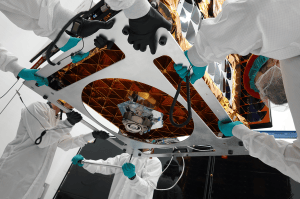
Flight hardware: The DSOC flight laser transceiver will feature both a near-infrared laser transmitter
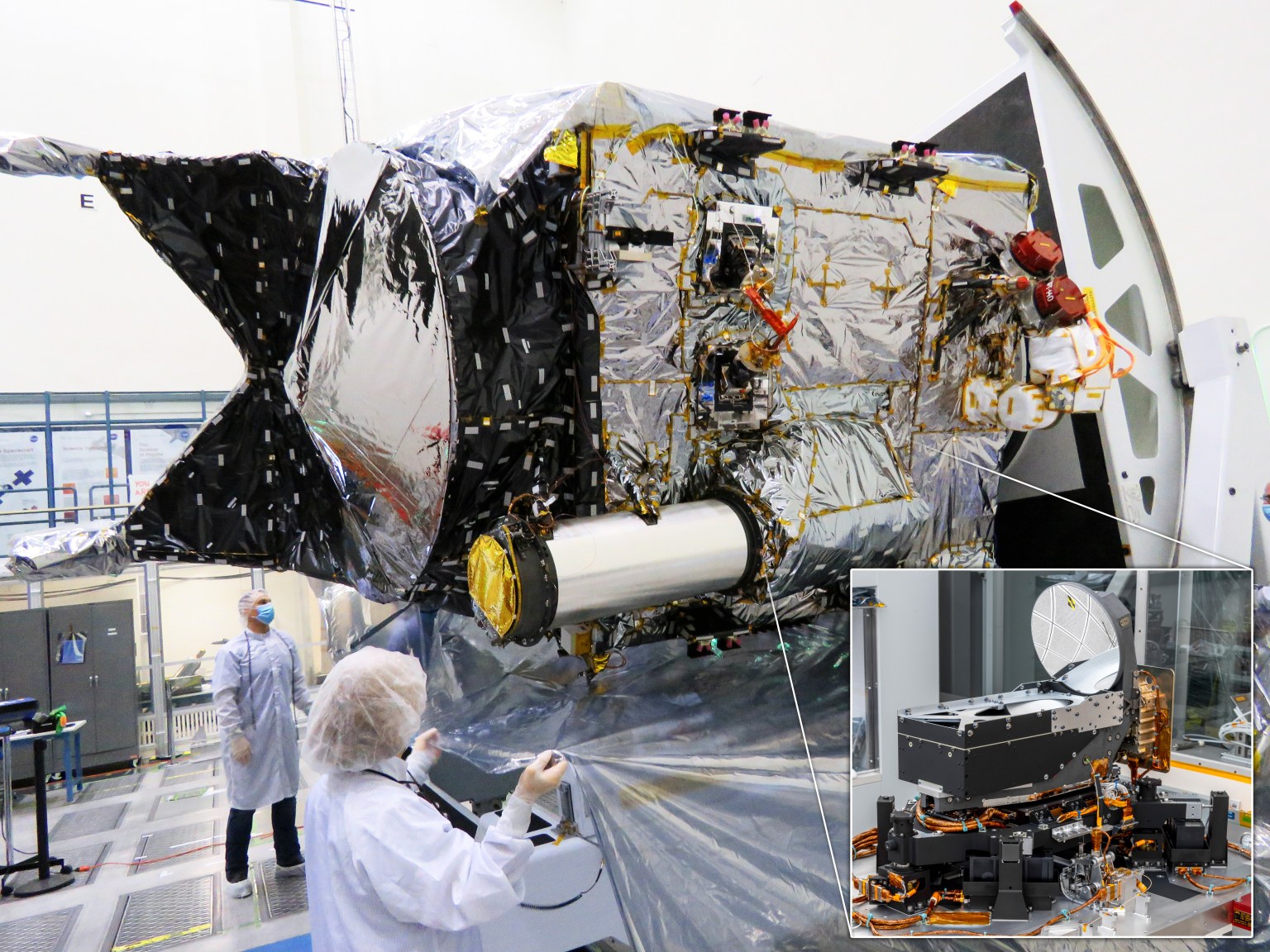
to send high-rate data to the ground system, and a sensitive photon-counting camera to receive a ground-transmitted laser. The transceiver’s 8.6-inch (22-centimeter) aperture telescope is mounted on an isolation-and-pointing assembly that stabilizes the optics and isolates it from spacecraft vibrations. The flight hardware is fitted with a sunshade and protrudes from the side of the spacecraft, making it one of Psyche’s easily identifiable features.
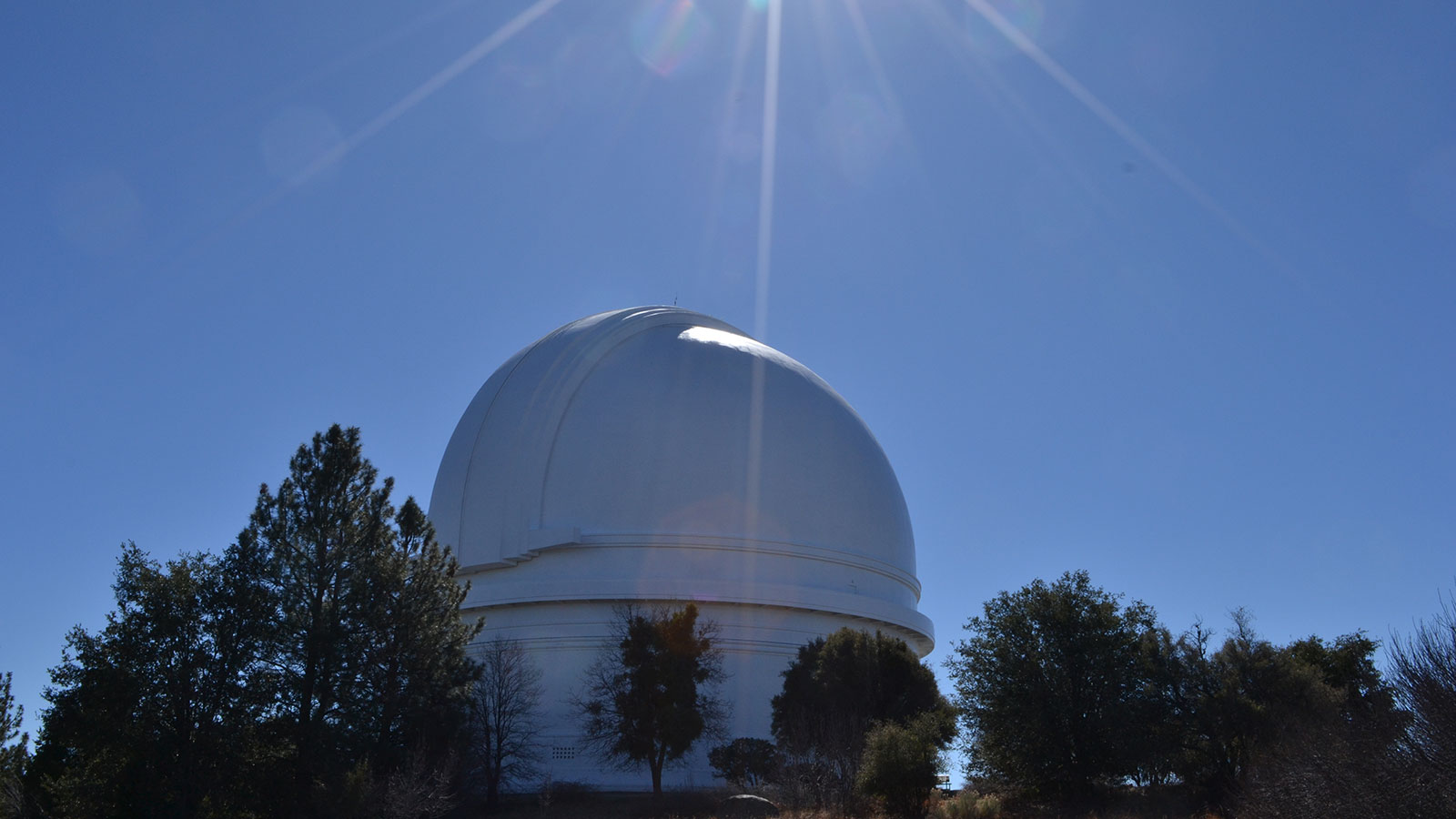
Ground systems: A high-power near-infrared laser transmitter at the Jet Propulsion Laboratory’s Table Mountain facility near Wrightwood, California, will uplink a modulated laser beam to the flight transceiver and demonstrate the transmission of low- rate data. The uplink laser will also act as a beacon for the flight transceiver to lock onto. The data sent back by the DSOC transceiver on Psyche will be collected by the 200-inch (5.1-meter) Hale Telescope at Caltech’s Palomar Observatory in San Diego County, California, using a sensitive superconducting nanowire photon-counting receiver to demonstrate high-rate data transfer.
History
Laser communications have already passed several key tests. In 2013, NASA’s Lunar Laser Communications Demonstration tested record- breaking uplink and downlink data rates between Earth and the Moon.
In 2021, NASA’s Laser Communications Relay Demonstration launched to test high-bandwidth optical communications from geostationary orbit and to demonstrate relay capabilities so that spacecraft don’t need to maintain a direct line of sight with Earth to communicate.
In 2022, NASA’s TeraByte InfraRed Delivery system downlinked the highest-ever data rate from a satellite in low-Earth orbit to a ground-based receiver.
With a launch set in 2023, DSOC will take optical communications into deep space for the first time. This will set the foundation for establishing higher data-rate returns from future robotic and human missions to Mars and beyond.
Program Management
NASA’s Jet Propulsion Laboratory, a division of Caltech in Pasadena, California, manages the
project for the Technology Demonstration Missions program within NASA’s Space Technology Mission Directorate, and the Space Communications and Navigation (ScaN) program within the agency’s Space Operations Mission Directorate. JPL’s William “Bill” Klipstein is DSOC’s project manager and Abhijit “Abi” Biswas is the project technologist.
Contact
Sarah Frazier
Headquarters
Washington D.C.
202-853-7191
Ian J. O’Neill
NASA Jet Propulsion Laboratory
Pasadena, California
818-354-2649