











Crew Studies Cardiac Research, Artificial Intelligence as Dragon Boosts Station’s Orbit
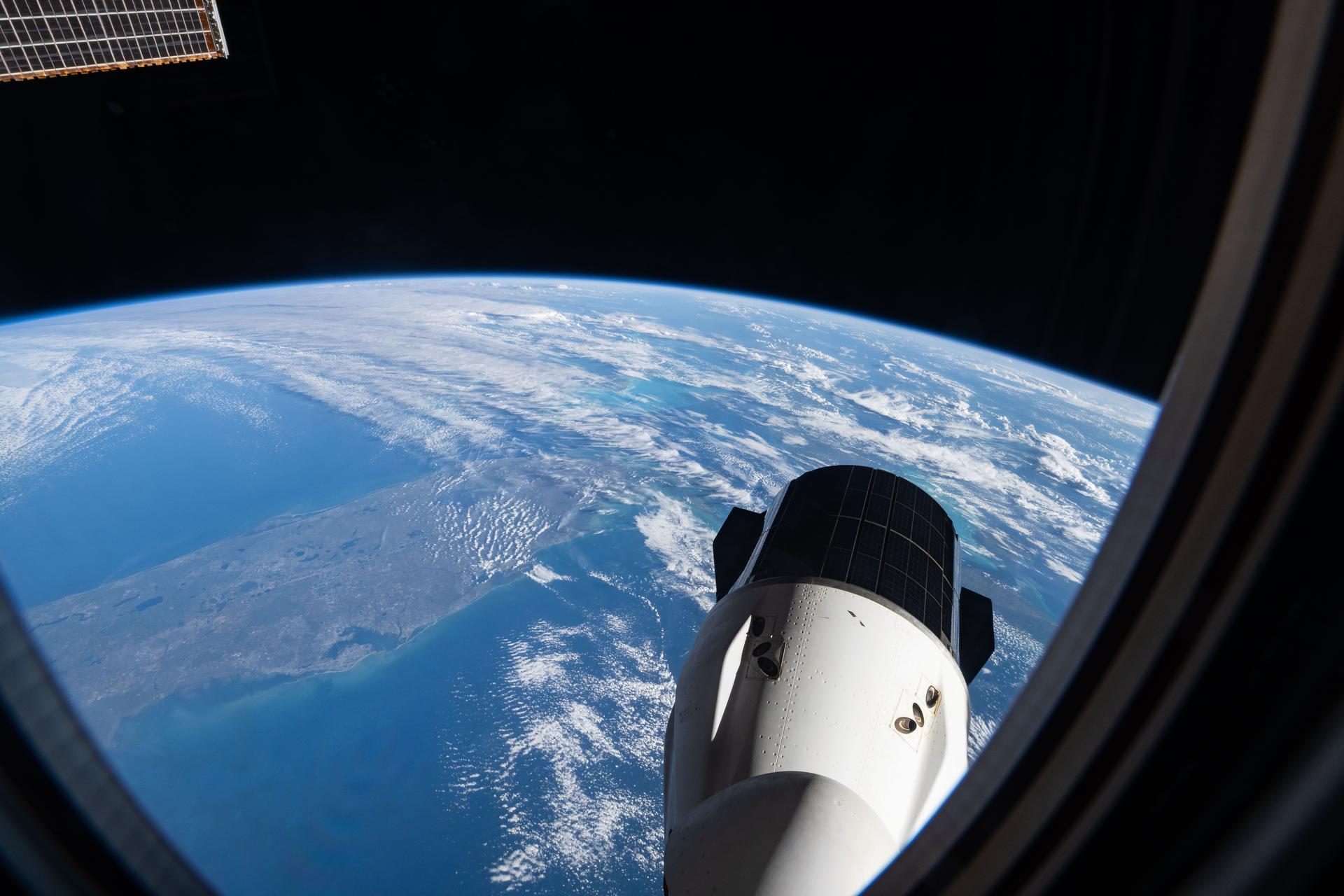
Cardiac research and artificial intelligence were the main science topics for the Expedition 74 crew on Friday. The International Space Station also received an orbital boost when the SpaceX Dragon spacecraft fired its engines at the end of the week.
NASA Flight Engineer Chris Williams started his shift inside the Columbus laboratory module setting up the Ultrasound 2 device and attaching electrodes to his chest. Next he scanned his neck, chest, and leg vessels with the Ultrasound 2 with assistance from doctors on the ground as the electrodes measured his heart’s electrical activity. Afterward, Williams jogged on the COLBERT treadmill while wearing a heart monitor then worked out on the advanced resistive exercise device as his movements were tracked. Doctors will use the biomedical data to understand how living and working in space long-term affects the cardiovascular system.
Roscosmos cosmonauts Sergey Kud-Sverchkov and Sergei Mikaev joined each other in the Zvezda service module and studied using artificial intelligence to boost crew efficiency aboard the orbital outpost. The duo tested AI-assisted tools to convert speech-to-text and improve data handling and communications between the crew and ground controllers. Researchers seek to use the new technology to speed up and increase the accuracy of crew documentation benefitting operations aboard spacecraft.
Kud-Sverchkov also serviced the Elektron oxygen generator inside Zvezda, collected air samples from the station’s Roscosmos segment for analysis, and cleaned ventilation fans inside the Soyuz MS-28 spacecraft. Mikaev deactivated physics research gear that enables observations of crystallization, plasma behavior, and radiation effects then inventoried computer and electronics gear to wrap his work shift.
On Friday, Jan. 23, SpaceX’s Dragon fired its thrusters for 26 minutes, 11 seconds, boosting the International Space Station’s orbit.
The two Draco engines, which are located in the spacecraft’s trunk and use an independent propellant system, increased the station’s altitude by 3.1 miles at apogee, or highest point of station’s orbit, and 2.3 miles at perigee, or lowest point of station’s orbit, placing the station in an orbit of 269 x 255 miles.
This Dragon spacecraft, which is supporting SpaceX’s 33rd commercial resupply mission for NASA, arrived at the orbital complex on Aug. 25 and previously performed five reboosts of the station on Sept. 3, Sept. 26, and Oct. 14, Nov. 7, and Dec. 29. This is the final planned reboost for this Dragon spacecraft before it returns to Earth with critical research and cargo and splashes down off the coast of California.
Learn more about station activities by following the space station blog, @space_station on X, as well as the ISS Facebook and ISS Instagram accounts.
Get the latest from NASA delivered every week. Subscribe here.
