




Suggested Searches

Blogs

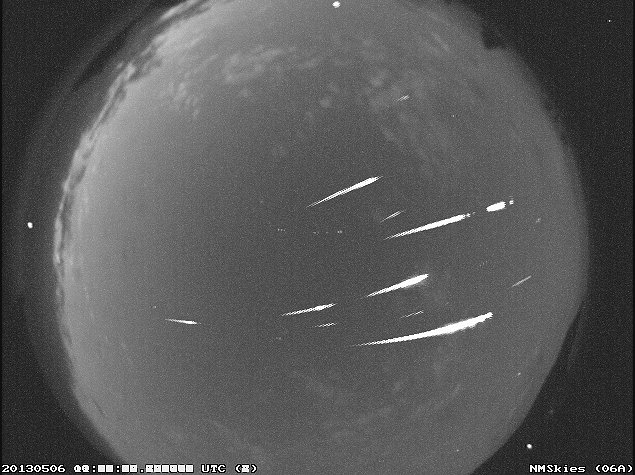
    NASA All Sky Fireball Network Captures Eta Aquarids
    1037759main_eta.jpg

    A composite image of 13 Eta Aquarid meteors from the NASA All Sky Fireball Network station in Mayhill, New Mexico the morning of May 6, 2013.  Clouds seriously hampered our view of the ETAs this year. Observations reported to the International Meteor Organization indicate an outburst in the early hours of  May 6th UTC.(Credit: All Sky …

    Read Full Post

    First Observations of the 2013 Eta Aquarids

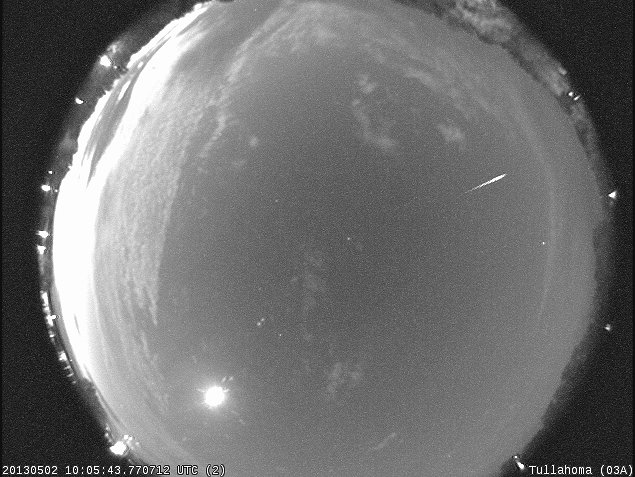
    Despite interference from the moon and clouds (and rising sun!), this morning we snagged our first observations of the 2013 Eta Aquarids.  Here’s an image of one from the all sky camera in Tullahoma, Tennessee.  The Eta Aquarids peak in the pre-dawn hours on May 6 and are material from Halley’s comet.  They zoom around …

    Read Full Post

    ISS Daily Summary Report – 05/06/13

    New Status:  Spinal: Hadfield and Marshburn conducted their 3rd and final session of this experiment with Cassidy as operator and remote guidance from ground teams. Spinal Ultrasound uses ground and space-based studies to characterize spinal changes during and after spaceflight.  Ground based pre- and post-flight Magnetic Resonance Imaging (MRI) and high fidelity ultrasound, combined with in-flight …

    Read Full Post

    ISS Daily Summary Report – 05/03/13

    New Status:   improved Payload Ethernet Hub Gateway (iPEHG)-1 and -2 Installation: Commander (CDR) Hadfield upgraded PEHG-2 Wednesday and PEHG-1 today by removing the legacy PEHGs and installing two new iPEHGs. The new iPEHGs have enhanced configuration capabilities over the legacy PEHG, improved Gateway modes of operation and improved network protocols to support integration into Joint Station …

    Read Full Post

    A Line of Snow in a Cold Spring Shower

    Our forecasters at Iowa State, and I believe via the National Weather Service, are calling this a “once in a career storm.” The heavy snow in central Iowa—really, almost on top of us right now, is the reason. We ran NPOL all night long with the D3R radar in cold rain that started around 2 […]

    Read Full Post

    ISS Daily Summary Report – 05/02/13

    New Status:  Burning and Suppression of Solids (BASS) Experiment (BASS): Cassidy conducted the 7th of 13 sessions planned for this experiment. BASS examines the burning and extinction characteristics of a wide variety of fuel samples in microgravity and will guide strategies for extinguishing fires in microgravity. BASS results contribute to the combustion computational models used …

    Read Full Post

    Waiting for the Rain near Traer, Iowa

    We have been waiting for rain at the NPOL site. Yesterday evening it got very close- within 50 km or so. In the interim, we were waiting for convective cells to develop along what is called a radar “fine-line”.  Fine-lines are little boundaries in the lowest part of the atmosphere associated with small changes in […]

    Read Full Post

    Meet the 2-D Video Disdrometer

    A rain gauge will collect how much rain falls, but how exactly do scientists measure the size, shape, and fall speed of raindrops near the ground? Patrick Gatlin of NASA’s Marshall Space Flight Center, sent us a couple photos from Iowa of the instrument that does exactly that: a two-dimensional video disdrometer. Shaped like a […]

    Read Full Post

    ISS Daily Summary Report – 05/01/13

    New Status:  In-Flight Maintenance (IFM) improved Payload Ethernet Hub Gateway (iPEHG) Installation: Commander (CDR) Hadfield upgraded PEHG-2 (in LAB1D2) by removing the legacy PEHG and installing the new iPEHG. IPEGH-1 installation is scheduled for this Friday, May 3. The new iPEHG will have enhanced configuration capabilities over the existing PEHG, improved Gateway modes of operation and …

    Read Full Post

    ISS Daily Summary Report – 04/30/13

    New Status:  Mobile Servicing System (MSS) Operations: Today Robotics Ground Controllers powered up the Mobile Servicing System (MSS) and translated the Mobile Transporter (MT) from Worksite (WS) 4 to WS2.  They then maneuvered the Space Station Remote Manipulator System (SSRMS) into position, grappled the Special Purpose Dexterous Manipulator System (SPDM), and released it from Mobile Base …

    Read Full Post