



Suggested Searches

Blogs

    Profiling Salinity from the Ship

    By Eric Lindstrom A workhorse of our voyage is the two primary means of measuring salinity from the ship. We use two different Conductivity, Temperature, and Depth (CTD) instruments. One is used on station, when the ship is stationary and the other is used while we are underway (smartly dubbed the underway CTD). Remember that […]

    Read Full Post

    Are We There Yet?

    By Eric Lindstrom If you all are waiting to see some action at sea, I am sorry it is taking a bit to unfold. It takes about a week from Woods Hole to reach our study site at 25N, 38W. It’s good for us to have the time to check and re-check the instruments, get […]

    Read Full Post

    Discovering Hot Towers

    Two hours before Hurricane Isaac made landfall, a satellite orbiting hundreds of miles above the storm used a radar instrument to map the storm’s inner structure. The instrument on the Tropical Rainfall Measuring Mission (TRMM) observed two extremely tall complexes of rain clouds called hot towers in the eyewall, a sign that Isaac was trying to strengthen. The towering clouds […]

    Read Full Post

    Measuring Salinity from Space

    By Eric Lindstrom Recent years have seen significant developments in satellites for oceanographers. The European Space Agency launched the Soil Moisture and Ocean Salinity (SMOS) mission and NASA launched the Aquarius instrument on the Argentine SAC-D mission. Salinity has always been a challenging but critically important measurement for oceanographers. The small changes in salinity that […]

    Read Full Post

    September puzzler

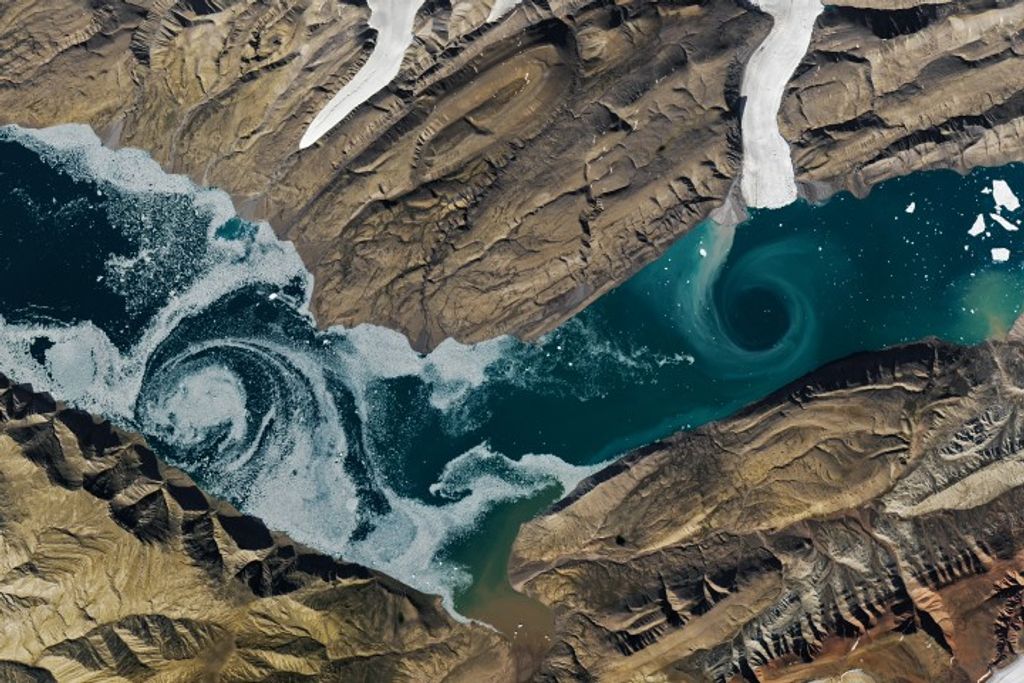
    Every month, NASA Earth Observatory will offer up a puzzling satellite image here on Earth Matters. The fourth puzzler is above. Your challenge is to use the comments section below to tell us what part of the world we’re looking at, when the image was acquired, and what’s happening in the scene. How to answer. […]

    Read Full Post

    Of ship meals and science

    By Eric Lindstrom Saturday, 8 September 2012 — Given the talk around the Knorr’s dinner table, you would have to say that oceanographic expeditions run on their stomachs. Key to surviving weeks away from home and family is good food and good moods. The food on the Knorr is excellent, so we are likely to […]

    Read Full Post

    Hurricanes, make way for Knorr!

    By Eric Lindstrom We knew when we left Woods Hole yesterday that we had two hurricanes (Leslie and Michael) standing between us and our study site, far southeast of Woods Hole in the mid-Atlantic. How Captain Adam of the Knorr chooses to deal with this over the next days is a study in weather and […]

    Read Full Post

    Off to sea!

    By Eric Lindstrom We had a whirlwind of preparations after the Labor Day Weekend.  All the gear was loaded on the ship and lashed down. The scientific party (22 people) arrived and set up in various spaces around the ship.  Bill Ingalls, a NASA Headquarters photographer, captured many great shots of the Knorr and the […]

    Read Full Post

    Another kind of image of the day

    Every day we bring you a different view of Earth, as only NASA can see it…from high above, and usually from space. One of our colleagues has also been working since 2000 to bring you breathtaking views of Earth…albeit, from a perspective that’s a bit closer to the ground. Together with a few professional helpers […]

    Read Full Post

    Once in a Blue Moon

    One way to make a Blue Moon is by using a blue filter.

    Image credit: NASA/MSFCOn Aug. 31, if the night sky is clear, you will be able to see the second full moon of the month, which is called a “blue moon.”You may have heard the expression, “once in a blue moon,” meaning “almost never,” because having 13 full moons in a calendar year — instead of …

    Read Full Post