
















Suggested Searches

Blogs

    A Big Thank You To Our 100,000 Facebook Fans

    On March 11, 2009, we posted our first image on Facebook, a spectacular view of ash billowing from Mount Etna (below). At the time, we had just a handful of friends on Facebook, and just a few of them shared it with theirs. Fast forward three years…and tens of thousands of you have joined our […]

    Read Full Post

    Our Top 10 Most Popular Images of 2012

    Whether it was retreating ice, super storms, wildfires, or the simple changing of the seasons there was no shortage of fascinating, beautiful, and occasionally ominous imagery in 2012. Throughout the year, we published more than 600 images. Of those, the ten most popular (based on the number of page views) are below. Click on each image […]

    Read Full Post

    December Puzzler Answer

    Congratulations to Alan for being our first reader to work out that the December puzzler showed an area near the Flat Tops in northwestern Colorado. Alan recognized that the treeless regions in the lower right were plateaus and pinpointed the location on December 19, even pointing out Devils Causeway. Meanwhile, other puzzler players — notably […]

    Read Full Post

    December Puzzler

    Every month, NASA Earth Observatory will offer up a puzzling satellite image here on Earth Matters. The seventh puzzler is above. Your challenge is to use the comments section below to tell us what part of the world we’re looking at, when the image was acquired, and why the scene is interesting. How to answer. […]

    Read Full Post

    How Do You “Win” the Puzzler Exactly?

    The answer we had in mind for our November puzzler was fog in Argentina’s, Lake District. The exact coordinates were -40° 24′ 50.47″, -71° 22′ 59.14.”   We had a number of players who came quite close — including Stuart Grice, and David P , and Michael Osborne — but no one got the exact coordinates, […]

    Read Full Post

    Geminids: How Low Do They Go?

    The Marshall Meteoroid Environment office put together the plot below showing the distribution of end heights of Geminids seen with our fireball camera network. 85% of Geminids burn up 40 to 55 miles above Earth’s surface and 15% get below 40 miles altitude.  Geminids penetrate deeper into the atmosphere than the Perseids because they are …

    Read Full Post

    Behind the Scenes Team of a Web Chat

    Ever wonder what it takes to pull together our web chat series? The chats usually consist of two components, live streaming and web chats. The Automated Lunar and Meteor Observatory, or ALaMO, at NASA’s Marshall Space Flight Center in Huntsville, Ala., is where the live streaming component of “Watch the Skies” begins. The ALaMO consists …

    Read Full Post

    Arctic Report Card

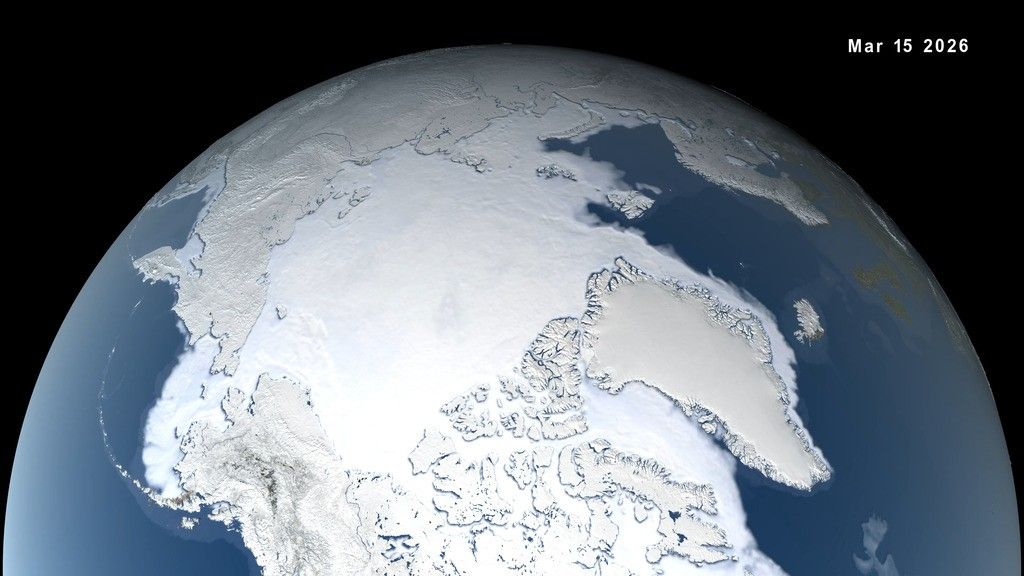
    On December 5, 2012, the National Oceanic and Atmospheric Administration (NOAA) released its annual Arctic Report Card, covering late 2011 through late 2012. The report listed a number of significant events in a record-breaking and sometimes sobering year. One of the biggest stories was the record-low sea ice extent in the Arctic Ocean. Arctic sea ice […]

    Read Full Post

    Meteor Over Texas

    This morning at 6:43 AM Central Standard Time, eyewitnesses across Texas and adjacent states saw a very bright fireball streaking across the sky, moving roughly east to west. It was also recorded by a NASA meteor camera in Mayhill, New Mexico some five hundred miles to the West, which is very unusual and testifies to …

    Read Full Post

    Will We See A New Meteor Shower?

    Some computer models indicate that the Earth may pass near decades old debris left behind by Comet Wirtanen in mid December, creating a new meteor shower. In the most optimistic scenario, viewers could see as many as 10-30 meteors per hour radiating from a point in the constellation Pisces in the early evenings, sometime between …

    Read Full Post