






Human Research, Advanced Tech Keep Crew Busy Before Dragon Departs
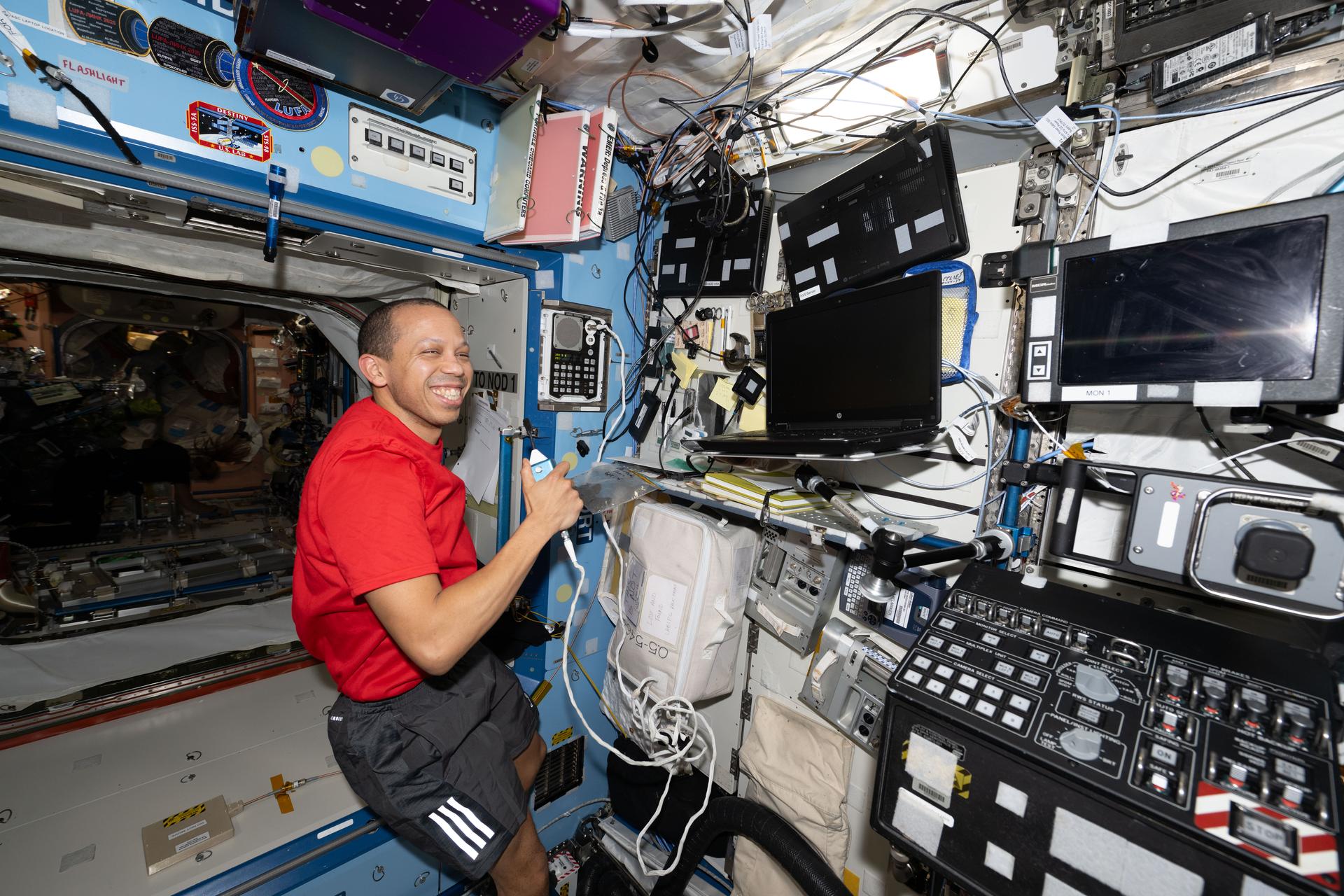
Human research, advanced robotics, and experimental workout gear filled the schedule for the Expedition 74 crew aboard the International Space Station on Wednesday. The orbital residents also continued packing a SpaceX Dragon with science experiments and space hardware for its departure on Thursday.
Flight Engineers Jessica Meir of NASA and Sophie Adenot of ESA (European Space Agency) kicked off their shift together answering a questionnaire about their sleep quality and collecting their saliva samples for analysis. Researchers will use the biomedical data to understand the stress and behavioral risks during a spaceflight, devise meditation and relaxation techniques for crews, and improve the experience of a long-term mission.
Meir then collected and processed her blood samples with assistance from NASA Flight Engineer Jack Hathaway for the Venous Flow study that examines the risk of space-caused blood clots. Next, Meir inspected and cleaned the Enhanced European Exploration Exercise Device, an advanced, compact all-in-one workout device being tested for use on deep space missions. Adenot partnered with Hathaway at the end of their shift loading hardware packed with research samples into a SpaceX Dragon scheduled to undock from the orbital outpost’s Harmony module at 12:05 p.m. EST on Thursday.
NASA Flight Engineer Chris Williams started his shift inside the Kibo laboratory module installing and configuring a pair of small robotic arms. The advanced robotic technology is demonstrating precision mobility and experiment automation in microgravity to reduce astronaut workloads. Williams then joined Meir in the Tranquility module and replaced components on the advanced resistive exercise device that mimics free weights on Earth.
Station Commander Sergey Kud-Sverchkov, attached to electrodes, pedaled on an exercise cycle for a cardiovascular assessment while Flight Engineer Sergei Mikaev monitored and assisted. The Roscosmos cosmonauts then split up their day with semiconductor research, an artificial intelligence investigation, and photographic inspections of windows on the Zvezda service module.
Roscosmos Flight Engineer Andrey Fedyaev closed out an automated photography session that imaged Earth landmarks in a variety of wavelengths during the crew’s sleep shift. The two-time station visitor then spent the rest of his day servicing the Nauka science module’s ventilation system and inventorying hardware located in the Zarya module.
Learn more about station activities by following the space station blog, @space_station on X, as well as the ISS Facebook and ISS Instagram accounts.
Get the latest from NASA delivered every week. Subscribe here.
