



Subscribe by E-mail

To receive news releases from the Marshall Center newsroom by e-mail, send a blank e-mail message to:
msfc-news-subscribe@newsletters.nasa.gov.

To unsubscribe send a blank e-mail message to:
msfc-news-unsubscribe@newsletters.nasa.gov.

The system will confirm your request via e-mail.

Marshall in Review: 2008

Marshall Star 2008 in Review

The Marshall Star's "Year in Review" edition highlights Marshall's exciting accomplishments in 2008.

› View PDF (5 MB)

Fact Sheets

Artist concept of the Gravity Probe B spacecraft

Marshall fact sheets provide current and background information on a variety of NASA projects.

› View All Fact Sheets

Latest Marshall News

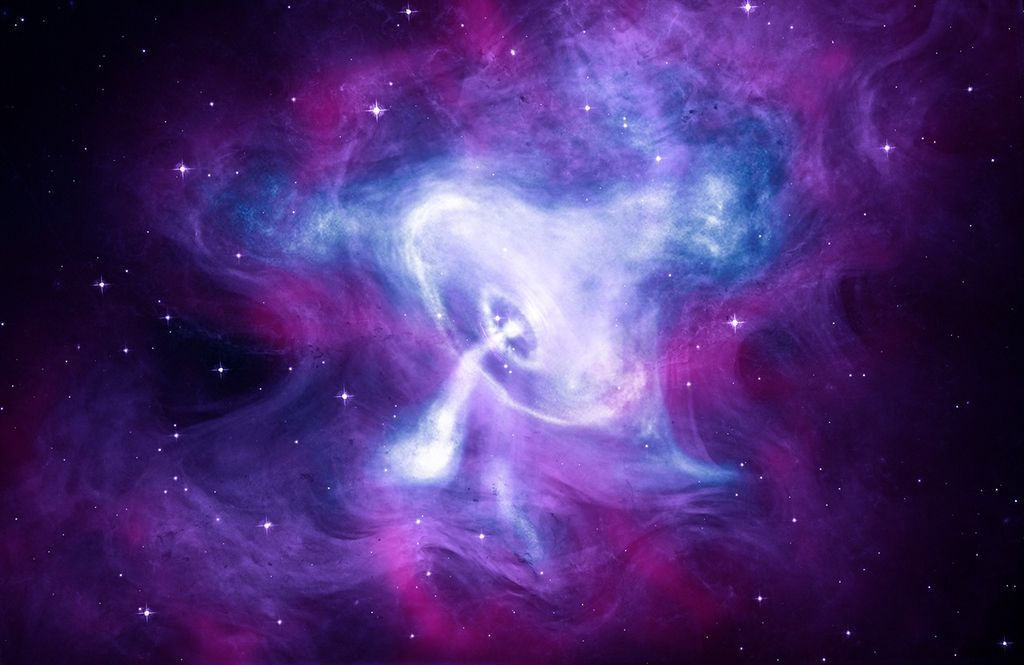
    Carbon Atmosphere Discovered on Neutron Star

    Central region of the supernova remnant Cassiopeia A

    Central region of the supernova remnant Cassiopeia A. Image credit: NASA/CXC/Southampton/W. Ho et al.

    Evidence for a thin veil of carbon has been found on the neutron star in the Cassiopeia A supernova remnant. This discovery, made with NASA's Chandra X-ray Observatory, resolves a ten-year mystery surrounding this object. This is the first time the composition of an atmosphere of an isolated neutron star has been confirmed. The Marshall Center manages the Chandra program.

    > News Release
    > Photo

    NASA Gives ‘Go’ for Space Shuttle Atlantis Launch on Nov. 16

    Space shuttle Atlantis is poised for liftoff on Launch Pad 39A.

    Space shuttle Atlantis is poised for liftoff on Launch Pad 39A at the Kennedy Space Center, Fla. Credit: NASA

    Space shuttle Atlantis is targeted to begin an 11-day flight to the International Space Station with a Nov. 16 launch from the Kennedy Space Center, Fla. Liftoff is scheduled for 1:28 p.m. CST. Shuttle Atlantis' launch date was announced Oct. 29 at Kennedy, following a flight readiness review that assessed the risks associated with the mission and determined the shuttle's equipment, support systems and procedures are ready for launch.

    > Shuttle Web Page
    > Photo

    NASA's Ares I-X Rocket Completes Successful Flight Test

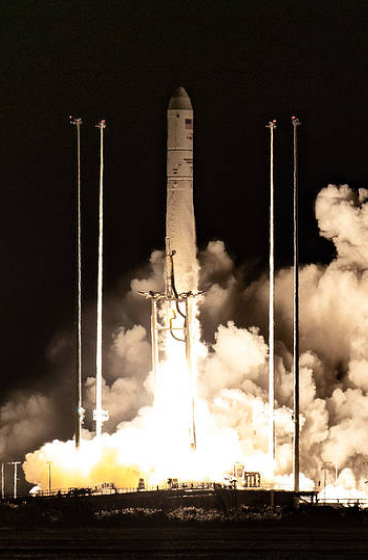
    Ares I-X launch

    The Ares I-X test rocket zooms off Launch Complex 39B at NASA's Kennedy Space Center in Florida. Image credit: Scott Andrews, Canon

    NASA's Ares I-X test rocket lifted off at 11:30 a.m. EDT Wednesday from NASA's Kennedy Space Center in Florida for a two-minute powered flight. The test flight lasted about six minutes from its launch from the newly-modified Launch Complex 39B until splash down of the rocket's booster stage nearly 150 miles down range.

    > News Release
    > Photos


    External Tank ET-134 Arrives at Kennedy Space Center

    ET-134, which will launch space shuttle Atlantis in February, journeys toward the Vehicle Assembly Facility at Kennedy.

    ET-134, which will launch space shuttle Atlantis in February, journeys toward the Vehicle Assembly Facility at Kennedy. Image credit: NASA/MSFC/ Mick Speer

    ET-134 makes its way toward the Vehicle Assembly Building at NASA's Kennedy Space Center, Fla., Oct. 24, after arriving on the Pegasus barge towed by solid rocket booster retrieval ship Liberty Star. Traveling with the external tank during the 900-mile journey from NASA's Michoud Assembly Facility in New Orleans were Marshall Space Flight Center public affairs officer Steve Roy and Marshall Television producer Mick Speer. They provided a unique behind-the scenes look during the seven-day, 900-mile sea journey via a Blog, "Sailing with NASA."

    > Sailing With NASA Blog

    FASTSAT Instruments Shipped to the Marshall Center for Tests and Launch Preparation

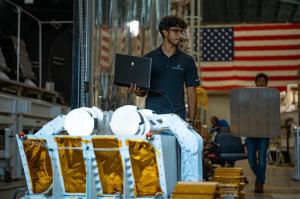
    Three of the satellite instruments that will fly on an upcoming satellite mission called "FASTSAT" have been created at one NASA center and have arrived at another for more tests to ensure they are flight ready for launch. They're now at the Marshall Center for further testing. "FASTSAT" means "Fast, Affordable, Science and Technology Satellite."

    > News Release
    > Photos

    Cooking Up Water From the Moon? NASA Studies Water Extraction With Microwaves

    Dr. Ed Ethridge holds his “moon in a bottle” experiment in his lab at the Marshall Center.

    NASA scientist Dr. Ed Ethridge holds his “moon in a bottle” experiment. Image credit: NASA

    Intrigued by NASA lunar missions in the 1990s which suggested the existence of ice within craters at the moon's poles, NASA scientist Dr. Edwin Ethridge and his team started cooking up a way to extract water from lunar soil. Using a conventional kitchen microwave and lunar soil simulant -- created to have the same characteristics as lunar soil -- Ethridge and his team at the Marshall Space Flight Center in Huntsville, Ala., have literally cooked water out of the soil.

    > News Release
    > Photo
    > Animation
    > Focus on Marshall video

    NASA Tests Load Limits for Ares I Rocket Main Parachute

    Ares Drop Test, October 2009

    Ares main parachute test in Yuma, Ariz. Image credit: U.S. Army Yuma Proving Grounds

    NASA and industry engineers conducted a design limit load test of the Ares I rocket's main parachute Oct. 8 at the U.S. Army's Yuma Proving Ground near Yuma, Ariz. The Ares I is the first rocket in NASA's Constellation Program which will launch explorers on journeys to the International Space Station, the moon and beyond.

    > News Release
    > Photo

All Marshall News

Marshall 2.0: Social Media

View All NASA Blogs

Related News Sites

Past Years Archive

Media Inquiries

    Members of the news media can contact the Marshall Media Relations Department at 256-544-0034.