










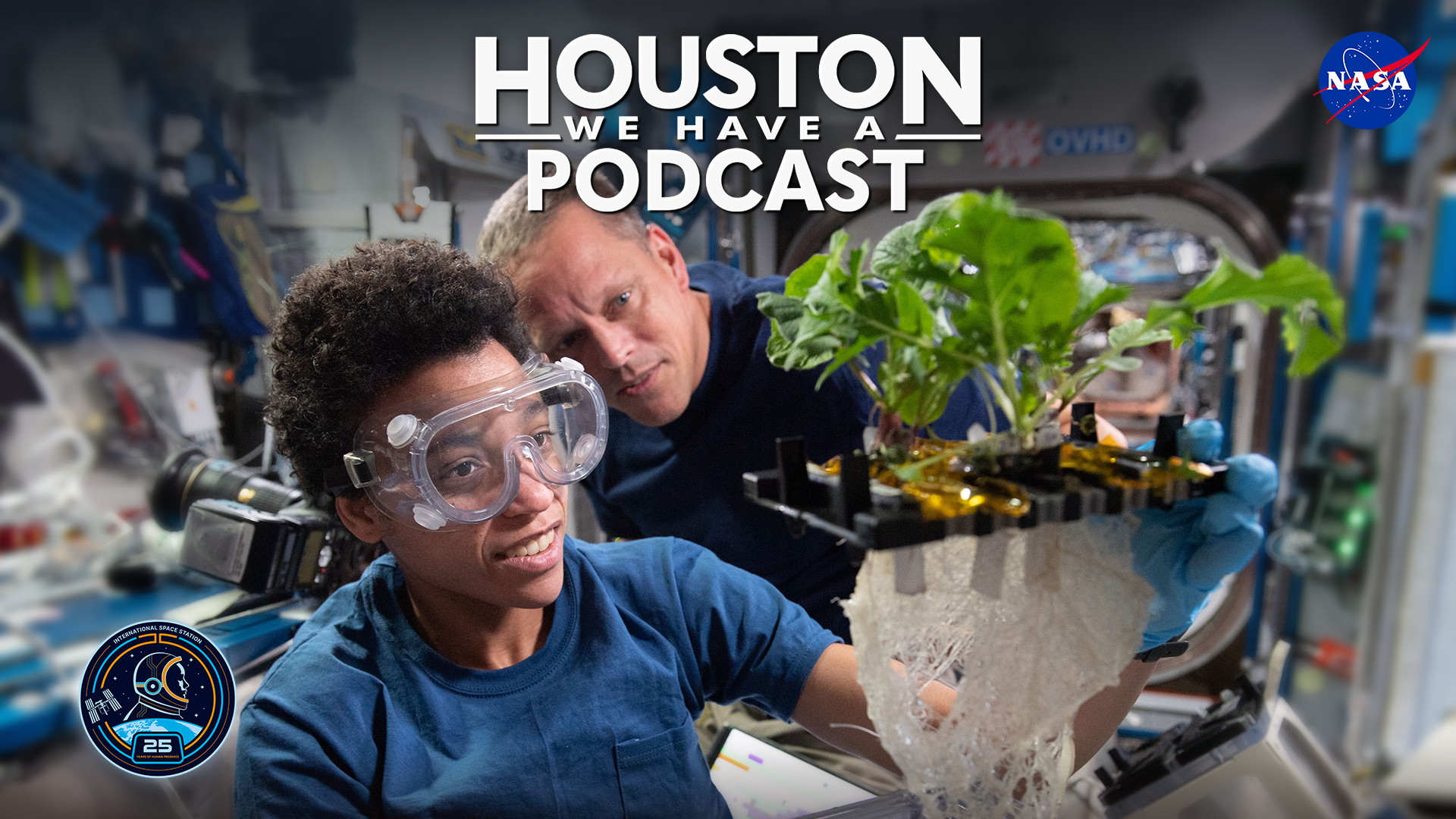




From Earth orbit to the Moon and Mars, explore the world of human spaceflight with NASA each week on the official podcast of the Johnson Space Center in Houston, Texas. Listen to in-depth conversations with the astronauts, scientists and engineers who make it possible.
On episode 406, International Space Station leaders Laura Shaw and Jennifer Buchli discuss the science, discoveries, and innovations that have defined nearly 25 years aboard the orbiting laboratory. This episode was recorded September 23, 2025.
Transcript
Dane Turner
Houston, We Have a Podcast. Welcome to the official podcast of the NASA Johnson Space Center, Episode 404. The evolution of the laboratory. I’m Dane Turner, and I’ll be your host today. On this podcast, we bring in the experts, scientists, engineers and astronauts, all to let you know what’s going on in the world of human spaceflight and more.
We’ve recently hit a monumental milestone. Expedition 1 began on November 2, 2000, so November 2, 2025 marks 25 years of continuous human presence aboard the International Space Station. And to celebrate that, we are dedicating several upcoming episodes to covering different aspects of the ISS and how we got to where we are today.
For nearly a quarter century, the station has been a hub of scientific discovery, international partnership and technological innovation, and those discoveries and innovations are what we’re going to focus on today to tell us more about our orbiting laboratory and the science that’s been done there, we have deputy manager of the ISS vehicle office, Laura Shaw, and International Space Station Program chief scientist Jennifer Buchli. Together, we’ll hypothesize just what it is that makes the International Space Station so instrumental.
Let’s get started.
Dane Turner
Laura, Jennifer, thank you so much for joining us on Houston We Have a Podcast today. Before we get started, can you tell us a little bit about yourselves? What brought you to NASA, and how did you get to where you are today?
Laura Shaw
Yeah, hi. This is Laura. I was born a space nerd. From a very early age, I was fascinated with human space flight in particular, so I spent most of my younger years studying space history, and then went to engineering school with the dream of coming and supporting what however I could. So I was hired as a co op in college, which is like an intern. And then that was 26 years ago, and I’m still still working here today. Love every minute. So I’ve just worked my way up a little bit by little bit to, you know, gain experience over time to this to this point. So it’s been great.
Dane Turner
Fantastic. Jennifer, how about you?
Jennifer Buchli
I actually grew up in this area, so I grew up in the space community. My dad was a shuttle astronaut. So for me, space was very normal, and so that was kind of an interesting experience for me, leaving Clear Lake and going off to college and realizing not everybody knows that people live and work in space and and does science in space. But, you know, at the time, I was really focused on wanting to be a researcher and wanting to be a scientist. And that was pretty competitive. This was pre ISS, as far as flying payloads on the on the space shuttle. So I did some of that work. Worked on some teams that did a shuttle payload when I was in college, and then went to grad school and kind of moved on and worked in research. I worked in some early stem cell research. But I think, you know, always had that, that piece of me that NASA just felt like home. I love the culture, I love the people. And so I came back, I moved around a little bit, had been living abroad, and I came back here, and I applied for a job, and I was like, you know, if I get this job, I’ll stay for a couple years, you know, if not, I’ll move back up to the east coast and be in science. And so at the time, I was offered a job in flight operations. So this was kind of early station. We were doing some science, but we weren’t full up yet, and so I was offered a position working in the ECLSS group, so environmental control and life support, and little did I know, when they hired me, they were about to bring on the regen ecosystem, which is how I met Laura. We worked together, because I take a lot of chemistry, and I knew what a biofilm was. So they were like, great, come on. So I did that for a couple years, and I loved it. So I worked in flight ops, and then right around the time that we finished assembling the International Space Station, I got really serious about coming back to science, and I moved over to the program and joined the program science office. And from there, I’ve been, you know, in that world for about a decade. And as Laura said, you know, kind of moved through some different positions and came back a couple years ago after work in exploration science to be the ISS program chief scientist.
Dane Turner
That’s so cool. Now, Laura, you’re the deputy manager of the ISS vehicle office. So what does that actually mean, right?
Laura Shaw
So the vehicle Office manages the vast majority of the physical things that you think of with the ISS so the modules, the solar arrays, all the systems that make this the ISS function. So like taking the power that the solar arrays are, you know, taking from the sun and converting that into usable power, distributing that to the different you. Users the cooling systems that keep the station both as hot as it needs to be and as cold as it needs to be. We have both problems, you know, and then all the way to the life support systems like Jen was referencing, that keep our crew alive, and then all of the things that make their life comfortable, like crew quarters, sleeping quarters, the kitchen, which we call the galley, and all the equipment that they use. We also are responsible for the what we call payload facilities, which is all the support structure and systems that support research. So different payloads can be launched and installed into these payload facilities to operate on them. So that’s in a nutshell. That’s what the vehicle office does.
Dane Turner
So you think of the ISS as the vehicle, and you’re in charge of the vehicle of the ISS.
Laura Shaw
That’s correct. That’s really I’m the deputy. But yes, okay, yes,
Dane Turner
Jennifer, you’re the ISS program chief scientist. Does that mean that you oversee all of the science on the ISS?
Jennifer Buchli
There are quite a few people who are helping us implement, oversee and manage all the science on the ISS so my primary role is really to set the science strategy for the ISS program, you know, to be a resource for the ISS program manager to consult on scientific matters, and then also to make sure that we are effectively using our resources to complete science. And so this means I work really closely with all the different NASA Science divisions to talk about what they want to accomplish and what our goals are. I also work with the international partners. So I have my counterpart for all of the agencies. We meet together regularly and talk about, what do we want to accomplish? How are we going to do that? You know, people say a lot space is hard, right? It’s also it’s very difficult and it’s very expensive, right? So if we want to accomplish some of these really difficult science investigations, we need to work together. So I, you know, chair, chair, some forums where we talk with other people and our agency and also outside and with our partners to make sure that we’re doing that
Dane Turner
now, we’ve had a laboratory in space. The ISS for 25 years now, and it’s changed a lot over the last two and a half decades. But before we start talking about the evolution of the technology and science on board, I want to ask, what is it about doing science in space that makes the space station so beneficial?
Jennifer Buchli
Yeah, that’s a great question. You know, we have learned a lot as we’ve gone in those 25 years. We’ve made discoveries of ways we can use microgravity to our advantage that we never even knew. So a couple different things is that microgravity can be a game changer for a lot of scientists on the biological side, it can induce a lot of stress in organisms. So you see different responses. You see different genes activate things you don’t think about, like plants, they need gravity to signal where their roots should go. What happens when you take that away? How does that signaling change we have fluid physics works very differently in microgravity, so surface tension becomes a really dominant force for combustion research. Hot air doesn’t rise in space. So, you know, instead of that nice kind of candle shape you get, you get, actually, a ball, if you see some of those experiments. So how does that change it? And so, you know, it really is a great opportunity within the space station and that microgravity environment for researchers to be able to manipulate different phenomenon and factors, to look at their science in a new way. And then, you know, Laura talked a little bit about, you know, the vehicle itself. We have an incredible vantage point, both looking out into space and then also down on the earth. The International Space Station covers 90% of the inhabited surface of earth due to its orbital path. And so we do a lot of science, both, you know, looking out and looking down is how I think about it. We do astrophysics, we do heliophysics. We also do things like, through earth science, taking a look at stress in crops. Like, how do we share that data with farmers so they know before it becomes evident in their crops that they’re experiencing some stress, and it could be a really difficult season. So there’s, there’s quite a bit that that we do on the International Space Station
Dane Turner
that’s so cool. Now the space station is designated as a national laboratory. Can you tell us what that means? And was is that how it was envisioned from the beginning?
Jennifer Buchli
I don’t know if it was envisioned that way, from the beginning, to be honest. You know, I think people always thought about it as a national asset. And then around 2005 Congress designated the International Space Station as a national lab. So that means the doors are open for US companies, as well as the US public. So, you know, you think about Livermore, Sandia, those national labs. 50% of the NASA allocation of our share of the International Space Station is a national lab, so that’s for non NASA users.
Dane Turner
Oh, wow. So in the early days, space was limited, and only a couple of modules were in orbit. How much science was being done then, and was the type of science? Limited due to the equipment constraints
Jennifer Buchli
it was. So I’ll say we were doing science all the way from expedition one. You know, we will always find a way to do science so, but we did some science that was kind of carry on from shuttle. So our first experiment was protein crystal growth. So this has been one that has been a huge success for Space Research. This is really where we’re looking at pharmaceuticals. How do you grow crystals pure and in higher quality? So you can do things like accelerate drug development. So that was in Expedition 1, and then as we added modules, we ramped up capability. And then, you know, Laura can probably talk a lot about that, as far as the facilities coming online, and then also being able to go to Fort Crew. So that was all thanks to Regent iklis and the work that Laura did.
Laura Shaw
That’s exactly right. You know, in the shuttle days, we had a lot of up and down capability. We’d bring science up, we’d do the experiments, bring them down. We also have these refrigerators and freezers that we can use to bring biological science up and down. So that was probably present from early days. But yeah, the facilities on ISS were very limited. It was a very small space. And then as it grew, like Jen just said, we added all kinds of different capabilities. So we started with things like our EXPRESS racks, which are basically open volumes that provide a structural mounting location for for experiments, and then also utilities like power cooling data for communication, you know, up and down, for telemetry to come down, and for commands to be sent up. We can also provide nitrogen, pressurized nitrogen, and vacuum resource so you can vent things overboard. So all kinds of things are available. It’s really just a blank slate, right? A canvas of what what can be done. So that was those were added Express Racks, first launched in 2002 on the space shuttle. We also were able to add a micro gravity science glove box, which allows for experiments like any toxic substance that you can imagine. In a laboratory on Earth, there’s vent hoods, things like that that take away noxious chemicals from the lab environment. It’s a little bit more challenging on in microgravity, because not only do you need to do that, but you also need to contain any liquids that might come loose, or any other particles, or any other thing that could become real serious hazards to the crew. So the glove boxes are these enclosed volumes that you can put whatever inside. You can also give it utilities like power, data, vacuum, etc. And then crew can stick their arms in with gloves and then do the work, and they’re protected from from any sort of risk, right? So those, we added that the microgravity science glove box in 2002 sort of pretty early on as well in the in the program, and then all kinds of other things were added. And over time, I can talk about those as well if you’d like to meet.
Dane Turner
Yeah, yeah. How did it change over time? We added modules. We added more, more- a couple of them are called labs. So like, what? How did our capabilities change as that grew?
Laura Shaw
Yeah. So we added the Japanese Experiment Module and the Columbus, which is the ESA, European Space Agency module, where they can house their facilities and have their experiments. But we also added racks, like a Combustion Integration Rack, where we can do a combustion experiments in microgravity. And Jen mentioned the fact that that, you know, a fire, a fireball, is a ball in microgravity. So we have the facility there that can house different experiment setups. And so we’ve, over time, we’ve done a campaign of solid actually, we just recently did solid fuels. We started with liquids, went to gasses, and then we then we’ve been burning solid so they can test them in different under different conditions, different parameters and different fuels, to learn all about how things burn in space, which can help us with, you know, of course, understanding of fundamental combustion research, but also how things would burn on a- if there was ever a spacecraft incident, you know, we learn a little bit about how the behaviors of those types of phenomena. And then what else do we have? We can do fluids research, like there’s a flow boiling experiment that was performed. But all kinds of things have been done in these different these different facilities. There’s furnaces, so we can test different materials in these a European, developed furnace that was flown so there’s all kinds of things, yeah.
Dane Turner
You mentioned flow boiling? What is that?
Laura Shaw
Do you know about this experiment? I know a little bit about it. I think just flowing like liquids through tubes and then boiling, you create two phases. And how do those two phases that lack liquid in the gas interact together in tubes in microgravity, which is different than it is on earth.
Dane Turner
That sounds fascinating. Right? Yeah,
Jennifer Buchli
so, so, you know, one thing that I think has been really interesting to watch as we talk about, like, looking back over the past 25 years, Laura talked a lot about when we first had to build the lab, and, you know, lab being, I guess, all of ISS right, you know, including the Columbus and the JEM and and really, just do core capability, right? These are the things like that you have in an everyday lab on the ground, right? How do you do it in space? You have glove back boxes. We need centrifuges. We need gas. We need vacuum source, you know, kind of the day to day, like core piece of it. And then there were these really specialized facilities, which is what I feel like early on, was the priority, right of, okay, we know we need to do plant growth, and we need to do combustion, and we need to do and so we had to fly these custom racks to make sure that we could make this all work and manipulate and microgravity. And the cool thing is that I feel like now there are so many commercial companies who are, we call them payload developers or implementation partners, who are bringing their own hardware to the International Space Station. So instead of these large NASA built facilities, now, we have companies that are building their own cube labs to house, you know, cancer research or cellular biology, we’re looking at doing plant growth in new ways. And, you know, can we even do that in the open cabin now? And so I feel like it’s been this really cool evolution. And then, you know, we also added external surfaces too, right, to be able to put stuff out of an airlock, slide it out, expose it to, you know, the vacuum of space, atomic oxygen, see how materials break down, and slide them right back in. And so it’s been
Laura Shaw
There are so many different ways we can experiment on things.
Jennifer Buchli
Yeah, it’s been a cool evolution to see it. In my mind, the in these kind of this, this era of ISS we’re in right now, all the capability we have, and it is becoming more like a core lab with microscopes and Gene sequencers and, you know, stuff that we didn’t really envision when we first started out. So you we just watched it grow and mature in that way,
Laura Shaw
right? It’s almost like we’re limited only by our imaginations.
Jennifer Buchli
Yeah, yeah. And we’ve done, I have to, we’ve done so many tech demos too for exploration, so that’s been a big part of the infrastructure that was kind of planned from the beginning, and really has continued for Absolutely. I don’t know how long, Laura would you say?
Laura Shaw
I just looked it up. We started the evolution of our life support to try to get it to be an exploration version for a Mars mission, sort of a simulated Mars life support system. We started it 10 years ago, started talking about it, and we’ve evolved it over time and demonstrated all kinds of different technologies. For example, we used to recover about, or recycle about 90% of our water on ISS. We’re now at 99% which is huge, right? It’s a huge,
Dane Turner
incredible,
Laura Shaw
yeah. And that’s through learning from how, where we started from, which was a very complex system with a lot of complex parts that have to work together perfectly. And we’ve learned what works well and what doesn’t, and then we’ve added additional capabilities on top of that over time. So it’s been a life support system test bed. The ISS has for many years now, and we’ve been hugely successful in that area.
Dane Turner
That’s so cool. You mentioned now that you’re only limited by your imagination, but looking back, what were some of the challenges due to the limits of technology at the time, and did it impact how things were done on orbit?
Jennifer Buchli
You know, that’s a really good question. I think I can probably talk about it from more of the logistics side, and what I saw, and you can from, from how you guys have evolved the vehicle, you know, and resources there. But, you know, early on, when we were in the assembly phase, as we’re adding modules, the crew is out doing Eva is there, you know, they are very busy building a space station. And so one of the challenges we faced early was crew time. You know, it’s this competing priority of building a lab and doing the science in the lab, right? And so we were able to do science kind of all along. But you know, we would have to work around operational activities during what we call the assembly phase. So I think that was a limiter. And then now some of it is just we have so much interest. And I mentioned some of these commercial companies are starting to bring in their own customers, other government agencies. So the word has gotten out. And now some of that tends to be cargo, right? Is that there’s only so much refrigerated space that we have on our spacecrafts, and so we’re trying really diligently to manage that, to make sure that we are sequencing the science correctly. We’re lining that up with, you know, timeframes and when the crew can work on it. So it’s really a throughput issue, which is a great problem to have.
Laura Shaw
It is so much stuff we can’t fly at all. Yeah, we and, you know. Originally, the ISS started out with three crew members, so we were obviously limited there as well. We can only do so much with three people every day, especially when you’re assembling and maintaining the vehicle. But we were able to expand our capabilities as we added modules and then added systems to, you know, in those spaces, to extend the crew size from three to six, and then we eventually went to seven. So that’s including the Russian segment. So we’ve got four USOS, meaning us honorable segment, which includes our Japanese, Canadian and European partners on the US side. US segment should call it. So anyway, that really, I mean having additional crew members makes a big difference in what you can achieve from a research point of view
Jennifer Buchli
yeah, I think just from the number of hours when we added that seventh crew member, you know, obviously everyone’s sharing the load on maintenance, but also getting to do research. But when we added that seventh crew member, almost all those hours entirely, we saw just straight upper in our science hours. So that, I think that’s probably one of the biggest game changers that we’ve seen, is just being able to add more crew, have more more hands to accomplish the science. And one thing I realized, as we’re talking through all this, we talked about the facilities, the crew members themselves volunteer to be subjects. So that’s another piece of it too, right? Is that the science, like the astronauts, are not only our scientists in space, but they’re also volunteering to be part of the science, to buy down risks for Mars too.
Laura Shaw
Yeah, whether it’s being just their breathing and eating and, you know, all those things, or as actual test subjects with medical experiments, you know, checking how their eyes change or how their muscle mass and bone density and all those things change with exposure to microgravity, and that’s going to be very beneficial for future exploration.
Dane Turner
That’s so cool, how you’re able to layer the science so you’ve got some of your test subjects doing other experiments for you, while you have long running experiments in the space around them. Just so many layers to the science here. So we’ve talked a little bit about how this is a NASA laboratory and a national laboratory. So who all gets to send science to the space station?
Jennifer Buchli
So we have all of our international partners send science to the space station, right? So Laura mentioned our Russian colleagues earlier, you know, the Japanese Space Agency (JAXA), ESA, the European Space Agency. We have OSSE, the Italian Space Agency, as well as the Canadian Space Agency, right? And so we all work together, along with NASA. And then we talked a little earlier in the podcast about how 50% of NASA’s allocation is a national lab open to the US public. So I would say, you know, on the that covers the international piece of it, on the NASA side, we see research coming in from everywhere. We see, you know, people from academia who are proposing internal NASA researchers. We see companies. So I mentioned earlier, we’ve had, you know, a lot of pharmaceutical research done on the International Space Station. We’ve helped some companies like Merck develop and improve some of their blockbuster drugs, like Keytruda, which has been a huge success story for them. They came to us. That’s probably one we talk about a lot because it’s been so impactful through the ISS National Lab to refine, they had already created Keytruda, but refine the the crystals of it basically protein crystal growth for delivery, right? And so we actually just found out this week that it has passed the phase three clinical trials and is now hitting market. So now, instead of people receiving cancer drugs through a port and spending a long time for delivery, people can get a subcutaneous injection. So obviously, a lot of work was done by them on the ground, but some of that purity also, you know, those results were contributed by ISS. So we’re starting to really see everything from pharmaceutical to semiconductor quality improvement. Just you know, as Laura said, right things that I probably would have not even imagined years ago. Yeah, we’re seeing them come through.
Dane Turner
You mentioned how beneficial was to get that seventh crew member there for doing experiments in crew time. How much of an astronaut’s day is taken up doing science on the station.
Laura Shaw
They have to do a lot of, you know, they have to do a fair bit of exercise each day because you’re floating around and, you know, you’ve got to keep your muscles strong. So there’s a fair bit that they just they have to do for that, for maintenance, for, obviously, meals and things like that, but everything else that we don’t need for them to do with system maintenance and all those other upkeep for themselves and the vehicle we put towards science so as much as possible. What do you think? How many hours do you think, a day on average? What do you think?
Jennifer Buchli 24:53
You know? I think it really depends on what we have going on. We recently had a SpaceX, a. Cargo vehicle dock to ISS, we had some really high priority experiments. We had, you know, some of the astronauts that were doing eight hours of science that was their whole day, right? Pretty much doing these long, really high priority investigations for us. But then there are other times where maybe we’re between vehicles, we don’t have a science resupply, or the program has a really high priority EVA. And so those weeks we do very little science, because the focus of everyone shifts on to doing space walks or or whatever else needs to be done. So we can see anything kind of across the whole crew complement, you know, it we’ve had over, you know, 100 hours, 110 hours of science being done a week kind of distributed. But then, you know, it kind of ebbs and flows.
Dane Turner
So as we built out the space station, how has the expanding of our capabilities on the station impacted the research being done, like, like the types of research or, or the types of experiments,
Jennifer Buchli
um, you know, we talked a little bit earlier about some of the external capability. I think that’s an area where we saw, as we built more facilities right now, we basically have things like porches, where we can put things out and change how we’re doing material science. And that wasn’t something that we did early on. You know, I think some of those more commercial or COTS, like facilities that we talked about COTS, or we call them the right the commercial off the shelf, being able to fly, microscopes, being able to fly. We’ve got a DNA sequencer. We can sequence DNA on board. Now, these are things that have have kind of come along as we’ve gone, they’ve allowed us to work more like you would in a normal lab, right? So you can check samples as you go, or you can get data back real time, which is very different than how other programs or maybe even early space station was where you would do the science. But then you’d have to return the samples to the ground, and people would have to wait. So I think that’s one way in which we’ve evolved. I don’t know, from a facility standpoint, or if there’s
Laura Shaw
I was gonna say, I feel like the science has somewhat led us towards what we need to support. So we’ve done rodent research, for example, and so we’ve, you know, there was a time when we were really focused on doing that, and then it kind of has, has kind of tapered off. We had, I’ve mentioned the EXPRESS racks earlier. There’s a certain form factor where they could pay loads, could only be a certain size. We’ve expanded the design to open it up more so that the form factor can be, instead of just a big kind of rectangle. It can be a long and thin rectangle, which can change. In fact, we put one of our ECLSS, our life support tech demos, in that spot because we needed a long, thin packed bed to do carbon dioxide removal, and it wouldn’t have fit in the other version. So we were able to take advantage of that new form factor in the express rack to enable this type of, you know, type of tech demo, technology demonstration on ISS,
Jennifer Buchli
yeah, I think that’s a really good point. You know, as the science changes, it drives us to create these facilities to answer the questions, you know, one that comes to mind is, there’s a variable g centrifuge, right? And so we’ve done a couple experiments where you can actually in space, spin it at different speeds. To Do you know, microgravity, kind of basically zero G, Martian gravity and lunar gravity. And so we’ve done, as we move into exploration, right? We’ve done experiments where you look at, how does concrete cure in all of these different environments with all these different gravity gradients. So neat. I don’t know if people thought about it 25 years ago. I certainly didn’t, but now we’re like, oh, we need to answer this question. How do you actually build things in this environment?
Laura Shaw
I love hearing Jen Talk about these things because, you know, we’re my office. We’re very focused on keep the vehicle running, you know? But when she talks about all the cool thing I didn’t even know about this concrete experiment, for example, it’s amazing.
So we also added a second glove box. We found a lot of users for the glove box capability. The micro gravity science glove box, the one I mentioned, launched in early in the program. Only one crew member can use it, and it’s kind of made for generic use. We flew another one, and it’s a life science glove box. And this one is really tailored towards biological sciences, but it allows two crew members to stick their arms in the to the chamber, which really opens up what can be done. And we can be doing experiments in both of them at the, you know, the both of the glove boxes at the same time, we also actually provide portable Glove boxes. They’re like little plastic tents that are really disposable. But honestly, we could have three glove box experiments going on at once with all these different capabilities. Again, an example of us following where the science is leading us.
Jennifer Buchli
Yeah, I think a cool thing about that is it really alleviated a lot of the traffic jam that we have too. Right? The original glove box was in the lab, and then the life science glove box that Laura described is in the JEM. And then, typically, the when we use the portable glove box a lot of times, we set it up on a table in node two, yep, just to spread people out. So now you can have three simultaneous experiments instead of people waiting sequentially.
Dane Turner
Oh, that’s great. So we’ve had continuous habitation on the ISS for nearly 25 years at this point, what are some of the big milestones or breakthroughs in science in that timeframe?
Jennifer Buchli
Wow, that’s such a such a tough one. So I think we’ve talked about some of the examples. You know, I struggle a little bit when we get these questions, because people will say, like, what’s your favorite experiment? What do you think the biggest breakthrough is? And there are really so many, and they’re all really exciting. So I talked a little bit about how we, you know, have done some work with pharmaceutical companies to take a look at, how do we enhance different drug formulations. So protein crystal growth has been a blockbuster in that we’ve done it for cancer research. You know, a Japanese experiment was able to help with a formulation of a treatment for Duchenne muscular dystrophy that is also in clinical trials in Japan. So that’s that’s been a breakthrough that I feel like really improves life here on Earth. One of the things that we’re also looking at now is a lot of tissue engineering. So you know, when people are trying to use 3d bio printers here on the ground, you’re fighting against gravity, and so a lot of times they have to do is print it into a scaffolding and figure out, how do you fight against that constant pull down, and then also, what do you do with that scaffolding? When you’re done, right? You have to use maybe a harsh chemical to dissolve it, but in microgravity, we can just print and it just stays where we put it. And so we’ve done some really cool things, like been able to print heart tissue. We’ve printed a knee meniscus. So that type of work I’m really excited about again, I think will help improve our lives here on Earth. You know, same thing with organoids. It’s turned out to be a really good 3d model for tumors. So we’ve taken a look at things like, how do we treat triple negative breast cancers, which are notoriously difficult to treat. We’ve tested drugs on the International Space Station and allowed them to interact with the tissue in 3D manner. That’s really difficult to do here in a two dimensional flat petri dish on the ground. So from a from medical standpoint, those are the ones that that really stand out. But I, you know, I could do this with combustion, and talk about, we discovered cool flames, which are flames that ignite at a lower and burn at a lower temperature. We discovered we had that was just something we happened to discover while looking at something else, right happens on Earth too well. We discovered it in space, and then it spawned this whole field of combustion research on earth, of can we design things on earth to burn at these lower temperatures, to make things more fuel efficient as well? And so there have been a lot of these things that you know, I would say that’s the biggest one. Cool flames. It was a phenomenon we didn’t even know about until we learned about it in space
Dane Turner
That’s so, so cool. Well, we’re kind of on a roll here. Are there any others that you can think of that like benefit the people on earth?
Laura Shaw
I was gonna mention some of the fundamental physics research, , which I don’t know a lot about. I strive to understand it better. But the Alpha Magnetic Spectrometer is measuring cosmic rays and trying to find dark matter and antimatter. It’s amazing. And then the Cold Atom Lab is using lasers to test atoms at ultra cold temperatures, like nearly absolute zero. So they can, like, suspend an atom in a little magnetic field because it’s just has no, like, virtually no energy because it’s so cold, so we can understand just the fundamentals of of our world. You know, in our universe, it’s amazing.
Dane Turner
That’s incredible,
Jennifer Buchli
yeah. So that one, you know, that’s an area too, that I feel like has really picked up. You mentioned Cold Atom Lab. So it’s really looking at, it’s quantum physics, you know, essentially, how do these atoms behave as like a particle wave, right? And so they don’t fall in the same way that they do with gravity. But we also are looking at things like, you know, atomic clocks and kind of this whole area of quantum science that I don’t think we started out with, but we’ve evolved during the time that we’ve had the International Space Station and. And found great uses for it. And you asked about, you know, Earth applications. These are great for things like, you know, obviously computing, you know, we use quantum sensors, financial transactions. I mean, this is just a huge national priority. And how do we advance this technology? So we’re, we’re moving into that in space, I think this, this year we also started some semiconductor crystallization experiments too. So you know, it’s great to see new users and new fields coming in.
Dane Turner
That’s so cool. What does the future of science in low Earth orbit look like?
Jennifer Buchli
So the future of science and low earth orbit, from my perspective, we’re here to stay. So, you know, the International Space Station is funded through 2030 and I will tell you we are jam packed with a line of people who want to come do science in low Earth orbit. Post ISS. We’ll move into the commercial LEO Development Program has some platforms that they’re working on. These are basically commercial space stations that will be in low Earth orbit. And so the idea is that as NASA steps out into the solar system again, we start exploring the Moon and Mars, we will become one of the users in low Earth orbit, along with some of these commercial stations. You know, we’ll use them, but some of these other users, we talked about, other government agencies, companies will also continue their research in LEO.
Dane Turner
So we’ve mentioned Moon and Mars a couple times now. How does the research on the ISS right now help us to move forward to the Moon and Mars?
Laura Shaw 37:00
So we talked about the life support systems. I think that’s a big one. We’re also looking at a new exercise device that we’re going to launch relative next year, mid next year, hopefully, to test that out for for a exploration mission like going to Mars, we’re looking at some crew medical devices that, you know, we can’t on ISS. We can send samples home. We can send the crew home even pretty quickly if something happens, if they get sick or injured, they can come home relatively easily. If we’re on a multi year mission to Mars, that’s not going to be the case, so we have to be, you know, have everything we need with us, including abilities to treat illnesses and injuries. So we’re looking into demonstrating some of those types of things, and also like we need to monitor our air and water quality so we make sure our systems are working correctly. So we’re working on ways of being less reliant on sample return for that type of capability.
Jennifer Buchli
Yeah, and Laura mentioned earlier, you know, the way that we use things like zero, boil off, tank and things to look at phase changes. You know, we need to figure out how we want some of the, I guess, some things like fuel transfer to play into our mission architecture. You know, right now we launched that from the earth on the vehicle and at rendezvous with station, and comes back. But you know, you may need these, these depots along the way, right? So if that’s something that you want to build into it, how do you transfer those fluids in space? They work very differently than they do here on the ground. So we’re doing some experiments on the International Space Station that support that. We’re doing a lot of work with plants and nutrition, so that’s something that, you know, we need to make sure we keep astronauts healthy. How do you do that long term, huge psychological benefit, too. I know quite a few of us, including myself, got into gardening during covid, right? So there’s something about being able to grow, but also supplement the nutrition that you have. Like, how do you get those micro nutrients and make sure we make sure we keep our astronauts healthy? So I think, you know, we’ll, we’ll see a lot of things coming out of the International Space Station that help us buy down risks for that, those programs as as we finish, you know, our experiments in the coming years.
Laura Shaw
We also talked about the crew members being test subjects and and learning about how their bodies are affected by long duration space flight. So we’ve had a couple of crew members that have flown for over a year or around a year. So that’s really, you know, helpful to understand how the body reacts to long duration,
Jennifer Buchli
yeah. And then I think for infrastructure, we had ILLUMA-T, which was a laser calm experiment. So we’re doing things like, how do we test communication using new technology from the International Space Station back to Earth? But these are also things that are buying down risk for things like lunar com, right? If we want to use this on the lunar surface, you know, use the International Space Station as a stepping stone. So testing things like that or in the external environment, testing coatings, materials making, you know, design decisions for future programs.
Dane Turner
This has been fantastic, and I have learned so much by have one last question for you, what is one thing that you think the average person would be surprised to learn came about from science on the ISS?
Laura Shaw
I’m going to defer to you, you know all about the science.
Jennifer Buchli
We talked a lot about experiments and results and how it helps your life on Earth, right? We’re monitoring crops where investigating diseases like Alzheimer’s and cancer, right? And having really great results. The thing that I think most people probably don’t know about science on ISS, is that we are open to the public. You know, I think people think a lot about ISS, and think it’s NASA Science for NASA researchers, but 50% of our assets are really open to the American public, American companies, right? So, you know, in universities and high schools, right? Absolutely, right. And so, you know, this is a way that I think International Space Station has has changed people’s access fundamentally. It’s not just for NASA, right? Microgravity and LEO science is for everyone.
Dane Turner
Now, that’s fantastic. Laura and Jennifer, thank you so much for coming on Houston We Have a Podcast today. This has been incredible.
Jennifer Buchli
Thank you. Thank you so much for having us.
Dane Turner
Thanks for sticking around.
This was the second episode celebrating 25 years of continuous human habitation on the International Space Station.
You can check out the latest from around the agency at nasa.gov, and you can learn more about the International Space station at nasa.gov/iss.
Our full collection of episodes, and all of the other wonderful NASA Podcasts can be found at nasa.gov/podcasts. On social media we’re on the NASA Johnson Space Center pages of Facebook, X, and Instagram. If you have any questions for us or suggestions for future episodes, email us at nasa-houstonpodcast@mail.nasa.gov
This interview was recorded on September 23, 2025.
I’m the show’s producer, Dane Turner. Audio engineers are Will Flato and Daniel Tohill. And our social media is managed by Kelsey Howren. Houston We Have a Podcast was created and is supervised by Gary Jordan. Special thanks to Kara Slaughter and Mary Pfister for helping us plan and set up this interview. And of course, thanks to Laura Shaw and Jennifer Buchli for taking the time to come on the show.
Give us a rating and feedback on whatever platform you’re listening to us on, and tell us what you think of our podcast. We’ll be back next week.
3.. 2.. 1.. This is an official NASA podcast.