


















Two NASA Scientific Balloon Launches Planned From Antarctica
NASA’s Scientific Balloon Program is back in Antarctica for another long-duration scientific balloon campaign, with two launches planned from the icy surface. Launch operations will begin early December from the agency’s facility located near the U.S. National Science Foundation’s McMurdo Station on the Ross Ice Shelf.

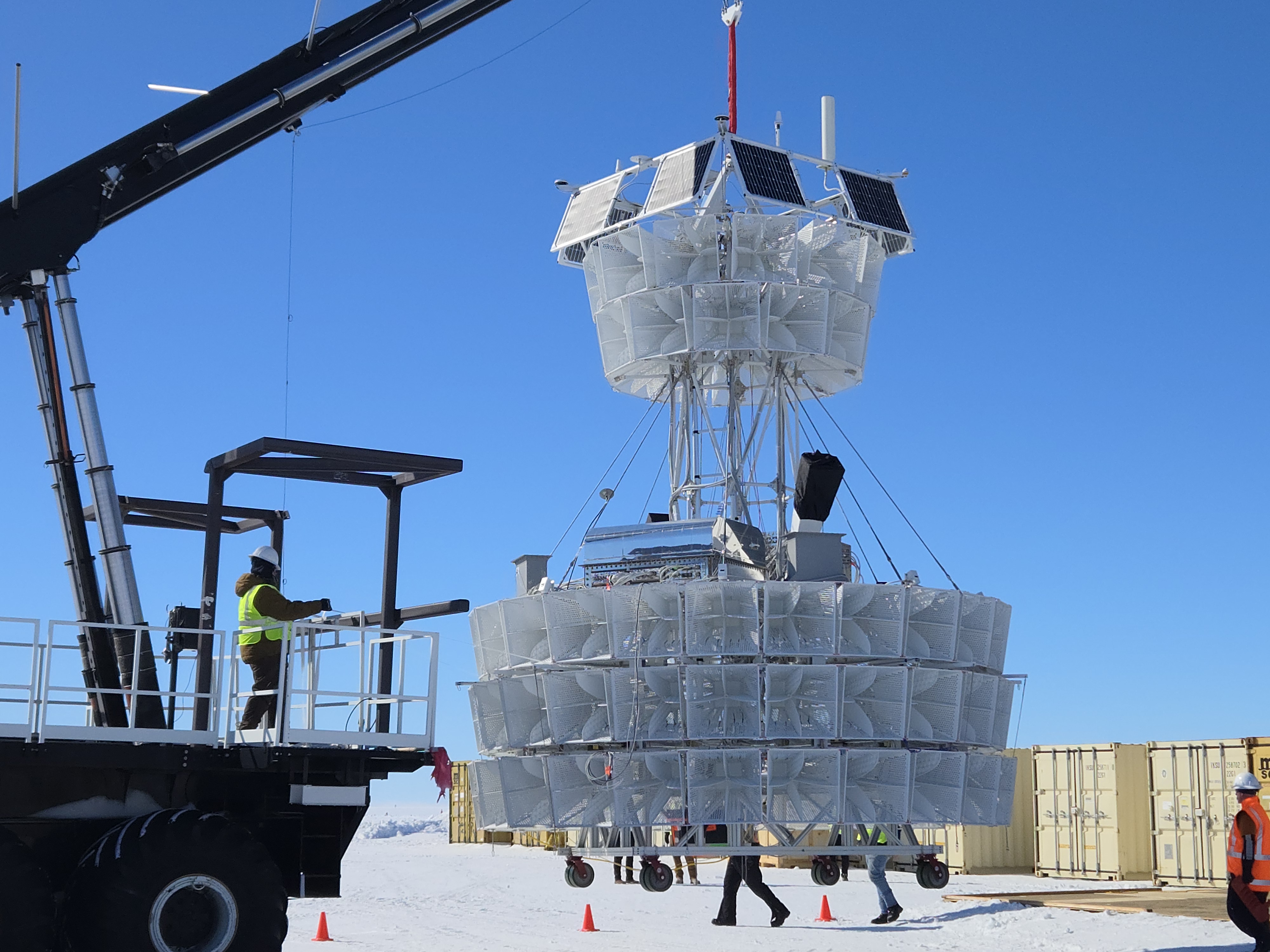
To follow the missions, visit NASA’s Columbia Scientific Balloon Facility website for real-time updates of balloons’ altitudes and locations during flight. The program is supporting two missions this year: the Payload for Ultrahigh Energy Observations (PUEO) and the General AntiParticle Spectrometer (GAPS).
NASA’s PUEO will be the first balloon mission to launch through the agency’s Astrophysics Pioneers program, which supports compelling astrophysics science at a lower cost. The PUEO payload is designed to detect signals from neutrinos, high-energy particles that travel across the universe undisturbed, carrying information about events billions of light-years away. The mission will search for radio signals created when these neutrinos from space hit ice. This will be the most sensitive survey of cosmic ultra-high energy neutrinos ever conducted, offering valuable clues about the highest-energy astrophysical processes, from the creation of black holes to neutron star mergers.
“I’m excited to see our first Astrophysics Pioneer mission on the launch pad, with more to come very soon,” said Shawn Domagal-Goldman, acting director, Astrophysics Division, NASA Headquarters in Washington. “The PUEO mission is essentially like using the Antarctic ice as one big telescope, to detect signals from high-energy events that will help us better understand how our universe works. It’s a great example of the important science we can undertake at a lower cost when we do things differently and embrace innovation, as well as the opportunities the program creates for early- and mid-career researchers.
The GAPS experiment is designed to help reveal the origin of dark matter – an invisible form of matter that makes up more than 80% of the total matter in the universe, yet little is known about its true nature. The GAPS mission is optimized to detect certain anti-matter particles that are only produced when dark matter decays. A single detection of one of those particles could have a tremendous impact on our understanding of how the universe works.
Zero-pressure balloons, used in this campaign, are in equilibrium with their surroundings as they fly. They maintain a zero-pressure differential with ducts that allow gas to escape to prevent an increase in pressure from inside the balloons as they rise above Earth’s surface. This zero-pressure design, polar orbit, and constant sunlight makes the balloons very robust and well-suited for extended duration flights, such as those in this campaign. NASA’s Wallops Flight Facility in Virginia manages the agency’s scientific balloon flight program. Peraton, which operates NASA’s Columbia Scientific Balloon Facility in Palestine, Texas, provides mission planning, engineering services, and field operations for NASA’s Scientific Balloon Program. NASA’s balloons are fabricated by Aerostar. The NASA Scientific Balloon Program is funded by the Science Mission Directorate’s Astrophysics Division at NASA Headquarters in Washington.