











Significant announcements:
26th October 2020
- The MASTER (Modis-ASTER Airborne Simulator) team from the Airborne Sensor Facility (ASF) successfully concluded their support of NASA’s JPL-led 2020 Western Diversity Time Series (WDTS) ER-2 flights out of AFRC. From 17 September through 15 October 2020, conducting 9 successful flights, the AFRC-based NASA ER-2 (809) carried JPL’s AVIRIS and HyTES, as well as the ASF’s MASTER and PICARD instruments. The 2020 WDTS (formerly HyspIRI) observed California’s ecosystems to provide critical information on natural disasters such as volcanoes, wildfires, and drought. On the last flight on 15 October, the ER-2 flew over the central Sierra Nevadas to the Yosemite/Soda Straw area, observing remnants, plumes, and burn scars of the Creek Fire northeast of Fresno, CA.
Link (MASTER quicklook data): https://asapdata.arc.nasa.gov/sensors/master/data/flt_html/2190600.html
Link (CalFire): https://www.fire.ca.gov/incidents/2020/9/4/creek-fire/
- NASA Ames is in Stage 3 in the NASA Response Framework to pandemics – Staff are continuing work with adjustments in work style, focus and schedules due to the COVID-19 distancing protocols. ESPO-managed NASA airborne missions and other programs and projects at Ames are experiencing major schedule delays due to COVID-19. Ames Earth Science Division staff are focusing on data analysis, publications/proposals/reports writing, and computer-aided design work. The division is actively engaged with the directorate/center and with HQ on identifying mission-critical research and activities and is preparing return-to-onsite-work (RToW) implementation plans.
• The Sub-Mesoscale Ocean Dynamics Experiment (S-MODE) Earth Venture Suborbital-3 (EVS-3) investigation managed by ESPO, recently delayed from this fall until spring 2021, received approval to RToW from Ames (https://espo.nasa.gov/s-mode/content/S-MODE).
• Instrument payload development activities at Ames for the Asian Summer Monsoon Chemical and Climate Impact Project (ACCLIP) also received approval last week to proceed with RToW in preparation for the field campaign now planned for summer 2021 in South Korea. Teams are on center as of this week, preparing the laboratory and the COMA instrument for pressure and thermal testing, in anticipation of test flights on the NASA WB-57F research aircraft in spring 2021.
• The Investigation of Microphysics and Precipitation for Atlantic Coast-Threatening Snowstorms (IMPACTS) Earth Venture Suborbital-3 (EVS-3) investigation managed by ESPO received center RToW approval, signed by the Center Director on Thursday October 8th, 2020 (https://espo.nasa.gov/impacts/).
• The SCIFLI-Hayabusa Airborne Re-entry observation Campaign (SHARC) investigation managed by ESPO and operating out of Adelaide (Australia) to observe the re-entry of JAXA’s Hayabusa Sample Return Mission received center RToW approval, signed by the Center Director on Thursday 8 October 2020 (https://espo.nasa.gov/sharc/)
19th October 2020
- Chris Potter’s work “Assessing California Fire Scars” was featured as NASA Earth Observatory’s Image of the Day on Oct 15, 2020 – Using remote sensing data of near-infrared (NIR) and shortwave-infrared (SWIR) light collected by Landsat 8 for the time period July 24 through September 26, 2020, Potter quantified the wildfire burn ratios for two Bay Area wildfires that were ignited by lightning in August 2020: The CZU Lightning Complex Fire and the SCU Lightning Complex Fire. By analyzing subtle differences in the NIR and SWIR bands of Landsat 8, Potter derived the normalized burn ratio.
Link: https://earthobservatory.nasa.gov/images/147374/assessing-california-fire-scars

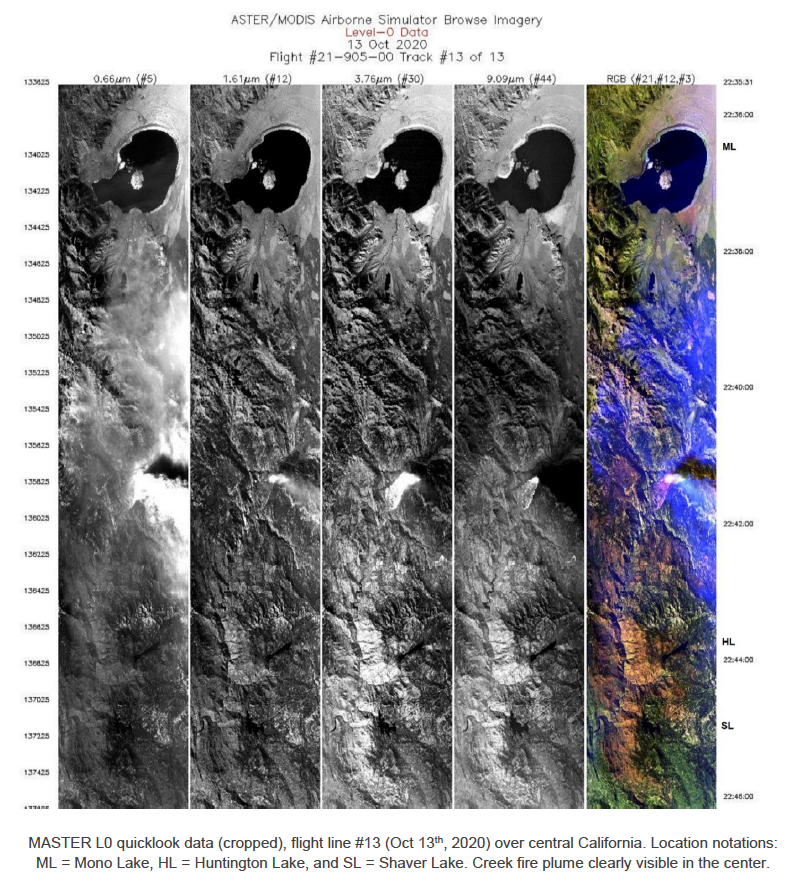
- The Airborne Sensor Facility’s (ASF) MASTER (Modis-ASTER Airborne Simulator) team continues to support NASA’s JPL-led Western Diversity Time Series (WDTS) ER-2 flights out of AFRC. They had had a successful flight over the San Francisco Bay Area box on Tuesday October 13th, and are flying again today Thursday October 15th, for the final collect of this season. During Tuesday’s flight, observations of the Creek fire in the Sierra Nevada mountains northeast of Fresno CA were made.
Link (MASTER data): https://asapdata.arc.nasa.gov/sensors/master/data/flt_html/2190500.html
Link (CalFire): https://www.fire.ca.gov/incidents/2020/9/4/creek-fire/
- NASA Ames is in Stage 3 in the NASA Response Framework to pandemics – Staff are continuing work with adjustments in work style, focus and schedules due to the COVID-19 distancing protocols. ESPO-managed NASA airborne missions and other programs and projects at Ames are experiencing major schedule delays due to COVID-19. Ames Earth Science Division staff are focusing on data analysis, publications/proposals/reports writing, and computer-aided design work. The division is actively engaged with the directorate/center and with HQ on identifying mission-critical research and activities and is preparing return-to-onsite-work (RToW) implementation plans.
• The Sub-Mesoscale Ocean Dynamics Experiment (S-MODE) Earth Venture Suborbital-3 (EVS-3) investigation managed by ESPO, recently delayed from this fall until spring 2021, received approval to RToW from Ames (https://espo.nasa.gov/s-mode/content/S-MODE).
• Instrument payload development activities at Ames for the Asian Summer Monsoon Chemical and Climate Impact Project (ACCLIP) also received approval last week to proceed with RToW in preparation for the field campaign now planned for summer 2021 in South Korea. Teams are on center as of this week, preparing the laboratory and the COMA instrument for pressure and thermal testing, in anticipation of test flights on the NASA WB-57F research aircraft in spring 2021.
• The Investigation of Microphysics and Precipitation for Atlantic Coast-Threatening Snowstorms (IMPACTS) Earth Venture Suborbital-3 (EVS-3) investigation managed by ESPO received center RToW approval, signed by the Center Director on Thursday October 8th, 2020 (https://espo.nasa.gov/impacts/).
• The SCIFLI-Hayabusa Airborne Re-entry observation Campaign (SHARC) investigation managed by ESPO and operating out of Adelaide (Australia) to observe the re-entry of JAXA’s Hayabusa Sample Return Mission received center RToW approval, signed by the Center Director on Thursday 8 October 2020 (https://espo.nasa.gov/sharc/)
13th October 2020
- NASA’s Western Diversity Time Series (WDTS, formerly HyspIRI) flew a southern California sortie on 7 October, observing wildland fires and other targets. The Airborne Sensor Facility’s (ASF) MODIS-ASTER (MASTER) Airborne instrument team is supporting the JPL-led WDTS project funded by the SMD Earth Science Division Biodiversity Program. Data collected from ER-2 flights deployed out of Palmdale, CA, are being combined with Airborne Visible and IR Imaging Spectrometer (AVIRIS) data, operated by JPL, to develop a data set that prepares the science community for the NASA Surface Biology and Geology Designated Observable study, which is in pre-formulation and currently evaluating mission architecture.. Quick look data from the MASTER instrument is also being provided to agencies responding to the current CA wildfires through the NASA Applied Sciences Portal.
Link: https://go.nasa.gov/36JlIlM - The Indigenous Peoples Capacity Building Initiative, led by Cindy Schmidt and Amber McCullum, in partnership with the United Tribes Technical College are hosting the all-virtual Introduction to Remote Sensing for Tribal Lands training series, starting on Tuesday 6 October 2020 – This course will consist of four modules: (1) An Introduction to Remote Sensing and NASA Data, (2) Land Cover Classification, (3) Change Detection and Time Series Analysis, and (4) Web Tools for Remote Sensing. Each module will be presented with lectures and hands-on lab exercises where participants will analyze data using Geographic Information System (GIS) software. Each week, we will focus on a different tribal region in the U.S. with guest speakers from the Navajo Nation, the Sault Ste. Marie Band of Chippewa Indians, the Rosebud Sioux tribe, and the Tulalip Tribes. This multi-week training series will take place each Tuesday at Thursday at 12-2pm ET (UTC-4:00), and has over 230 registrants.
Link: https://appliedsciences.nasa.gov/join-mission/training/english/introduction-remote-sensing-tribal-lands - NASA Ames is in Stage 3 in the NASA Response Framework to pandemics – Staff are continuing work with adjustments in work style, focus and schedules due to the COVID-19 distancing protocols. ESPO-managed NASA airborne missions and other programs and projects at Ames are experiencing major schedule delays due to COVID-19. Ames Earth Science Division staff are focusing on data analysis, publications/proposals/reports writing, and computer-aided design work. The division is actively engaged with the directorate/center and with HQ on identifying mission-critical research and activities and is preparing return-to-onsite-work (RToW) implementation plans.
• The Sub-Mesoscale Ocean Dynamics Experiment (S-MODE) Earth Venture Suborbital-3 (EVS-3) investigation managed by ESPO, recently delayed from this fall until spring 2021, received approval to RToW from Ames (https://espo.nasa.gov/s-mode/content/S-MODE).
• Instrument payload development activities at Ames for the Asian Summer Monsoon Chemical and Climate Impact Project (ACCLIP) also received approval last week to proceed with RToW in preparation for the field campaign now planned for summer 2021 in South Korea. Teams are on center as of this week, preparing the laboratory and the COMA instrument for pressure and thermal testing, in anticipation of test flights on the NASA WB-57F research aircraft in spring 2021.
• The Investigation of Microphysics and Precipitation for Atlantic Coast-Threatening Snowstorms (IMPACTS) Earth Venture Suborbital-3 (EVS-3) investigation managed by ESPO received center RToW approval, signed by the Center Director on Thursday October 8th, 2020 (https://espo.nasa.gov/impacts/).
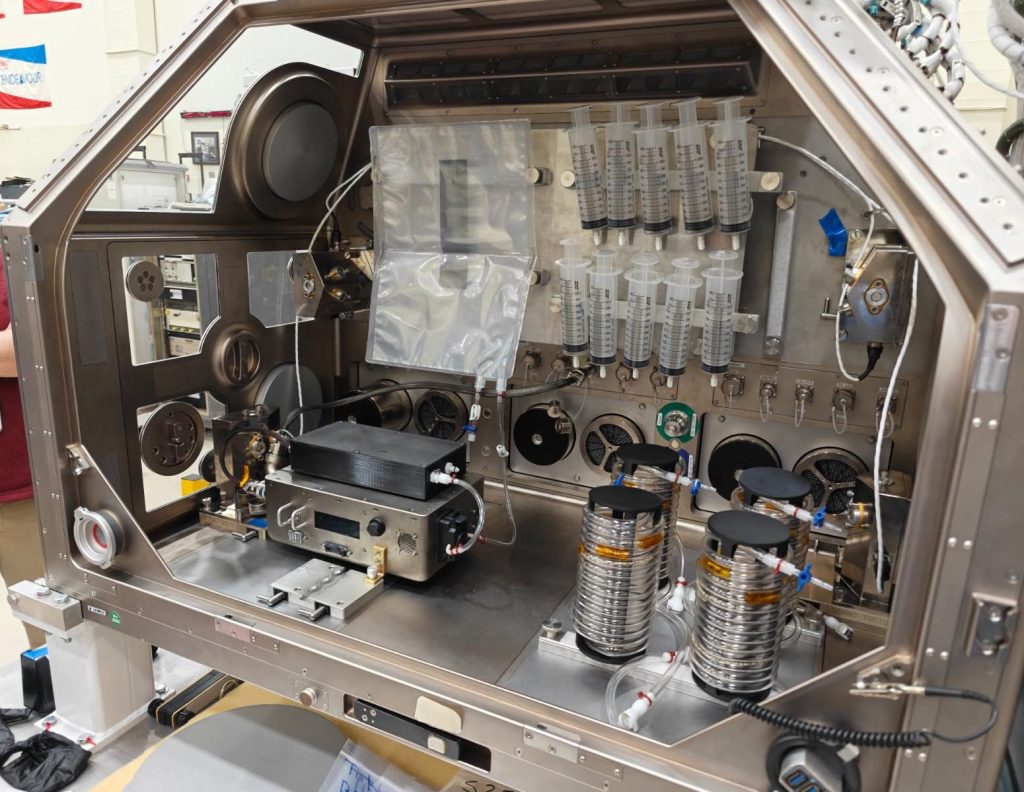
• The SCIFLI-Hayabusa Airborne Re-entry observation Campaign (SHARC) investigation managed by ESPO and operating out of Adelaide (Australia) to observe the re-entry of JAXA’s Hayabusa Sample Return Mission received center RToW approval, signed by the Center Director on Thursday 8 October 2020 (https://espo.nasa.gov/sharc/) - The Carbon monoxide Measurement from Ames (COMA) Instrument team has successfully passed all reviews and inspections and is resuming on-site instrument development work in support of the ACCLIP airborne field campaign – The COMA instrument was selected by NASA’s Earth Science Division to participate in the Asian Summer Monsoon Chemical and Climate Impact Project (ACCLIP) field campaign, now scheduled for summer 2021. Before test flights on the WB-57 aircraft (March 2021), COMA needs to be modified to fly in an unpressurized cargo pallet with an in-flight calibration system to provide sufficient accuracy to meet the science needs of ACCLIP. The recent RToW approval allows the team to do laboratory as well as environmental chamber testing of modifications recently completed by the manufacturer and to continue our engineering design work which was significantly slowed by telework limitations.
- Samuel LeBlanc was featured in a blog post from Bay Area Environmental Research Institute (BAERI), showcasing one of SGG’s scientist.
Link: https://medium.com/bay-area-environmental-research-institute/climate-scientist-samuel-leblanc-is-working-to-reduce-of-the-biggest-uncertainties-in-climate-62647686e078
5th October 2020
- The MODIS-ASTER Airborne Simulator (MASTER) observed the Bobcat Fire in the San Gabriel Mountains (Angeles National Forest) on 17 September 2020 – MASTER is managed and operated by the NASA Ames Sensor Facility (ASF) on behalf of the NASA SMD Earth Observing System (EOS) Program. The current flights with together with JPL’s AVIRIS and the ASF’s PICARD instruments on the ER-2 are part of a long-term time series being built in support of future satellite missions and to explore how imaging spectroscopy from visible through the mid-wave and longwave infrared can be used to understand and model land surface change. With the ongoing wildfire disasters unfolding, ASF was asked to provide near-real-time quicklooks of the raw MASTER data.
Two overpasses of the Bobcat Fire in the San Gabriel Mountains (Angeles National Forest) were flown by MASTER on 17 September 2020. MASTER acquired the imagery from 65,000 feet (20 km) while flying aboard the NASA ER-2 (809) based out of Palmdale, CA as part of the Western Diversity Time Series Campaign (formerly HyspIRI).
Subsequent missions on 24 and 25 September 2020 acquired similar imagery over the Creek Fire in the Sierra Nevada Mountains. The ASF’s Eric Fraim (ARC/USRA) and Rose Dominguez (ARC/USRA) supported the activities to observe this ongoing disaster with airborne instruments. - NASA Ames is in Stage 3 in the NASA Response Framework to pandemics – Staff are continuing work with adjustments in work style, focus and schedules due to the COVID-19 distancing protocols. ESPO-managed NASA airborne missions and other programs and projects at Ames are experiencing major schedule delays due to COVID-19. Ames Earth Science Division staff are focusing on data analysis, publications/proposals/reports writing, and computer-aided design work. The division is actively engaged with the directorate/center and with HQ on identifying mission-critical research and activities and is preparing return-to-onsite-work (RToW) implementation plans.
- The Sub-Mesoscale Ocean Dynamics Experiment (S-MODE) Earth Venture Suborbital-3 (EVS-3) investigation managed by ESPO, recently delayed from this fall until spring 2021, received approval to RToW from Ames (https://espo.nasa.gov/s-mode/content/S-MODE).
- Instrument payload development activities at Ames for the Asian Summer Monsoon Chemical and Climate Impact Project (ACCLIP) also received approval last week to proceed with RToW in preparation for the field campaign now planned for summer 2021 in South Korea. Teams are on center as of this week, preparing the laboratory and the COMA instrument for pressure and thermal testing, in anticipation of test flights on the NASA WB-57F research aircraft in spring 2021.
- The Investigation of Microphysics and Precipitation for Atlantic Coast-Threatening Snowstorms (IMPACTS) Earth Venture Suborbital-3 (EVS-3) investigation managed by ESPO received center RToW approval on 1 Oct and the plan is expected to be signed by the Center Director the week of 5 Oct 2020 (https://espo.nasa.gov/impacts/).
NASA’s Western Diversity Time Series (WDTS, formerly HyspIRI) flew a southern California sortie on 7 October, observing wildland fires and other targets. The Airborne Sensor Facility’s (ASF) MODIS-ASTER (MASTER) Airborne instrument team is supporting the JPL-led WDTS project funded by the SMD Earth Science Division Biodiversity Program. Data collected from ER-2 flights deployed out of Palmdale, CA, are being combined with Airborne Visible and IR Imaging Spectrometer (AVIRIS) data, operated by JPL, to develop a data set that prepares the science community for the NASA Surface Biology and Geology Designated Observable study, which is in pre-formulation and currently evaluating mission architecture.. Quick look data from the MASTER instrument is also being provided to agencies responding to the current CA wildfires through the NASA Applied Sciences Portal.