









Significant announcements:
30 October 2019.
- 4 – 6 November 2019. SMD ESD Earth Surface and Interior Science Team Meeting. NASA Solid-Earth Team Meeting, La Jolla, California. The NASA Solid-Earth Team includes investigators funded by Earth Surface and Interior (ESI) and related NASA research programs, associated postdocs, graduate students and their advisors, and members of mission science teams working on topics relevant to ESI. The inaugural annual meeting will offer opportunities for face-to-face interactions among the broader ESI (https://science.nasa.gov/earth-science/focus-areas/surface-and-interior) community, sharing of ESI research highlights, information about upcoming missions, solicitations, and research opportunities, as well as training sessions and tutorials on key capabilities for the ESI community. The program will also include discussions to collect community input that could help inform future projects, campaigns, or funding opportunities. Matthew Fladeland will be giving an invited keynote regarding Technology Disruptions in Earth Science, focusing on Unmanned Aircraft Systems. Ian Brosnan and Ryan Spackman will also be attending on behalf of the Ames Earth Science Division. The meeting will be held at the Scripps Institution of Oceanography. Link: https://sites.google.com/a/nasa.gov/esi-2019/home
- 28 – 30 October 2019. DCOTSS (Dynamics and Chemistry of the Summer Stratosphere). The Science Team Meeting is being held in Denver, Colorado. DCOTSS is an Earth Venture Suborbital-3 investigation managed by ESPO to examine the impacts of intense thunderstorms over the US on the summertime stratosphere. Paul Bui and Ju-Mee Ryoo are attending the meeting on behalf of the Ames Earth Science Division. Link: http://dcotss.org
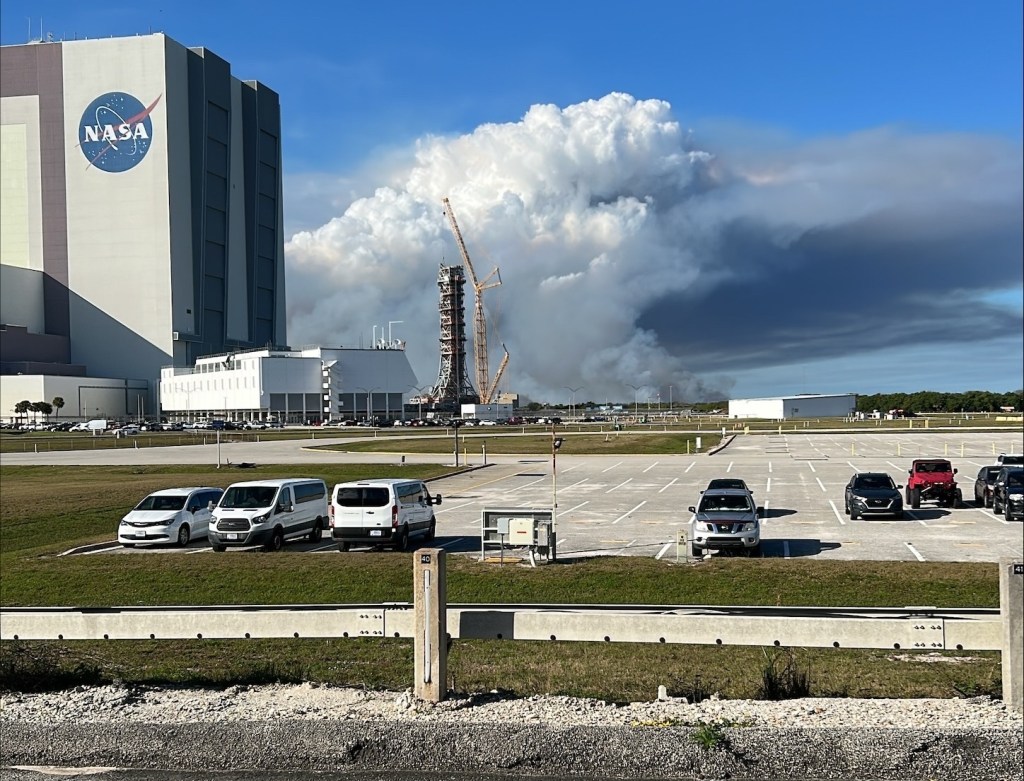
- FIREX-AQ (Fire Influence on Regional to Global Environments eXperiment– Air Quality) – Deployment is complete. Instrument removal from the NASA DC-8 research aircraft is complete.
- Airborne Science Program Fall 2019 Newsletter – The Airborne Science Program has published their recent Fall 2019 Newsletter: https://airbornescience.nasa.gov/sites/default/files/documents/ASP_Fall_2019_Newsletterpdf.pdf The next newsletter will be published in spring 2020.
23 October 2019.
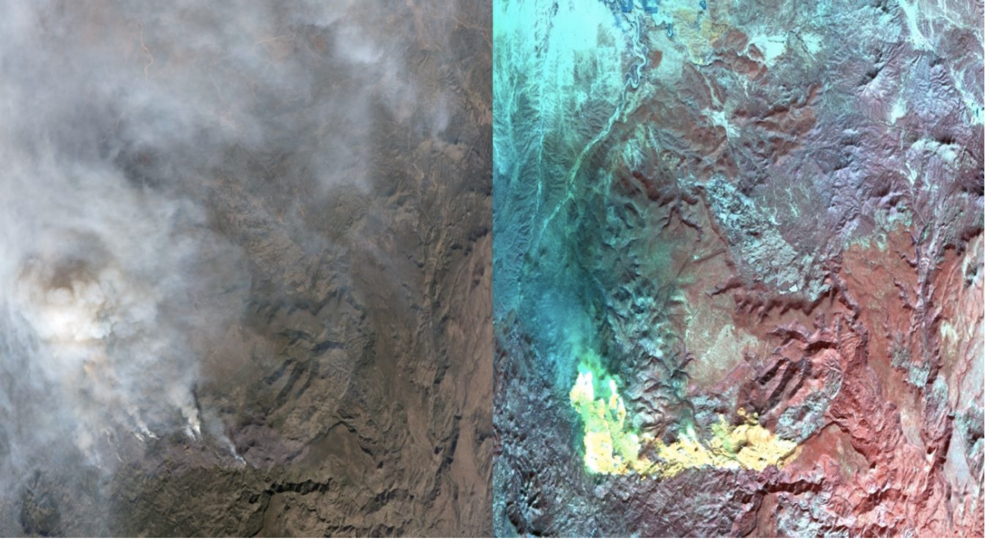
- FIREX-AQ (Fire Influence on Regional to Global Environments Experiment – Air Quality) – The Ames Airborne Sensor Facility (ASF) was heavily involved in the FIREX-AQ experiment this summer. A joint NASA/NOAA effort, FIREX-AQ was designed to obtain detailed measurements of trace gas and aerosol emissions from wildfires and prescribed burns, relate them to fuel and fire conditions at the point of emission, and characterize the chemical transformation of smoke plumes as they are transported across the landscape. Large-scale assessments of air quality impact and the efficacy of satellite detections for estimating fire emissions are key goals of the experiment. The ASF staff operated two multi-spectral infrared imaging devices to pin-point the sources of smoke emissions and to estimate the radiative power of the fires. The MASTER instrument (MODIS/ASTER Airborne Simulator) was flown on the NASA DC-8 research aircraft together with in-situ atmospheric sampling systems, while the eMAS (enhanced MODIS Airborne Simulator) instrument was operated at high altitude on the NASA ER-2.
- Daniel Griffith is now onboard – The second joint NASA/USGS post-doctoral fellow recently finished his Ph.D. at Oregon State University and his post-doctoral research is focused on developing hyperspectrally-derived globally-scalable Lineage-based Functional Types models (LFTs) that will enable Earth System Models (ESMs) to represent more complex vegetation traits and enhance ESM predictions. As a member of the Surface Biology and Geology (SBG) Study Team, he will also be assisting the SBG Modeling Working Group, co-led by ARC’s Weile Wang, in quantifying the science return from these and similar models given select observing system architectures (including instrument performance and mission parameters). He is co-advised by Ramakrishna Nemani (NASA) and Kristin Byrd (USGS).
- Meytar Sorek-Hamer (ARC, USRA) and Marit Meyer (GRC) presented at AAAR Conference in Portland, Oregon. 14 – 18 October 2019
The American Association for Aerosol Research (AAAR) 37th Annual Conference shared latest research progress in aerosol science and technology, while networking and re-connecting researchers in related fields.
“Developing an Air Quality Index for Space Vehicles and Habitats”
Abstract: The development of an adequate tool to help the layperson understand pollution levels in their environment is of high importance. This tool must be able to inform about the levels of pollution in a simple and understandable way but also can be used for decision-making and mitigation activities to protect the health of the exposed population. One of the most useful and up-to-date approaches for characterizing air pollution is the Air Quality Index (AQI). It is an easily-calculated, powerful, data-driven tool that summarizes a complex phenomenon, such as air pollution, in straightforward indicators. The AQI system has been developed in different countries around the world, mainly for outdoor environments, based on the results of risk assessments, epidemiological studies, and current local air pollution regulations and standards. There is a need for such a system in low gravity indoor environments where air quality is of fundamental importance to astronaut health, with concerns encompassing both gaseous contaminants and particulate matter. Earth-based AQIs cannot be extrapolated to microgravity indoor environments due to different aerosol transport characteristics and altered lung deposition in low and partial gravity. The objectives of this work are to explore what areas of expertise, types of research, and data will be required to formulate a spacecraft-specific AQI. An initial dataset is available for this effort, combined from two aerosol sampling experiments, which have characterized airborne particulate matter on the International Space Station (ISS). We outline future research needs for formulating a narrowly focused version of a widely-used metric, namely, an indoor AQI for future space missions.
Link: https://www.aaar.org/2019/ - Cindy Schmidt (SGE) is participating in the workshop in San José, Costa Rica. 22 – 25 October 2019
“Mapping Nature for People and Planet in Costa Rica” Workshop
The workshop is organized by the UN Development Programme and the Costa Rica Ministry of Environment. This workshop brings together policy makers and international spatial data experts to identify nature-based solutions for biodiversity, climate and sustainable development.
- Anh Nguyen and Adam Zufall will be participating in the meeting at Jet Propulsion Laboratory (JPL). 29 – 30 October 2019. Surface Biology and Geology (SBG) Team-X Meeting
The outcome of this meeting will be high-level technical feasibility ratings (e.g., high/low/none) for a set of potential SBG instruments based on cost, technical resource, and performance constraints. These ratings will subsequently be used to winnow down the 60+ potential SBG architectures to three, or fewer, architectures suitable for detailed subsystem level design studies. Anh Nguyen is the SBG Architecture Formulation Co-Coordinator and Adam Zufall is a contributing engineer. The Surface Biology and Geology Study is one of four pre-Phase A studies for the observing system missions identified in the 2017 Earth Science Decadal Survey to which Ames Research Center is contributing science, technology, and engineering expertise.
Link: https://sbg.jpl.nasa.gov/news-events/2019-surface-biology-and-geology-sbg-community-workshop
Project Milestones
C-HARRIER Team Flight Readiness Review on 24 October 2019
- On 24 October 2019, Jim Eilers will lead the C-HARRIER Team’s flight readiness review of the new airborne 3STAR instrument integration on the Naval Postgraduate School’s Twin Otter Platform. The full payload will include the fairing installation of radiometers that have flown in past missions (2011 and 2013) supporting coastal water quality research. The addition of the 3STAR sun photometer enables measurements of aerosol optical thickness (AOT) that will be used to tune the atmospheric correction of the airborne radiometers used for deriving water-leaving radiance (water quality). 3STAR is part of an airborne instrument suite capability for coastal and inland waters calibration and validation.
16 October 2019.
- CAMP2Ex (Cloud, Aerosol, Monsoonal Processes – Philippines Experiment) – Deployment, including 19 science flights, has been successfully completed. Air and sea shipments in transit. CAMP2Ex addressed the complex, inter-related physical processes between aerosols, cloud microphysics, and radiation in the tropical atmosphere often influenced by human-made pollution. Link: https://espo.nasa.gov/camp2ex
- S-MODE (Sub-Mesoscale Ocean Dynamics Experiment) – Confirmation Assessment Meeting will be held on 1 November 2019. S-MODE is an Earth Venture Suborbital-3 investigation managed by ESPO to examine the sub-mesoscale variability in ocean-atmosphere exchange over the Pacific Ocean off the coast of Northern California. Link: https://espo.nasa.gov/s-mode
- IMPACTS (Investigation of Microphysics and Precipitation for Atlantic Coast-Threatening Snowstorms) – The integration of the instrument payload on the ER-2 research aircraft will begin at AFRC on 12 November 2019. The chief objective of this Earth Venture Suborbital-3 investigation managed by ESPO is to improve our predictive capability for east coast snowstorms. Link: https://espo.nasa.gov/impacts
-
Matthew Fladeland (SG) presented at Pecora 21 Conference in Baltimore, Maryland. 6-11 October 2019.
This was a joint meeting of the 21st William T. Pecora Memorial Remote Sensing Symposium (Pecora 21) and the 38th International Symposium on Remote Sensing of Environment (ISRSE-38). The combined conference was hosted by NASA, NOAA and the USGS, with an overarching theme of “Earth Observation – Continuous Monitoring of Our Changing Planet: From Sensors to Decisions.”
“Demonstrating next-generation high-altitude, long-endurance aircraft for earth science”
Matthew Fladeland, Susan Schoenung, Randal Albertson
Abstract:
This paper will address NASA activities to monitor and study Earth processes from long-duration unmanned aircraft systems (UAS). NASA is currently supporting both large and small UAS development and demonstration. In a follow-on to previous work, NASA Armstrong Flight Research Center is hosting test flights of a large AeroVironment solar-powered aircraft, while NASA Ames Research Center is supporting the demonstration of a light-weight solar-powered aircraft by Swift Engineering. Both are designed for long-duration, multi-day flight. Recent significant commercial investments are now leading to the realization of a long-held goal of week- to month-long sustained observations and measurements from the stratosphere. We will also report on progress towards a NASA-supported flight tests solar electric vehicles planned for 2019.
-
The Science Team Meeting will be held in Denver, Colorado. 28 – 30 October 2019.
DCOTSS (Dynamics and Chemistry of the Summer Stratosphere) is an Earth Venture Suborbital-3 investigation managed by ESPO to examine the impacts of intense thunderstorms over the US on the summertime stratosphere.
Paul Bui and Ju-Mee Ryoo are attending the meeting on behalf of the Ames Earth Science Division. Link: http://dcotss.org
-
SMD ESD Earth Surface and Interior Science Team Meeting. NASA Solid-Earth Team Meeting, La Jolla, California. 2 – 6 November 2019.
The NASA Solid-Earth Team includes investigators funded by Earth Surface and Interior (ESI) and related NASA research programs, associated postdocs, graduate students and their advisors, and members of mission science teams working on topics relevant to ESI. The inaugural annual meeting will offer opportunities for face-to-face interactions among the broader ESI (https://science.nasa.gov/earth-science/focus-areas/surface-and-interior) community, sharing of ESI research highlights, information about upcoming missions, solicitations, and research opportunities, as well as training sessions and tutorials on key capabilities for the ESI community. The program will also include discussions to collect community input that could help inform future projects, campaigns, or funding opportunities.
Matthew Fladeland will be giving an invited keynote regarding Technology Disruptions in Earth Science, focusing on Unmanned Aircraft Systems. Ian Brosnan will also be attending on behalf of the Ames Earth Science Division.
9 October 2019.
- CAMP2Ex (Cloud, Aerosol, Monsoonal Processes – Philippines Experiment) – Deployment, including 19 science flights, has been successfully completed. The NASA P-3B research aircraft departed from the Philippines and is in transit back to WFF (Wallops Flight Facility). De-integration of the instrument payloads will begin on 11 October 2019. Link: https://espo.nasa.gov/camp2ex
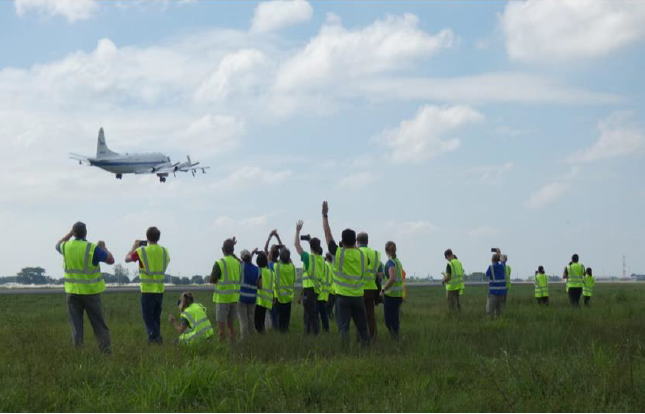
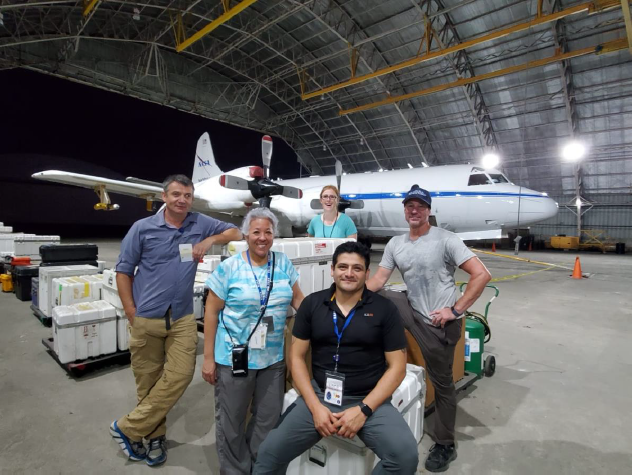
- IMPACTS (Investigation of Microphysics and Precipitation for Atlantic Coast – Threatening Snowstorms) – The team has successfully completed their Investigation Confirmation Review with NASA HQ. A site visit to Hunter Army Airfield in Savannah, Georgia is underway. Integration of the instrument payloads on the NASA ER- 2 research aircraft will begin in November in preparation for the first field campaign in Jan-Mar 2020. Link: https://espo.nasa.gov/impacts
2 October 2019.
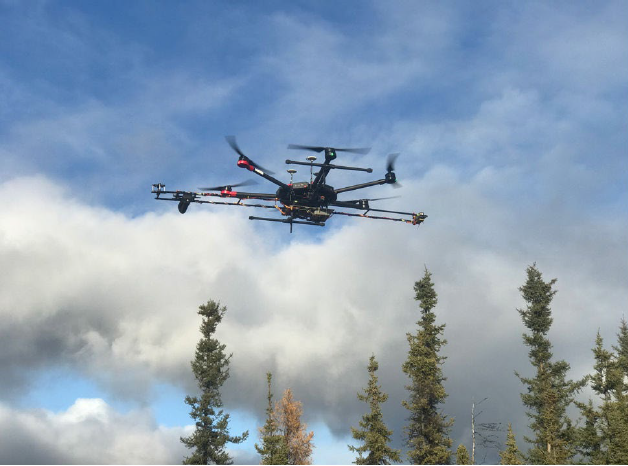
- NASA Ames supports USGS methane measurements in Alaska – A joint NASA-USGS team lead PI Kristen Manies (USGS) completed flight testing and data collection with a new CH4 sensor integrated onto a DJI M600 multirotor UAS. The project is being funded by the USGS Innovation Center to evaluate the utility of SUAS to provide measurements of CH4 fluxes from ecosystems. The deployment took place outside of Fairbanks, AK and the team successfully flew several missions over bogs and wetlands. The payload also included a sonic anemometer which will enable the team to derive fluxes of CH4. The long-term goal of the project is to enable multi-tiered remote sensing of CH4 emissions at various scales to enable scaling up of local measurements to enable regional estimates of CH4 emissions in this rapidly changing region. Rick Kolyer (Code SGG) lead the integration engineering and also assisted in piloting the aircraft.
- CAMP2Ex (Cloud, Aerosol, Monsoonal Processes – Philippines Experiment) – Deployment continues. Sixteen P-3B science flights have been completed. Scientists are happy. P-3B to begin transit back to the U.S. on 5 October 2019. Last science CAMP2Ex flight for the SPEC Learjet has been completed. Transit to the U.S. begins today.1-6 October 2019.


- Diana Gentry (ARC-SGE) and David Smith (ARC-SCR), the co-directors of the Ames Aerobiology Lab, have been invited via Dr. Adriana Ocampo’s office at NASA HQ to attend the Venera-D Landing Sites and Cloud Habitability Workshop in Moscow, Russia. The Venera-D mission concept has been under development for four years, with the goal of advancing the investigation of Venus’ atmosphere, surface, and interior and the processes that link them as a system. The workshop will be held on 2-5 October 2019 at the Russian Space Research Institute (IKI), Moscow, to gather community input on the criteria for scientifically desirable landing sites at Venus for the Venera-D lander and methods that can advance our understanding of Venus’ habitability, present and past. Dr. Gentry and Dr. Smith will be sharing their expertise on life and biochemistry in terrestrial clouds, including methods for sampling and detection technologies. Link: https://www.hou.usra.edu/meetings/venera-d2019/
28 September – 4 October 2019
-
Meytar Sorek-Hamer (ARC-SGG) presented a talk at the Joint Satellite Conference in Boston, MA.
“DSCOVR-EPIC MAIAC AOD – a Proxy for Understanding Aerosol Diurnal Patterns from space.”
Abstract:
Our work analyzed the capability of the satellite-borne data to capture the aerosol diurnal variation by associating it with AERONET AOD (Aerosol Optical Depth) at 440nm data over the contiguous US. We validated the DSCOVR MAIAC AOD data over 100 AERONET stations during 2015-2018, and examined the contribution of the surface reflectance and relevant acquisition angles, derived by the MAIAC algorithm, to the predicted error.
To date, most satellite-based air quality models have been using daily AOD observations from the overpass of low earth orbit satellites. This temporal resolution may not capture the daily peak concentration of aerosols or certain short air quality events that humans are exposed to, because no one breathes “24-hour averaged” air. A better understanding of diurnal variation in AOD and future modeling using more frequent retrievals has the potential to capture peak exposures, monitor rapidly changing conditions, and support improvements in exposure assessment for better evaluating the acute human health risks of particulate air pollution.
Link: https://www.ametsoc.org/index.cfm/ams/meetings-events/ams-meetings/2019-joint-satellite-conference/