

























Episode description:
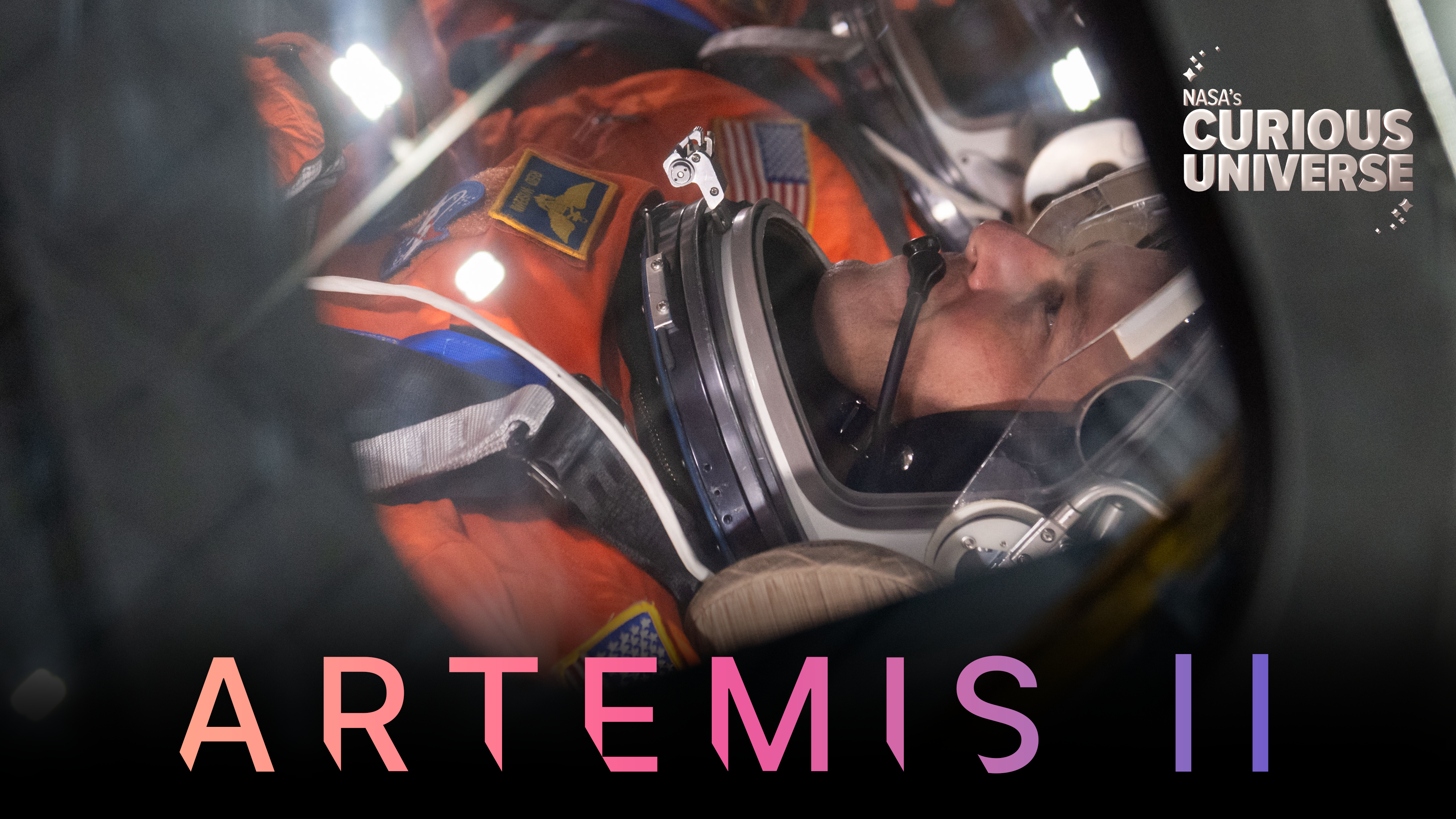
During Artemis II, humans will fly Orion—NASA’s next-generation spaceship designed to take us to the Moon and beyond—for the first time. Tour Orion with Branelle Rodriguez, the vehicle manager for Artemis II, to hear about the support systems that keep astronauts alive and how exactly you use the bathroom en route to the Moon. Then, pop the hood of NASA’s most powerful rocket, the Space Launch System, with David Beaman, one of its key architects.
For Artemis II news and the latest launch information, visit nasa.gov/artemis-ii
[MUSIC: “Supercluster” by Sergey Azbel]
JACOB PINTER: You’re listening to NASA’s Curious Universe. I’m Jacob Pinter.
PADI BOYD: And I’m Padi Boyd. NASA is leading a golden age of space exploration. The Artemis II mission will send humans around the Moon for the first time in more than 50 years. It sets the stage for future Artemis missions, when astronauts return to the Moon’s surface. And Artemis will build upon the foundation we’ve laid and prepare us for the first human journey to Mars.
JACOB: In this limited series, you’re along for the ride of Artemis II. You’ll meet the astronauts flying around the Moon and go behind the scenes with NASA engineers and scientists powering this mission.
PADI: This is episode three of our Artemis II series. In this episode: NASA’s new ride to the Moon. We’ll get a tour of the spaceship returning astronauts to deep space. And we’ll hear from one of the architects of the Space Launch System, the most powerful rocket NASA has ever built.
NASA’s next-generation spaceship is called Orion. It’s part of NASA’s system to send astronauts on journeys of exploration to the Moon. During the Artemis I mission in 2022, Orion flew around the Moon without humans onboard. Now it’s time to send astronauts.
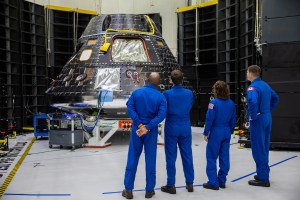
VICTOR GLOVER: The Orion spacecraft is humanity’s first lunar capable spacecraft in a very long time.
[MUSIC: “City Builders” by Laurent Levesque]
PADI: That’s Victor Glover, the pilot for Artemis II. Along with Reid Wiseman, Christina Koch, and Jeremy Hansen Victor is part of the crew that will fly Orion for the very first time. Here’s Christina.
CHRISTINA KOCH: The Artemis II mission at its heart is a test mission of the Orion space capsule. This is going to be the first time that humans have ridden inside that capsule and that everything on board keeps us alive. We’ll do different things to test out the vehicle for a few days. We’ll come very close to the moon, go around it, and spend a few days coming home to Earth.
PADI: Throughout the mission, Orion has to protect the astronauts from some extreme conditions. In deep space, it provides air pressure and oxygen that humans need to survive. To return home, the spacecraft pierces Earth’s atmosphere at about 25,000 miles an hour, or 40,000 kilometers an hour. Orion’s heat shield will reach temperatures of 5,000 degrees Fahrenheit. That’s getting close to the temperature of the Sun! But inside the capsule, it will be right around room temperature. According to Reid Wiseman, you can feel how sturdy Orion is.
REID WISEMAN: When you get inside this spacecraft, you start to realize the depth of thought that has gone into everything. I once joked that every lesson that has ever been learned in human spaceflight has been rolled into Orion. Every cable is a little bit thicker than it needs to be. Every computer has more redundancy than it needs to. But at the end of the day, that’s what you want when you’re flying into deep space, when you’re leaving the comfort of planet Earth and you’re heading out to the Moon and on to Mars. You need those redundant and reliable systems.
PADI: The amount of space inside Orion’s crew module—that is, the part where the astronauts actually stay—is along the lines of two minivans. So during their 10 days in space, these four astronauts are going to spend some quality time together. And it’s not just that they need protection from the elements. Orion also has to provide a place to sleep, to eat, and, of course, to use the bathroom.
CHRISTINA: Basically Orion is kind of like our RV, you could say, on these deep space missions.
PADI: The Artemis II astronauts have a unique relationship with Orion, and they also have a unique privilege.
[MUSIC: “Orion Rises” by JC Lemay]
As the first crew to fly this spaceship, they get to name it. The crew chose Integrity. It’s a core value shared by NASA, the astronaut office, and the Canadian Space Agency. Reid says, at first, Integrity was actually not even on the list. But as the astronauts ran through their options over and over, Integrity appeared and then rose to the top.
REID: And then we started to look through our own core values as a crew, because we spent a lot of time and intentionality on that. And we have a little saying in the crew that you we could either be “in integrity” or “out of integrity”. We use it all the time. If you show up to class prepared and early and ready to go, you’re in integrity. If you show up five minutes late because you had to go grab a coffee or you didn’t plan properly, you’re out of integrity. So we give each other a lot of grace. You know, you’re not always perfect and you’re not always wrong, so you can come in and out of this mindset.
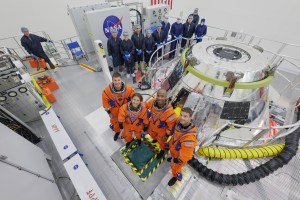
JACOB: Integrity is also an important quality for a spaceship. Orion must maintain integrity to survive the brutal environment of space and to return the astronauts safely. Every single detail is critical. That’s why it has taken the work of many people to get Orion to the launch pad and years of development and testing.
I spent some time talking to one of those people: Branelle Rodriguez. She’s the Orion vehicle manager for Artemis II. Orion draws on lessons learned from basically every NASA mission, especially the International Space Station. After all, humans have been living on the space station continuously for more than 25 years. And that’s where Branelle got started too. She worked her way up as a NASA engineer, starting with equipment used on the space station.
BRANELLE RODRIGUEZ: And I got to work on space flight hardware. Specifically, I got to design life support systems. And I always used to tease, it was always your bedroom, bathroom, and kitchen. You know, the essential things that make us all tick.
JACOB: I was, you know, just getting ready for this, and I was doing some research, and I found some papers you wrote in the past, or like, maybe abstracts for papers you presented at a conference or something. But some of the topics that I found were making a better fire extinguisher on the International Space Station and the Urine Monitoring System on the International Space Station. I mean, how do you describe that part of your background?
BRANELLE: Yeah, those are my two babies. Those are great ones. Actually, just had an opportunity to talk to my daughter’s fifth grade class, and it was a very basic question of, “What do engineers do?” And I had, you know, 50 different kids yelling things at me. But the root of it is, is we just problem solve. And we problem solve using math and science, right? And it was a fun thing to kind of talk about, like whether that problem solving is figuring out how to launch and trajectories of a spacecraft, or if it’s as simple as, Hey, we have to put out a fire in microgravity and I don’t have gravity. How would we do it? Emergency response is very critical, right? You always design and build stuff, especially for spaceflight—we rule out the capability of ever getting into that scenario. That being said, what’s the what if? What if we do get into that scenario because we didn’t think of something and we failed to imagine a failure going here, what would we do? We want to arm the crew with any means necessary. And so the fire extinguisher was a super cool project, because not only did you have to understand how fire would react in zero-G, but then you had to understand how your fire extinguisher would basically be expelled, and where all those now mixed up contaminants and things like that would go, and how are we going to effectively fight these fires?
JACOB: Did that fire extinguisher that you worked on, did it end up on the ISS?
BRANELLE: It sure did! And it’s my one piece of hardware that I hope never gets used.
[MUSIC: “Early Symptom” by Pierre Terrasse and Nicolas Subrechicot]
JACOB: So I am wondering if you can give me a tour of Orion. And I’m almost imagining like this is the Orion episode of MTV Cribs, and we show up at the front door together, such as it is. What do we see first?
BRANELLE: Well, the first thing you’re going to see if you’re on the ground, you’re going to see two spectacular doorways as we enter into Orion. No, so we do have two hatches that—so when the astronauts kind of enter into the vehicle, there’s actually two hatches. The first hatch is what’s called our Launch Abort System, the big tip-top point of the rocket that is only there for the first part of spaceflight. And hopefully we never have to utilize it. And then we’ll jettison it. But then you’ll go into the crew module side hatch, and when you enter into Orion, you’ll step down. And the first thing you’ll step down in 1 g is your hygiene bay. So right below where you step down from Orion is actually the bathroom. Don’t worry, you don’t step into the bathroom. There is a door. We do respect privacy, but that’s actually where that’s at. And when you’re stepping into it, you actually step over what we call our flywheel or it’s our exercise device. Think of it kind of like a rowing machine. And so you’ll step over that, step over there, and we have four seats in Orion. You have your commander, your pilot, and they’re going to be up underneath the displays. And so when I walk in, those are on my left-hand side. And then the mission specialists, which would be Christina and Jeremy, they’re going to be on our right-hand side, kind of sitting below, so to speak, our commander and our pilot, which is Reid and Victor. And so you’ll kind of go in and get buckled up, and when you’re on your backs now ready for launch, you have your displays in your controls that are right overhead. So Victor and Reid get to take a look at those as they launch. But then there’s going to be four beautiful windows that they also get to look out of and see, you know, Earth and the Moon from their viewpoints. And then, honestly, kind of around is the uniqueness of space, right? We can use every wall—little nooks and crannies that we can to kind of put things.
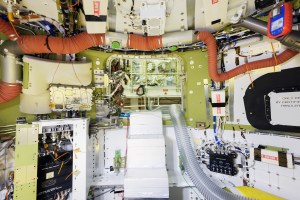
JACOB: I’ve heard the astronauts say that in terms of the amount of space that they have inside Orion, it’s on par with a minivan, maybe. So it’s not a huge amount of space. But it sounds like it’s sort of segmented. Like, this is the place where you go to the bathroom. This is the place where you fly the spacecraft. This is the place where you can exercise.
BRANELLE: Yeah, absolutely. And if you’ve seen anything about minivans, man, they design those so that there’s all sorts of ways you can take advantage of that space and maximize it to its fullest, and that’s kind of what we’ve done with Orion as well. We are people, you know. Our astronauts are people, right? So having any type of an opportunity for them to have that personal space, whether it is just to go use the restroom or it is, “Hey, this is my little corner of my nook”, right, where I’m going to keep my things is really critical for everybody. Just like you are in a minivan, right? This is my seat. I have my situation right here. I got my bags. I know what I want. I know where my book’s at, that sort of thing too.
JACOB: This is always a point of interest, so I’m just going to go for it. How do you use the bathroom in Orion, in space?
BRANELLE: (Laughs) Very carefully. You know, spaceflight and going to the bathroom is probably one of my favorite conversations, I’ll be honest. And it’s a great one to have actually with kids, because you’d be surprised at how brilliant their answers are. So the toilet that we actually have on Orion is modeled and designed after one of the toilets that we have on the space station today. When you get in there, first and foremost, you’re going to find yourself to make sure you get in a good configuration where you’re—you know, there’s handrails, there’s tethers, there’s things to secure you, right? Because you’re in microgravity, so you’re constantly moving around and floating. For liquid wastes—the liquid waste will actually be vented out of the spacecraft, very similar to how Apollo also did it. And solid wastes are actually stored into a container. We call it a fecal collection container, and we utilize filters like carbon filters and things to help with odors and whatnot.
JACOB: Can you say more about how Orion draws on the 25 years of research that we have from the International Space Station? I mean, are there, like, specific lines you can draw where you say, Oh, yeah, that system, we really learned how to do that on the space station? Or that piece of technology or equipment or whatever it is.
BRANELLE: Our life support system is one of them. The water dispenser that we have is based off the water dispenser that we have on space station as well, kind of different versions, if you want to call it that, because of the need for and the size and constraints and things in Orion. A lot of what we’ve learned is honestly how the human body reacts and responds as well. And we’ve taken those things into account with, you know, what we need to do for radiation protection, what we need to do to do exercise, and how would we accommodate that from that perspective, let alone all your thermal protection systems and everything else that we’ve learned from shuttle and, you know, the years that that team has to understand how to build those systems has really all flowed into Orion and what Orion can do.
[MUSIC: “Flight” by Alex Kish]
JACOB: Tell me about the relationship that your team has with the Artemis II astronauts. I mean, there are a lot of people building Orion and making it as good as it can possibly be, but they’re the ones who have to climb into it at the end of the day, right?
BRANELLE: They absolutely do. The Artemis II crew, they’re phenomenal. I will be the first one and probably not the only one to say that. They have, from the get-go, made an effort to meet as many of the folks that touch this vehicle, that fly this vehicle, that have anything to do with getting this mission off the ground as they can. They have been really integral in all of that, and we appreciate [that] for them, right? Because they bring a perspective and an aspect that is unique to their viewpoint, and we really appreciate that, and that’s what we need.
JACOB: The astronauts chose the name Integrity for their spacecraft. Did you get a vote? Or your team?
BRANELLE: That was all the crew. This crew has really shown how much this is not just them, but it’s everybody, and I think Integrity—that they chose that—really builds upon, you know, not only the patch that really is encompassing to everybody who’s been involved in it and all of humanity, but also what it takes to kind of do what we do some days, right? It takes that integrity to continue pushing and driving and speaking up when you don’t agree. And that’s—it’s pretty cool that they brought forward that way. But no, I did not get a vote.
JACOB: Have you thought ahead to what it will feel like for you personally when Artemis II and Orion and those four astronauts fly away?
BRANELLE: To some extent, yes. You know, I’m kind of an athlete by heart, right? And so with anything, I think, when you talk with folks who do sports or run races or whatever they might do, everyone at some point thinks, look what I could accomplish, right? Look what I could get to. I can get to, you know, running across the finish line or winning the match. You know, sometimes I’ll envision seeing that moment when the crew pops open the hatch, right? And they get on the helo and land on the deck of the ship and smile and wave at the camera, right? Because that’s the moment that I’m waiting for, because I feel like then, then I can breathe. Then I can take a moment to say we’ve gotten the crew back safely, and that’s the success point, right? After that, I’m going to take a very long vacation and probably a nap, but we’ll get to that bridge when we get to it. So there are moments, yeah, absolutely, you got to remind yourself of ultimately what the goal is, and that’s my goal.
JACOB: Orion is going to help deliver humans back to the surface of the Moon and maintain a long-term presence there, and one day we’re going to watch humans leave the first footprints on Mars. Do you ever step back and think about the role that you are playing and making that all happen? And if so, how do you think about all that, or process all that? Just—it’s a lot. It’s big.
BRANELLE: It is a lot. No, that’s a great way to describe it. It is a lot. I’m very lucky. I have two awesome kiddos that keep me grounded, and we’ve had to have a lot of conversations, because my time with them has been very limited, especially in the last several months, and will be in the months leading up to the flight and the mission. And, you know, it’s kind of interesting, because sometimes when you just put it in the [most] basic of terms, it makes the most sense. And so they’ll sit there and be like, Well, Mom, why do you have to do this? Why do you have to go? And you know, it’s like, well, because we’re making history. And history is not easy sometimes. And so when you have kids and you’re reading a book, this mission is going to be part of that, and Artemis is going to be part of that. And that is pretty darn cool when you think about it.
[MUSIC: “Radiate” by Janet Overfield]
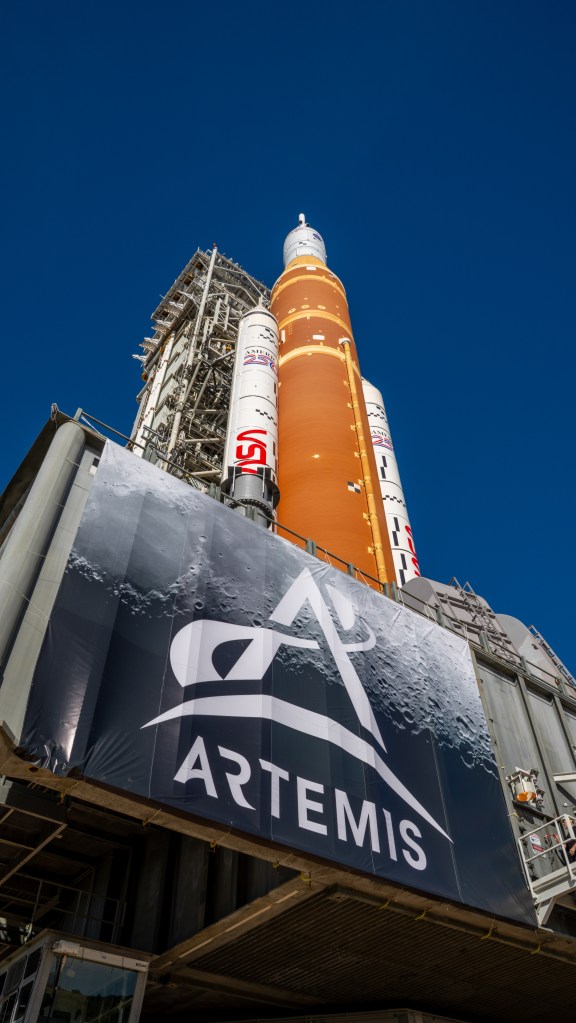
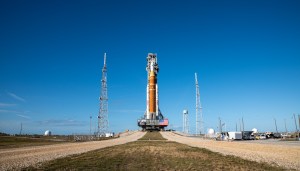
JACOB: Branelle Rodriguez is the Orion vehicle manager for Artemis II. Now, Orion is an important part of the trip to the Moon, but it’s not the only part. It needs a big rocket to push it off of Earth’s surface and begin the journey to deep space. NASA’s new Moon rocket is called SLS, the Space Launch System. It’s the most powerful rocket NASA has ever built. Fully assembled, SLS stands more than 30 stories tall. If you laid it on its side, SLS would be as long as a football field, and it creates more than 8 million pounds of thrust.
PADI: Like Orion, SLS builds on NASA’s experience over time. Some parts of the rocket use hardware and designs that were proven during the space shuttle program. For example, of the four main engines on SLS for Artemis II, three of the engines flew to space on shuttle missions, and the other one is new, with some hardware that has previously flown.
JACOB: David Beaman is one of the key figures behind this rocket. He’s the acting manager of the Space Launch System. He’s been working on this rocket for over a decade, and before that he was a part of dozens of space shuttle missions. Today David is chomping at the bit to head to the Moon.
DAVID BEAMAN: I’ve heard people ask, why do we need to go back to the Moon, right? We’ve already been. The Moon is the same when we went in the 60s. We are not. We’re different today. Just because you’ve been somewhere doesn’t mean you shouldn’t go back and experience more. We don’t do that with vacations, right? You don’t say, “Well, you know, I’m not going to go on vacation this year. I went on vacation last year,” right? No! You don’t look at it like that. You look at it and say, I have an opportunity to experience more, right, know more and do more. And that’s part of the excitement.
[MUSIC: “Not the End of the World” by Jay Price]
JACOB: David is actually a second-generation rocket scientist. His father, Robert Beaman, worked on the Apollo program that landed the first astronauts on the Moon. Eventually he held the title of chief engineer at NASA’s Marshall Space Flight Center in Alabama, which is where David is based now.
David is a senior engineer in his own right. He’s part of the Artemis II mission management team. The mission management team assesses risk throughout the mission and is responsible to make key decisions like, are we ready to launch? In fact, on launch day David will be one of the people asked to provide a final sign-off. To begin, I asked if he could boil down the Space Launch System into a sentence or two.
DAVID: It’s the rocket that our forefathers dreamed about, right? You know, they had the Apollo program. They had the Saturn V. We have so much more technology today, so it’s really the most energetic, accurately flying rocket that humans have ever thought about, and it’s capable of carrying humans into deep space and protecting them, not only on the journey there but on the journey back.
JACOB: Can you sort of pop the hood for me and explain, you know, how does it do that? What makes SLS tick?
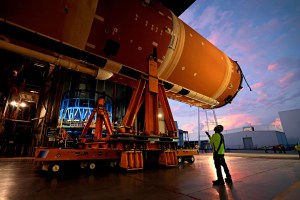
DAVID: OK, yeah, I’d love to. So the first thing is, you have two solid rocket boosters. The solid rocket boosters were built on the pedigree of the space shuttle program. Those two solids provide about 70 percent of the thrust to get it off the launch pad, millions of pounds of thrust, and they burn for a little over two minutes. And the whole purpose of them is to get that initial oomph to get us off of the launch pad and to take us into an area where we have the opportunity to get the upper stage to orbit. At that point, they separate. The whole time you’re relying on the liquid engines as well. So the RS-25s, which are based on the space shuttle program as well, they’re providing a significant amount of thrust on ascent. But then when the solid rocket boosters separate, they provide the next stage capability, and they go all the way through about 500 seconds, about eight minutes.
[MUSIC: “Conscious of Time” by Paul Richard O’Brien]
JACOB: After those eight minutes—at which point the rocket has already climbed almost a hundred miles above Earth’s surface, traveling almost 23 times the speed of sound—the core stage falls away, leaving an upper stage to propel Orion to the next leg of its journey.
It’s hard to wrap your head around just how powerful this rocket is, and it’s even harder to imagine being strapped into the spaceship on top of it. Each of the engines in the SLS core stage produces about eight times more thrust than an F-15 fighter jet. And the rocket has four of those engines. The solid rocket boosters—which are the skinny white tubes on the side—burn so hot that when you test-fire them here on Earth, they turn sand into glass.
This is a brawny, powerful rocket, but it also has brains. The core stage of the rocket has three flight computers with sophisticated software designed specifically for SLS. Those computers guide the rocket like an autopilot system. In fact, SLS basically flies itself, although humans can take over if something unexpected happens. NASA engineers have tested the software repeatedly, verifying all of the code that will control the rocket.
DAVID: So we will have done literally thousands of simulations in pieces, and then ultimately we do end to end testing dozens and dozens of times with those particular simulations with the software executing things, and then we introduce the human into the loop, and we do simulations of launches. And you have everybody sitting in the place that they would be, and so all of the data is flowing to the launch team like it would be in a standard launch countdown, and then there are problems that are interjected into that data to see how the humans and how the computers deal with it. So you don’t just do simulations with computers. You introduce the human element into it, because ultimately humans are flying on it. If there are things that happen during launch countdown that require us to accept additional risk before we launch, that’s what the mission management team is responsible for.
JACOB: Once Artemis I flew and you had a chance to sort of step back and look at everything, how did SLS perform during that mission?
DAVID: It really performed well. What I can tell you, from a prediction standpoint, our chief engineer, Dr. Blevins, likes to quote that we flew within 0.02 percent of our prediction. Nothing’s going to fly perfect. I can tell you there were things that we learned in Artemis I that’s going to make Artemis II safer. Spaceflight is inherently risky, so what you want to do is learn from everything that you can. You know, one of the most exciting things to me after Artemis I was to come home and talk to my dad. You know, my dad was an engineer—very similar job to what I have—during the Apollo program. And so to be able to come home and share with him the mission and how it performed and listen to him feed back to me things that they did during the Apollo program, you know, that was priceless to me. And so what I tell you is he always taught me that you learn from your mistakes, right? Success never taught me a single thing, right? I learned something when I didn’t do something that wasn’t quite as successful. And we have to be a learning organization, because we already know how risky spaceflight is. You don’t want to take someone’s mom, dad, aunt or uncle, or brother and sister and put them on a spacecraft and fly on hope, right? Hope is not a management technique.
JACOB: When you were growing up with a dad who worked on the Apollo program, I mean, did you always know you wanted to be in the space program? Did you just have NASA stamped across your forehead?
DAVID: I didn’t, and I took a little bit different path, and I worked on some military projects and other things. You know, when you’re a part—when you’re in the middle of something—you don’t always appreciate the significance of it. And yes, you know, I knew my dad, he worked with von Braun and Rudolph and all those guys, and I knew he did something that was pretty meaningful. But it was your life every day, and you really didn’t appreciate how epic what we did back in the sixties was. I’ve just really come to appreciate that, really in the last 10 years, having an opportunity to work on a program to try to go back to the Moon, seeing the challenges that we have and realizing what those guys did back in the sixties. And they didn’t have the tools we have, right? They’re the true giants from spaceflight. They’re the ones that taught us that we could, right?
JACOB: What does your dad think of the Artemis program? And especially, what does he think about your role in it?
DAVID: Well, I lost my dad three days after we landed Artemis I.
JACOB: Oh, I’m sorry.
DAVID: But, like I said, he was still—I was able to come back after the launch and talk with him about it. He was excited that we were going back to the Moon. He was extremely proud that I was doing something similar to what he did. You know, he was—he’s a hundred times the engineer I ever was. I’m blessed to be in the right place and work with a lot of smart people. He was one of the smart people. And so I would like to think that he’s looking down on me right now, and he continues to be very proud at what I’m doing and how I’m able to continue what he would consider to be a tremendous NASA legacy.
JACOB: Yeah. I have no doubt. Artemis II will put astronauts onto your rocket for the first time. Does that change the way that you and your team get ready for this mission?
DAVID: It does to some extent. So obviously, we wanted to design this rocket from the beginning to be human rated. But it’s just like anything else you do: when it comes down to the point where you’re actually putting another person’s life at risk, yeah, it changes how you look at it. Our job is to protect those people, right? Our number one job is to protect the astronauts. We want to go to space. We want to go to the Moon. We want to execute science. But none of that is worth a life. So it changes how you think about it. It makes you ask yourself questions. When you’re sitting in the mission management room and you’re working an issue, you ask yourself, What if I’m wrong? When you try to solve a problem, it isn’t just, “I think I’m right. I think this is what we should do.” What is the consequence if I’m wrong? And if you don’t really understand the problem, you ought to stand down for that day. Three weeks after the launch, no one is going to care whether you launched on Tuesday or on Friday, right? They care that day. But you need to do what’s right. You need to do what’s right to protect the precious cargo and the astronauts that we have. We go there to do science with humans. We need to make sure those humans are taken care of.
JACOB: I know that there’s still work to do, but have you thought ahead to that moment when, you know, weather is good, everything checks out, it really happens, and Artemis II flies away? I mean, do you know what you’ll be thinking or feeling right then?
DAVID: Yeah, I think about it every day, because decisions we make on a daily basis are much more important than the decisions we make the day we’re sitting in the firing room, right? If we don’t make the right decisions from now till then when we do our flight readiness reviews, that decision that day will not be the decision that causes us to be successful or not successful. So, yeah, I think about it all the time. I just think about what it would be like to fly. You know, would I go tomorrow? Strap me on. I would fly in a heartbeat. Because exploration, it’s built into our DNA. When we’re little, we explore our crib, right? And when we get out of that—finally get to the point where we can crawl out—we explore our room and then our house and then our neighborhood. We don’t stop and say, “I’ve learned enough. I don’t want to go to the next neighborhood,” or “I don’t want to go to the next city.” It’s built into us to have a desire to learn something new, see something new, and do something different.
JACOB: One thing that I always ask people: What are you still curious about? Whether it’s at work or something, like, completely outside of work.
DAVID: Gosh. I’m curious every day. I like anything that challenges me. And the best thing you can do if you want me to do something is just tell me I can’t do it or I’d better not do it. Either one of those is—that’s a trigger for me.
[MUSIC: “Enigmatic Serenity” by JC Lemay]
You ever laid in your backyard at night and looked up at the stars? What’s out there? Right? We ask ourselves, what’s out there? When I lay out, and I look and I see all the stars, it makes you feel really small in the grand scheme of things, but then it makes you feel really big that you’re a piece of this overall universe. And you can either choose to do something positive and add to it and help add to the legacy of what we’re doing in this country, or you can choose not to be a part of it. I choose to be a part of it.
[MUSIC: “Inner Peace” by JC Lemay]
PADI: This is NASA’s Curious Universe, an official NASA podcast. Our Artemis II series was written and produced by Christian Elliott and Jacob Pinter. Our executive producer is Katie Konans. Wes Buchanan designed the show art for this series. Music for the series comes from Universal Production Music.
JACOB: We had support throughout this series from Rachel Kraft, Lisa Allen, Lora Bleacher, Brandi Dean, Courtney Beasley, Amber Jacobson, and Thalia Patrinos. Huge thanks to the subject matter experts you heard in this episode, as well as Amy Marasia from NASA and Jim Skaggs from Lockheed Martin. At Kennedy Space Center, we had help from Allison Tankersley. At Johnson Space Center, we had help from Rad Sinyak and Will Flato. At Marshall Space Flight Center, we had help from Marcia Lindstrom, Janet Sudnik, and Alex Russell. You can find transcripts for every episode of Curious Universe — and explore NASA’s other podcasts — at nasa.gov/podcasts.
If you enjoyed this episode of NASA’s Curious Universe, tell us about it! Leave us a review wherever you’re listening right now. Why not send a link to one of your friends? And you can follow NASA’s Curious Universe in your favorite podcast app to get a notification each time we post a new episode.