




















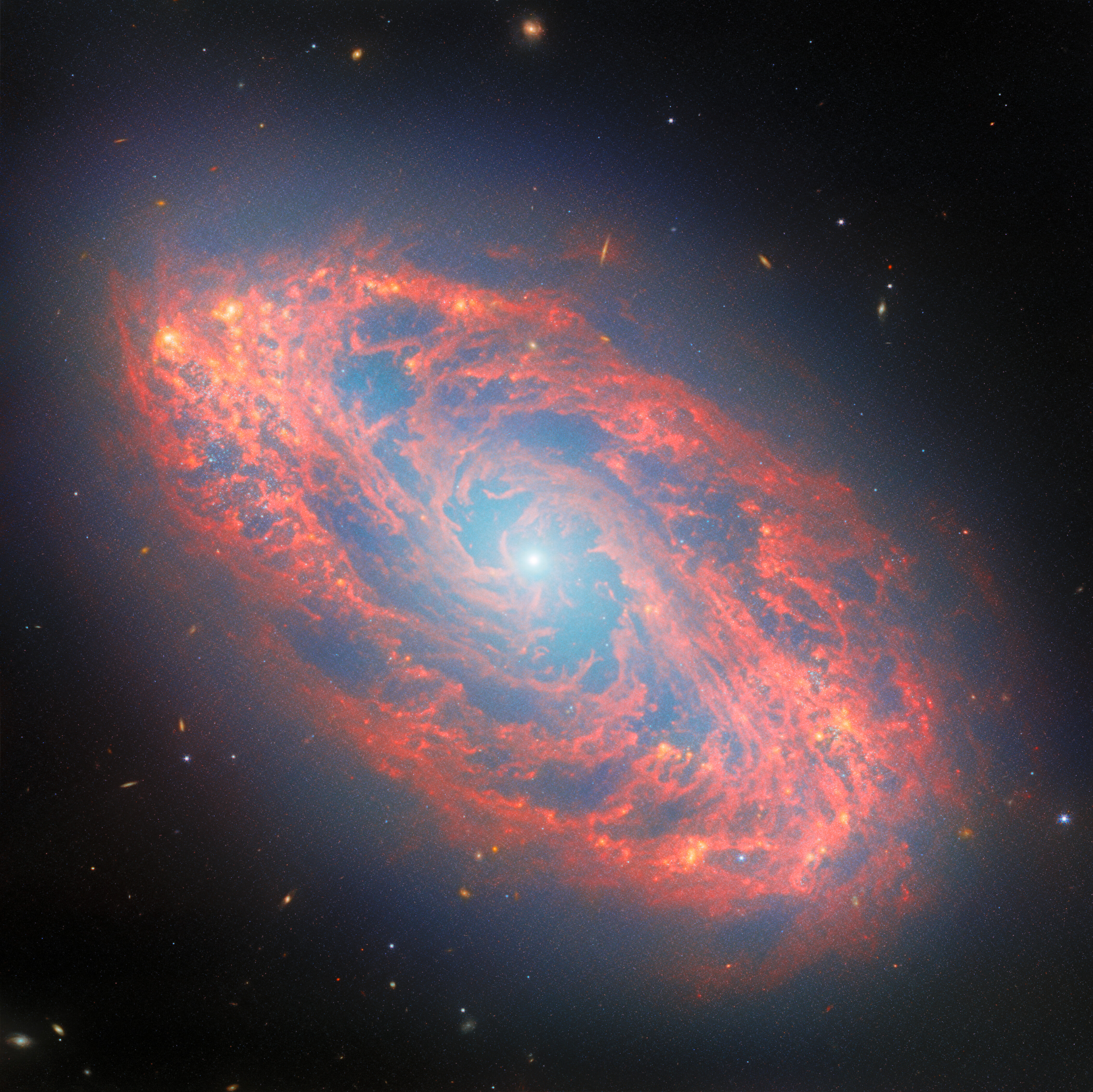
Stars peek through the dusty, winding arms of NGC 5134, a spiral galaxy located 65 million light-years away, in this Feb. 20, 2026, image from NASA’s James Webb Space Telescope. Webb’s Mid-Infrared Instrument collects the mid-infrared light emitted by the warm dust speckled through the galaxy’s clouds, tracing the clumps and strands of dusty gas. The telescope’s Near Infrared Camera records shorter-wavelength near-infrared light, mostly from the stars and star clusters that dot the galaxy’s spiral arms.
By using Webb to study the infrared light nearby galaxies like NGC 5134 whose stars and gas can be seen in detail, astronomers can apply their knowledge to galaxies too distant to be observed so closely — like those that are scattered in the background of this image, barely more than points of light.
Text credit: ESA (European Space Agency)
Image credit: ESA/Webb, NASA & CSA, A. Leroy