
















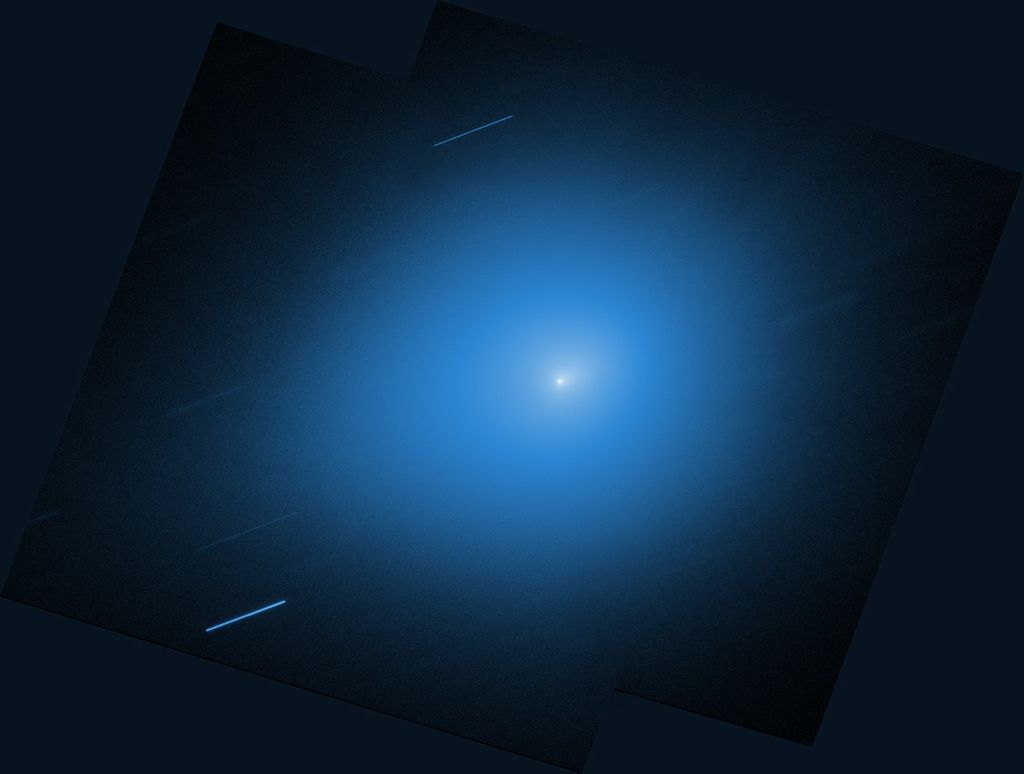


On June 30, 1908, an asteroid plunged into Earth’s atmosphere and exploded in the skies over Siberia. Local eyewitnesses in the sparsely populated region reported seeing a fireball and hearing a large explosion. They also reported massive forest fires, and trees blown over for miles. Because of the remoteness of the site, the event garnered only brief attention even within Tsarist Russia and much less outside. The first scientific expedition did not reach the area until 1927, but still found ample evidence that eventually led to our understanding that an aerial explosion of an asteroid caused the destruction. Scientists have found evidence of similar events in the past, and smaller asteroids regularly break up in the atmosphere causing little or no damage. NASA established the Planetary Defense Coordination Office and during the DART mission tested the technology to redirect a small asteroid should one pose a danger to Earth in the future.

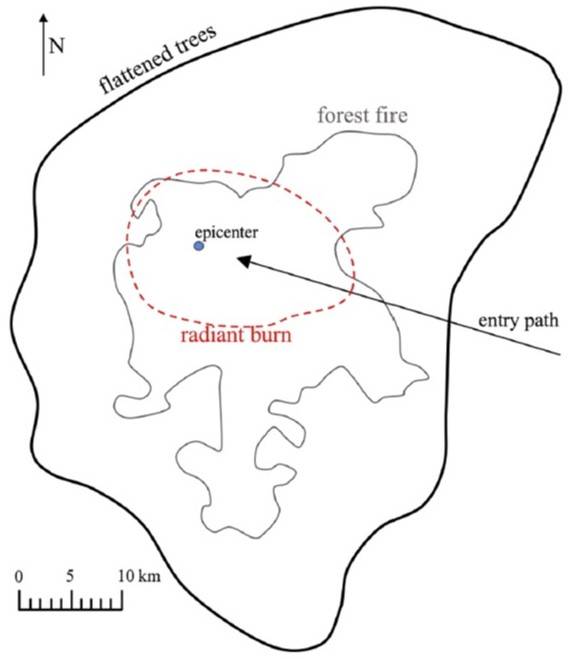
the epicenter located beneath the blast, and the areas of burned and flattened trees.
At about 7:15 am local time on June 30, 1908, when Tsar Nicholas II ruled Russia, in one of the remotest areas of Siberia, a most unusual event occurred. The few reindeer herders of the local Evenki people who witnessed the event described seeing a fireball trailing smoke, then a flash brighter than the Sun, followed by a loud noise like thunder. Those closest to the event reported being blown into the air and knocked unconscious, and their dwellings damaged or destroyed. Fortunately, because of the low population density, very few human casualties resulted, though there were reports of herds of reindeer perishing. Further afield, eyewitnesses reported seeing a large column of smoke rising high into the atmosphere. The asteroid, called a bolide once in the Earth’s atmosphere, with a diameter estimated by some scientists to be 130 feet, had an entry angle of about 30 degrees based on the trail it left in the sky, and may have exploded at an altitude of about 6 miles. The resultant shock wave and thermal radiation most likely correlate with the eyewitness reports and with the destruction described by later expeditions. Seismic instruments in Russia hundreds of miles from the site recorded the tremors caused by the shock wave.
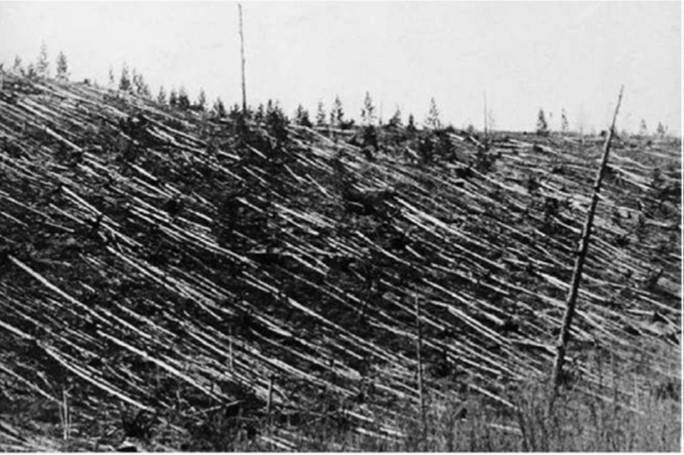

No scientific expeditions to the Tunguska site took place for nearly 20 years, partly due to its remote location and partly due to distractions such as World War I, the Russian Revolution, and the ensuing civil war. The Soviet Academy of Sciences first sent geologist Leonid A. Kulik on an expedition to the site in 1921, but the area proved so inaccessible that he could not reach it. Not until 1927 did Kulik succeed in reaching his goal. Even though 19 years had passed, the area still bore unmistakable signs of the explosion. Near the epicenter, trees remained standing but with broken branches and stripped of bark, with evidence of burning. Though he failed to find physical evidence of the bolide, Kulik’s multiple expeditions started to help make sense of what had happened.
Later aerial and ground surveys and additional fieldwork by professional scientists and voluntary researchers in the 1950s and 1960s eventually outlined a butterfly-shaped area of destruction of 830 square miles extending nine to 22 miles from the epicenter with millions of trees knocked over. A mid-air explosion most likely vaporized the object. Though later expeditions found microparticles indicating an extra-terrestrial origin, these remnants could not be conclusively tied to the blast. For a while, there was debate about whether the Tunguska explosion might have been caused by a comet, but most scientists today believe it was an asteroid that rained destruction on Siberia on that June day in 1908. In 2016, the United Nations proclaimed June 30 as International Asteroid Day to raise awareness about asteroids and efforts at planetary defense.

the impact site of the asteroid that caused the extinction of 75 percent of Earth’s
species including the dinosaurs 66 million years ago.
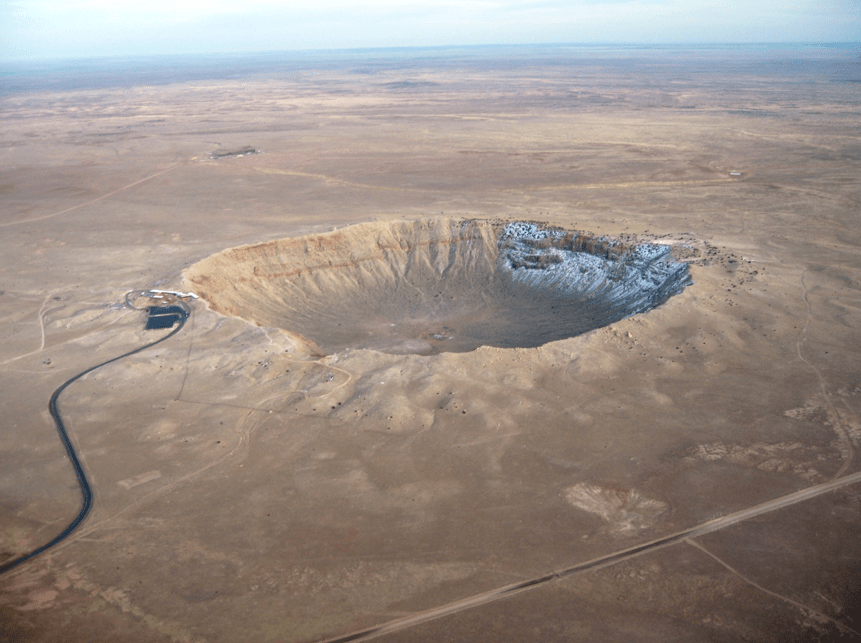
Meteor Crater in Arizona.
The Earth bears geologic evidence of past cosmic impacts. Although not as abundant as on celestial bodies with little or no atmosphere, some of the terrestrial ones involved catastrophic results. In 1990, geologists identified the partially-submerged 125-mile-wide Chicxulub Crater in Mexico’s Yucatan Peninsula as the likely impact site of the 6-mile-wide asteroid that 66 million years ago caused the extinction of not only the dinosaurs but 75 percent of Earth’s species. Tourists can visit the site of a more recent cosmic impact, Meteor Crater near Winslow, Arizona, a nearly-mile-wide crater caused by the impact of a 165-foot-wide asteroid about 50,000 years ago. The geological record shows evidence of other prehistoric cosmic events that caused damage to uninhabited areas. Evidence such as unique 29-million-year-old glass in the Libyan Desert of Egypt, 2.5 million and 430 thousand year-old deposits of meteoritic debris in Antarctica, and 11 thousand year-old glass in the Atacama Desert, all indicate ancient airbursts larger than the Tunguska event.

Several events, such as the widely-observed impact of the more than 20 fragments of Comet Shoemaker-Levy 9 on Jupiter between July 16 and 22 , 1994, and the well-documented air burst of an asteroid about 60 feet wide, releasing energy equivalent to an estimated 500 kilotons of TNT, over Chelyabinsk, Russia, on Feb. 15, 2013, prompted NASA to form a Planetary Defense Coordination Office (PDCO) on Jan. 7, 2016. The PDCO funds efforts to identify Near-Earth Objects (NEOs) that could pose a threat to the planet, and is responsible for sending global warnings should one become a hazard. The PDCO also coordinates global planetary defense efforts and studies technologies to mitigate against NEO impacts with Earth. NASA’s Double Asteroid Redirection Test (DART) mission, managed by the Johns Hopkins Applied Physics Laboratory, demonstrated the planetary defense technique known as kinetic impact. Launched on Nov. 23, 2021, DART consisted of a main spacecraft designed to impact its target asteroid at approximately 14,000 miles per hour to change its trajectory and a CubeSat called LICIACube, provided by the Italian Space Agency, to image the impact and its aftermath after separating from the impactor. NASA chose the binary asteroid system of Didymos, about a half-mile in diameter, and its smaller companion Dimorphos, about 500 feet in diameter, for the encounter. On Sept. 26, 2022, DART impacted Dimorphos, with its camera relaying images of the asteroid until the last second. The LICIACube returned images of the impact and the ejecta plume, also observed by Earth-based telescopes, the Hubble Space Telescope in Earth orbit, and the James Webb Space Telescope at the Sun-Earth L2 point roughly 1 million miles away from Earth. The kinetic impact slowed Dimorphos’ orbit around Didymos by 33 minutes, and for the first time demonstrated asteroid deflection technology.


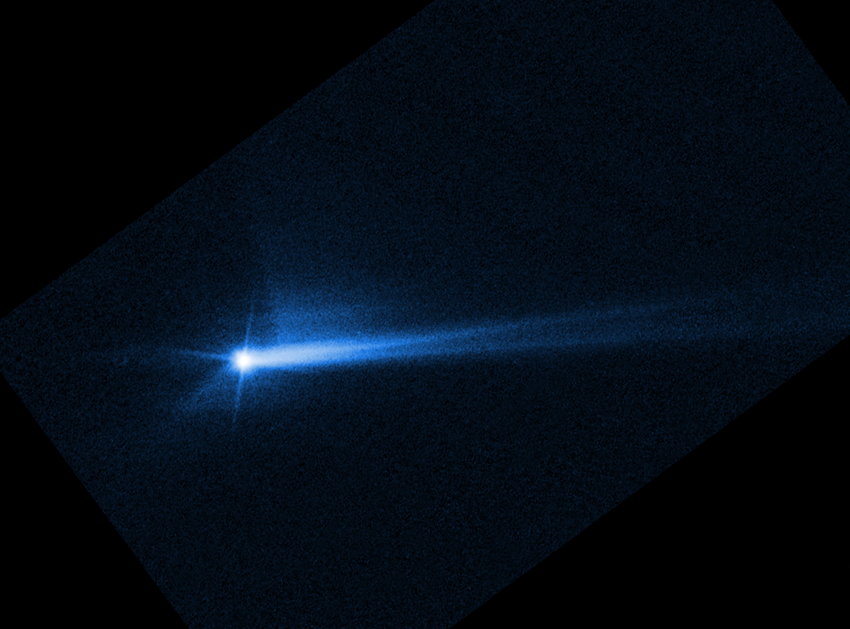
NASA’s PDCO continues to search for and monitor NEOs that come within 30 million miles of Earth’s orbit. In the past month, seven have approached to within the orbit of the Moon but passed by without harm. In April 2023, the agency released a strategic plan for planetary defense, outlining the goals of continued observation and vigilance. The recent positive experience with DART shows that technologies exist to mitigate against possible NEO impacts with Earth.
“A collision of a NEO with Earth is the only natural disaster we now know how humanity could completely prevent” said NASA Planetary Defense Officer Lindley Johnson. “We must keep searching for what we know is still out there, and we must continue to research and test Planetary Defense technologies and capabilities that could one day protect our planet’s inhabitants from a devastating event.”