










Suggested Searches

Blogs

    Orbit Departure Burn Coming Up

    The orbital departure burn is planned to happen in just about 5 minutes. The second stage engine will restart for its second burn (SES-2) and will continue to burn for approximately 3 minutes. This second burn will give the Europa Clipper spacecraft the thrust it needs escape Earth’s gravity. When the burn is complete, the …

    Read Full Post

    Second Stage Engine Cutoff Reached

    The initial second stage engine cutoff (SECO-1) is complete. The second stage engine will restart for its second burn (SES-2) in just about 40 minutes. This second burn (SECO-2) will give the Europa Clipper spacecraft the additional thrust needed to escape Earth’s gravity, after which the spacecraft will separate from the second stage. You can …

    Read Full Post

    Rocket Reaches Max Q, Booster Engines Cutoff, First Stage Separation

    The Falcon Heavy passed Max Q, or the moment of peak mechanical stress on the rocket, and reached booster engine cutoff (BECO), where both boosters cease firing and separated from the center core. The center booster also completed its burn and separated from the second stage that carries the Europa Clipper spacecraft. After that the …

    Read Full Post

    Liftoff of NASA’s Europa Clipper!

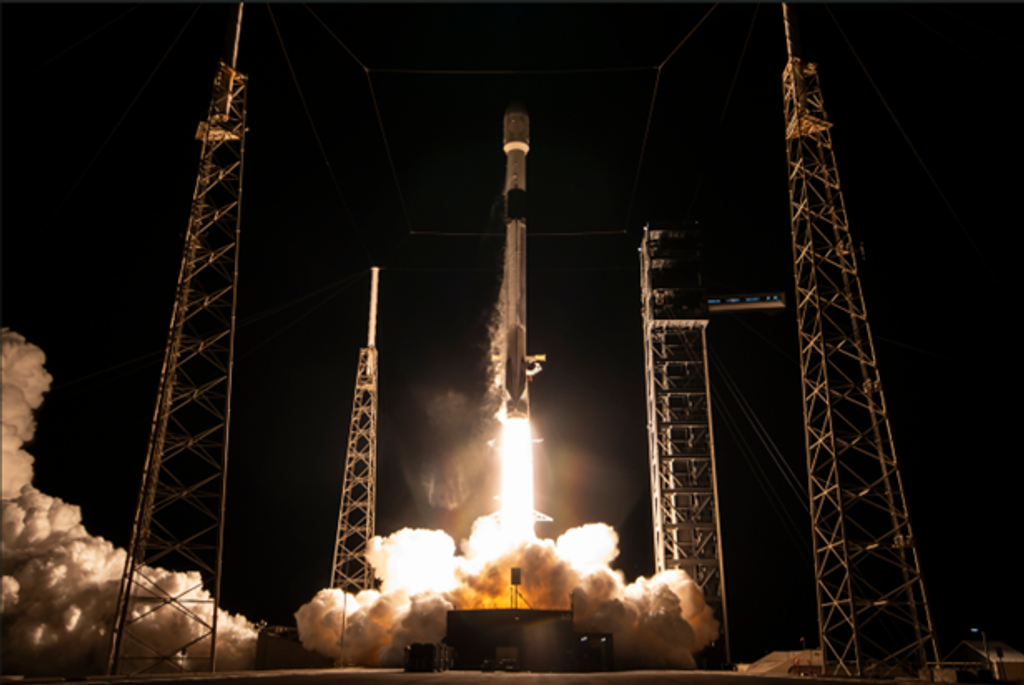
    We have liftoff! NASA’s Europa Clipper spacecraft, launched from Launch Complex 39A at Kennedy Space Center in Florida at 12:06 p.m. EDT. The Falcon Heavy’s 27 Merlin engines are generating more than 5 million pounds of thrust, quickly pushing the vehicle through the atmosphere and away from the Florida spaceport. The Falcon Heavy first stage …

    Read Full Post

    NASA Launch Manager Gives ‘Go’ for Launch

    NASA Launch Manager Tim Dunn has just given NASA’s Europa Clipper mission a “go” for launch! Mission and launch managers are counting down to the launch of the SpaceX Falcon Heavy rocket from Launch Complex 39A at NASA’s Kennedy Space Center in Florida. This will be NASA’s second interplanetary mission for SpaceX’s Falcon Heavy, following …

    Read Full Post

    Weather Remains Favorable

    We are about 10 minutes from launch and the weather outlook for NASA’s Europa Clipper launch from Kennedy Space Center in Florida remains outstanding. Weather officials the U.S. Space Force’s 45th Weather Squadron at Cape Canaveral Space Force Station predict a 95% chance of favorable conditions for liftoff of NASA’s Europa Clipper mission.

    Read Full Post

    ‘In Praise of Mystery: A Poem for Europa’

    Along with the science instruments and hardware needed for NASA’s Europa Clipper’s long journey to the Jovian system, the spacecraft also continues the long legacy of NASA spacecraft carrying inspirational messages from Earth, including the Pioneer Plaque, the Voyager Golden Record, and engravings carried aboard NASA’s Mars rovers. The original poem “In Praise of Mystery: …

    Read Full Post

    Second Stage Fueling Started

    SpaceX confirms that fueling for the second stage of the Falcon Heavy rocket carrying the Europa Clipper spacecraft is underway at NASA’s Kennedy Space Center in Florida. Comprising three Falcon 9 nine-engine cores, the 27 Merlin engines of the Falcon Heavy combine to generate more than 5 million pounds of thrust at liftoff, equal to …

    Read Full Post

    NASA’s Europa Clipper Mission: By the Numbers

    As NASA’s largest planetary spacecraft heads to the solar system’s largest planet to study one of its moons, let’s take a closer look inside the numbers of NASA’s Europa Clipper mission. 9 — The spacecraft carries nine science instruments and a gravity experiment that uses the telecommunications system. All the science instruments will operate simultaneously …

    Read Full Post

    First Stage Fueling Started

    Moments ago, mission teams polled “go” to begin fueling the SpaceX Falcon Heavy rocket. The Falcon Heavy is a two-stage rocket with a central core and two side boosters that uses RP-1 (a refined kerosene) and liquid oxygen (LOX) to fuel its 27 Merlin engines, which combine to generate 5 million pounds of thrust. Loading …

    Read Full Post