


















From Earth orbit to the Moon and Mars, explore the world of human spaceflight with NASA each week on the official podcast of the Johnson Space Center in Houston, Texas. Listen to in-depth conversations with the astronauts, scientists and engineers who make it possible.
On episode 411, the CHAPEA Mission 2 crew members record their first audio log just weeks after entering the Mars analog habitat, with added context from CHAPEA co-investigator Dr. Suzanne Bell on the science behind the mission. This episode was recorded December 18, 2025.

Transcript
Kenna Pell
Houston We Have a Podcast. Welcome to the official podcast of the NASA Johnson Space Center, Episode 411: CHAPEA 2: Audio Log 1. I’m Kenna Pell, and I’ll be your host for our series of CHAPEA Mission audio logs. On this podcast, we bring in the experts, scientists, engineers and astronauts all to let you know what’s going on in the world of human space flight and more.
Four humans are currently on Mars. Well, sort of. Four individuals are just a few months into a year-long analog mission in a habitat right here on earth that is simulating very closely what it would be like to live on Mars. This is the second analog mission for CHAPEA, or Crew Health and Performance Exploration Analog. This isn’t so much a technology demonstration or a dress rehearsal for a human Mars mission. The primary purpose of the study is human research. The results of CHAPEA and the knowledge gained from the analog missions will allow NASA to understand trades between resources and health and performance risks, directly informing development of interventions or supports, NASA standards, resource requirements and associated vehicle mass and volume requirements for long-duration exploration missions.
We got a chance to chat with the crew before they began their journey on episode 404, and they shared their background and mindset of entering this habitat for a year. We’re lucky enough to have access to the crew quarterly throughout their journey, and they’ve promised to record audio logs about their experience.
On this episode, we hear from the CHAPEA crew for their first audio log a few weeks after they ingress into the habitat. And to add some context, we’re also bringing in Dr Suzanne Bell, CHAPEA, Co-Investigator, to describe more of the science behind the mission. I’m very excited to hear from the Mission 2 Crew inside CHAPEA for the first time.
Let’s hear from the Martians!
<Intro Music>
Kenna Pell
First up is CHAPEA 2 Mission Commander Ross Elder to give us an overview on how the crew is settling in.
Ross Elder
Hello, this is Ross Elder, the Commander of the NASA Crew Health and Performance Exploration Analog Mission number two at Johnson Space Center in Houston, Texas.
This is the beginning of week number four here at Mars Dune Alpha. And the first three weeks have been off to a stellar start, packed with lots of in mission training and weeks of extra vehicular activities or EVAs.
Before ingress on October 19, the crew had endured over a year of the selection process and about a month and a half of some fast and furious training and quarantining. In comparison, the ingress happened in a flash. Within just a few minutes of arriving to the facility, we had set our farewell speeches and quickly found ourselves in the habitat with the door shut behind. It was still quite a rush for me, as it was the first time that we had been in the habitat without plenty of other trainers, personnel or the backup crew. The seemingly small habitat instantly got a whole lot larger.
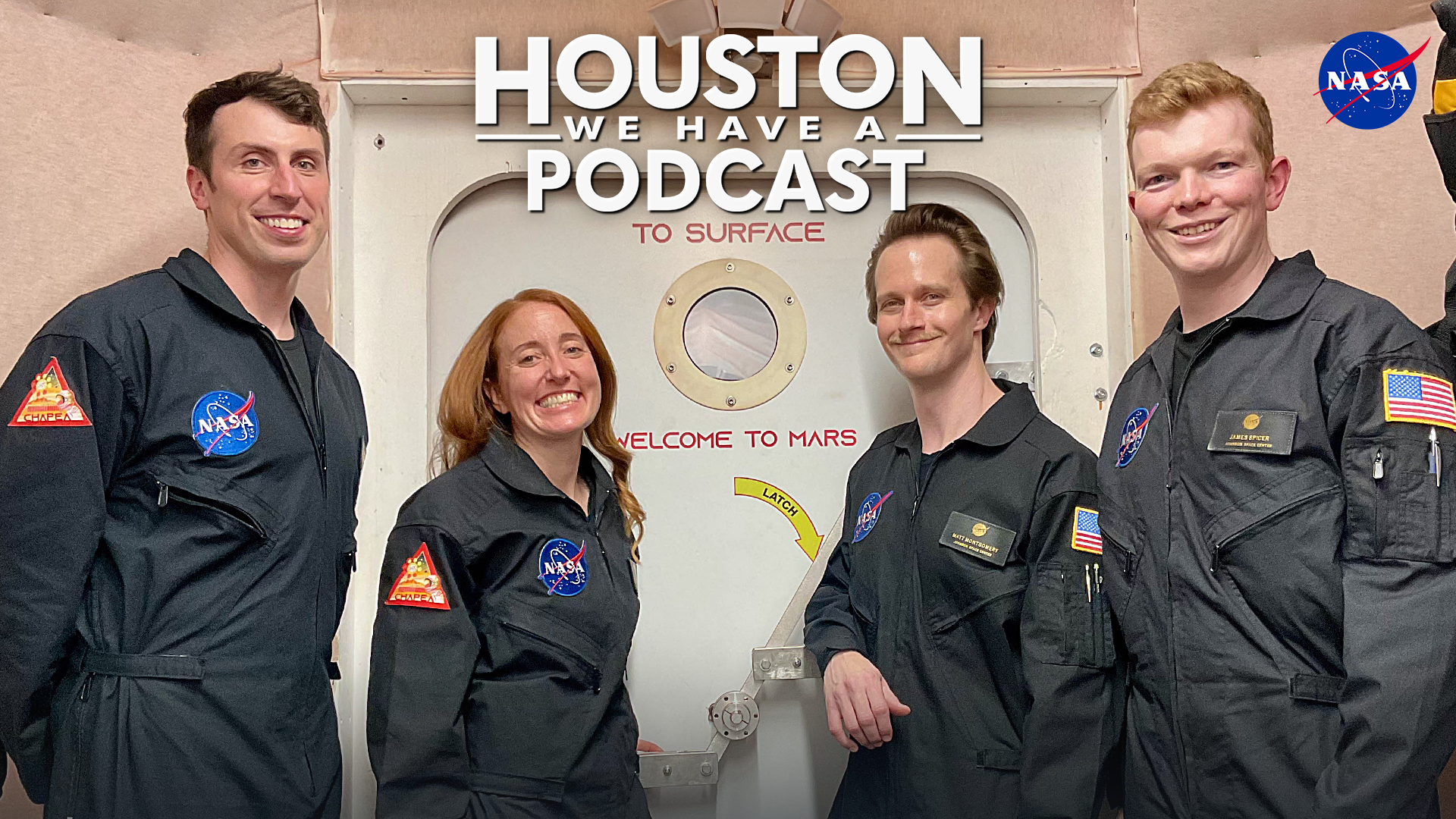
As an homage to the original crew, we all split our rations of hot chocolate and had a celebratory toast. We played some music to ring in the start of a long adventure with most still yet to come. We also found ourselves exceptionally curious, and opened up nearly every drawer and container we could find to start some inventorying of supplies. We even collectively wandered into the airlock and took our first crew photo with a glimpse out the porthole to Mars. With only a few hours from ingress to our scheduled sleep time, we quickly diverted our energy to prepping for the following day and turning in for the night. We all wanted to hit the ground running in the morning at full speed.
I think some of the crew members might have stayed awake a bit later than others. There were plenty of bags to unpack and messages to be sent to friends, family and loved ones, and lots of on the job training opportunities that we had. It was no easy task to simmer down to sleep, but we all quickly found our nightly rhythms in the following days.
Our schedules ensure we are hacking the mission and staying employed. Schedules are full of work and experiments keeping us quite busy. And luckily, the crew also has a natural tendency to absorb information. And because of that, I’ve found it was quite easy for us to quickly adjust and stay focused.
Since we started in October, Halloween was immediately around the corner, so the crew built and displayed pumpkins and ghosts, black cats and aliens. We had some creative crew members given our limited decoration supplies, but picture less Picasso and more paper mâché. In our rooms and around the habitat we have displayed some pictures of scenery, comics and photos of loved ones in our favorite memories during the selection process in crew training.
I have been quite surprised by the variety and depth of food options that are available to us. While they’re typically rehydrated or thermo stabilized, they still pack a lot of flavor. We’ve also found some pretty unique ways to combine options, so there’s no tiring of the choices just yet. We do find ourselves eating a lot of food and fairly frequently as our high physical workload leads to quite a demanding caloric intake, we document all of our workouts, extra vehicular activities, and food to help manage our nutritional intake and ensure we’re eating and hydrating just the right amount.
The first week, we focused primarily with on the job training, maintenance actions, inventorying, science and engineering work, and preparation for EVAs. Crew members would don our spacesuit simulators and venture out to the habitat to set up critical infrastructure systems and new additions and maintain those systems as required.
My personal highlights are getting to send off the crew on their EVAs. I’ve been able to incorporate a little bit of the fighter pilot culture by playing what we call step music as the crew ventures into the airlock to suit up for the activities. I loudly play some music tailored to that day or a special quest from the crew. And I’ve thoroughly enjoyed trying to boost up the energy and kick the EVAs off with a strong start prior to jumping into their first procedures. I would also say I definitely enjoyed the challenges that come with the EVAs. We’ve managed to quickly build some challenging systems on the Martian surface, despite significant constraints. And more than once, we couldn’t keep our elation and resulting in a few necessary celebratory high fives or fist bumps.
We do have a band, but it’s quite at its infancy, and let me set the stage. Imagine an orchestra such as a philharmonic preparing for a large performance. The musicians start with their individual tuning. It’s all building up for something beautiful to come. Now imagine nothing like that. You’ve got me on the banjo, Matt on the harmonica, James on the keys, and Ellen on the mic. We’re all learning it as we go. We’re definitely in the tuning phase, but I’m looking forward to us coming together. We’ve got some fast learners on the team, and I expect nothing but the finest music by the end of the mission, and maybe we’ll walk right on out to the Grand Ole Opry.
I’m looking forward to us finding our pace. We’ve been introduced to a significant portion of the critical pieces of the study, and while there are many new twists and turns to come, despite our initial success with hitting key objectives, I’m excited to see just how much better we get as a crew, if this is us just picking up steam, I’m excited to see how fast we’re shredding at the finish line.
Kenna Pell
It really was so special to be able to get to know this crew a little bit ahead of ingress on episode 404. Their enthusiasm, passion for the mission ahead of them was really infectious. You could feel it. I remember walking away from the conversation not only extremely excited for them, but for lack of better terms, I feel like I had a little bit of FOMO or fear of missing out and wanted to join them. Now, of course, that’s easier said than done, as the crew is very astronaut like, as you heard on our first episode. Incredibly accomplished resumes working through the application and interview process and rigorous training. But hey, this is as close as we can get, and I am so excited and honored to bring you along for the ride through these audio logs.
Okay, next is CHAPEA Mission 2 Science Officer Matthew Montgomery. He gives us an update on the team’s science work, and of course, we’ll dive a little bit deeper with Suzanne Bell here shortly on the episode. He also gives a really great overview of ingress and the feeling when the doors finally closed and the 378 day mission began, and a much anticipated but very unofficial update on their musical endeavor.
Matthew Montgomery
Hi. This is Science Officer Matthew Montgomery. The first three weeks in the Hab have really flown by, and I feel like in that time we’ve accomplished a lot. There’s a feeling that we’ve been doing this for quite a while, but somehow that feeling is also kind of juxtaposed with the feeling that ingress wasn’t really that long ago.
The day of ingress itself was quite a long day, but the process of ingressing felt very rapid. On that day, we took one of the lunar rovers from another building over to our building and said goodbye to the team. It was quite a nice outdoor event. We jumped out of the lunar rover, and the extended project teams were there. They had come out. It was a Sunday, and they wanted to send us off. It was an incredibly nice gesture of support from that wider team, and really kind of a culminating for training and all of us working for the last five or so weeks together to get to the point that we were at. From there, we went into the building, and inside were a couple of the NASA directors from JSC. We all gave public addresses at that point. I was really excited at that time to get the mission started. It felt like we had been training on site for a while and had really mastered everything in training, and I just felt ready for the mission. During the public address, I was feeling a responsibility to represent the programs in JSC, in my view, on why this science was important, and tried to communicate all that in my ingress address.
When we first came into the Hab. I think the most noticeable feeling was just the calm inside. There’s always been lots of people with us whenever we were in the habitat during training, whether that was the people training with us, or people doing inventory checks or things like that. So when it was just the four of us, the calmness was a very present feeling. One of the first things we did while we were still in our flight suits was we gathered in the airlock and we took a photo in front of the exit to Mars doors. It came out really well, and I’m excited about that one. After that, we kind of changed into more relaxed attire, and then started getting ready for Monday morning. We knew that was going to come quickly, so we wanted to make sure we were ready for those next day events, and we also wanted to make sure we knew where the food items were, because we had to get into breakfast early that next day. And then on top of that, we decided to pay a little bit of homage to Mission 1’s crew, and we celebrated with a round of hot chocolate.
The first night in the habitat, we all went to bed on time, but with all the adrenaline from the day’s events, it took me a little while to fall asleep. The hab rooms themselves, I think, are rather cozy, and the bed is comfortable, so I didn’t have any issue sleeping, once I fell asleep.
Adjusting to hab life has been pretty smooth. I think of it not as a binary transition into hab life, but a little more gradual. We had been training in and around the Hab during the entire training period, so we got familiar with what the operations and flow of the habitat were like well prior to ingressing, so that that jump didn’t feel as so dramatic when we finally just made it in with the four of us.
We ingressed fairly close to Halloween. So to start personalizing the habitat, we started with the Halloween decorations. My partner had prepared those like paper ghosts that I had at least made as an arts and craft project in elementary school. So that was a fun little activity on the weekend for us to try. Each of us got to make our own paper ghost, and they had their own unique touches. Each one came with a name card, so we got to name them and hang them up in the living area, along with some other decorations, and we posted their name cards up there. It was fun to see kind of the names everyone had come up with.
There’s also photo frames all around the Hab. James had brought in our group photo from NOLS. So that was a fun one to take a look at and hang up and kind of reminisce about the journey getting here. He also brought a bunch of comic printouts, so those are fun to read while you’re kind of in the different hab areas, and just kind of brightens the mood throughout the day.
In my room, I have some personal photos. My friends from LA sent me off with a photo collage of some of our favorite trips and memories. I’ve got a little mushroom shaped bag that’s hanging in my room. It’s both decorative and functional. I got that at Yosemite one time, so it’s a nice reminder of the outdoors. My mother also packed me, it’s like a bag of magnets, and there’s one magnet for every other day of the mission, and they have either some small personal photos or kind of inspirational phrases. It’s a been a really nice treat to dive into that and just pick one out randomly and have a nice memory or have a little boost. And I’m hung those around, kind of on there’s a lot of metal pieces, so there’s places to put those.
During our evaluation week, we get to sample some of the food items. And I really enjoyed them then, and I still do. The food system provides a lot of variety, which is very nice between. In the exercise prescriptions and our EVA tempo, our caloric expenditure is pretty elevated. So a lot of the thinking, at least on the crew side, about the food, has been around, how do we maintain a balanced diet while still hitting that daily caloric target?
Week one was a good transition period. We had additional training, and then got to review a lot of the procedures in their written form again. We also went through and did a full inventory of the consumables and non-consumables in the habitat. This is a really worthwhile exercise, not just from the value of the inventory itself, but we got hands and eyes on everything that was in here. Really got in the nooks and crannies, and understood what the inventory and what those potential tools and pieces were and where they are. We also settled into our roles and responsibility. We each had different training sets based on those and different weekly and monthly responsibilities, so we familiarize ourselves more on that aspect.
Non-VR, non-virtual reality EVAs, or extra vehicular activities were a combination of mentally and physically challenging. Virtual reality EVAs are a different type of experience, a little more Mars realistic in a sense of getting to see the surface of Mars and interact with some geological features that are representative. We’re going into exercise performance and biological collections. So that’ll be a little bit different than the EVAs. And then, of course, throughout all of that exercise has been a constant.
Some highlights for me so far have been a seed germination experiment. I have done indoor agriculture in the past and a lot of germination, so getting to do something similar to my background is very interesting. We did those with a control and then a Mars simulant, and I found that process very stimulating. I’ve also spent a lot of time working with the 3D printer, so getting that up and running and familiar with that particular printer and printing software I found enjoyable. And then we also did a little bit of geology, rock identification based on some samples that we picked up during an EVA going through that identification process and kind of helping some of the other crew members with that is fulfilling task, and it’s a little bit of a mystery and a puzzle that you get to solve. And I find that very appealing.
Unfortunately, Ellen and the Boys have not yet had their first practice. We haven’t quite gotten that band off the ground yet, but between us, we do have a number of musical instruments. We have brought in a banjo, several harmonicas, a nice fold out keyboard. So there’s definitely some potential there. So far, times really been consumed by mission activities, settling in, personal communications, and then a bit of studying and reading.
Something I’m looking forward to is actually coming up later this week, and that’s the drone and rover operations. I really enjoyed that piece of training, so I can’t wait to give it a go again. I’ve worked in the robotics space on the development side throughout my career, so using and interacting with a field application side is something I find both satisfying and I think it will be very informative.
Kenna Pell
Great update from Matthew, and very much looking forward to hearing about the science work as the mission progresses.
Okay, we have one more segment left where we have the Medical Officer and Flight Engineer together, but first, let’s speak with Dr Suzanne Bell CHAPEA Co-investigator. To add some context.
Suzanne, welcome back to the podcast! What a crew. You can hear the excitement in their voices, even through the audio logs.
Suzanne Bell
It’s amazing. They’re absolutely amazing.
Kenna Pell
Yeah, Last time we spoke with you on the podcast was during CHAPEA 1, can you tell us what you’ve been up to since?
Suzanne Bell
Well, I lead the behavioral health and performance lab, and what we really focus on is solving the unsolved challenges related to returning to the moon and having a sustained presence on the moon, and then going to Mars, anything related to behavioral health, Team functioning and performance, and then individual performance. And so we have a number of projects really following along the agency’s objectives for commercializing low Earth orbit. We provide subject matter expertise and do some research related to that. We have a lot of research focused on Artemis, including leading the Artemis crew health and readiness research for Artemis. And so that is a big project for us. And then we also have a lot of space walk research solving those challenges of doing repeated space walks over and over again to really create that sustained presence on the moon. And then we have our Mars focused research and technology development. We’re also very involved in technology development, so CHAPEA is one of our Mars projects. And also we have some technology development related to the communication delay and how the crew will communicate back with Earth. So it’s, it’s a very busy lab.
What have I been up to in the last two years, leading an amazing team of scientists who are actively working those challenges and providing really novel solutions and really focusing on answering and providing solutions to getting us to have a sustained presence on the moon and going to Mars.
Suzanne Bell
So I’m a co-investigator. I’m- Grace Douglas is the principal investigator. I don’t know if she would think of it this way, but I’m basically the Robin to her Batman. Love it, and a lot of what we deal with in long term isolation and a complex project like this is behavioral health and performance related. So so my lab, we’re experts in behavioral health, Team functioning and performance, but also performance. Performance is very important to the CHAPEA project and understanding how things affect performance. And so making sure we’re getting the right data, making sure that in-mission trades and supports that are given are not jeopardizing the integrity of the data are very important. And so, Grace and I interact very regularly, just like in Mission 1, to make sure we’re getting the data that we need.
Kenna Pell
Got it and so did your role change between Mission 1 and 2?
Suzanne Bell
No, it’s the same role. So before Mission 1, I supported helping build the habitat, not in terms of me building it myself, but gathering the right teams along with Grace to get information on what it might look like for Mars. What do we need to include? What questions do we need to ask, and then seeing it along until we got to Mission 1, being involved in Mission 1 as a CHAPEA co-investigator, and then now we’re in Mission 2. So it’s the same role. It’s a massive, long-term project, but it’s really important to have that consistency, because we don’t want anomalies in the data just because of the way it was administered or run, or, you know, science oversight. And so making sure the differences we see between the crew are true differences, rather than, you know, just because someone else is running it now. And so, so it’s really been the same role, which might sound boring, but honestly, it’s so dynamic. It’s a different thing every day, and it’s not boring in the least. It’s really challenging.
Kenna Pell
No, I wouldn’t think that, and I like the way you described it, for consistency reasons, helps too. So okay, we’ve already done CHAPEA 1, can you explain to our listeners why we are doing a CHAPEA 2?
Suzanne Bell
Yes. So CHAPEA 1 was the first time NASA has had an intact crew in isolation for over a year. So the crew was in isolation for 378, days, and they are in Mars resource restricted environment, including a significant communication delay, 13 to 22 minutes each way. And so they have a restricted food, restricted water, and so there’s a number of these restrictions. How the crew is able to survive and thrive in those circumstances, how they adapt to those circumstances, how they respond to those circumstances, is critically important, and that’s really building our data set. This data set is an invaluable data set for decision making to get us to Mars faster and prioritize what we need. Why we have Mission 2 is because we don’t want to just chase after something we saw with one crew. We need to look to see if the trends that we’re seeing, if the discoveries that were made are robust across more than one crew, because that’s how we prepare the crew of the future. We have to be able to make those statements about what do we do for the actual Mars crew going and so getting that repeat data is critically important so we don’t chase after the wrong things, that we’re just a struggle, or more of a struggle for one crew versus another.
Kenna Pell
Okay. And so are there different objectives in this second mission, or are you mainly trying to look at trends or consistency in data?
Suzanne Bell
So they’re largely the same. So our primary objectives is to build a really important integrated data set of human health and performance in the operational circumstance we expect for Mars. And then be able to make risk and resource trades around that. So what I mean by that is we know that astronauts lose weight in space, and the Mars food situation is going to be even more constrained. And so what does that mean for performance, for their wellbeing, for their health. So being able to have that integrated look at, okay, not only food, but with nutrition and cognitive performance, behavioral performance, to understand and tie these things together, we have that same primary objective that we had for Mission 1, for Mission 2, there are also nuances of different things we’re looking at for Mission 2, but those were pre planned and intentional, so we are able to do both. We’re able to look at that trend over two missions, but then also have some novelty, which asks very specific questions at specific times, so we can kind of do both.
Kenna Pell
As the lead of the behavioral health and performance laboratory. Are there any specific questions when it comes to that portion of science?
Suzanne Bell
Absolutely. So we have our overall objectives for CHAPEA With that integrated human health and performance look, and that’s very important from a behavioral health and performance perspective. But then we also have really targeted things. We’re looking at some of the challenges that the crew faces, like long term isolation and confinement and that communication delay, both with their interaction with family and friends, but a communication delay also affects your ability to get real time provider support. So private psychological conferences right now in the International Space Station are real time. Private medical conferences with the physician back on Earth are real time. That’s not going to be possible for Mars, and so one of the things we’re doing in behavioral health and performance, looking at CHAPEA, is understanding the suite of countermeasures that we now have for doing that, for supporting crew on that communication delay. Is it sufficient?
We don’t want to over complicate going to Mars. Mars is already complicated enough, so we have to prioritize and target what we need and spend our time on that. And so what CHAPEA will tell us at the end of the second mission is, is the way we’re supporting them on comm delay enough? Or do we need to come up with something new, some novel way of providing support?
Kenna Pell
The crew has been inside the habitat for a few months now. We just heard from them. But how are they doing? Do you talk with them on a daily basis, or through Mission Control?
Suzanne Bell
Well, they don’t talk to anybody.
Kenna Pell
That’s right… Gosh. Are you able to communicate with- You’re right. You’re right. Okay.
Suzanne Bell
You know what? It really is, just such a different environment. I mean, even that notion of, yeah, like, can I talk to, you know, one of my most important projects right now, I can’t. And that’ll be how Mission Control feels when they’re problem solving with the crew is, boy, I just, I just want to pick up the phone and tell them how to fix it, and they just won’t be able to. And those are the types of things we’re looking at in CHAPEA, and so, no, I don’t talk to them, nor does anybody, you know. Nobody talks to them, but we do have ways of communicating with crew on that comm delay. With my role as a co-investigator and lead of the behavioral health and performance lab. I’m very involved when mission control needs to provide guidance on a situation and there might be impacts.
Pretty much a lot of guidance involved behavioral health impacts. So we have to think through very carefully, look, if I just quickly respond to a message, how might that be received from someone in a very different environment in long term isolation? And maybe it was critically important to them, and just making sure you do that perspective taking and understand like, how might this message look to them? How might it be received by them? And then is it conveying in a really tight way, the information they need to proceed or have asked for? So I provide a lot of advisory on that type of information, but it is not, you know, talking to them. And then also, we do, as science teams, provide guidance. And so there are ways that we communicate to that crew as well, but we do respect that comm delay.
So even when a science team has to provide information or guidance on, let’s say, there’s a question about the exercise protocol. You know, the exercise team will provide that guidance on comm delay, similar to, like, what we would have on Mars. And so, yes, I quote, unquote, “Mars talk to the crew”, but not, not pick up the phone, you know, like we can do now.
Kenna Pell
Right. It’s so easy to forget. You know, here on Space Station, it’s latencies. It’s almost real time you’re talking about, like doing experiments, you know, on board, and then talking to the PIs here on the ground. And so what was that delay? You said? Was it?
Suzanne Bell
It’s 13 to 22, minutes each way.
Kenna Pell
Gotcha.
Suzanne Bell
So think 26 to 44.
Kenna Pell
So crafting the message for them is important, for sure.
Suzanne Bell
Yes. And a really important thing to remember with that communication delay is that’s actually the minimum. So that’s one of the things we talk about with the friends and family when we when we do the training and provide other supports, is, you know that that message… it might not even come 44 minutes later because they’re busy doing mission activities. And likewise, for the crew, even though it’s a it’s it could be a 44 minute communication delay. It might even be longer your spouse might be at the grocery store in the middle of work. And so it’s actually a little bit more similar to, like when you text a friend throughout the day, except always on a comm delay. But sometimes you’ll text them and then you’re busy with work, and then, like, check back later your phone at four, or something like that. And so, so there is the, the minimum of 44-minute communication delay, but, but sometimes it can be longer, depending on bandwidth restrictions, depending on what people are doing. And so it’s, it’s really operating autonomously in an unprecedented way that’s really exciting for space flight.
One of the challenges of being in long term isolation, is that you are doing this mission in context of life. So life is still happening. You know, we’re going to have the Artemis launch. You’re, you know, if you have a child, something’s happening to that, like your friends are getting married, just like one of the crew members said in the first podcast. And it’s like, like people are continuing on in their stories and and you’re just dedicating your time to science. And so it’s just, it’s just an interesting thing to think about.
Kenna Pell
Yeah, we were talking about that a little bit this morning, living where you work and having work life balance too, right? And that’s kind of part of the psychological and that sort of realm,
Suzanne Bell
and we do that. We have a really high workload.
Kenna Pell
6am to 10pm they are scheduled, right?
Suzanne Bell
But we also try to respect their weekends, so it’s not the entire weekend off, but it turns into a very low workload, because particularly when you’re talking about sustained performance over time in extreme circumstance, you do need that work rest interval. And we have all sorts of data from other environments that tell us that rest interval also has to be disengaged from the work. So it’s not just let me do a lighter type of work, or, you know, read this book related to work. It’s like you actually need to disengage and say, yeah, that is hard in an isolated and confined environment, because you are still there, right? And so finding ways to disengage so from the work, so that you can maintain your motivation and be able to perform in a sustained way is, you know, part of what’s scheduled. I mean, it’s actually scheduled in that way.
Kenna Pell
So sure, which is interesting, because you know, the crew on station, they have a task list where they can choose from, you know, just kind of easier jobs, maybe less focused items and but maybe not with this crew, right? Because you want them to fully disengage.
Suzanne Bell
Oh, well, you mean in their downtime, yeah, weekends, we would encourage them to do some sort of downtime activity that they brought with them or that has been supplied in the habitat. Ultimately, they are individuals that we don’t control. You know, that’s not the intent. The intent is to equip them with information to be able to survive and adapt in this circumstance, but you know, it could be that they might putter around at something work related, but we really encourage them to take the time that is scheduled to relax and disengage and do something fun, whether with other crew members or themselves, so that they can continue on for the full 378 days. It’s a marathon, not a sprint.
Kenna Pell
We were talking about that with work. Actually, right before this, it feels like the more and more you work, it’s like, the less you’re actually like, able to critically, think and focus. It’s like that downtime is so important.
Suzanne Bell
Yes, and there’s actually a lot of research done outside of NASA to support that. That is not a unique thing to space flight. It’s just more extreme in space flight because of being in an isolated and confined environment, or a restricted environment where you can’t go home. But that that concept of needing rest is critical to humans, and you get much better performance when people aren’t burnt out and fatigued.
Kenna Pell
Got it. We got to hear a little bit information from Matthew when it came to science, but as it pertains to the crew as a whole, and from where you sit, how is the science on the mission going now?
Suzanne Bell
They are fantastic partners in science. So when you hear, if you’ve listened to the previous podcast with the crew. I mean, they’re just really motivated to contribute to the space program and and going to Mars. And so that that really helps, because they understand that we need this really critical data to make our risk and resource trades and and choose and prioritize what we need to do in the next handful of years to really, realistically go to Mars. And so they are really good partners, very dutiful in their both, following the schedule, which is mission realistic, very heavy, multiple space walks and multiple activities, maintenance activities, dealing with anomalies. They do all sorts of things. And so they are, they are very dutifully plugging away and then providing all the data that we need, whether it’s biological samples or surveys or other data. And so they’re, they’re amazing. We’re very thankful for them.
Kenna Pell
If there’s one thing you’d want people to take away or to know about the work that we’re doing and what this mission, you know, hope to get out of it, what would that be?
Suzanne Bell
what do I hope that we get out of CHAPEA? So going to Mars will be complicated, and we have to know what to prioritize to be able to get there anytime soon. So I can’t make an endless list of countermeasures or interventions. I can’t build whatever I want. I really need to know how much food do I need to send, what type of food do I need to send? What other bare minimum interventions are necessary? Then, if we have more time, we have more resources we build upon that CHAPEA is so important, because with this integrated data set, we can make those trades. I can actually answer the question of whether or not losing weight and having a restricted diet to the extreme that we would like will impact the way they perform. Why do we care about that? Why do we care how they perform? It’s not a regular job performing. Thing means mission success, meeting mission objectives and also safety. So in order to have a successful mission, the crew has to perform well, and they have to maintain their health. And instead of an endless list, what are the top things we need to do that? CHAPEA has a powerful data set that can help us begin to answer that question and guide us in the right direction, so we can answer what we need to and then just be okay with the fact that it’s going to be a hard mission, but even with some of the challenges, they’ll be able to survive and so prioritize what we need to.
Kenna Pell
Exciting.
Suzanne Bell
Yeah.
Kenna Pell
Suzanne, thank you so much for joining us today.
Suzanne Bell
Thank you, Kenna, my pleasure.
Kenna Pell
Okay, last but not least, the last two crew members recorded their experience together. This is medical officer Ellen Ellis and flight engineer James Spicer.
James Spicer
Hello, Houston. We have a podcast. This is CHAPEA Mission 2 Flight Engineer James Spicer and Medical Officer Ellen Ellis, we are reporting to you from Mars Dune Alpha, our home for the next year. We are three weeks into the mission and having a great time. So Ellen, how have your first three weeks in the habitat been?
Ellen Ellis
Thanks, James, the first three weeks have been great. We’re starting to form new routines around preparing for the next day’s activities and taking care of a lot of maintenance tasks. It’s important to all of us that NASA achieves its research goals for this long duration mission. And I think we’ve all been very focused. It’s been nice to stay connected with friends and family back in the Space Force and at the National Reconnaissance Office. So yeah, I’d say, off to a fantastic start. How about you, James, how have your first three weeks been?
James Spicer
So fairly similar. I feel like we’ve all been drinking from a fire hose. We had the five weeks of training prior to ingress, and then they really threw us right into it with plenty of activities and tasks to do in the first few weeks. We’ve been learning a lot and reading a lot and getting to know the habitat, getting to know all the equipment. Mission Control has been keeping us busy with a lot of activities, lots of tasks that we’ll talk about in a bit. But of course, it’s been great working together with the rest of the crew, getting to know each other, spending more time together. Well, spending all the time together, really. Now we’re three weeks in, we’re starting to get the hang of things a little bit, figuring out how everything works and we’re no longer doing things for the first time, which is good, so settling into a routine. So Ellen, tell us about the ingress.
Ellen Ellis
Sure, it was a very busy day. There were some things I wanted to take care of ahead of Ingress, like making phone calls to my family. I called my mom and dad in Rhode Island and my mother-in-law in South Africa. My husband, Steve, works remotely, so he was able to join me here in Houston for the duration of training, which was wonderful. When it was time for ingress, I knew I had the love and support of my family, and I felt very prepared. How about you, James?
James Spicer
So quite similar to you, I made some last-minute phone calls to my family, then packed up my phone because we’re not going to need it for the next year. And then the event itself was also pretty busy. We arrived by rover, as you do, which was a real treat that NASA organized for us. And we basically got out of the rover, and we said a few words, and then it was into the habitat. It was all very quick. One minute we were outside saying our goodbyes to the rest of the team, and then the next minute, we were in the habitat. And the rest was a blur, really.
Ellen Ellis
So James, what were some of the first things you did after ingress?
James Spicer
We made some hot chocolate as a group. This was the first time we’d really been together, just the four of us in the habitat, without our backups, without the staff. And so reality was starting to hit a bit, but we made some hot chocolate, had a drink, and then it was really just down to unpacking and setting everything up, setting my room up, trying to make it more homely and that’s an ongoing process. And how about you?
Ellen Ellis
It was nice. We spent a few minutes in celebration, reflecting on the day. It had been kind of a blur. So it was nice to take a minute do some unpacking. In the evening, I did some journaling. The Behavioral Sciences Lab here at Johnson is very interested in how we’re processing this experience of being part of a long duration mission. So wanted to make sure I had documented the thoughts that were coming through my mind that first night.
James Spicer
My first night in the hab, I slept pretty well. The five weeks of training we’d had prior to Ingress, as well as ingress itself was quite busy, and so I was pretty tired after all that. And we got into the hab, and I went straight to bed, really. Also getting used to the schedule of waking up before 6am every morning takes a bit of getting used to so so far, fingers crossed, I haven’t had any problem sleeping. And you?
Ellen Ellis
Yeah, the first night was quite restful, all things considered. It feels a little bit like camping, but I’m sleeping quite well. The room is dark. Beds are comfortable. I think we have all the things that we need for a good night’s rest. I think the first evening, I had some maybe nervous energy, excited about what was to come, but I managed to fall asleep, and now I’m having dreams about being in the Hab, so…
James Spicer
How has the adjustment to hab life been for you?
Ellen Ellis
Overall, I think the adjustment’s been very good. We have all the things we need to be comfortable. I think one observation I’ve made is that it’s a challenge to keep a work life balance, where you work, where you live, and you live with your coworkers. We’re all very driven people, so it’s not atypical for one of us to be working on a task and then everyone else pitches in, and then suddenly it’s very late into the evening, but we’re quite prepared for the next day. So that’s been one adjustment. Water constraints are also likely to be a challenge for future long duration missions. We’re given a weekly allotment, and we monitor our water consumption, so that translates into shorter showers, no real time to dawdle, which has been an adjustment for me. How about you, James?
James Spicer
Well, I totally feel you on the showers. Yes, we only have a certain number of minutes each, and so it’s very much, turn the water on, get wet, turn it off again, and you scrub yourself with soap, and then you turn the water back on and kind of rinse off. But we’re getting used to that. As I mentioned, I’ve never been much of a morning person then, so getting used to the schedule of we have stuff on our timeline from 6am in the morning till 10pm in the evening. And yes, there’s personal time and mealtime scheduled as part of that. But still, we’re getting used to what they refer to as chasing the red line where you have the red timeline that’s always marching forward, and whether you’re doing personal time or meal times or tasks, activities, etc. You always know what you’re supposed to be doing at any given hour of the day. So certainly an adjustment compared with life back on Earth. So what are some things that you’ve done, Ellen, either yourself or as a group with us to personalize the Mars Dune Alpha habitat as your home away from home for the next year?
Ellen Ellis
Our families prepared lovely care packages for us. So I have some of those items up in my room. We also have a photo up of our trip to the National Outdoor Leadership School, which was part of our interview process. It’s a nice reminder that we can do hard things together. James thoughtfully brought some comics. We have those up in frames around the Hab. They bring some levity, which I very much appreciate. How about you, James?
James Spicer
Well, so as you know, each of us, we have our own room, and it’s a small room, but we can personalize it a little bit. So I’ve put up some posters, put up some photographs of my friends and family. We’re all very jealous of the rug that you brought. And I think if I was to do this again, I think a rug would be on the list of things to bring. But yeah, we’ve been able to personalize our rooms a bit. As Ellen mentioned, we’ve been putting up some pictures around the hab, small things to remind us of the world outside. We also have some noise generators that can generate, you know, sound of rustling leaves or the sound of waves on a beach or something, to replace the beeps and fans that we hear 24/7 in the habitat. So what do you think of the food so far?
Ellen Ellis
There’s a very wide variety, from beef fajitas to Indian curry we’ve been given a lot of independence in choosing how to meet our caloric goals. My nephew, Tim’s, scout troop in Abingdon was appalled that we’d have to go without ice cream for a year. But we are given a lot of other dessert options and some fun choices. How about you, James?
James Spicer
Yeah, it’s interesting that what they sell as astronaut ice cream is actually not part of any astronauts diet. As far as we know, we think it’s due to the FOD concerns, you know, the small pieces that break off. But yeah, the food, as you mentioned, there’s huge variety of stuff, many, many dishes we can choose from. It’s a combination of dehydrated stuff and thermo-stabilized meals. And so far, I’ve been really enjoying it. It’s always interesting to open a drawer and see what you’ll find on any given day. And I think after three weeks, we’re now finding our favorites, what dishes we like, what dishes we don’t. And of course, everything we eat and drink actually gets recorded on a big spreadsheet so that mission control and the scientists and researchers know what we’re drinking and eating every day, down to the last calorie, down to the last dash of salt. So hopefully we’re providing good data for them on that.
Ellen Ellis
James, what are some of the tasks you’ve done in the first few weeks?
James Spicer
So as we mentioned, mission control is keeping us very busy, and we’re scheduled for most of the day. On any given day, we’ll be doing some form of exercise, and we have a few different types of exercise here, whether it’s aerobic or resistance. We spend a lot of our time doing maintenance, cleaning the habitat, fixing things that might have broken, and especially in the first few weeks, there’s been a lot of reading procedures, reading books, reading some of the source material and a lot of literature, because we had a good amount of training during the five weeks before, before the mission started. But there’s a lot of stuff to learn. There’s a lot of equipment in here that need to understand how to use. We also began doing space walks, and so we have two different types of space walks. We have the non virtual reality, where we basically go out into the giant red sand pit that’s outside the habitat, and we have the virtual reality types of space walks, where we spend time on treadmills wearing a virtual reality headset. So we’re walking on a treadmill, but in the headset, we’re walking across the desolate landscape of Mars. And so those have been really interesting. So far, it’s been really cool to work together to make this happen. Each of the space walks could last several hours, and so that’s normally a large chunk of the day, and during the space walks, we have various physical and cognitive tasks to keep us busy. So what did I miss? Anything else you’ve enjoyed?
Ellen Ellis
Yeah, I think in addition to the learning curve that you mentioned, reviewing all the procedures and learning how to do the day to day things in the hab, we also each have a role and specialty, and we have tasks associated with those jobs. So our commander has been given a very lengthy list of books to read, and he’s doing a good amount of the communication back with our program manager. We have a science officer who is helping us through some of our rock collection procedures that we have and getting our 3D printing capabilities up and running, and James has been amazing with all the tasks that we have to do in the hab as Flight Engineer, making sure that we’re on top of all of those. As Medical Officer, I’m doing a lot of the biological collection activities that we have ahead of us, so making sure that we have our supplies ready. So we’ll have a intense week of that, any highlights, either with work or off duty time?
James Spicer
So obviously, every day so far has brought a new challenge and new interesting things to learn. I think one of my favorite activities came last week when we got a couple of hours spare and we used to play table tennis. So some of us have brought some table tennis paddles and equipment and plenty of balls. And so we were using one of our small tables in the habitat, very much, not a regulation size table, unfortunately, and with a few obstructions, but we were able to get a good game going, which is a lot of fun. And how about you, Ellen, any highlights from the first few weeks?
Ellen Ellis
Yeah, as, as you mentioned previously, we had an EVA and our very first one, we had Matt and Ross outside, and they were, they just crushed it. They completed all their assigned tasks. And I think as a team, collectively, when they came back inside, it was like a celebratory moment, you know, that we, we got through our first major milestone, and then it went very successfully. I was very proud of that. Um. So, yeah, that was a that was a nice work highlight for me.
James Spicer
And the most important question so far, mission control understands that we have a band. Have Ellen and the Boys had their first practice yet. What instruments are you playing and what type of music are you creating?
Ellen Ellis
Okay, I’m going to start by saying that name is still being workshopped, but we’ve all been getting situated with most of our mission tasks right now. So we haven’t had a practice yet, but I am looking forward in the future to some jam sessions. One of the things I’ve really enjoyed is sharing music over a meal together or in our off duty hours. It’s been really interesting to see the music that people brought with them or that was provided by their partners. It’s been an it’s been a great way to get to know each other. How about you?
James Spicer
Well, in answer to the question of instruments, so we have several instruments between us. So the commander has brought a banjo, and we’re all very excited to get that going. We have a couple of harmonicas, and I brought a folding piano. So we’re hoping that between that we can get some good vocal, harmonica, Banjo, keyboard arrangements going. But stay tuned and dial into future episodes of Houston, We Have a Podcast to see how we get on. No promises, though. And Ellen, what are some things you’re looking forward to in the next few weeks to months.
Ellen Ellis
I’m really looking forward to learning and progressing together as a team. I think we’re off to a really great start, and I can’t wait to see how much progress we’ll make together in the future. How about you?
James Spicer
Yeah, same on my part, I think we all feel very lucky to have the crew that we do. We’ve done a tremendous amount of work in the first few weeks, but there’s plenty more to go. We’re only really scratching the surface of this mission so far. So excited to work more together, live more together, play more table tennis, and also, of course, we have the holidays coming up and, and as Ellen mentioned, our families have sent some care packages with us, and I think in those care packages could be a couple of holiday gifts and, and so we’re excited for that special time of year. That’s it from Flight Engineer and Medical Officer, thank you for the opportunity, Houston We Have a Podcast, and looking forward to talking with you again soon. Thanks very much.
Kenna Pell
Thank you, Ellen and James. That was a fantastic overview of how the crew is settling into a routine and adjusting to Lab life, and also the perfect way to wrap up our first round of audio logs.
<Outro Music>
Kenna Pell
All right, it was so great to hear the voices of the CHAPEA Mission 2 Crew today, I’m looking forward to our next check in with the crew in a couple of months.
You can check out the latest from around the agency at nasa.gov, and you can find out more about the CHAPEA mission at nasa.gov/chapea. Our full collection of episodes and all the other wonderful NASA Podcasts can be found at nasa.gov/podcasts.
On social media. We are on the NASA Johnson Space Center pages of Facebook, X, and Instagram. If you have any questions for us or suggestions on future episodes, email us at nasa-houstonpodcast@mail.nasa.gov.
This interview was recorded on December 18, 2025.
Our producer is Dane Turner. Audio engineers are Will Flato and Daniel Tohill, and our social media is managed by Kelcie Howren. Houston We Have a Podcast was created and is supervised by Gary Jordan. Special thanks to Kelsey Spivey for helping us plan and set up these interviews. And of course, thanks again to Dr Suzanne Bell for taking time to come on the show and Ross Elder, Ellen Ellis, Matthew Montgomery, and James Spicer for taking time out of their busy schedules to record some audio logs.
Give us a rating and feedback on whatever platform you’re listening to us on, and tell us what you think of our podcast. We’ll be back next week.