











From Earth orbit to the Moon and Mars, explore the world of human spaceflight with NASA each week on the official podcast of the Johnson Space Center in Houston, Texas. Listen to in-depth conversations with the astronauts, scientists and engineers who make it possible.
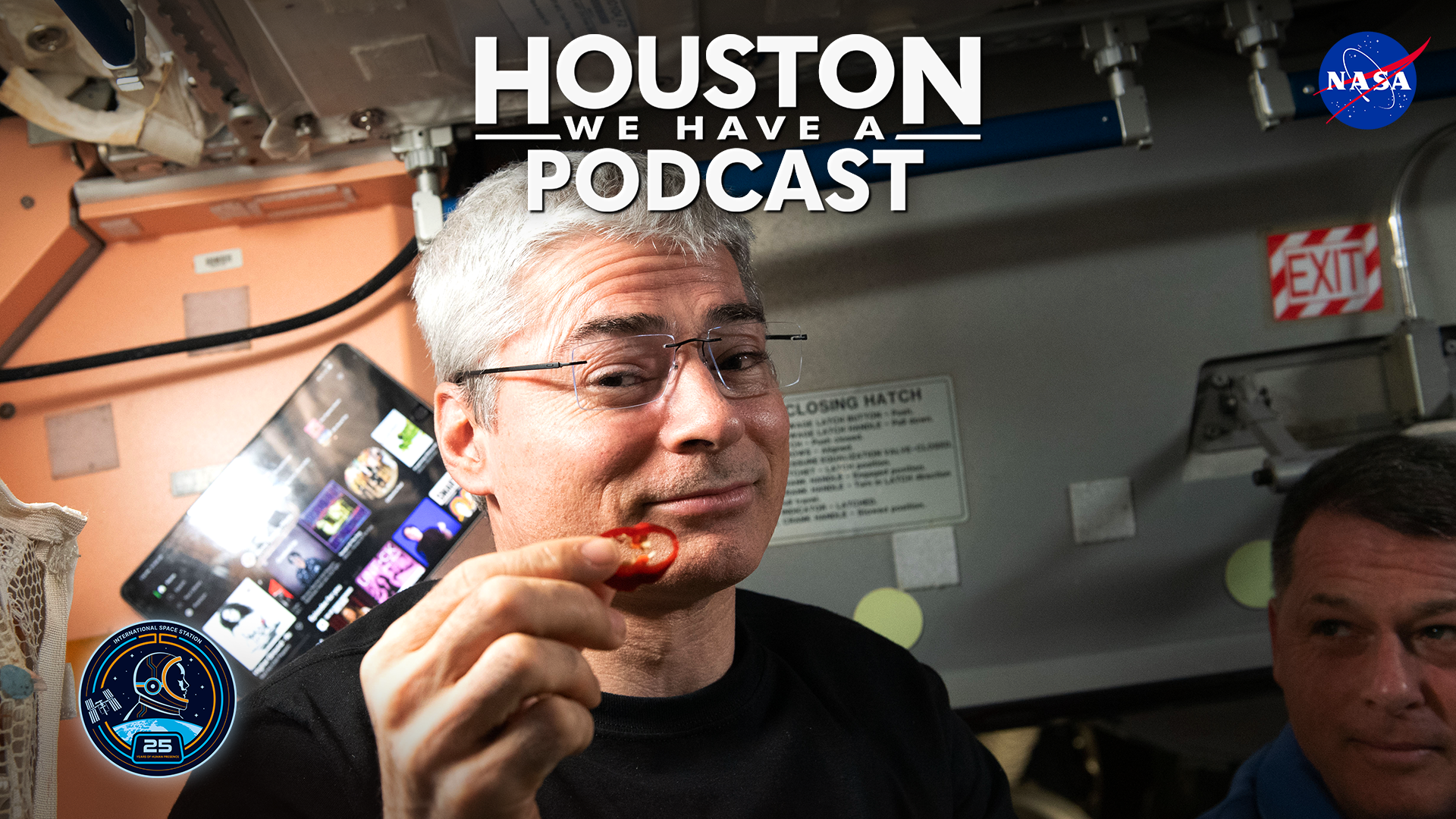
On episode 409, Part 2, NASA astronaut Mark Vande Hei reflects on his time aboard the International Space Station and his experience calling space home as part of our ISS25 series. This episode was recorded September 26, 2025.

Transcript
Nilufar Ramji
Houston We Have a Podcast. Welcome to the official podcast of the NASA Johnson Space Center, Episode 409: A Place in Space to Call Home, Part 2. I’m Nilufar Ramji, and I’ll be your host today. On this podcast, we bring in the experts, scientists, engineers, and astronauts, all to let you know what’s going on in the world of human spaceflight and more.
For the last 25 years, humans have lived and worked aboard the International Space Station… turning what was once a dream into a permanent home in space. What started as a bold idea has grown into a symbol of international cooperation, a cutting-edge laboratory and a launch pad for humanity’s future exploration of the Moon, Mars, and beyond.
On this episode we’ll be speaking with NASA astronaut Mark Vande Hei. He’s had two stints aboard the station, the first from 2017 to 2018 during expeditions 53 and 54 and the second, a nearly year-long stay across expeditions 64, 65, and 66 from March 2021, through March 2022. That mission put Mark in second place for the record of longest single spaceflight for a NASA astronaut, and overall, he comes in fifth on the list for cumulative stay in space. Here’s my conversation with Mark.
<Intro Music>
Mark, welcome to Houston. We have a podcast.
Mark Vande Hei
Thank you. It’s good to be here.
Nilufar Ramji
We’re so happy to have you, and we are celebrating 25 years of continuous human presence aboard the International Space Station. And that’s partially thanks to you. So thank you so much for all that you did while you were doing your two rotations on station, and we’d like to get to know you a little bit before we dive into the topic of the International Space Station. So tell us a little bit about when you joined NASA and what your experience was like, whether it was training to as you became an astronaut, what’s your background before while you were at NASA?
Mark Vande Hei
Okay, so, actually, I started working at NASA because the army loaned me to NASA. There was a brand new career field in the army called Space Operations. It started when I happened to be studying Space Physics, and I thought, hmm, I’m going to go back to the tactical army after having spent two years in grad school and three years teaching, and I’m not going to be very good at the tactics anymore. And then they started the Space Operations thing. I thought, Whoa, maybe they let me work at NASA. Of course, looking back on it, the reason nobody else had done that before is because it had just started. But I realized after I started that we don’t have anybody working at NASA that’s in this role. Trying to make a long story short, it turns out that the three-star general that was in charge of army Space Operations officers was trying to figure out how to professionally develop this group of new people doing a new career field in the army. And an army astronaut was talking to him, Pat Forrester, and said, Hey, why don’t you loan somebody to us in the astronaut office? We’ve got a job called capcom-ing that we could potentially use them for. And this all was going on without my knowledge. I came back from being overseas for quite a while and gave a presentation. Pat Forrester’s in the audience, and then next thing I knew, they were inviting me to come to work at NASA. And I was just like, what’s just going on? How did this just happen? So, yeah, I felt like I was very, very fortunate to to be loaned by the army to NASA.
Nilufar Ramji
Well, thank you for your service, and NASA is very happy to have you with 355 days in space. But tell us a little bit what was human space exploration like at that time when you joined?
Mark Vande Hei
Well, we were still building the Space Station. This was 2006. We had not gotten the Japanese module on the space station. Yet. There were still space shuttle flights that were flying. I showed up as somebody who is trying to learn about the systems on the space station with about a year to try to get into a control center to contribute to that team, when I realized that about five years were required for everybody else on the flight control team, and I was only on loan for about three and I was very concerned. in the army an SOP is a Standard Operating Procedure. At NASA, it’s a Secondary Oxygen Package. So all this lingo that I had learned just did not apply. I didn’t understand. There’s a lot of acronyms we use at NASA, so it was really challenging. I had to definitely read a lot and ask a lot of questions. But eventually that worked out really well, and I really, really enjoyed doing that. I got to work in the Mission Control Center during some space shuttle flights. A lot of shifts during routine operations on the space station. But the space station has changed since I started, from being constructed and installing a lot of systems on the space station, a lot of what I would call maintenance tasks now to how it was intended to be, to doing a lot of science. So as time went on, the capsule communicators job, the capcom’s job, got less and less, because more and more frequently the pay-com, which is the payload communicator, who’s working out of the Mission Control Center in Huntsville, started doing more and more of the communication, because we’re doing science.
Nilufar Ramji
It’s it’s great to see that evolution. And you talked a little bit about what it was like from being a being on the ground, but what about the point of view of what space station or human space exploration was like from the point of view of an astronaut?
Mark Vande Hei
So being on the space station, yes, wow. So it’s an amazing place to be. It’s hard to get your head wrapped around the fact that you’re in orbit. Yeah, and it’s partly because looking at the Earth, the scale is just really challenging. I went to space the first time and had the good fortune of flying with Paolo Nespoli, an Italian astronaut, and we did a post flight tour of Italy with him. And every time I looked at the boot of Italy from space, I could see both coasts. When I was in Italy on a train, and I couldn’t see the coasts, nor could I see the mountains down the middle of the peninsula. I was really having a hard time trying to understand like, like, wrap those two perspectives together.
The space station is all about science, and I like to say that the astronauts on the space station really serve as laboratory technicians. We are making sure all those experiments that largely run without our interaction have the facilities they need, maybe if there’s combustible parts, or certainly consumable parts, we make sure we replace those parts. We’re we’re not doing the research papers. We’re not planning the experiments. We are just helping those primary investigators execute those experiments. And there’s hundreds of experiments going on at any given time. It’s really an amazing National Lab.
Nilufar Ramji
It is a true engineering marvel, a science marvel. The discoveries that are made in low Earth orbit just help us, you know, will help us go to the Moon and Mars. So that’s very exciting. So 25 years of continuous human presence aboard station, tell me what that means to you. What does 25 years of the International Space Station mean to Mark Vande Hei?
Mark Vande Hei
So the fact that we’ve had human beings, actually Americans, in space that entire time, it’s a really tremendous feat. We’ve got a lot of young people today that have not lived without having one of their country people in low Earth orbit
Nilufar Ramji
Exactly!
Mark Vande Hei
I really would love someday to be able to say the same thing about having people on the surface of the moon. And I think that would be an amazing next feat. Now that’s I’m not sure what the plans are for something like that, but I would really love for some future generation it’s talking much like we are right now, about 25 years of presence on the moon surface.
Nilufar Ramji
I… that… that statement brings me joy and excitement and anticipation of the unknown. So I’m glad, I’m glad we’re on the same page. Let’s talk a little bit about your experiences during expedition 53 and 54 specifically, how, how did that mission look to- you were aboard station for about six months. Tell us a little bit more about that.
Mark Vande Hei
Sure. I felt like I got some tremendous opportunities. I went up to the space station not expecting to do any space walks, not necessarily being able to do a vehicle capture with the robotic arm. Using the robotic arm is something we spend a lot of time preparing for. But I got to do four space walks, and largely making sure that the latching end effector, which is, if you imagine the robotic arm that we have on the space station, the Canadian robotic arm, the latching end effector, is kind of like the hand on that arm. We replaced it. Lubricated, lubricated it. So I got to use a grease gun in in space. Got a little bit of grease on my spacesuit, but, but most of it did get to the right places. Yeah, while traveling five miles a second, which does not feel like you’re traveling five miles a second, it was amazing. I worked with some wonderful people, lots of science, really busy.
We, at that time, the US vehicles that were flying to the space station were cargo spacecraft, and every time we had a Dragon cargo spacecraft arrive, there was a lot of long hours making sure we transferred the cargo off of that spacecraft and then put the cargo back onto that spacecraft to return it to the earth, because that was a unique capability for that spacecraft.
Nilufar Ramji
Favorite cargo item that you received during your time up there.
Mark Vande Hei
My favorite item to get off of a cargo spacecraft was frozen popsicles. so we don’t get a lot of icy cold stuff on the space station, but every cargo spacecraft would deliver some fresh fruit. That was interesting. But something about getting icy cold ice cream or popsicles. I had three of those popsicles in a row. They were just delicious, and it was because it was so different from the normal either hot or lukewarm food that we would that’s great. It was really nice. the other nice thing to get off of a cargo spacecraft was a large object, because it was very satisfying to take a large chunk of cargo off and then put it someplace else. Happens very quickly. Big sense of accomplishment, yeah. Challenging ones are when you get a little tiny bag with a whole bunch of compact discs in it, and every Compact Disc had to go to a different place, you could spend an hour and a half trying to make sure you put all those things in exactly the right place, and it just wasn’t that satisfying.
Nilufar Ramji
You also probably felt very strong being able to carry those large packages or that large cargo in and out.
Mark Vande Hei
You know, it’s interesting, I never thought about that. I just thought to myself that the large packages are hard to lose. So if I had a paper clip on the space station, I would never want to let go of it, because it’s really hard, with just the stickiness on your fingers to not impart a relative velocity compared to how fast you’re moving to that paperclip. So if you turn your back on a floating paper clip. I wouldn’t expect it to be there. The air flow is enough that it might make it go someplace else. But if I had a 300 pound object, I could put my hands on it and just slowly let go, and that thing’s not going anywhere, because I would have had to put a lot more force into it to get to accelerate so I could turn my back on it, do stuff, come back, and it right where I expected it to be. And as long as you don’t move it really fast, because the faster you move it, the harder you have to work to stop it. So large objects are actually much easier.
Nilufar Ramji
Much easier. Okay, good takeaway for when I end up in space someday. Tell me a little bit about your most memorable time, or the most memorable moment from expedition 53/54.
Mark Vande Hei
My most memorable moment is, were every one of the space walks they how do I express this? You are outside the spacecraft, and there’s nothing between you and the rest of the universe, except for that visor on your helmet. Now, I would argue that when you’re on the earth, there’s nothing between you and the rest of the universe other than this fuzzy, thin layer of atmosphere, of air. We’re all in space all the time. We just don’t think about it. It feels like it’s separate going to space, being outside the atmosphere. It’s just much more visceral. You… and you have a lot of work to do, so it’s hard to process when you have to have this intense focus on doing these things correctly and keeping yourself safe and connected to the space station, quite frankly. While at the same time, there’s part of you that wants to just try to figure out, how do I how do I wrap this into my perception of reality? What I’m seeing right now? So it’s it’s an interesting time.
Nilufar Ramji
It definitely is. Now, let’s take it, bring it a little bit closer to our home planet. Tell me a little bit about what what did you bring with you to remind you of home while you were up in space,
Mark Vande Hei
I brought my wedding ring, that was a key thing, and kept that on my watch band because I was always dealing with things I didn’t get my ring caught anywhere. Otherwise, pictures of family. The best way for me to stay connected with the ground wasn’t physical objects. It was the opportunity to communicate with people on the ground. My kids went off to college while I was in space. And the nice thing about that was that NASA was very supportive of us have being able to have a weekly video teleconference, even though each child was in a different place, and my wife was in a different place, so in three different places, but that formed a weekly habit, and we still get on the phone every week and talk to each other, and even though we’re all four of us, well, my wife and I are in the same state, but my two adult children are out of the state, in different states,
Nilufar Ramji
So you kind of started a little family tradition, in low Earth orbit.
Mark Vande Hei
Yes, and really happy to do that.
Nilufar Ramji
I love that. Now let’s fast forward to a few years later, but a handful of years later to your long duration stay. That was expedition, 64, 65, and 66. Tell me a little bit about what changed over these missions.
Mark Vande Hei
Physically, the space station, going back felt really familiar to me. In fact, once you come back to Earth after a space flight, it’s hard to relive those memories, because there’s not a lot of similarity with your day to day experience in space that will be like, oh yeah, this is just like being in space. There’s just not those things. So going back to the space station, felt like I was getting to relive vividly some of my memories. I stayed in the same crew quarters as I did on the previous flight. Most things were pretty similar. I did blow some circuit breakers one time because I made an assumption that we plugged things into the same place. Turned out that wasn’t the case. So you got to be careful about those things.
The biggest thing that changed for me was because I knew that I was going to be in orbit potentially a really long time. I paid a lot more attention to my mental health than on the first flight, and I think I was easier to live with because of it. I got in the habit of every day spending 20 minutes meditating. At first it was just in my crew quarters, but then later on, I decided to start doing it in the cupola with my eyes open, and I got up before everybody else. So I could turn off the lights in Node Three, which is where the cupola is. And for those of you that aren’t aware, the cupola is our largest window looking down towards the earth. So I would have the lights off in in the vicinity of the cupola. My previous flight, I would have claimed that you really can’t see the stars very well. Because of the reflections from lights inside you’re looking through. It’s like being in your house trying to look at the stars. Well, if you turn off all the lights, it helps a lot. If you close the laptop screens in the vicinity it get rid of some of that reflection. And since I was spending 20 minutes in that space trying to just appreciate every moment, your eyes also adjust, after about 15 minutes, to the darkness. If you just happen to be just happen to be looking at the Earth inside the shadow of the earth, and it was incredible. There’s- when your eyes adjust to that darkness of space, it starts to feel like there is no darkness. There’s so much stuff that there’s just shades of gray because there’s there’s enough stuff way in the background that it feels like your eyes just can’t resolve as separate. So there’s kind of just different shades of faint light. Everywhere you look, there’s some spots certainly that seem like maybe something’s blocking and seems extra dark there. But by and large, everywhere you look, there’s a lot of stuff.
Nilufar Ramji
You’re making me feel goose bumps, excitement, some level of emotion here right now. That’s that’s really cool.
Mark Vande Hei
Well, I’m glad, because somehow I got to figure out a way to share it. It is. I feel like I got the benefit of some amazing experiences. I would love for people to be able to to experience. Because it is, it really? It’s an amazing thing.
Nilufar Ramji
It really is it is it just gives you a different perspective on the remarkable beauty that exists all around us. It’s thank you for sharing a little bit about that with us. Now on this mission, you did some fun things aboard station. If I recall correctly, you had two chili pepper harvests.
Mark Vande Hei
I believe that’s true. Yes.
Nilufar Ramji
Did you eat them?
Mark Vande Hei
Yes, and they were incredibly spicy.
Nilufar Ramji
Wow. Okay.
Mark Vande Hei
In fact, New Mexico sent me a certificate saying that I’m actually a “hatch-stronaut” today.
Nilufar Ramji
Because it was the hatch chilis?
Mark Vande Hei
So I’m proud to be a hatch-stronaut. Yeah, one of the nicest things about dealing with that experiment to grow those peppers was opening up the screen, the window to that habitat for those peppers, and then smelling vegetation. We don’t get that smell. So that was, that was really nice. And then a lot of the peppers we had to send back to the earth because they were the results of a science experiment. But the the folks that that were in charge of that experiment said that we could eat some of them, and we had a little bit of a party with hatch chili peppers that night.
Nilufar Ramji
What did y’all make?
Mark Vande Hei
We put them on tortillas, we just tried them straight up, and they were potent. I think the first batch wasn’t as potent as a second batch. I don’t know why, but my understanding, oh, gosh, I’d love to be corrected if I’m wrong about this, is that, because it’s a little more stressful of an environment for the peppers that they because of that, they end up being more spicy.
Nilufar Ramji
Oh, they get a little angry.
Mark Vande Hei
Apparently, yes.
Nilufar Ramji
That’s great. Um, did you grow anything else while you were up on station?
Mark Vande Hei
I did not.
Nilufar Ramji
Okay, well, chili peppers, they take a while to germinate and flower and turn to chili so that’s really exciting. Did you do you generally eat spicy food?
Mark Vande Hei
Um, I’m not a- I have suffered through some extremely spicy food. So there is certainly a limit. I do like a little bit of spice, but I don’t like sweating while I’m eating food.
Nilufar Ramji
That makes absolute sense. I was just wondering, since taste buds and things like that evolve, I wondered if you know something that wasn’t as spicy, maybe tasted a little bit spicier to you?
Mark Vande Hei
Oh, actually, I think what happens in space is you start looking for something that’s different. For me, I could make anything taste good by putting garlic paste on it. We had these tubes of garlic paste, and honestly, the green beans, they were kind of like eating canned green beans. It was I would eat them because they were what was available sometimes, but I would put a lot of garlic paste on those green beans, and then…
Nilufar Ramji
Garlic. Okay, so I remember talking to Comrade, Randy Bresnik for our listeners, and he said he hated grapefruit on Earth, but when he went into space, that was his favorite thing to interesting. So it’s always interesting to hear what you guys like eating up there.
Tell me a little bit about your daily routine on station. You wake up in the morning, you meditate, and then what happens? You have some tasks you do. How much science tell us a little bit about your day.
Mark Vande Hei
It changes every day. We have- The routine is that at seven in the morning, and this is using Greenwich Mean Time for the space station, at seven in the morning, we have a daily planning conference. 15 minute tag up with the ground control team, and then right after that, we get to work. And that work day consists of, it could be maintenance activities, science activities, every, typically, every crew member, which is nowadays it’s seven people, is working on their own, on their own, separate tasks. It’s more it’s actually a lot more fun when we get to work with another person. But it doesn’t happen very often. Most of the things are individual tasks, and they get a lot more efficiency out of us when we’re all able to do those things by ourselves. The, in that time period, but, and then that goes through around 7pm maybe, I think maybe 7:30 but 7pm I think, would we have an evening planning conference, and that would at the end of that, that would end the day I liked getting up.
Oh, and also, between that 7am and 7pm we’d have an hour for lunch, and we’d have about two and a half hours for exercise. I really liked exercise is super important to me, and I liked getting up, like I mentioned, earlier than everybody else, meditating. And then when I had, when you first I think 6am is wake up, or it’s called post-sleep, so you have time to do whatever hygiene you want to do and eat breakfast. I liked working out before I ate. So I would get up at 430 in the morning, meditate, and by five in the morning I was exercising. And then when, ideally, I’d have all my exercise done before we had that daily planning conference. And then when I had exercise time scheduled later, it was an opportunity for me to catch up on administrative things, email, take a break, eat my breakfast, things like that.
And yeah, that was and then, because I got up so early, as soon as the evening daily planning conference was done, I’d ask people to turn on the mood lighting. The space station has three as really nice lights. There’s three different settings. One is normal operations, the other one is a pre sleep mode. I’m not sure if I’m getting the terminology correct, but it’s a very reddish light, and it really surprised me how much that shift in color of light makes you feel like you can relax a little bit more. So because I was gonna go to bed in about an hour after that, we shift to mood lighting. That’s what we called it. And then there’s another thing we didn’t use very often, but it’s called phase shift, and that’s a very blue light. So if at three in the morning a vehicle is docking, we all had to be alert. You could turn that on, and it was way better than a cup of coffee you would be just, show up to alertness. Yes.
Nilufar Ramji
Wow. That’s why they have those blue light blockers and things like that.
Mark Vande Hei
Yeah, it’s your- Yes, it does have an impact.
Nilufar Ramji
So, Space Station. International, Space Station. So international cooperation, working with colleagues from different parts of the world, from different global space agencies, tell me a little bit about how teamwork and international cooperation are essential to the space station.
Mark Vande Hei
Yeah, one of the niceties from my perspective of working on the space station is the international aspect. You get exposed to a lot of different cultures or ways, different ways of doing things. Certainly, you have to be aware that there’s some cultural norms that are different. And it’s nice too, recognizing that the way we do things is not the only way to do things, and you can learn, learn, sometimes better ways to do things from other people we sometimes there’s challenges associated with that, because each country does have its own desires. There’s, for example, space walks. By and large, Americans are doing the space walks on the US segment, but our international partners would love to do more of those space walks. And we don’t always have the opportunity to give everybody the opportunity to do a space walk. So sometimes we don’t get to get everybody out the door to do that. There is but, but it really is, one team all the time.
The Russian, our Russian crew mates, spend most of their time in the Russian segment getting instructions for what they’re supposed to do from Moscow in the US segment, which which involves Japanese astronauts, Canadian astronauts and European astronauts. They’re getting instructions from Houston, and we’re collaborating with the mission control centers and in Germany and in Tskuba, Japan and Huntsville, Alabama, they were focused on those things. And we typically would cross paths with the Russians when they come to use our resistive exercise device, because it’s a really good device, and they can get a really good workout out of it. So that was nice that we got to see them when they were doing that. Sometimes I had to go to the Russian segment to do an experiment, or even doing a ham radio pass. We would use their ham radio. The other time we- my crews, some crews do this, more or less, but the crews I was on, every Friday night or Saturday night, one of those two nights, we would have a group dinner, and it would be hosted by the US segment, or the. Russian segment. So we tried, once we got a sense for what type of American foods the Russians liked we throughout the week, if we were hosting, we would save some of the some of their favorites. And likewise for them. They’re very different food systems. And that variety was really nice to get when we go over the Russian segment and eat Russian food. It was, it was a nice change. And then we also, the other night of the weekend, we’d have a movie night, and it was fun, because we shifted to a technique where everybody got a turn to pick the movie, and they tried to pick a movie that they had already seen, but they want to share with everybody else. And so it was fun. We got, honestly, we saw some pretty strange movies sometimes. But it was also interesting when a Russian picked out a US Western that he really liked, and we watched that so…
Nilufar Ramji
Good bonding. I imagine that you would have spent a lot of holidays up in space as well, and I know there are some that are different, depending on the crew that you have up there. So memorable holidays. Let’s hear a little bit about how we celebrate holidays in space.
Mark Vande Hei
New Year’s Eve is is the primary holiday in Russia, and so they make a really big deal about that. They make this salad Olivye, which I was really impressed that the cosmonauts that were in space with me figured out a way to make that salad with the stuff they had put in a ziploc bag and and mixed all the materials they could find together and made a really good version of that salad, just because it was their tradition, and it was really nice to hang out with them and celebrate that we also had, I guess I should call them holiday cookies. Christmas cookies. They- The nice thing about that is you can make some really fancy cookie decorations in orbit, because you the frosting can easily be very three dimensional. So if you want to, if you want to make a full size snowman out of cookie frosting, you can just build up the layer
Nilufar Ramji
That is so cool!
Mark Vande Hei
You can put a Christmas tree, not just layered flat like peanut butter spread on the cookie, but built up as a three dimensional Christmas tree out of frosting on your cookie. So we had a lot of fun having the ground judge our cookies and a cookie decorating contest. And then another thing we did that was fun going into the holidays is it’s an interesting time, because in the United States, that’s a time when a lot of people are taking vacations, right? But people still have to work the mission in the Mission Control Center, so we wanted to make it fun for them, too. They were making a sacrifice to be with us, and one of the capcoms came up with a bingo game, and it was every day, there was a different movie theme, and they put quotes on the bingo cards that they passed out they could email to different control centers, and it became a contest between the Mission Control Center in Houston, Tskuba, Germany, and Huntsville, and Moscow to see who would win the bingo game. And our job as crew members was, while we were talking to the ground team, was to just try to work these movie quotes into what we were saying, and then they quickly check off their block. Raja Chari was exceptionally good at working those into his conversations.
Nilufar Ramji
Yeah, those casual slips. That’s that’s really fun. I can’t wait to see what Crew-11 does during the holidays. Now, you’ve given them some really good ideas. So aside from that, I wonder I’m gonna stick with the holiday theme. So you talked a little bit about the cargo that you’ve gotten, some of the icy pops that you’ve enjoyed when you get the holiday kit. What’s your favorite thing from the holiday kit?
Mark Vande Hei
Oh, we got a, we got a lot of food items that are associated with our Thanksgiving for the time period around Thanksgiving. So there was turkey breast and cranberry sauce, things like that.
Nilufar Ramji
Gives you a little taste of home.
Mark Vande Hei
Yes, yes, it was really nice.
Nilufar Ramji
Okay, that’s I’m hungry. Now. Let’s change a little change topics. A little bit about microgravity research. So you talked about the chili peppers you grew, the different experiments that you’ve done, tell us a little bit, from your point of view, why microgravity research is so critical for life on Earth and missions beyond low Earth orbit.
Mark Vande Hei
So in general, science tries to isolate variables to figure out how whatever we’re trying to understand better reacts to those things. So I like to point out that it’s not really a micro gravity environment. It’s an environment where everything is falling together. So if you get on a scale in an elevator and weigh yourself, if the elevator is accelerating upward, the scale reads a higher number. The scale is not really measuring the force of gravity on you. The scale is measuring the force of the floor pushing you up. And if the floor starts dropping out, then that scale starts reading less and less as it accelerates faster and faster. Well, if you’re in a spacecraft where the floor is always falling away from you, that’s it’s. It’s that simple. There’s nothing fancy about being in orbit. You’re just in a room that is constantly falling towards the center of the Earth, but it’s going so fast horizontally, it keeps missing. And there’s no wind, so it’s very, very stable. It just feels like gravity has been shut off. But the gravity, if gravity was shut off, then we would not stay near the planet. It’s that gravity that keeps us there.
So in reality, what’s happening? It’s a situation where the surfaces you’re surrounded by are not pushing on you very hard, and our skeletal structure is required to make sure that as the floor pushes on us, to prevent us from falling through the floor, that we can stay standing. When, if you want to have complex structures, that they have to be able to deal with the force of the ground pushing back. That’s really what all these things do on the Earth’s surface. So when you’re in space, it’s- I taught physics, so we call that a normal force. It’s the force perpendicular to the surface. It’s really, it doesn’t sound very cool to call it a zero normal force environment, but that’s really what it is if you type on a keyboard without anchoring your feet under something, you will send yourself, you’ll fly to the ceiling just because of the force of your fingers on the keyboard. And I know that because I did it. It’s just really frustrating when you first get up there. It’s even hard to type then.
So there’s so many things that behave differently. So when you make a mixture in a fluid on the Earth’s surface. The fact that there’s these buoyant forces will make the lighter things go to the top and the heavier things go to the bottom. But there’s no buoyant force. There’s not that differentiation of an up or a down in orbit when when you’re in this free fall environment. So you can keep a really homogeneous mixture. That’s one example. When you have a flame on the Earth’s surface, it’s getting all of the oxygen rich air flowing in, because the heat of the flame makes makes that air lighter as it goes up and it goes up and away, and that draws in that oxygen. Well, it turns out it’s really hard to keep a flame going in space, because it just makes a sphere and kind of wants to choke itself out. So one of our reactions to a fire in the space station would be just turn off all the ventilation, because it should put itself out, shut off the electricity and shut off the ventilation. There’s and I could go on and on. There’s so many things.
Another interesting thing to research is material science, if we want to understand how materials react on the Earth’s surface and we want to heat them up, there, always have to be in a container, and there’s the interaction with the surface of the container can make the experiment less accurate. But in orbit, there’s actually something that I thought was really interesting, called ELF. Oh gosh, Electromagnetic Levitation Furnace is what it was called, and they had little pellets that were held in place without a crucible, but they could be heated up. And we don’t have the contamination with that crucible, all kinds of things like that.
Nilufar Ramji
So all of the experiments that you’re doing a board station, talk to us a little bit about how that will help us to head to the moon and eventually Mars.
Mark Vande Hei
Yeah, I’m, I’m a big fan of us recognizing the risks going to Mars, using the moon as a stepping stone, and using the space station experience as as a way to understand how to keep people healthy on a long flight in that zero G environment. And when I say G, when you when you take a five-G turn in a plane, you feel like you’re five times as heavy, right? I’m talking about the force of gravity did increase, but the seat of that plane is pushing on you five times as hard as the force of gravity. So that’s why we call it. I’ll call it a zero G environment.
People are gonna have to live in that environment for a long time, unless we build a very big, very large spacecraft that spins around so that they get some sensation of gravity. I suspect we won’t do that unless we have the vehicle accelerating for a long period of time and then decelerating For a long period of time. You could use that to simulate gravity. So it’s going to be challenging, especially when people get to another planetary surface and they don’t have medical staff waiting for them when they arrive. I landed after close to a year in space, but I got a lot of attention right after I landed. Some of that attention was to do experiments on me to understand what I could do without any assistance. So. So we’re getting really good about how to keep bone density healthy. The exercise programs we do on the space station helps out tremendously. I felt really good after my second space flight coming back. I could walk within a few hours. I could jump up and down. I certainly felt a little unsteady, but by and large, I felt very functional. There’s medicine that helps out with that. There’s, yeah, there’s the food systems, even understanding how to keep food that’s not expired in the right places for to support the crew. Carbon Dioxide scrubbing that we got to do on the space station, that’s an issue that we certainly have to have solved for long duration spacecraft that go further away from the Earth.
Nilufar Ramji:
So not only are we looking at how long duration space flight and going deeper into space with calm delays and things like that affect us as humans, but also how it affects life around us, what we need to be sustainable, to be to be able to survive on another planet or another planetary body. So I think you’re making some really good points, and I appreciate the insight you’re bringing from the space station to help us take this beyond. Thank you so much for everything that you did during your two missions. I have a couple more questions for you, just kind of reflective questions, if I may. So you were part of what group of class of astronauts?
Mark Vande Hei
I was in class 20, also known as The Chumps.
Nilufar Ramji
Oh, You were part of Kjell Lindgren’s class?
Mark Vande Hei
Yes, I was.
Nilufar Ramji
Great. So we just announced our 24th group of astronaut candidates. And you know, how does it feel being part of a program that spans decades, that has made history, that has so much pride and with, with, NASA. This is it’s so cool. I want to hear from you.
Mark Vande Hei
I- It’s hard for me to answer that question without getting choked up. It feels like such a privilege to have even worked a day at NASA, and to to recognize that it’s getting closer to 20 years, than 10 years that I’ve been here and seeing people showing up that are so well qualified and are going to take this program, all of our programs, into wonderful new places and new challenges. There’s a lot of challenges, but we got we’re hiring the right people, and I’m so excited for them. I’m excited for the country. It’s… yeah. Something that struck me immediately about getting to NASA is how good people are at their jobs. How passionate they are about their jobs. And how proud they are about the job that they get to do, and it makes it a really wonderful place to work.
Nilufar Ramji
Yes, I completely agree with you. It’s really wonderful to see that almost 20 years in, that sense of pride that you had on day one versus day today is the same, and that is why this is one of the best places to work, in my opinion, just the level of excitement that you bring to your job. Well, anything that you want to share with our audience before we wrap up today?
Mark Vande Hei
Yeah, I’d like to re emphasize that we are all in space all the time, and space is not a different place. I was talking to one of my classmates, David St Jacques, last night, and he mentioned people look at him funny when he says that. But he says, “Are, you know, are you in Houston?” The answer would be yes. “Well, are you in Texas? Are you in the United States? Are you on the surface of the earth? Are you in space?” You’re in all those places, right? It’s just feels really separate, because it’s hard to get outside the atmosphere. But again, when you look at the atmosphere from low earth orbit, it looks like it’s a puddle in a parking lot. It feels like it is this very thin varnish on a beautiful rock. And all of human history, all of our existence, is inside that atmosphere, and it is so thin that when you go to higher elevations and go hiking in the mountains, your body feels it. There’s places on the Earth’s surface that you can’t survive for extended periods of time because there it’s because you’re getting to thinner and thinner layers of the atmosphere. And so I left, I left low earth orbit, feeling very protective of what I see as a as a fragile resource. That we’re not so much earthlings as we are atmospherelings, because this all of our existence. In fact, when we go to space, we replicate that atmosphere so that we can live there, because that’s our environment.
Nilufar Ramji
Mark, thank you. Thanks for being here today.
Mark Vande Hei
I really appreciate it. Thanks for the wonderful questions and yeah, thanks for giving me the opportunity to give you the answers.
Nilufar Ramji
Of course!
Well, thanks for sticking around. I hope you learned something new today.
This episode is the fourth of our International Space Station 25 series, where we’re celebrating a quarter century of continuous human presence in space with the people who made it possible. And then we’re exploring what comes next.
If you want to hear more from Mark Vande Hei, he’s been on the show previously on episodes 13,15, 94, 190, and 245.
You can check out the latest from around the agency at nasa.gov, and you can find more about our astronaut corps at nasa.gov/astronauts. You can also learn more about the International Space station at nasa.gov/iss.
Our full collection of episodes and all the other wonderful NASA Podcasts can be found at nasa.gov/podcasts.
On social media we are on the NASA Johnson Space Center pages of Facebook, X, and Instagram. If you have any questions for us or suggestions for future episodes, email us at nasa-houstonpodcast@mail.nasa.gov.
This interview was recorded September 26, 2025.
Our producer is Dane Turner. Audio engineers are Will Flato, Daniel Tohill and Greg Wiseman. And our social media is managed by Kelsey Howren. Houston We Have a Podcast was created and is supervised by Gary Jordan. Special thanks to Kara Slaughter, Mary Pfister, and Courtney Beasley for helping us to set up this interview, and of course, thanks again to Mark Vande Hei for taking the time to come on the show.
Give us a rating and feedback on whatever platform you’re listening to us on and tell us what you think of our podcast.
We’ll see you next week.
3… 2… 1… This is an official NASA podcast.