















From Earth orbit to the Moon and Mars, explore the world of human spaceflight with NASA each week on the official podcast of the Johnson Space Center in Houston, Texas. Listen to in-depth conversations with the astronauts, scientists and engineers who make it possible.
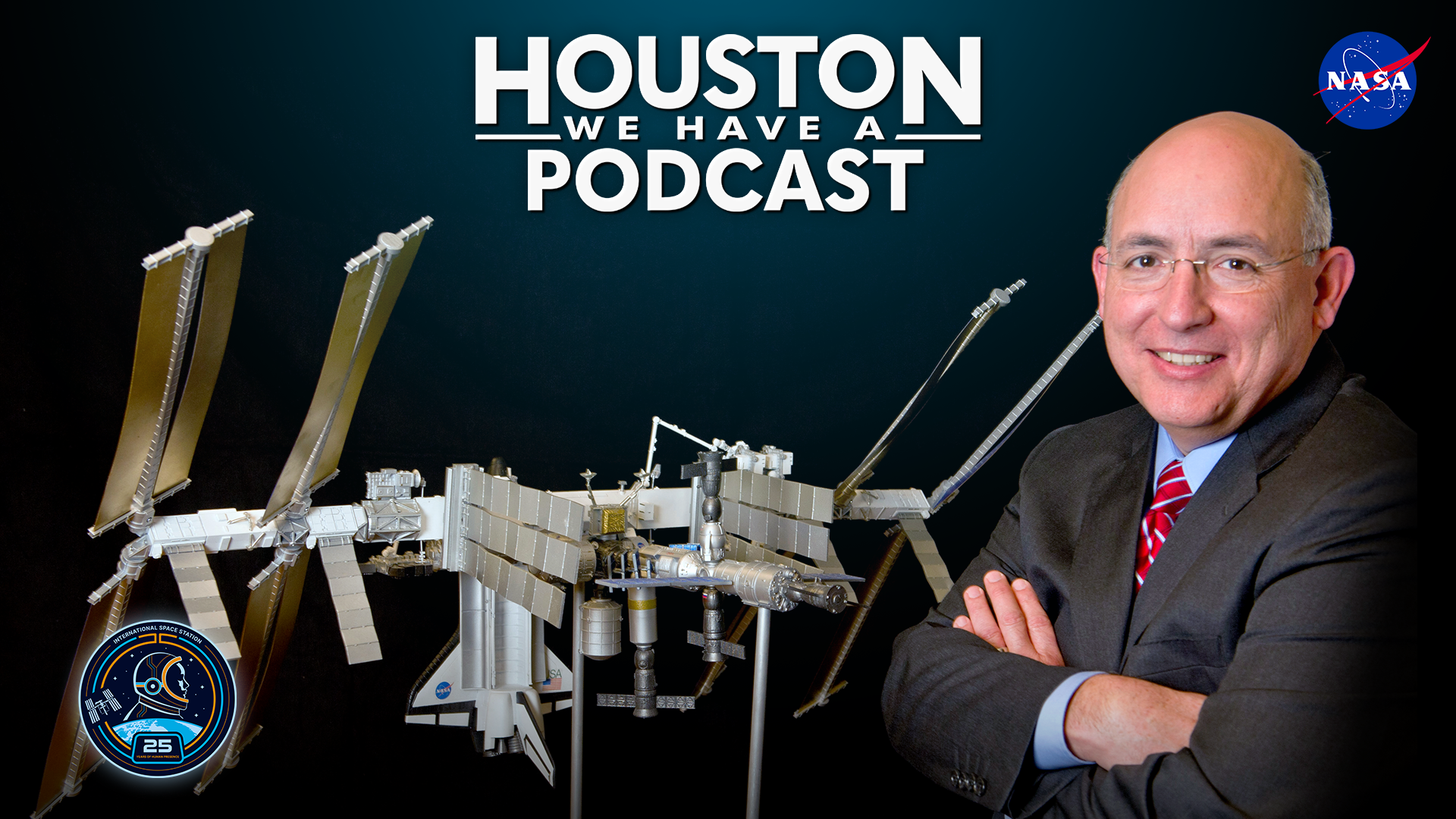
On episode 405, former ISS program manager and Axiom Space co-founder Michael Suffredini reflects on the ambitious path to building the International Space Station and the lessons learned from a decade of leadership. This episode was recorded September 25, 2025.
Transcript
Gary Jordan
Houston We Have a Podcast. Welcome to the official podcast of the NASA Johnson Space Center, Episode 405: Building the International Space Station. I’m Gary Jordan, and I’ll be your host for this episode. On this podcast, we bring in the experts, scientists, engineers and astronauts, all to let you know what’s going on in the world of human spaceflight and more.
We’ve recently hit a monumental milestone. Expedition 1 began November 2, 2000 which means that November 2, 2025 marked 25 years of a continuous human presence aboard the International Space Station. And to celebrate that, we are dedicating multiple upcoming episodes to covering different aspects of the ISS and how we got to where we are today.
For a quarter of a century, this station has been a hub of scientific discovery, international partnership and technological innovation. It’s where humans from across the globe have come together to live and work in space, pushing the boundaries of what’s possible. But getting to this point wasn’t easy. Building the International Space Station is one of the most ambitious engineering projects in history, requiring decades of planning, international cooperation and some of the brightest minds in human spaceflight.
In the first episode of our ISS25 series, we’ll talk with former ISS program manager and co-founder of Axiom space, Michael Suffredini, who played pivotal roles in turning the dream of a space station into reality as a space station program manager from 2005 to 2015 overseeing the completion of assembly to the transition to utilization, we’ll hear how he led through challenges, fostered global partnerships and set the foundation for the next era of human space exploration.
Let’s get started.
<Intro Music>
Gary Jordan
Mike Suffredini, thank you so much for coming on Houston We Have a Podcast to help us kick off 25 years of the International Space Station and human presence on board. Thank you very much.
Mike Suffredini
My pleasure. Thanks for having me.
Gary Jordan
It’s- you have a quite a history with the International Space Station Program. There is a reason you are here to help us to kick this off. I want to start off though, like I usually do with our guests, and helping our listeners to get to know a little bit about you. We’re going to go a little a little farther back and start biographical before we get into the International Space Station. Want our listeners to get to know a little bit about you growing up and what helped you to get to where you are today, and that passion for space exploration that led you to, I guess, what we’re going to talk about here primarily is, is being a program manager of the International Space Station and following along that path and getting to where you are, if you don’t mind starting there.
Mike Suffredini
Yeah, no problem. This is a story that doesn’t usually, uh, start off the way most of the space people want to hear it. Start off because they want, they want to hear that. You know, I watched Armstrong touch foot on the moon, and was ready to go to be a space guy. I did watch him touch foot on the moon, and I was very, uh, blown away by it, even at the young age I was at the time, but really, I went to the University of Texas and majored in aerospace engineering because of planes. I thought I wanted to work on high performance jets, really. And it wasn’t until I was about two or three years in that I took a course called orbital dynamics, which is a difficult course, but a fascinating course. And the gentleman who taught that. His name’s Victor Szebehely at the University of Texas, he’s now passed with but he he was the way he taught, and the things he taught us that we could do was just fascinating, and that kind of started leading me towards the space side of things. So when I got ready to graduate, I interviewed, not only with different aerospace and helicopter companies, but also with NASA, McDonnell-Douglas and Lockheed-Martin. Ultimately, I ended up here, as in operations, actually, is how I started off my career. And then I from there, I moved on on the really, kind of on the payload side of things, a little bit teaching, really, doing training was what I came on to start doing. And I did training in various different applications. IUS was a big thing. And so there was training of different programs. Even helped the Air Force out some. And then ultimately, I became a civil servant in 89 when shuttle was picking back up after the Challenger accident, and they needed people to manage what they called Mission valuation room. That’s where the engineers were that, you know, followed the mission and gave advice to the operations guys about what to do. And then after the shuttle landed, we did a lot of work to recover and fix things and then get ready for the next flight. And so that’s really how I ended up as a civil servant. And then from there, I was in human space flight all along through, well, the ops was all human space flight, of course, but shuttle. I stayed with shuttle for a number of years. Eventually ended up as a manager, Space Shuttle Program Manager. At the time, they had directors, so I was an assistant manager. I wasn’t the the program manager. I worked for Brewster Shaw and Tommy Holloway. Great, great people, by the way. They’re just I learned so much from them, and they really are the when you start thinking about the people that really push us along. Those are a couple of big, big managers, along with with George Abbey. And speaking of George, George was the one that decided it was time for me to go over in the space station. So in 1994 George asked that well, didn’t ask at the time, I asked if I could say no, and Harvey Hartman said, Well, that’s that’s an option, but it’s limits your future a bit, maybe. But anyway, so they asked me come over. And so I came over at the at the time, Randy Brinkley was the program manager, and Shep had just left maybe six months later, moved on to be an astronaut. He was the program manager way back at the beginning, and then from there, it’s just been an interesting ride. I started off in the Budget Office, of all places, and then about six months in, Randy brought me in and said, Hey, we want you to start this thing. You know, we’re building this program to build to do research and science on board. We’re not really thinking about that very clearly. I want you to come in, we put ops and in and all this payload and research stuff together. And so I created this, what we called the ISS research office. And I think started off as ISS payloads office, and then eventually we changed the name, and I did that for about three years, and it was a fascinating job, because really, we were affecting the design of the lab, and the lab’s design was way far along. And so we were trying to come and say, Okay, here’s where we have to plant our flags. These are things we can do, that we must do, and here’s the things we don’t have to do. The research guys were actually spending money way faster than the program was was building. So fact, when I took it over, our budget was over $2 billion it was a, it was a, just a fascinating thing. But anyway, And then after that, Tommy asked me to go to the vehicle, what we call the vehicle office, and that was right when we started flying. We had launched, FTP had launched, the node had launched, and Z1 launched. Actually, I was, I was in the vehicle office for the Z1 launch. And then I was there through many, many elements that flew all the way up through.
I moved on right before a P1 flew. So we did the lab and and at Z1 launched, about the time I was coming over, but the lab and P6 which was a, which was a huge accomplishment. And then we had research, not research. We had missions that brought up the arm, and we did. We brought up supplies and some of these things. And then we started building out the trust. Anyway, it’s just a fascinating time. We did some amazing things to get these, this hardware, ready to go fly. And we learned a lot along the way. It was just, it really, was truly fascinating. And then from there, I became the head of operations, and I did that for several years. And then eventually [William] Gerst[enmaier] asked me to be his deputy. And so I was deputy to Gerst until 2005 where he was told that he was supposed to go to headquarters. And then that’s when I became program manager and did that for the next 10 years.
Gary Jordan
All over the place. So if you were and so this, I think what eventually, what I’m seeing is a trend of what led to your eventual placement in 2005 I believe, as the program manager, is this experience in operations, in management, you did a little bit of research, the engineering side of things, whether it be from the mission evaluation room or from the vehicle office, there’s, but there’s, there’s all of these different components, the International Space Station being as complex of a complex as it is, you seeing so many different parts of it is really looking after the team that is that is managing more into the details, but knowing the right questions to ask and knowing the right people to do it. So it was a little bit, a little bit of that, and that, that wide experience maybe led to, eventually, that placement as the program manager?
Mike Suffredini
Certainly. Actually, and it played a major role in in this crazy idea I had to go, you know, build next the first commercial space station was founding of Axiom, and it was basically because of all the things I had experienced and have an opportunity to do, including the work with the partners, that led me to this point where I said, Well, there’s a way to do this commercially, where we can save money and still be safe. And you know, this is going to have to happen at some point. So that’s really what drove me to think that I could could do something as as profound as start a company that’s going to build the first commercial space station, and we’re still going, so that’s awesome,
Gary Jordan
and I want to see, and I want to tell the story and revisit some of these moments in your career all the way through ISS, and then do get to commercial stations and how this is really paving for future exploration as well, even 25 years later, of continuous human presence. But, but going back in your career into the especially to the early years you said you went to the station program in 94 this is really spinning up the program. You already had experience in shuttle. There was, you know, Shuttle-Mir was around this time. So, so there were these low Earth orbit operations that eventually led to this, this idea of of International Space Station, I wonder if you can sort of help us to understand the whole landscape of things around the time of your career and your time in the International Space Station as we are, you know, working with our Russian partners and FGB as a collaborative endeavor, and some of those early years of construction, you mentioned Z1, P1, you mentioned these early assembly missions and these components of international state space station, bringing them together. Your perspective of those early years from your post in the program at the time.
Mike Suffredini
Well, remember, I started in the program after we had decided to bring the Russians on board, and right we were going through phase 1 and all that. And so that’s when I really stepped into the program. And at that point to what you said it when, when I look back on what we said we were going to do, it’s pretty phenomenal, because we had all of these components that were going to be built by the international partners, and somehow they were all going to get to orbit and plug in and work and and when you just think about that intellectually, you you, it scares you, you know. And that’s really the thing, and you can’t do it until you can get all the engineers in a room. And what’s fascinating, and what I learned through this whole process is, when you put engineers in a room, it’s amazing how quickly they they can talk to each other, because they’re all they’re using the same equations, you know, stress analysis, stress analysis, how you do it’s a little different. Some do things a bit different, but the equations are same, the assumptions are same, which you what you go through, very, very similar. And that was probably what made this early on technically viable was that engineers really talked the same language. So when you put them all in a room, that was that’s probably the linchpin that let us technically be able to do this. Now, what really allowed that to happen was the politics of the day. So with the with the wall falling, there was a big push to bring the Russians in and participate. We knew we were going to have to help fund them, but we wanted their space program to continue to be robust and that play in politics was really the green light that NASA had to go do the many things we did over the years, and it’s what we were allowed to do when nobody else was is, is pretty phenomenal. And I can just remember conversations later on with, you know, you change manage leadership at NASA. You know, every two or three years, leadership’s changing out, particularly the highest level leadership. And I can remember a conversation with one of our heads of I’m trying to remember what we called it, H, O, M, D, I think at that time it was human space flight and operations was all in one and I won’t mention his name, but he he came in and sat down and said, Okay, well, we want to do something this way. And we kind of said, well, okay, but we need to talk to the partners, and they, well, we’re in charge, right? So, well, we’re not completely in charge. We have responsibilities, including the safety of the vehicle. So So NASA had this authority around safety, and if, if it was a safety decision, we said, we said, this is the way we’re gonna do it. That’s what all the partners are supposed to do. But when it came to technical solutions, although we were building a lot of the space station and we were providing the infrastructure that most of the users would use, we still had to work with the partners. So we were trying to make a decision about something that was going to fly on a progress. And I can remember we were not in sync with our Russian partners on on this item, and I don’t want to get to the item or the or the leadership that was involved, but there was something that they had load onto the progress that we didn’t think was safe. And so we, you know, told our Russian friends, who told us their opinion, and it was that it’s safe and it’s, you know, loaded, and they’re ready to go fly. And, you know, they don’t really like to sit around and not fly if they can help it. And so we had to go to our leadership headquarters and say, Look, we’re doing this. This is where we’re at. This is why we were concerned. This is, this is what we got the Russians agreed to do, but still it’s flying. And I remember him just as clear as day, saying, Just tell him it’s not launching. We had to say curses with me, and we had to just kind of help him understand that that really wasn’t an I mean, we can say it, but it may not make a difference. You know, if you can’t prove that, you know, this is a serious safety issue, then you know, and we couldn’t convince them that it was so that just being in that position where we built a space station, that differing numbers been anywhere, let’s call it $150 billion that was spent by this government to build a space station, and we don’t have complete control over everything that goes on on board. That is unfathomable today. It’s just not. There’s no way that anybody would ever agree to that today. But that was the foundation of the partnership. We couldn’t reach agreement to get 15 countries to play together, unless we recognize that all the countries had a say, and to limit to varying degrees, it had to always work, and because we owned most of the infrastructure, that was an easy conversation. We just said, well, the infrastructure doesn’t support or it does. But then it came to some things that were very sovereign oriented. And you had to, you had to accept that they have reasons why they’re spending a lot of money themselves on the space station, and you have to respect that. So you have to figure out how to work through that. I tell people all the time. They say, what’s the, what’s the, you know, what is the biggest thing to come out of space station? And I always say it’s the partnership, it’s how we work together. Still work together, and it’s really trying. Now, I’m glad I’m not the program manager right now, those guys are really challenged with the politics around it, and they’re doing a great job, fantastic job. But that’s the that’s the foundation of everything going forward, going to Mars, has got to be done by the planet can’t be done by a handful of countries that agree to play. We got to get together and do this as humanity. And it starts with what we do with ISS. So it’s we should be very proud of that.
Gary Jordan
It’s still something that we talk about today. And actually one of the themes I certainly wanted to reach as we’re talking about this is this international component. It was fascinating to hear you talk about that, because I, because I, I’ve highlighted a couple of moments in your career talking about all these different skills, and maybe more from a technical and knowledge perspective, the operational side, maybe the research side, maybe the engineering side, and then, of course, a certain leadership style. But it sounded like there was even, in the early days of International Space Station reframing and maybe a potential culture shift in how we approach a problem, rather than the directive of just make this work and just do it. This idea when we talk about and we use the phrase international collaboration, the stories that you’re saying of how we talk to each other and how we work out problems, that is what collaboration looks like. It’s not just directing and demanding. It is that give and take. It’s the negotiation to come to a common understanding and why we talk about the International Space Station even you know, 25 years later, as this beacon of collaboration and and a peaceful endeavor, right? That’s what you’re talking about, is how you work together. That’s what it looks like,
Mike Suffredini
yeah. And that story I just told you was one of very, very, very few instances in my 20 years in ISS where we where we didn’t really see eye to eye on something so many in it. You see it particularly in operations. I did. I led the operations group for four years or so as a program manager responsible for operations, and that is very real time. You don’t have time to go, Hey, let’s go chat about it. Well, sometimes you did, but sometimes you didn’t. We worked through many, many, many issues together as a partnership and work through them successfully. And so so that instance I gave you is really, even though we have lots of challenging ones, we always seem to find a spot where we can both get comfortable and and go forward and yeah, and that’s just you. The. The team and people who’ve done that, both from this country and and and others, they deserve a huge, huge amount of credit for that, and the politicians that said this was so important that we’re going to put this unprecedented relationship together to spend an unprecedented amount of money. You know that’s that deserves. When people look back and say, Why was this successful? That’s a key part of it, that foundation doesn’t exist today and but, and that was a bold statement based on the politics of the day, and it really rode, it held for many, many years.
Gary Jordan
That’s right. I want to, I want to lead into your years as a program manager, but But thinking about this, and staying with this theme here, on this collaborative approach and and enabling the success and that ultimately led to to get us to today, of 25 years of continuous human presence, I wonder what you learned throughout The years prior to becoming program manager, that sort of shaped your leadership style, that would ultimately, that ultimately would be the style that you put forward for the 10 years that you were served as program manager, 2005 to 2015 I wonder. You know, there we’re talking about collaboration. We’re talking about this evolution of culture. And then, of course, in your years as program manager, you see through a shift of International Space Station from this assembly phase to more of a utilization. And, all right, we built it. Now. Let’s go do the science and this reframing, just even in the middle of your of your tenure, I wonder if you can elaborate on the leadership approach that you took and that you learned from for those years?
Mike Suffredini
You know, I’ve been, I’ve been really blessed with the opportunities I’ve had, and I can’t say that I planned out my career. You talk to people and they’ll say, yeah, when I graduate, I’m going to do this, and I’m gonna do that. And I knew any of that I just came in, this was a cool job, and, you know, people offered me the next job. And, I mean, I had a sense for what I wanted to do. I was always more of the big picture guy that was trying to get the big picture put together. I could do the nuts and bolts stuff. It just wasn’t that interesting to me. So I’ll just tell you a little bit about it. And shuttle, shuttle, as a manager, I kind of learned that, you know, there’s a certain kind of structure, and you need to, you need to listen to everybody, make them feel like you heard them, and then put forth an answer that that everybody could get comfortable with. And if you didn’t, you didn’t fly. And so that was kind of a, one of the early things I learned. I came up with Space Station, and, you know, I I learned quite a bit in the finance world. Being six months in finance, but, but other than that, it was really about just taking care of the people. Was one of the big things that we learned. Because the leader at the time was a little rambunctious. He would just run, run, run, and, you know, the people didn’t matter that much. And I was like, whoa, whoa, whoa. So a little bit of people, but probably one of the biggest things that stuck with me was what I learned in the research side and in the vehicle side. On the research side, you know, I came to a group of people, and at first they were kind of symboling, but they were very… shy is not the right word, but they just assumed things that couldn’t happen. You know, their research, their second fiddle, George, didn’t care about research. He cared about building the space station. Everybody assumed that research money be stolen from eventually, when the space station development ran out of money, and all these kinds of things. And one of the biggest things I’d like to think that I put into that team was No, no, we’re deciding what’s going to happen on board. We’re making those decisions. Nobody else is and we don’t. They don’t get to say no. They want to say no, they can explain why, and then we can decide what we’re going to do about that. But you, you’re, you guys are assuming that the answer is always no, that you’re that you’re limited in what you can do and what I hope that I left them with, and I think I did over the three years that I did that job, was “no, no, we have a responsibility. We’re not building the space when we’re done building space station, we’re not done. That’s that’s not the end. That’s the means to an end. The end is what we’re doing. That’s what you got to make sure happens. And if we get to the end and we can’t do research, we screwed up.” So I like to think that that was one of the biggest things I learned, was you really have to help a team drive themselves, and that’s a big part of what I did. And then I got in the vehicle world, and wow, the next big thing I probably figured out was we have a lot of safety constraints at NASA left to its own devices. You wouldn’t fly, you know, you really got to drive the team, and so you started asking questions. Like, here’s a good example, P, P1 that it was so we had P1, and S1 and these were the tread, the first truss pieces that it attached to the station put together, attached station. So when we we had the S0, and then we had P1 and so, so S0 was a nightmare, because we had, I mean, it was already tough enough to put the structure together, but the blankets on that thing was we were taking blankets, trying to put them on they wouldn’t fit. So we would take the blanket off, and somebody would turn that into a description of what didn’t work. Then they send it to the engineers, who would re engineer the blanket. And then some sewing person would go sew the re engineering drawing. And then somebody would eventually get the new blanket and stick it up there and go, Oh, it’s just an inch off. So then you’d start this, no kidding, this is what we were doing. And so, you know, you start to ask yourself, why is it so important to do all this engineering? Just get up there if it doesn’t fit, bring the soap person and see, you know, can they stitch an extra piece on can they just recut it and do it right quick? And they’re, oh, my god, well, the engineering won’t reflect what’s on orbit. So to what end, what? Why do I care there’s never going to be another P1 ever built in the history of the program. Why do I care if we know exactly what the blankets look like that are covering this, this spacecraft, and this was all driven by the design, engineering and safety community, so I learned pretty quickly in that they’re so conservative that you did have flexibility, but you just had to drive the team to get that flexibility up. And that’s and that’s probably what drove my management style all the way through is this program, but in the end, we we drove the team to do things that we otherwise wouldn’t have been able to do, and it’s because we had the margin, because we built spacecraft with so much robustness in most areas, not all, most. And we always had these safety functions, so much safety in everything. And so, you know, I wanted to fly vacuum cleaner, so they were ready to go design new vacuum cleaner. So one on orbit screen, I said, No, no, no, go to Best Buy. Go buy the three best small vacuum cleaners and bring them over. By then we had, I’d convinced the team to build adapters so that we could plug, you know, we had, we had, we had DC voltage on orbit, we had AC voltage and DC voltage, and so we built basically extension cords so that we could plug in AC plugs on orbit, which, of course, you can imagine the safety conversation that was all about, right? So, so, you know, the friction fit, you know, where are they going to go? You know, you plug them in, they just stay, you know. But no, we had Velcro straps to hold them in. But anyway, I got, I got my plugs on orbit, and then the next was how you use it? So safety razors, well, it’s just a charger. You plug it in. Doesn’t use much current, no big deal. But then I was going for the vacuum cleaner. The next big step in that was the vacuum cleaner and, well, they were like the engineers came back, set me down, so we just don’t know how well it’s built. I said, Okay, tell you what you do. Build buy two. Rip open one of them, see how you feel about it. If it’s good design, then that’ll be the one we fly so, so I made that. We got past that, all right, we might be able to live with that. So I went and, you know, I said, buy three or four. I don’t care. They’re hundreds of dollars compared to the millions of dollars we’d spend on a vacuum cleaner didn’t work very well, and so we did that. In the end, we flew a vacuum. I don’t remember which one we ended up picking. I didn’t really care which one we picked, just long as it worked good, was quiet and did the job. And the last thing I had to do to get somebody over the top, and I won’t tell you who the gentleman is, but a gentleman called me responsible for this function was he said, If you could just agree to let us wrap the cord with Kapton tape, I can get the team to be okay. I was like, fine. This was a phone call at night, and I said, Fine, you go do that. So we flew our vacuum cleaner. And that was, that seems like such a silly, small thing, but that was such a major shift in our ability to use computers, laptops, everything now that’s that’s chargeable, we can fly to orbit and just use it the way it is. We were we. We didn’t do any of that early on. Everything had to be redesigned, with very, very few exceptions, if not completely designed from scratch. So anyway, it it you really have to to drive the team and and think about the margins that are in the design and, and NASA was, there was a lot of, there’s a lot of margin in station. There’s, there’s areas where there’s not a lot of margin. But I. There’s quite a bit of margin in the station design, and we just had to figure out how to use that to our advantage, and saves you money, gives you flexibility. I mean, the laptops we fly, we don’t modify. We used to modify the flat laptops. We’d tear them open, code them, do all this crazy stuff to them, and I’d be like, okay, bought the laptops. Why aren’t they on orbit? We’ve got them in the lab. We got them torn apart. I went in there. Sure enough, they had them all ripped apart. They were coating them and doing, I forgotten all them. Oh, they were changing the plug, the plug, you know, that goes into the back. You know, they all have this little, it’s friction fit plug. But that wasn’t good in that they had a, it had to have a captive fastener, like, no, no, let’s not do that, you know. So these are things just automatically happened. And so what you had to do was dig in, and then you start talking about why and why you thought it might be okay. And then they have to think about it for a while. But that’s that was a big part of what I learned through my whole period of time as program manager, was you, you just need to, you need to make sure that you get everybody thinking the way you’re thinking. It’s possible to do these things in a different way, and if we do it this way, we get so much more flexibility. You look at what we do on Space Station today, it’s not anything like what we started off to think. And that’s a good thing. That’s a good thing.
Gary Jordan
This is, I think, you know, some of the questions I have here is thinking about the legacy of the International Space Station and leading to the future of low Earth orbit and commercial and all the things that we’re seeing today in the 2020s now. But when it comes to when it comes to that legacy, you know, and I feel like we could explore the vacuum cleaner story, for example, and just take tangents on each one of those problems and tell those stories, right? But, but what we’re leading to is is, you know, it’s this, it’s a culture shift. It’s a shift in a way of thinking and in a change in an evolution of the way of doing business, getting leaner, getting smarter, getting more efficient, using instead of inventing something using a commercial, off the shelf solution, and and rethinking how to do it safely, but, but also in a way that that it maybe is a little bit faster, maybe is a little bit cheaper, maybe is something that could be affordable for commercial companies down the future, whenever that time comes. And of course, we’re going to explore that time. There’s a lot of these pivotal moments in your career. And I want to, I want to jump to your time as the as the program manager. You’re taking over in in 2005 this is, is this is returned flight time frame, very dynamic time at NASA. I wonder if you can take us to that moment, your first year as the program manager, the culture at the time, and then your approach to seeing through the completion of ISS assembly?
Mike Suffredini
Yeah, that’s, that’s interesting, because, because when, when the accident happened, Gerst and I got together that evening and said, Okay, we got a progress flying in a couple days. You know, is there something we need on there? Because now we know we’re not going to shuttle for a while. What do we need to so there’s immediate reaction to that, and that was back in 2003 and so over that period, from from 2003 till when Gerst left and I became program manager, we really were worried about the logistics of the station and the vehicles that we could that could fly, and how we took care of everything, you know, we brought the crew down in size, and flew to crew for a while, and all those kinds of things. So return to flight was, was really a particularly challenging time for the agency, as we all know, we really struggled with, you know, do what is safe enough to fly. You know, this is what we got kind of hung up in what is safe enough. And we, we, I can remember lots of things I could talk about. We don’t have enough time to do it, but we had a lot of conversations about issues. And issues would pop up. We’d go to FRRs, and issues would pop up, and then, you know, we would, oh, my God, not that’s possible, I guess. So let’s go look at it, and then we do this over and over again. I’ll do one anecdote, because I love this anecdote. Mike Griffin was the was the head of the of the agency, really the right guy to try to get us flying again. He was really, really good. He was a little caustic sometimes, but he was really, really good. And I love the man for a lot of things that that he did, but I can remember one of the biggest things we were trying to do is get engineers to talk about what they’re concerned about, and not worry about how leadership felt about it was kind of one of the key drivers to the issue that we were, that we were, that we dealt with, with the accident, and so we particularly sensitive. I can remember one, FRR, some, some engineer came in with one of these issues. It was an another tile possible to, you know, maybe come off issue. And so went to. Our and we said, Okay, well, we, we, you know, we’re not ready to go fly yet. So now Mike has to go have this meeting with the press. And the press give me said, Look, somebody, the system worked, and the engineer said he’s got a concern. He brought it forward. We’re now looking at it. We’ll let you know. And people really wanted to know who the person was, and try, as Mike could, he kept saying, look, as much as I love, sit in front of you guys and talk about this. If I told every engineer that brought a story forward to us that they’d have to then press talk to you guys about it. He said, nobody would bring things forward. And I can remember him being harassed and harassed, and I thought he was gonna get upset. But finally he said, Well, I guess he was upset, but he was very calmly. He just said, Well, look, I can’t explain it to you, but I can’t understand it for you. And I the whole agency, I think after that was like, we’re 100% behind Mike. He just, you know, he’s really a driver.
Gary Jordan
I heard that one, yeah.
Mike Suffredini
So, so he, you know, the point and all that was to say that at that time, we were frozen in our tracks, and I can remember a moment at FRR where we were starting to work another problem, and I had to stand up, and it was probably one of the hardest things I did early on as a program manager. I said, Look, sitting on the ground is not an option. We’re talking like that’s the safe option. We’ve got a spacecraft on orbit that can’t keep operating the way it is. We have an obligation to start flying again. So and Mike, God bless Mike. He was like 100% he said, You’re exactly right. We got it. We’re it’s not okay to just say we’re sit on the ground till it’s ready. It’s that’s not okay. We got to go figure out what safe enough was. And that was the, probably the biggest early challenge I had. We were worrying about all the components that had to fly next, and they were all lined up to go, but are they ready to fly? When are they going to fly? We were busy deciding that the that the shuttle program wasn’t going to go much longer. So what are we going to cut out? We had a lot of things that we were working on, but the biggest thing was just to get flying again. And that was in in really the shuttle program did that. Us station guys did what we did. But it was the shuttle program had to figure that out. And it was probably it was it took, really a driving force to make that happen. And I think Michael Griffin deserves a lot of credit for, for really just pushing the team and pushing the team eventually saying, Okay, this is, this is as far as we’re going. We got to fly because we got a space station that we all own and operate. And so it was that was a big, big part early on for my, for my career, and as a program manager.
Gary Jordan
That’s a that’s a tough thing to define, right, especially, and I’m, I’m trying to think back to that time. I wasn’t, I wasn’t at the agency at the time, but I can only imagine the tension right, and especially post Columbia, that that is this right, is this safe enough? And, of course, the certain level of anxiety to to really answer the question, what is safe enough, but to establish a culture and a way of thinking, that new reporting system of making sure anyone can bring up an issue, and having that carry forward and mature and evolve over the years, right to carry us through to where we are today. That, of course, you know, in 2005 is there. It is very different from now in 2025 it has, it has evolved in a certain way to get us to where we are today. And it is that balance right of safety, but then also knowing that even you know, of course, the safest thing will, will not be to launch. That’s the That’s, of course, the safest option. But we have to take a certain amount of risk, and we have to explore, and we have to do those, those those bold things, and finding those, those that that right balance. I wonder if we can, we can zoom over to 2010 2011 timeframe, right? This is around the period where we’re starting to say, hey, we’re going to phase out of the shuttle, the shuttle, as we’re approaching STS 135 the final flight of shuttle. And we have to enter into this new era, not only of of a post assembly era, but now reframing the way we think about International Space Station as, let’s build this complex to let’s now use it and use it to its to its fullest capacity. I wonder if you can take us through your leadership there, of of reframing the workforce in the way that we approach operations aboard the International Space Station?
Mike Suffredini
Yes, and that in it started really with a conversation. You know, we start, we did return to flight. We started doing assembly. We we fell into some huge challenges, and we really focused on solving the problems and creating a space station that worked. And one i one, I’ll note is when we flew new node two, we had to retract a solar array and then and then redeploy a solar array. But also at that time, we had noticed that one of the one of the giant joints that we call them, the SARJ joints, it was the big alpha joints that rotated the whole end of the of the truss segment, on both sides, one of them had this noise in the data. And so we wanted the crew go out and take a look, and the crew went up take a look, and it was a mess. It was just we couldn’t believe it. And of course, the SARJ joint, while there is a spare you can go to, that’s a monumental undertaking. So we discovered that while the shuttle was there doing the EVA, but then shortly thereafter, we tried to deploy our solar array again, on P6 solar array, and it broke, if you can recall that. And so here we are sitting attached. We can’t leave because of the condition solar array, and shuttle leaves, it’s going to just rip it apart. So we’re kind of in this position where shuttle can’t go anywhere until we get the solar array fixed, or if it has to leave, we’re kind of screwed. And then we have this SARJ joint that is a mess. It’s just a complete mess. And you know, that was one of those cases. We sat down with teams. Said, Okay, we got X amount of time with shuttle here. We’ve got to decide what our priorities are. And we we said, hey, the priorities go fix that solar array. And you, you know the result all that. It’s the infamous couplings that are out there today, and the solar array works and and it’s really a phenomenal accomplishment. And we’ve also worked through the SARJ issues and cleaned it up, and it’s, it’s still working today. I can remember a press conference during that, that docked phase, where I had this rule that said, Look, you guys can do all the press conferences. I don’t necessarily need to get from the press, but if something goes, you know, haywire, then I’ll step in and and so I can remember that press conference. Oh, what was his name? Bill Harwood asked me because I said, Look, we’re going to go focus on solar array. We’re not the sergeant’s just gonna have to. And Harwood gave me a hard time. He said, You know, why? You know, normally you guys put teams together and you work all these different options and different pro why? Why aren’t you doing so? Because we only got so many people, and we got to go get this solar array fixed. Or, you know, we’re the shuttle is going to have a hard time leaving. And they just couldn’t. He couldn’t wrap his head around that. But that was part and parcel to everything we had to do. It was always going to be, you can’t do everything. It’s, you know, this goes back to it’s not a sprint, it’s a marathon. You know, shuttle flights are, are sprints, but station was a marathon. And so that led everything we did. We were driving to build this space station. And during those early years, after return to flight, even before we turn, before the accident, we were driven, everything was about, how do we make the station work the best? But about the time, close to 2010 it was actually probably 2009 or so that I started pushing this. We started saying, Look, you know we’re we see the end coming. We know what we have left to do. It’s time for us to stop saying the research is going to be something that’ll be done with the leftover time, because there was never any leftover crew time. So we changed the thought process. Might have been 2008 we changed the thought process and said, No, we’re going to obligate this much time for research and, oh, by the way, we’re going to grow that over time. So you guys, it’s no more of this. We’ll just do whatever we want to, to do all the fixing. Because we’re fixing the space station. It’s you only have this much time to fix the space station because the rest of time we’re going to spend using it for what it was meant for. And that was a big change in our thought process. It says it was probably, it may have been bigger than the commercial change that we ultimately went to, that I’ll talk to and then also during that period, if you can recall, we started looking at options for shuttle. So that’s when we said, hey, let’s do the why SpaceX exists today, and why Northrop Grumman has their vehicle and Boeing has theirs. This was all driven by this concept that now we need to, we’ve got to utilize this space station, get the most out of it, out of it, but shuttle is going away. So what are our options? And so the next step in our process was really the commercial, what we called the commercialization of low earth orbit, which was really the, it’s just a crazy way of saying, we’re going to use companies that build their own hardware. We’re going to utilize that, but we had to help incentivize them and put money up front to make that happen. And ultimately, the reason why we had to do that was because if NASA bought something, paid for it, a company couldn’t make money off of it. It’s just too hard. So you had to start with the company owning the hardware in the first place. And so that’s why we had the COTS program, which first said, Hey, we’re going to give some money so people can go build rockets and show us that it’s going to work, and then we’ll select the one we like the best. Didn’t quite happen like that because, because to get investors, you needed to show that you had a customer. So we ended up selecting the players earlier than we had planned to, but anyway, it worked out the same way. So we ended up with SpaceX and Orbital as the providers of these launch services. And then that led, of course, to crew services as well that we had. So that was probably even though the commercial use of space station was a major step, that probably is what cemented the idea that the commercial use of space station, and ultimately, a commercial space station was able to exist, and a commercial space suit was able to exist, was because of that step. And again, that’s a leadership you know? Mike said, we’re going to do this, and that’s all the cover I needed, you know, we we said this was we think this is the right way to go. Mike said he agrees, let’s go do that. And it happened and that, and that was huge. And without that cover and that leadership, we would have never been able to do that. Fact, there’s, there’s a lots of pros and cons with the whole thing, but in the end, it’s, it is the right way for us to be as as an industry, if we’re going to support long term space travel, the the companies have to own the assets that they’re responsible for, and the agency decides which ones they want to use. And that’s up to how well the company does, right? And so that whole concept was a big part of us. And in about halfway through that, so we’ll say 2010, timeframe, as we saw that assembly complete. We called it right, SCS 134, I think was the last, but assembly complete, it’s we started prior to that. We started saying, Okay, now we need to make time. It’s not enough for the research guys to have so much time, because eventually we’re gonna get to seven crew. And so with seven crew, we’re gonna have plenty of crew time. So now we start saying, Now not only do the space station guys have to have a limited time, the research guys have to carve out so much for commercial use. And so that whole concept started as well, so that by the time we got to 2011 2012 you know, we were kind of serious to this idea of finding commercial users. And we didn’t do it great to start with. It was very, very difficult. And it’s difficult because the spacecraft is owned by 15 countries. It’s not owned by a company. But nobody’s done it better. You know, the program continues to do it, to bring in commercial users, and and and and provide them access so they can do great things on orbit and but it’s what’s led to the this whole idea of the the thing with SpaceX and Orbital and Boeing providing these launch services is what led in this challenge with commercial using a government platform for commercial use is what’s driving us to it’s what drove us to a commercial space suit, and it’s what’s driving us to a commercial space station, because in those cases, the owner of the hardware can sell to other customers because they own the asset. Somebody else didn’t, didn’t build it for them. So we’ve seen, I mean, this is a legacy of ISS for certain, is this idea that the government is transitioned now completely to the idea that they don’t have to build rockets and stuff they can put out. You have to incentivize them. You have to give them some money to get going, but it’s much less expensive, and these companies can sell to multiple providers which lower the cost. And this is this is unheard of when we were flying shuttle, completely unheard of, and now today, it’s normal. Most of the contracts you see have this commercial bent, where you NASA looks and goes, What can a commercial provider do this? How do we do that? That’s how we’re going to the moon. May or may not happen anytime soon, because when you build rockets and do space stuff, it takes a long time. It’s hard, and there’s always delays, but it’s the right way to do it, because ultimately it helps evolve commercially to an existence. So today, if you keep doing the government owns the platforms in orbit, we will never fully utilize low Earth orbit. But when you create a platform that’s a commercial platform that people can sell, their business is based on them selling the asset and selling the use of that asset, they’re going to do much more with it. So when you think about where we are as an agency and what role ISS played, it’s pretty phenomenal, because this agency was based on exploration. But if we want to dominate the universe, if we want to live in the universe, if we want to evolve as a species and survive bad things that could happen to this earth, we’ve got to learn to live off the planet. This technique that we do today is what can allow us to live off the planet. And we did all of that we evolved the space agency, from where we started station to where we are, down to that thought process, and that’s that’s just unimaginable.
Gary Jordan
You’re hitting, you’re hitting on exactly the topics that, that I’m hoping to stress here is this, it was, you know, all of these different changes, all of these shifts. And mindset in the way that we did business. It all happened aboard the International Space Station. You had to change direction. You had to adapt to a changing climate, whether it be political or financial or whatever the landscape was. You just learned, learned, learned, and a lot of this transitions to what we now know today and what we’re aiming towards, even now, as we sit here, as we speak, we have a Northrop Grumman Cygnus attached to the space station. We have two SpaceX dragons, one cargo, one crew. I mean, it is, it is very much. And then, of course, all kinds of commercial companies and contractors with, with, with research and research hardware onboard station. Now, I mean, this, this, this landscape has changed and evolved thanks to everything that the space station has has allowed us to evolve to. Now we get now, I wanted to touch on just a little bit of all of these different moving parts and all of these different players we we were talking earlier about this, that reframing of this directive of just go do it to No, let’s, let’s collaborate, because now we have commercial or we have international partners and countries invested in this. Now we have this idea of of a commercial element to it, and that has kind of its own flavor. Yes, it’s collaborative, but then also you have to make sure it’s sustainable. It could be a sustainable business model over time, and you have all of these key players with a piece of the pie that ultimately have to come together and make this one complex space station work now and from the time you were started as program manager, and even before that landscape changed, right, you had a lot more players at the table. You had a lot more pieces of the pie, and you had to manage all of it. If you look at that whole landscape of of this collaboration and emphasizing that international and commercial, and just how to properly manage it for human spaceflight, whether it be commercial in the future, whether it is the International Space Station, taking away some of those key themes on how to make that work, when it would be so easy to just say, go do it. How to create that balance and that diplomacy at the table?
Mike Suffredini
Yeah, you still have to say, go do it, and somebody has to stand behind you, right, of course. So yeah, and I don’t mean that as flippantly as it sounds, political environments are very, very important, sure, and what you can get done in any given moment has a lot to do with the the politics around it at the time and and really you kept talking about my experience, research, operations, engineering probably one of the biggest things that you learn is, I’ll call it negotiation, but it really is about learning cultures, understanding people and and and respecting that. And then, if you start there, then negotiations get easier. But so from a partner standpoint, it’s a little different, because the, as I told you, the partners all are building a part of space station. So whatever pick one Columbus, so 11 countries part of ESA built Columbus and provided ATV and a number of other things. But they have obligations, too, to their people, to ultimately to the people that are paying the taxes that do this and so that those collaborations work, because we all needed, we all needed to work together in order to complete the space station. Until we completed the space station, most of us didn’t have much use of it. We, we did, and the Russians did, but the other 13 countries didn’t have much use, right? And so that was a big part of the collaboration. And why as countries and in this platform is such an amazing feat, is because we took these countries who all built our own things, and somehow, as I said earlier, somehow every one of them worked. When we brought them to orbit, the first time we plugged them in, they plugged in, and they turned on and they worked. And that’s that’s just unimaginable, but it was driven by this technical need, and if we didn’t do this technical thing, then we couldn’t meet our political obligations. None of us could. So that’s what kept us all at the table. We all had to do these things. We us same way, we’re building a space, and where’s your space at? Why isn’t it built? Well, I’m waiting on the Russians. Why are you waiting on the Russians? You gotta that’s not a specific example, but that that’s the point. So we, we were kind of all driven the table, but just the things we did was pretty phenomenal. And you could get belligerent if you wanted to, but it didn’t help you. The you know, we provided power to we today provide most of the power to Space Station. The Russian segment provides very little to itself. But the Russian segments, what provides the repulsive attitude control, although we’re we’re working on that, we all rely on each other to one degree or another, and and what that really teaches. Teaches us is that if we if we pick a project and say, This is what we’re going to do, the more you put countries in the critical path, the better you are. We hated that. We specifically talked about not doing that early on in exploration. It’s really the wrong approach. You got to have. If everybody doesn’t have real skin in the game. You’re not going to get what you need out of them, and what you need is a commitment and a significant investment to do this. So now that’s that’s the international forum of government spending money to go do something together.
Now back up, and let’s talk about what commercial is. Commercial is very similar to some of this government stuff, if you have individual entities spending their own money to make it happen. Now, government can be given some but, you know, it’s like a good example for for axiom for, since that’s my most recent project, is the space suits, and the work we do with spacesuit and we have Prada involved now in the space suit, and that was more of a government participant, the government in because the the Italian government had such a deep role in what we were doing that drove us to sit with Prada. Prada made an investment. We We gave them suit work, and that’s how we put that all together. So commercial is about doing things allow entities, and in some cases, individuals, to make money. I mean, it’s what it is. It’s very, very simple. We’ve been doing it for for eons, but it’s just getting to the point today where we can legitimately do that on orbit. But in order to do that, we the government has to get further and further away, because the government’s job is to create the environment where an entity can go build something that people ultimately need to do business in space. Let’s just talk about space for a minute, and that’s its role. But equally as important is it for it to step back as soon as possible and just become a customer, because that’s where you need that’s where everybody needs to be, the government and all the users need to be customers. Of course, the other users are customers, or they don’t get to fly, right? But the government can’t stay deeply involved. They can’t be driving. They’ve got to back up say, Okay, if I want to, if I want to fly with you, I’m going to buy time. I’ve already done what I need to do incentivize you to get to this point. Now I step back and I’m a customer, and that’s, that’s commercial, and that’s, that’s where we have to head in everything we do. So we’re going to go to the moon some be a little bit of critical the agency, because, because we’ve had so much success, particularly with SpaceX and Boeing and and and now Northrop Grumman, people think, Oh, well, then we’re just going to, we’ll commercialize the moon. Well, there’s nothing on the moon to commercialize, and it won’t be happening anytime soon. But everything we do, and you see it a little bit with some of the stuff the science is, the science directorates doing today is incentivizing companies to go do things, these landers that are going, that are, that really are commercial Landers. That’s an important part of the step. And and then the next step is you get to the moon, and you do enough research, you find there’s something that you can sell, and it takes a little time, but you gotta incentivize them, then they get to the moon. And next thing you know, you’re selling water to people that can use for fuel to go places, instead of coming back to, you know, the gravity well of Earth.
So this is, this is critically important to the success of going to Mars and beyond. And I, I caution us not to rush to Mars, because we rush to Mars, we’re going to be spending a lot of government money just to rush to Mars. But if we take these approaches, like we’re doing with the moon now, where we we look, we help incentivize the things we know we can incentivize, and we take kind of a stepwise approach then, then that’ll lead to things that’ll help us do the same thing when we go beyond, beyond cislunar space. So that’s a long winded way of saying that what what’s been set up, as we said earlier, this whole trend that we set up is critically important to our well being, because we’re just not going to have the money to spend to go to to Mars like it’s a Apollo trip to the moon. It’s just we can’t do it that way. Has to be sustainable, and you have to have the commercial element, and we got to have the partnerships. We can’t we cannot go to Mars as a handful of countries. We gotta go as a species, as a planet, and we can’t do it without commercial we gotta it’s just like when we went to do the gold rush. Then, you know, it started off as exploration, and then you have these folks, you know, go on these short trips with. Little bit of, you know. So we called that pioneering, and then ultimately, was settled. So we, we got to use that same process as we go out in outer space. So this is, I really think this is one of the big legacies that that the ISS brings to the agency and to the world, really, as a whole.
Gary Jordan
That’s, that’s sort of the area that I think is, is the perfect place to wrap up, is, is continuing in this theme, right, this legacy of the International Space Station. What we’ve described today is, is the construction of the International Space Station and the transitions that it’s led, sure, but then also thinking about it from start to finish, on this, on this this period of evolution and a new way of doing business over decades, that gets us to this moment where you know, in your last in your last answer, describing so passionately, this is where we need to go. We need to and this is how we should think about human space exploration. I think it’s because of all of the lessons that we’ve learned aboard the International Space Station, trying new things, adapting to new time frames and and having those lessons and working through those problems, whether it be, you know, these international entities, and balancing that with commercial space stations, or figuring out how to make a vacuum cleaner work right, whatever it is, everything in between, and you speaking so passionately about what the what the future holds, and then that’s sort of the thought that I wanted to end on. It is getting your perspective of that and continuing that theme of, you know, we talked about this idea of governments place, and how we how we think about NASA and its position in enabling human exploration and furthering that, and this idea, and you’ve, and you’ve and you’ve talked about this as as as axiom on the on the stage of looking at low Earth orbit and this commercial, the commercialization of it, and how to, how to best approach that, I wonder, from your perspective, how You see how the International Space Station leads to this future that we are envisioning, and that our now acting administrator, Sean Duffy, is expressing, as you know, looking at at the how low Earth orbit and and commercialization of low Earth orbit leads to exploration and this these commercial models, and how we evolve, and how we get there fast, and how we are competitive on the global stage. I want to hear your perspective on now. You know, looking at the legacy of the International Space Station, 25 years of continuous human presence, what you see as what’s next for human exploration?
Mike Suffredini
Yeah, let me, let me say two things historically. One is the partnership. The foundation of the partnership for exploration was the ISS partnership. So that’s where we that’s where we all started. So that’s, that’s a that’s pretty fascinating. The other big one a lot of people don’t know, you know, we’ve decided that we want to have this Gateway platform, at least that’s still out there somewhere, the idea of a Gateway. And we started Gateway actually in the ISS because we had the partners together. And so we started talking about, how do you build it? Who would do it? What roles do these partners play? And then we have this thing called CSOC, where countries, because of- Common System Ops Cost, is what that is, and because the things we provide, we have to provide as the US and on our platform, the countries pay us in in some item. That’s why the ATV existed. That’s why HTV exists. But when ATV stopped being built, and the Europeans didn’t, wouldn’t do that, we started doing things for Orion. That was a provision. So the service module was a was provided by Europe. That’s all something we started in the ISS program before really the exploration get to going. So that’s a, you know, it’s just part of the whole thing where we really did start exploration as as an, I won’t say an adjunct. That makes, makes it sound like we did more than we did, but we did make major, we started major things as part of the ISS that’ll that evolve and become part of exploration. Now to talk to what you said, and you just said it all perfectly. I mean, really, it’s you. We, as I’ve said, if we don’t do this with the eye towards commercializing everything we’re doing going forward, then we won’t be successful. We have to let companies build assets that they can build and turn around and sell services with on or or do something in orbit they ultimately bring home and sell. We have to make that foundational. The other thing we have to do is not jump too fast. So right now, the thing to do is evolve from ISS to commercial low Earth orbit platforms. We should focus on that. We should make it successful. Everybody’s learning how to live in space. You do it as close as you can to terra firma. So in case things don’t go the way you want, you’re not far away from home. That’s the whole premise of Space Station and why we do the things. We do on Space Station was all about learning to live in space without being too far away from home in case things went bad. That is why the space station is where it is. But now we’ve learned over the years that there’s these wonderful things that can happen in space that we can do, we can build and bring home. We can we have now learning how to make organs, the only place you can really build a 3d organ is in micro gravity, so and and that one just alone is fascinating. But the research potential, the drugs that have come out of space, the materials, is a big one. I’m gonna have this big idea about. I keep wanting to get a car company just go take the highest stress component in the engine and go make it in space and bring it home. The data suggests, and the testing that’s already been done suggests it’ll be twice as strong as its as its as its cousin made on the ground. I’d love to do that, because what it’s going to show you is there’s lots of applications to things you made in low Earth orbit, but we can’t just jump to the moon or jump to Mars. We have to do this step wise approach so that we learn how to drag to we do this with the eye towards bringing commercial in from the start. So you have to look to see what the opportunities are. And we won’t get those all right, we, I think we really understand low earth orbit, because ISS has been around for 25 years, so we learned a lot. But you want to do that in low Earth orbit, you’re going to learn a lot. In low Earth orbit, you’re going to build a lot of stuff that you can’t build on the ground, that you’re going to bring home. It’s going to be phenomenal. This is where I think the US really needs to focus its attention. It needs to get a little bit out of its shell and go, Okay, if we want to be a major exporter, which the country will really like to get to exporting more, then let’s go build products in space that can only be built in space on a giant space station, like the one we have and the ones that are being built to follow it, and then bring these products home and export them. I mean, to me, it’s phenomenal thought process. If, if we start building organs in space and bringing them home and then exporting organs, what you just can’t imagine that the materials alone that you can make in space, it’s just, you know, phenomenal. So we need to do this in a step rise approach, so that we learn how to do it. We learn now commercial needs to learn to live in space, and then then you go to the moon. It’s a little bit closer you’re there’s other opportunities to the moon that aren’t necessarily opportunities in low Earth orbit. You should do everything in low Earth orbit. You can particularly building products that are going to come back home, because it’s closer, just logistically, it makes more sense. But then there’s going to be things in the moon you can’t get anywhere but on the moon, and we’re going to figure that out. And there’ll be mining and all sorts of things. And then we’ll be making the next step and the next step and the next step, and that’s that approach, is the way we do it at the lowest cost and sustain it and make sure it’s sustainable. That’s that’s what this country has to do. It has to whatever we do has to be sustainable so that we get the advantage. Because ultimately, everything we did on Space Station was about making our lives better here on Earth. And that’s really the thought process that people ought to really focus on that these things we’re doing is to make us better, and ultimately, we explore because as a species, we need to make sure that we’ll survive whatever happens here on Earth. And we we have somewhere else to go if we have to. And so to me, that’s that’s a big driver.
Gary Jordan
Amazing. Mike Suffredini, it has been awesome to have your perspective and your experience shared with us to help us to kick off this series. I’m very excited to help tell the story of the 25th anniversary of continuous human presence on Space Station, and you did an awesome job of helping us to kick it off. Thank you so much for your time.
Mike Suffredini
Thank you for having me. I appreciate it very much.
Gary Jordan
Hey, thanks for sticking around. I hope you learned something today.
This episode is just the beginning of our International Space Station 25 series, where we’ll celebrate a quarter century of continuous human presence in space with the people who made it possible and explore what comes next.
You can check out the latest from around the agency at nasa.gov, and you can learn more about the International Space station at nasa.gov/iss.
Our full collection of episodes and all the other wonderful NASA Podcasts can be found at nasa.gov/podcasts. On social media we’re on the NASA Johnson Space Center pages of Facebook, X, and Instagram. If you have any questions for us or suggestions on future episodes, email us at nasa-houstonpodcast@mail.nasa.gov.
This interview was recorded on September 25, 2025.
Our producer is Dane Turner. Audio engineers are Will Flato and Daniel Tohill. Our social media is managed by Kelcie Howren. Houston We Have a Podcast was created and is supervised by me, Gary Jordan. Special thanks to Kara Slaughter, Mary Pfister, and Greg Dorth for helping us to plan and set up these interviews. And of course, thanks again to Mike Suffredini for taking the time to come on the show.
Give us a rating and feedback on whatever platform you’re listening to us on, and tell us what you think of our podcast. We’ll be back next week.
3… 2… 1… This is an official NASA podcast.