























Audience
Educators, Students
Grade Levels
Grades 5-8, Grades 9-12
Subject
Engineering Design, Space Science, Technology, Missions to Planets and Moons
Type
Hands-on Activities, Lesson Plans / Activities
Introduction
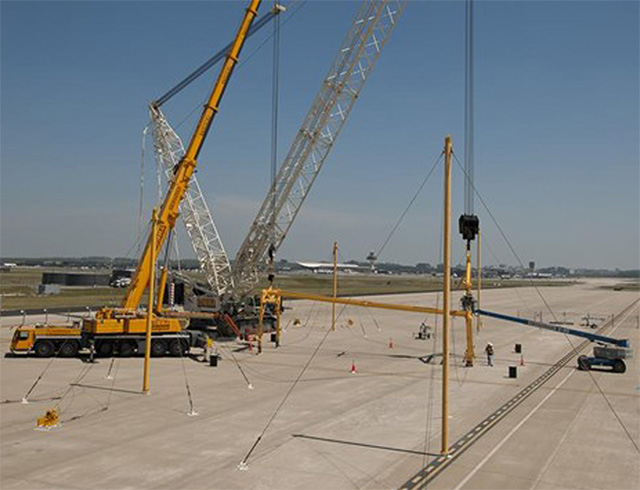
At NASA, engineers in the Vehicle Assembly Building use cranes to lift and stack spacecraft and rockets. As we prepare to return to the moon, cranes have been used to lift and stack pieces of the mobile launcher that will provide power to the Space Launch System (SLS). These cranes must be able to lift heavy loads without breaking, dropping the objects, or tipping over.
In this challenge, students will work in teams to design and build a crane that will lift and stack increasingly heavy pieces. The goal is to build the tallest possible tower without collapsing. Cranes can be maneuvered from the table and must have a base that allows the crane to function without needing to be held.
 Grade Range: 6-12
 Time Needed: 45-90 Minutes
 Materials List
Ensure that students have:
-
- Cardboard box
- 3 strips of cardboard
- Paper clip
- Small, lightweight cups
- Index cards or cardstock
- Pen or pencil
- Wooden craft sticks
- Scissors
- Safety eyewear
- Smooth string
- Variety of tape
- Weights (Coins, marbles, steel washers, gravel)
- Sketch paper
 Safety
Practice safety-cutting techniques when using scissors. Carefully support the piece being cut. Avoid moving around the room with scissors or other sharp objects.

Activity Procedure
Preparation
-
- Set out materials for participants and divide into groups of three to four.
- Connect a piece of string across the opening on each cup to create a handle for the crane hook to grab when lifting.
- Place weights in each cup, with cup one having the least amount of weight, and each cup having slightly more weight than the cup before. (For example: Cup one has one fishing weight, cup two has two, cup three has three. And continuing up to the maximum number of cups that could be stacked.)
Procedure
-
- Sketch a design for the crane that you are going to build.
- Use the provided materials to build and construct your crane.
- The crane must be stationary on the edge of a counter or desk.
- The crane must be attached to a base that will allow students to pivot the crane on the surface of the table.
- Sketch a design for a take-up reel.
- Use the provided materials to build the take-up reel.
- When the crane and reel are fully constructed, add the string and hook (paper clip).
- Participants will test their crane arm and take-up reel by maneuvering the crane to reach cups down on the floor.
- Participants must successfully hook the cups and stack as many as they can without the stack collapsing.
- After placing cup one, place and index card on top of it.
- Maneuver the crane arm to pick up cup two and stack it on top of cup one.
- Each additional cup will have more weight than the previous one.
- Continue stacking cups and placing index cards in between to make the tallest tower possible.
Challenge Questions
-
- What challenges did you face in designing and building your crane?
- What improvements did you add to your crane during the redesign? How did those changes impact your crane’s performance?
- What happens if the object a crane must lift is heavier than the counterbalance? How can we prevent that?
Extensions
-
- Load bearing competition: Strengthen your crane to make it able to hold the heaviest load possible. Use available materials to strengthen any part of the crane that fails. Compete to see whose crane is the strongest.
- Add a crank handle to the crane arm design.
- Add a cost constraint to the design challenge by creating a budget for students to “purchase” materials. Assign costs to all materials based on mass, area, or type of material.
Career Connection
Structural Engineers focus on designing and analyzing the structural integrity and safety of equipment, such as these cranes.
Heavy Machinery Operators are trained in the safe use of heavy machinery. Operating a crane to lift heavy loads requires special training to ensure that all people and equipment remain safe.
Software Developers create simulations of cranes that are used on earth, as well as cranes that will be used in space. This allows for exploration of how cranes may function and how we will utilize them on the moon.
Explore Related Activities
Build, Launch, Recover: Build a Crawler-Transporter Activity