



Lunabotics on Facebook

Facebook› Facebook→

Technology

Lunabotics Mining Competition
 
National Space Grant College and Fellowship Program logo
NASA Exploration Systems Mission Directorate
Higher Education Project
in partnership with the
National Space Grant College and Fellowship Program
is proud to announce the inaugural
Lunabotics Mining Competition
May 25-28, 2010
Astronaut Hall of Fame
Kennedy Space Center, Florida


Table of Contents

› Category Details and Scoring Rubric
› Joe Kosmo Award for Excellence
› Excavator Project Support
› Registration


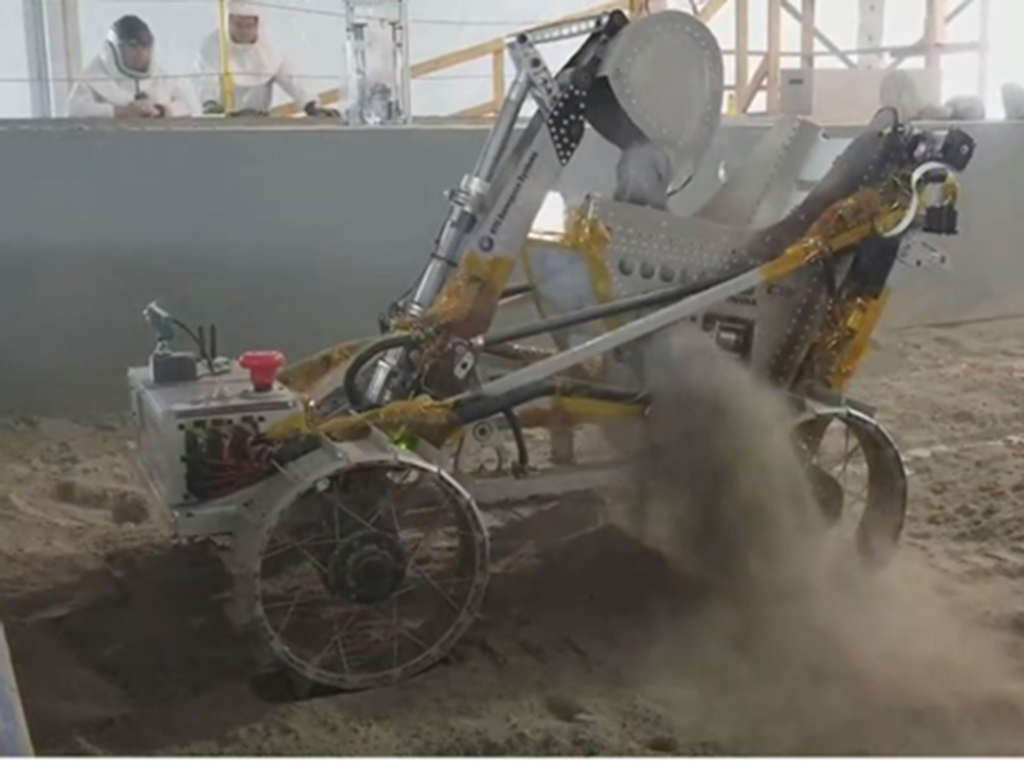
Lunar Rover Mining The purpose of the Lunabotics Mining Competition is to engage and retain students in science, technology, engineering, and mathematics, or STEM, in a competitive environment that may result in innovative ideas and solutions, which could be applied to actual lunar excavation for NASA.

Eligibility
Undergraduate and graduate student teams enrolled in a U.S. college or university are eligible to enter the inaugural Lunabotics Mining Competition.

Design teams must include:

  • One faculty or industry advisor with a college or university affiliation
  • Two or more undergraduate or graduate students
A group of universities also may work in collaboration on an excavator project entry. Multidisciplinary teams are encouraged. Collaborations between majority institutions and minority serving institutions are encouraged. Corporate sponsorship is allowed.

NASA's excavator project grants have been awarded for the 2010 Lunabotics Mining Competition.

Registration
Registration is limited to 24 teams.

To register for the Lunabotics Mining Competition, e-mail Susan.G.Sawyer@nasa.gov by Feb. 28, 2010. For more information, call 321-867-5482.

Important Dates
› Competition registration deadline: Feb. 28, 2010
› Collaboration notification due: Feb. 28, 2010
› Systems Engineering Paper due: April 15, 2010
› Slide presentation due: April 15, 2010
› Outreach report due: April 15, 2010
Practice days: May 25-26, 2010
Competition days: May 27-28, 2010
IP address requests due: January 15, 2010

The Lunabotics Mining Competition rules can be viewed by clicking here: Lunabotics Mining Competition Rules (PDF)

In addition to prizes listed below, school plaques and individual certificates will be awarded for exemplary performance in the following Lunar Regolith Excavator student team project categories:

Category Required/Optional Due Dates Prizes Maximum Points
Lunabotics Mining Competition (on-site in sandbox) Required Registration:
Feb. 28, 2010

Practice:
May 25-26, 2010

Competition:
May 27-28, 2010
1st place $5,000 and VIP Kennedy launch tickets 30
2nd place $2,500 and VIP Kennedy launch tickets 25
3rd Place $1,000 and VIP Kennedy launch tickets 20
Systems Engineering Paper Required April 15, 2010 $500 20
Outreach to Informal Education or K-12 Education Required April 15, 2010 $500 20
Slide presentation Optional April 15, 2010 $500 20
Team spirit competition Optional May 27-28, 2010 $500 15
Collaboration between a majority school with a designated minority serving institution Optional Feb. 28, 2010   10
bonus points
Digital video of the team’s lunar regolith excavator design and building process for the competition documentary Optional May 25, 2010
(at check-in)
  5
bonus points
Multidisciplinary teams - One bonus point for each engineering discipline on team Optional Feb. 28, 2010   up to 10 bonus points
Joe Kosmo Award for Excellence (highest cumulative score):

A school trophy and plaque, Kennedy VIP launch tickets, and up to $1,500 travel expenses for each team member and one faculty advisor to attend NASA Desert RATS.

130 max
Disclaimer
In the case of a tie, the prize(s) will be equally divided between all teams tied for first, second or third place. For example: In the case of only two teams qualifying for a prize and tying for first place in the excavator performance category, each would receive $3,750 and the third prize amount of $1,000 would not be awarded. Judges’ decisions will be final.

Winning the Lunabotics Mining Category
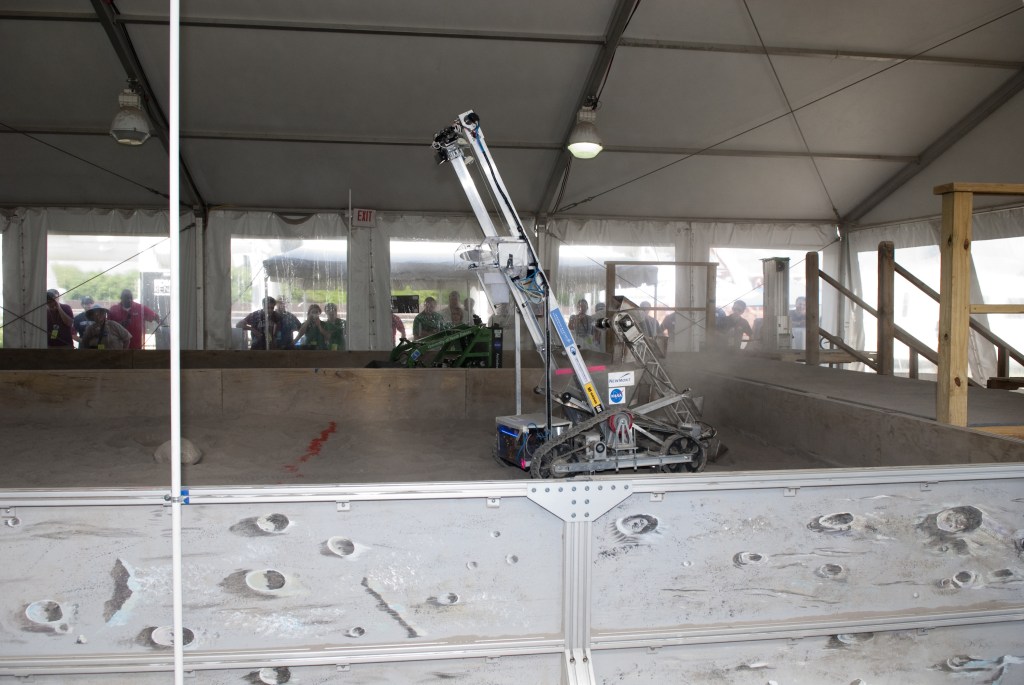
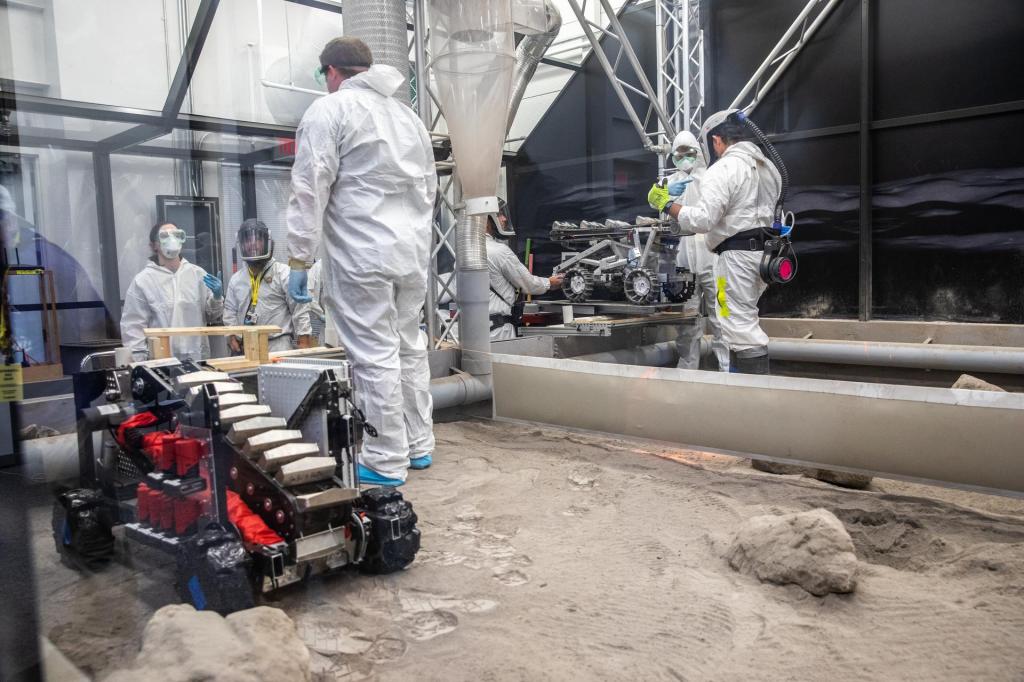
The challenge will be conducted in a head-to-head format, in which the teams will be required to perform a competition attempt using the regolith simulant, sandbox and collector provided by NASA. NASA will fill the sandbox with regolith simulant, compact it and place rocks in it. Each competition attempt will occur sequentially. Between each competition attempt, the rocks will be removed, the regolith will be returned to a compacted state and the rocks will be returned to the sandbox. Consideration of prize awards will be based on each team's performance during the official competition attempt. All excavated mass deposited in the collector during the competition attempt will be weighed after completion of the competition attempt. The teams that excavate the first, second and third most lunar regolith simulant mass over the minimum excavation requirement within the time limit will respectively win first, second and third place prizes. Official rules are to be determined. Students, check back at a later date.

Winning the Other Categories
Prizes will be awarded to the qualifying entries with the highest score in each of the other categories. Minimum scores on the following scoring rubrics are required to qualify in each category. Awards for these categories are not dependent on the on-site performance of the excavator.


Category Details and Scoring Rubric

Lunabotics Mining Systems Engineering Paper

Each team must submit a Systems Engineering Paper electronically in PDF to Susan.G.Sawyer@nasa.gov by April 15, 2010. Cover page must include: team name, title of paper, full names of all team members, university name and faculty advisor’s full name. Appendices are not included in the page limitation and the judges are not obligated to consider lengthy appendices in the evaluation process. A minimum score of 15 out of 20 possible points must be achieved to qualify to win in this category. In the case of a tie, the judges will choose the winning Systems Engineering Paper. The judges’ decision is final. The team with the winning Systems Engineering Paper will receive a team plaque, individual certificates, $500 and the paper will be featured at the Lunar Regolith Excavator Student Competition Awards Ceremony on May 28, 2010.

Systems Engineering Paper Scoring Rubric
Elements 4 3 2

Content: 

  • Cover page
  • Introduction
  • Purpose
  • Body of paper
  • Sources
All five elements are clearly demonstrated Four elements are clearly demonstrated Three elements are clearly demonstrated Two or less elements are clearly demonstrated

Intrinsic Merit (quality and feasibility):

  • Deliverables identified
  • Budget
  • Schedule
  • Major reviews: system requirements, preliminary design and critical design
All four elements are clearly demonstrated Three elements are clearly demonstrated Two elements are clearly demonstrated One or less elements are clearly demonstrated

Technical Merit:

  • Requirements definition
  • Requirement flow-down to validation and checkout
  • Trade-off assessment
  • Risk assessment
  • Interfaces defined
All five elements are clearly demonstrated Four elements are clearly demonstrated Three elements are clearly demonstrated Two or less elements are clearly demonstrated

Illustrations:

  • Relevant
  • Supports the technical content
  • Uses graphs effectively
  • Uses tables effectively
All four elements are clearly demonstrated Three elements are clearly demonstrated Two elements are clearly demonstrated One or less elements is clearly demonstrated

Formatting and Appearance: 

  • Clearly organized
  • Correct grammar and spelling
  • 10 – 15 pages; 12 font size; single spaced (cover page, references and appendices excluded in page limit)
  • Sources referenced
All four elements are clearly demonstrated Three elements are clearly demonstrated Two elements are clearly demonstrated One or less elements is clearly demonstrated

Lunabotics Mining Outreach Project
All teams must participate in an educational outreach project. Outreach examples include actively participating in school career days, science fairs, technology fairs, extracurricular science or robotic clubs, or setting up exhibits in local science museums or a local library. Other ideas include organizing a program with a Boys and Girls Club, Girl Scouts, local library, museum, etc. Teams are encouraged to have fun with the outreach project and share knowledge of science, robotics and engineering with the local community.

Each team must submit a report of the Lunabotics Outreach Project electronically in PDF to Susan.G.Sawyer@nasa.gov by April 15, 2010. Cover page must include: team name, title of paper, full names of all team members, university name and faculty advisor’s full name. A minimum score of 15 out of 20 possible points must be achieved to qualify to win in this category. In the case of a tie, the judges will choose the winning outreach project. The judges’ decision is final. The team with the winning outreach project will receive a team plaque, individual certificates, $500 and the project will be featured at the Lunabotics Mining Competition Awards Ceremony on May 28, 2010.

Lunabotics Outreach Project Scoring Rubric
Elements 4 3 2 1

Content: 

  • Introduction
  • Outreach recipient group identified
  • Purpose
  • Cover page

All four elements are clearly demonstrated Three elements are clearly demonstrated Two elements are clearly demonstrated One element is clearly demonstrated

Educational Outreach: 

  • Inspires K-12 students to learn about robotics, engineering or lunar activities
  • Engages K-12 students in robotics, engineering or lunar activities
  • Offers hands-on activities to K-12 students

All three elements are clearly demonstrated Two elements are clearly demonstrated One element is clearly demonstrated No elements are clearly demonstrated

Creativity:

  • Inspirational
  • Engaging
  • Material corresponds to students’ grade level

All three elements are clearly demonstrated Two elements are clearly demonstrated One element is clearly demonstrated No elements are clearly demonstrated

Illustrations and Media:

  • Appropriate
  • Shows the outreach project
  • Pictures

All three elements are clearly demonstrated Two elements are clearly demonstrated One element is clearly demonstrated No elements are clearly demonstrated

Formatting and Appearance: 

  • Correct grammar and spelling
  • Five-page limit (cover page and appendices excluded in page count)
  • Clearly organized

All three elements are clearly demonstrated Two elements are clearly demonstrated One element is clearly demonstrated No elements are clearly demonstrated

Lunabotics Mining Slide Presentation
Must be submitted electronically by April 15, 2010 in PDF to Susan.G.Sawyer@nasa.gov. The Lunabotics Slide Presentation is an optional category in the overall competition. A cover slide must contain the team name, title of presentation, full names of all team members, university name and faculty advisor’s full name. A minimum score of 15 out of 20 possible points must be achieved to qualify to win in this category. In the case of a tie, the judges will choose the winning presentation. The judges’ decision is final. The team with the winning presentation will receive a team plaque, individual certificates, $500 and will give the presentation at the Lunabotics Mining Competition Awards Ceremony on May 28, 2010.

Lunabotics Slide Presentation Scoring Rubric

Elements

4

3

2

1

Content: 

  • Cover slide
  • Introduction
  • Purpose
  • Stand alone
  • Sources referenced

All five elements are clearly demonstrated

Four elements are clearly demonstrated

Three elements are clearly demonstrated

Two or less elements are clearly demonstrated

Technical Merit:

  • Requirements definition
  • Requirement flow-down to validation and checkout
  • Trade-off assessment
  • Interfaces defined
  • Excavator functionality

All five elements are clearly demonstrated

Four elements are clearly demonstrated

Three elements are clearly demonstrated

Two or less elements are clearly demonstrated

Creativity:

  • Innovative
  • Inspirational
  • Engaging 

All three elements are clearly demonstrated

Two elements are clearly demonstrated

One element is clearly demonstrated

No elements are clearly demonstrated

Illustrations and Media:

  • Appropriate
  • Supports the technical content
  • Shows progression of project
  • Clearly presents design of excavator

All four elements are clearly demonstrated

Three elements are clearly demonstrated

Two elements are clearly demonstrated

One or less elements is clearly demonstrated

Formatting and Appearance: 

  • Proper grammar
  • Correct spelling
  • Copy edited
  • Readable
  • Aesthetically pleasing

All five elements are clearly demonstrated

Four elements are clearly demonstrated

Three elements are clearly demonstrated

Two or less elements are clearly demonstrated


Lunabotics Mining Team Spirit Competition
The Lunabotics Team Spirit Competition is an optional category in the overall competition. A minimum score of 10 out of 15 possible points must be achieved to qualify to win in this category. In the case of a tie, the judges will choose the winning team. The judges’ decision is final. The team winning the Team Spirit Award at the Lunar Regolith Excavator Student Competition will receive a team plaque, individual certificates, $500 and will be featured at the Lunabotics Mining Competition Awards Ceremony on May 28, 2010.

Lunabotics Team Spirit Competition Scoring Rubric

Elements

3 2 1

Teamwork: 

  • Exhibits teamwork in and out of the sandbox
  • Exhibits a strong sense of collaboration within the team
  • Supports other teams with a healthy sense of competition
All three elements are clearly demonstrated Two elements are clearly demonstrated One element is clearly demonstrated

Attitude: 

  • Exudes a positive attitude
  • Demonstrates an infectious energy
  • Motivates and encourages team
All three elements are clearly demonstrated Two elements are clearly demonstrated One element is clearly demonstrated

Creativity:

  • Demonstrates creativity
  • Wears distinctive team shirts or hats
  • Gives out objects of fun, such as pins, noise makers, etc.
All three elements are clearly demonstrated Two elements are clearly demonstrated One element is clearly demonstrated

Engage: 

  • Engages audience in team spirit activities
  • Engages other teams in team spirit activities
  • Makes acquaintances with members of other teams
All three elements are clearly demonstrated Two elements are clearly demonstrated One element is clearly demonstrated

Originality:

  • Demonstrates originality in team activities
  • Displays originality in the team name
  • Displays originality in the team logo
All three elements are clearly demonstrated Two elements are clearly demonstrated One element is clearly demonstrated


Collaboration between a majority school with a designated minority serving institution
The collaboration between a majority school and a designated minority serving institution must be indicated on the team roster by Feb. 28, 2010 to receive 10 extra points.

Video for Lunabotics Mining Competition Documentary
Submission of digital video of the team’s lunar regolith excavator design and build process is highly encouraged and may be brought to the competition on a DVD to receive five extra points. The actual competition will be recorded by NASA. A NASA documentary will be developed after the competition.

Multidisciplinary Engineering Teams
Each different science, technology, engineering or mathematics, or STEM, discipline represented will count for one bonus point up to a maximum of 10. Disciplines will be indicated on the team roster by Feb. 28, 2010. No bonus points will be given in this category if a team has only one discipline represented. If a member of your team is in a STEM discipline that is not on this list, you may e-mail Susan.G.Sawyer@nasa.gov to request approval of that discipline for the competition.

Systems Engineering

Engineering Management

Aerospace Engineering

Aeronautical Engineering

Astronautical Engineering

Chemical Engineering

Civil Engineering

Environmental Engineering

Health Engineering

Electrical Engineering

Computer Engineering

Software Engineering

Information Technology

Industrial/Manufacturing Engineering

Materials/Metallurgical Engineering

Mechanical Engineering

Nuclear Engineering


Astronomy

Astrophysics

Chemistry

Optics

Physics

Atmospheric Sciences

Geography

Geosciences

Natural Resource Management

Oceanography

Mathematics

Computer Science

Astrobiology

Biology

Biochemistry

Biophysics

Microbiology

Bacteriology


Joe Kosmo Award for Excellence

The team with the most cumulative points will win the Joe Kosmo Award for Excellence. The winner will receive a school trophy and plaque, individual certificates, Kennedy VIP launch tickets and up to $1,500 travel expenses for each team member and one faculty advisor to participate with NASA Desert RATS.

What is the NASA Desert RATS?
The Desert RATS is a NASA-led team of research partners working together to prepare for human-robotic exploration. This working group, led by NASA personnel, is comprised of both NASA and non-NASA members.

The Desert RATS field test activity is the culmination of the various individual science and advanced engineering discipline areas year-long technology and operations development efforts into a coordinated field test demonstration under representative (analog) planetary surface terrain conditions.

The purpose of the RATS effort is to drive out preliminary exploration operational concepts for extravehicular activity system requirements by providing hands-on experience with simulated planetary surface exploration hardware and procedures.

The RATS activities also are of significant importance in helping to develop the necessary levels of technical skills and experience for the next generation of engineers, scientists, technicians and astronauts who will be responsible for realizing the goals of NASA's Constellation Program.

To learn more, follow the Desert RATS’ fall activities.


NASA's Lunabotics Mining Competition is sponsored by:
Exploration Systems Mission Directorate Education
Lunar Surface Systems - Advanced Systems Division
Exploration Technology Development Program


Excavator Project Support

Lunar Regolith Excavator Senior Design Course Curriculum
The Lunar Regolith Excavator Senior Design Course Curriculum was developed for NASA by Dr. David Beale at Auburn University. This curriculum has an entire section devoted to systems engineering.

Competition POCs:
Susan Sawyer ReDe/Critique JV
Kennedy Education Office
ESMD Space Grant Project Specialist
Phone: (321) 867-5482
E-mail: Susan.G.Sawyer@nasa.gov
Mandi Falconer ReDe/Critique JV
Kennedy Education Office
ESMD Space Grant Project Specialist
Phone:  (321) 867-4439
E-mail: Mandi.C.Falconer@nasa.gov