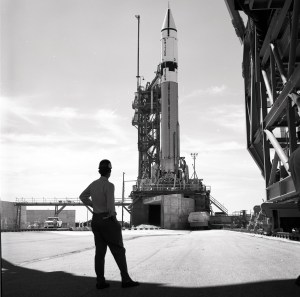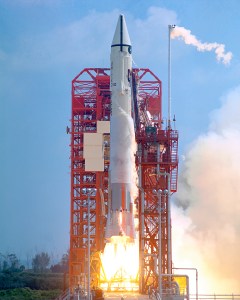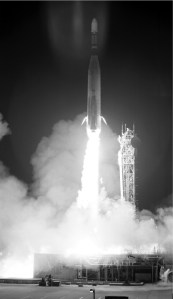















Since the dawn of the space age, NASA’s Glenn Research Center (formerly NASA Lewis) has been pioneering rocket engine and propellant technology. This early research resulted in the development of the Centaur upper stage, one of Glenn’s most significant achievements. The technology contributed to the Apollo program enabling massive payloads to be sent to the Moon.
For almost 30 years, the Center was responsible for the management of design, building and launch of the Atlas/Centaur and Titan/Centaur booster vehicles. Lewis also managed the Agena upper stage on several booster vehicles. The Center managed the launches of a variety of communications, weather, planetary exploration, and scientific payloads. Information gathered by these spacecraft has enhanced our daily lives and expanded our knowledge of the universe. Most notable are the Surveyor, Pioneer, Viking, and Voyager missions which studied the moon, Mars, and the outer planets, respectively. All together, Lewis managed over 119 unmanned launches.
In the 1990’s, Lewis was responsible for the overall management of commercial launch services for intermediate and large, expendable launch vehicles for NASA and other Government payloads. This role ended on October 1, 1998 when the Center’s responsibilities were transferred to the Kennedy Space Center. Glenn continues to support industry by developing and testing new launch vehicle technologies and hardware through cooperative programs.
The Final Chapters
Lewis managed Atlas/Centaur-121 on December 2, 1995 which launched the SOHO scientific mission aboard an Atlas IIAS rocket, NASA’s first use of this commercial version of the vehicle. The Center also has managed several launches of GOES next-generation weather satellites. The most recent was GOES-K aboard Atlas/Centaur-79 on April 25, 1997, the final launch of the Atlas I rocket.
Lewis’ final launch was the Cassini Spacecraft aboard a Titan IV-B/Centaur, which lifted off from Cape Canaveral Air Station on October 15, 1997. Cassini is a deep-space mission, managed by NASA’s Jet Propulsion Lab, that sent a probe into the atmosphere of Saturn’s moon Titan. It then continued its four-year tour of other moons, using repeated gravity assists from Titan to shape the trajectory to satisfy science objectives.
Lewis Expendable Launch Vehicle Record – 119 Total Launches 1963-1998
- Vehicle/Total Launches(), Dates
- THOR/Agena (11), 1964-1970
- Atlas/Agena (19), 1964-1978
- Atlas/Antares (2), 1964-1965
- Atlas F&H (6), 1978-1987
- Atlas/Centaur (72), 1963-Present
- Titan/Centaur (8), 1974-1997
- Titan III/TOS (1), 1992