











Audience
Educators
Grade Levels
Grades 9-12
Type
Other Multimedia, Videos
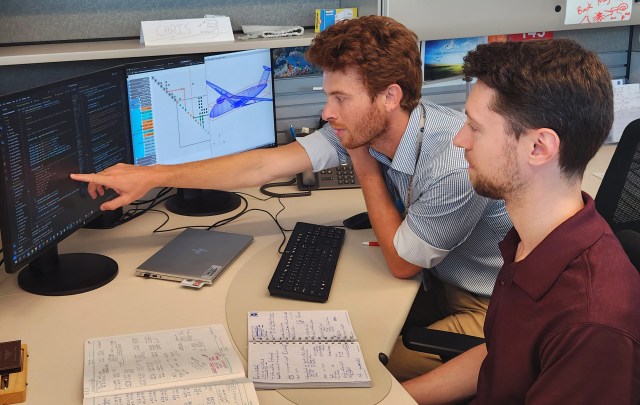
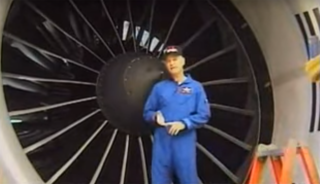
This NASA video segment explores how Newton’s second law applies to the thrust force on an airplane. Viewers watch an instructor at NASA’s National Test Pilot School and learn that an airplane’s engines work to change the horizontal momentum of the air surrounding the airplane. Viewers also learn that this change in momentum is accomplished through increased propeller speed, increased propeller diameter or increased air pressure in the jet engines. Onscreen formulas and calculations represent the forces mathematically. For example, in one part, the instructor uses Newton’s second law to derive an equation to find the minimum rpm’s needed to provide enough thrust to an airplane.
Thrust, Lesson 5
Duration: 10 minutes 40 seconds
More videos and video clips in this series:
Introduction to Newton’s Three Laws, Lesson 1
The Law of Inertia: Newton’s First Law
Force Equals Mass Times Acceleration: Newton’s Second Law
The Law of Action and Reaction: Newton’s Third Law
Weight and Balance, Lesson 2
Lift and Rate of Change of Momentum, Lesson 3
Drag, Lesson 4
Take Off, Lesson 6
Climb and Descent, Lesson 7
Cruise, Lesson 8
The Landing, Lesson 9
The Landing: Approach
The Landing: Flare
The Landing: Rollout
The Landing: Summary
Flight Testing Newton’s Laws Main Page