























Audience
Educators, Students
Grade Levels
Grades 5-8, Grades 9-12
Subject
Engineering Design, Space Science, Technology, Missions to Planets and Moons
Type
Hands-on Activities, Lesson Plans / Activities
Introduction
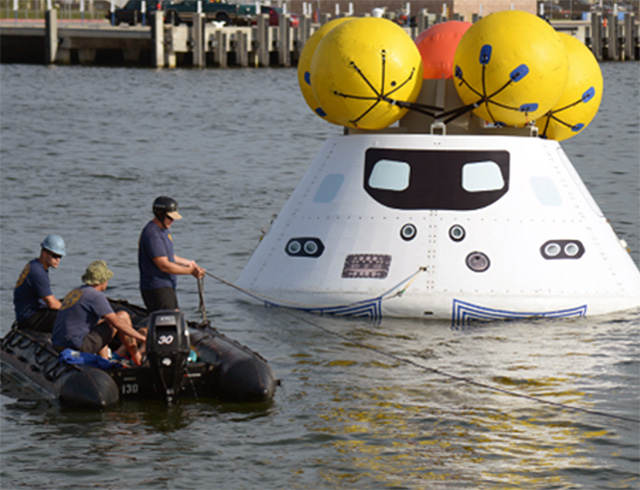
When a spacecraft returns from space and splashes down in the ocean, it must be recovered. NASA partners with the U.S. Navy and Department of Defense to practice recovering spacecrafts and crew members after splashdown. It is important that recovery is done as quickly as possible to safely rescue the crew that is on board.
In this activity, participants will act as NASA’s recovery team to recover a spacecraft that has splashed down in the ocean. Participants will use algorithms to create search patterns for the rescue vessels to be able to recover the spacecraft.
 Grade Range: 6-12
 Time Needed: 45-60 Minutes
 Materials List
Ensure that students have:
-
- Ocean Map Handout with Tokens
- Data Tables Handout
- Pen or pencil
- Scissors
- Lined paper

Activity Procedure
Procedure
-
- Print out the “Ocean Map Handout with Tokens” handout. The grid on the ocean map represents a 10 by 10 km area of the possible location where a spacecraft has splashed down.
- Cut out the tokens at the bottom of the handout. Tokens represent the spacecraft, the rescue vessel, and islands/obstacles.
- Participants will use algorithms as search patterns to attempt to find the spacecraft.
- Create two search pattern algorithms that your rescue vessel can take to ensure it visits every square on the map. Write them down on a piece of lined paper as you will need to reference them when beginning recovery.
- The rescue vessel can only search the square that it is in.
- The rescue vessel can only search one square at a time.
- Include a starting point for your search patterns.
- Include a detailed explanation of how the rescue vessel will move (will only be able to move exactly as the algorithm says).
- Place the spacecraft token at a random place on the ocean map. Record its row and column in the table provided below.
- Search for the spacecraft by completing your first search pattern algorithm. Count the number of squares the rescue vessel travels before it finds the capsule, then record the numbers in the table provided below. Complete this 3 times by moving the space craft to a new location each time.
- Search for the spacecraft by completing your second search pattern algorithm. Count the number of squares the rescue vessel travels before it finds the capsule, then record the numbers in the table provided below. Complete this 3 times by moving the space craft to a new location each time.
- Choose the search pattern that was most efficient out of the two that you tested.
- Randomly place three island tokens on the ocean map to act as obstacles.
- When the rescue vessel encounters an island, you must modify your algorithm to maneuver around it. Count the additional squares used to get back on track.
Challenge Questions
-
- Were you able to find the spacecraft by following your search pattern? If not, what made it difficult?
- What improvements did you or could you make to your search patterns?
- How did you navigate the obstacles? What changes or improvements would you make?
Extensions
-
- Add additional islands to your ocean map to increase the difficulty. Add requirements when you get to an island like rotate 90 degrees or move back two squares.
- Trade maps with a partner or team member. Have the other participant randomly place the spacecraft and islands anywhere on the map. Try to recover the spacecraft without looking at the map as you read your algorithm for the participant to navigate the rescue vessel.
- Use more than one rescue vessel, by placing them at different starting points. See which vessel gets to the spacecraft the fastest by using the same algorithm.
Career Connection
Geospatial Technicians works with geographic information systems (GIS) to analyze spatial data, which is crucial for creating and interpreting maps
Computer Scientists develop algorithms and software for search and rescue operations, as well as for navigation systems.
Emergency Medical Technicians provide emergency medical care often working closely with search and rescue teams.
Explore Related Activities
Build, Launch, Recover: Build a Crawler-Transporter Activity