

















This post was written prior to a reorganization of ESC’s projects and networks in support of the agency’s commercialization efforts. Though accurate at the time of publication, it is no longer being updated and may contain outdated information. For more information about the current projects, click here.
Laser Communications Technology
By Seema Vithlani, NASA Goddard Space Flight Center
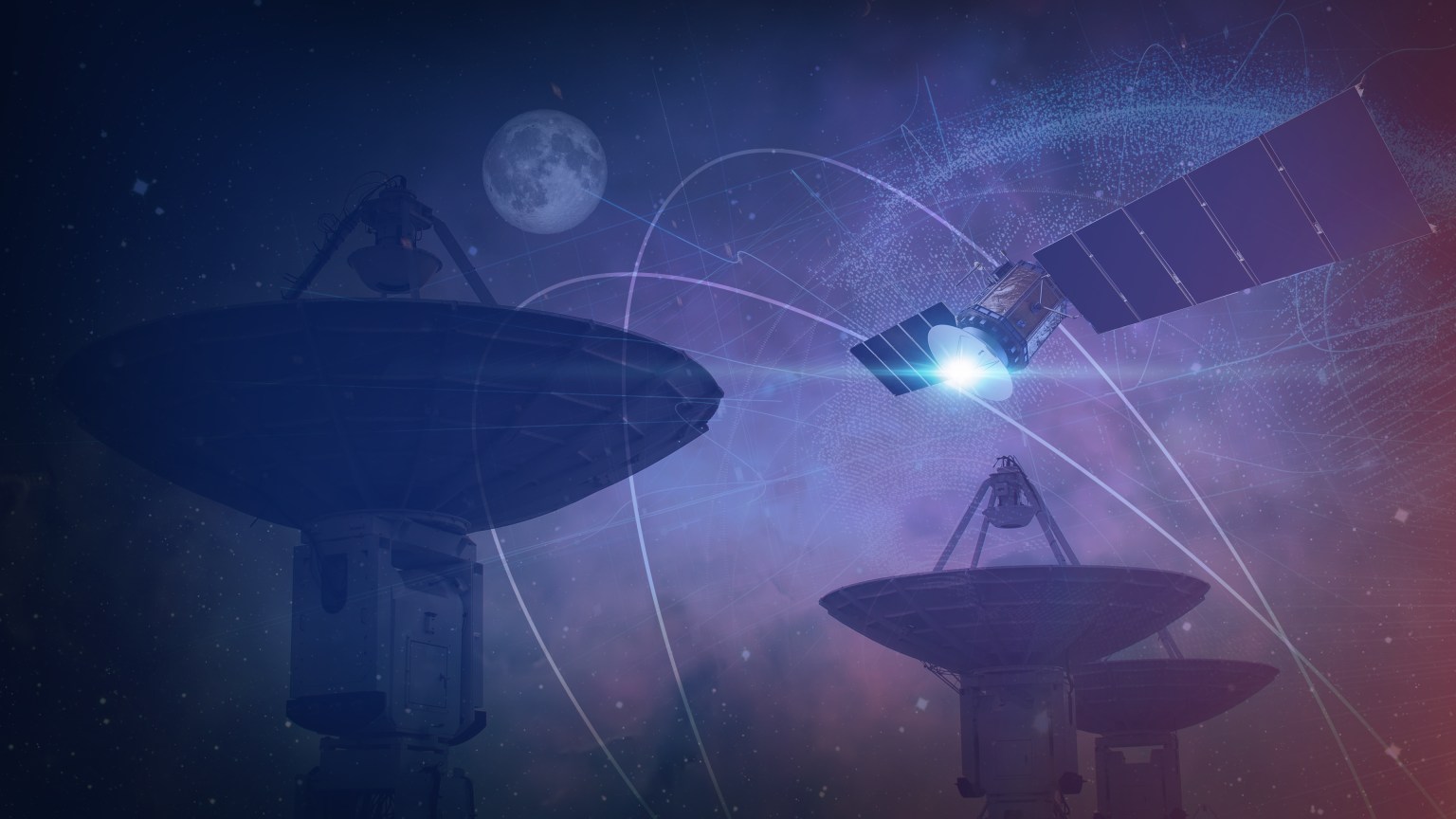
Technology breakthroughs have opened up literal worlds for investigation. As the capacity for science and research continues to grow, NASA is implementing laser communications technology to enable greater return of science data from space. But laser communications capabilities also present unique challenges, including the need for extreme pointing accuracy when beaming spacecraft data to ground stations; NASA engineers are solving these challenges by testing and implementing cutting-edge laser pointing technology.
Lasers not only enable the capacity for greater space data delivery, but they also offer greater security. When pointed at Earth, laser beams, which are forms of light waves, expand at a much lower rate than do the radio frequency (RF) waves that traditionally transport space data, and they therefore cover less surface area. For this reason, laser communications technology is more secure, minimizing the potential for outside interference to space signals.
But the narrower widths of laser beams require that lasers are very accurately pointed toward optical telescopes on the ground. Using traditional radio waves, spacecraft can dump down data as they pass over antennas without using special pointing mechanisms, but with lasers, the spacecraft must maintain contact with the ground antenna.
So how does this process occur? First, the ground station is notified in advance when a spacecraft will be making a pass. As the spacecraft nears the ground station, the ground station emits a signal that scans the general area of the spacecraft; because the pass was pre-scheduled, the spacecraft already knows to look for this signal. Sensors on both the spacecraft and the ground station drive the pointing mechanisms, enabling both to maintain contact, also known as “lock.” This is typically achieved within seconds.
Then, the spacecraft’s modulator transfers science or other data onto the laser beam, and the signal travels through the spacecraft’s optical terminal by bouncing on a series of strategically positioned mirrors inside the system. When the laser beam reaches the spacecraft telescope, it is pointed at the ground station with the help of the controller unit, which maintains lock with the ground terminal.
The challenge of acquiring and maintaining lock is even greater in deep-space environments, such as on Mars. From such a great distance, data takes significantly longer to reach the ground station, so the rotation and revolution of Earth must be taken into account. From Mars, for example, spacecraft telescopes must be pointed ahead of Earth to account for where in its revolution Earth will be by the time the data reaches the planet.
Laser pointing technology is critical to NASA’s laser communications activities, including the Laser Communications Relay Demonstration (LCRD) and the Orion Artemis II Optical Communications System (O2O) projects at NASA’s Goddard Space Flight Center in Greenbelt, Maryland.