

















Audience
Educators, Students
Grade Levels
Grades 5-8, Grades 9-12
Subject
Engineering Design, Space Science, Technology, Missions to Planets and Moons
Type
Hands-on Activities, Lesson Plans / Activities
Introduction
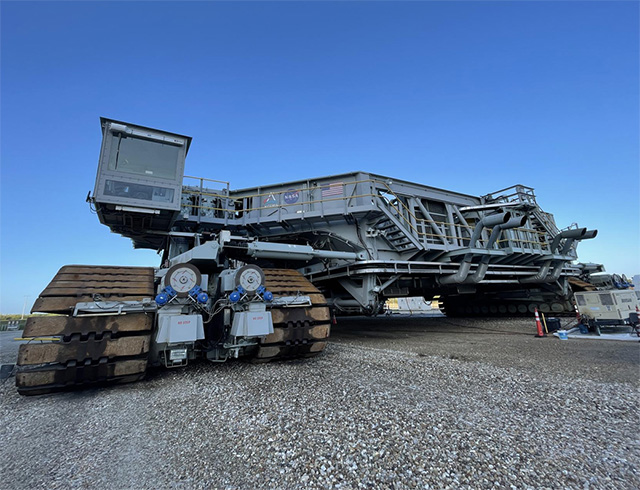
Since 1965, NASA has used its two massive crawler-transporters to transport spacecrafts from the Vehicle Assembly Building to the launch pad. Each crawler can carry more than 18 million pounds and is large enough to fit a baseball diamond on top of its platform. Carrying the SLS to the launch pad, the crawler travels less than 1 mph.
In this challenge, students become engineers and NASA crawler operators while working in teams to design and build a rubber band-powered model of NASA’s crawler-transporter that will be able to carry the most mass possible the farthest distance without failure.
 Grade Range: 6-12
 Time Needed: 45-90 Minutes
 Materials List
Ensure that students have:
-
- Cardboard box
- Rubber bands
- Wooden skewer
- Glue
- Small round objects for wheels (e.g., bottle caps)
- Ruler
- Meterstick
- Safety eyewear
- Straws (optional)
- Tape (optional)
- Various payloads up to 1 kg (e.g., book, plastic bottle)
- Scissors
 Safety
Practice safety-cutting techniques when using scissors. Crawlers should not contain sharp or pointed surfaces that could be dangerous. Test zone should be clear of people before beginning testing. Use caution and wear eye protection when handling and releasing crawlers.

Activity Procedure
Procedure
-
- Participants will be designing, building, and testing a crawler that is able to carry a payload without breaking.
- Observe the building materials that are available for you to use, and brainstorm how they can be used to build a crawler. Sketch a design of your crawler.
- Retrieve the needed materials to construct the crawler.
- Construct the crawler ensuring that it includes the necessary criteria and meets the constraints.
- Criteria
- Crawler must have at least two axles, with at least two wheels per axle.
- Crawler must be able to travel 1 meter while carrying a payload of at least 1 kilogram.
- Crawler must be rubber band powered.
- Constraints
- Crawler must not fail under the weight of the payload.
- Students must only use materials provided.
- Students must not use their hands to move the model crawler.
- Criteria
- The crawler is required to move on its own without any help. The crawler must also be able to move as far as possible.
- Have students consider cutting slits in the box for the rubber bands to slide into. Students may also tape the rubber bands to the box after attaching them to the axles.
- Once they have completed their design, crawlers will be tested by placing the payload on the crawler and allowing it to move without breaking.
- Some examples of problems the students may encounter and solutions to suggest:
- If the crawler should fail under the weight of the payload, have the students consider attaching the wheels or axles another way or use multiple strips of tape to stabilize the payload.
- If the crawler does not move when they release the wheels, make sure the axles are level and have large enough holes to spin and the rubber bands are not getting stuck under the box.
- If the rubber bands break when tension is applied, try using slightly thicker bands.
Challenge Questions
-
- How did your design work? If it failed, what can you change to succeed?
- If your crawler succeeded, how can you improve it to carry a larger payload?
- What was difficult about this engineering design process? Why?
Extensions
-
- Have participants add a device to stabilize the payload on their crawlers.
- Have a “Most Efficient Design” contest. To determine the winner, measure the distance the crawler was able to travel with a sequence of increasing payloads.
- Participants can calculate the velocity of the crawler by dividing the distance the crawler traveled versus the time it took to travel. This requires a timer or stopwatch.
- Modify the mass and then graph the distance, rate, and time versus the mass.
- Try attaching different rubber band sizes to see how it affects the distance the crawler travels.
Career Connection
Getting back to the moon is a massive effort that requires many teams to work together. There are many skills that are needed to develop and use the technologies necessary to take us to the Moon. Some of the careers that will assist in this are:
Mechanics/Technicians are responsible for maintaining the condition of crawler-transporter that carries the SLS from the Vertical Assembly Building to the launch pad.
Mechanical and Electrical Engineers are also responsible for maintaining and controlling the crawler to ensure the SLS makes the trip smoothly and safely.
Explore Related Activities
Build, Launch, Recover: Build a Crane Activity