








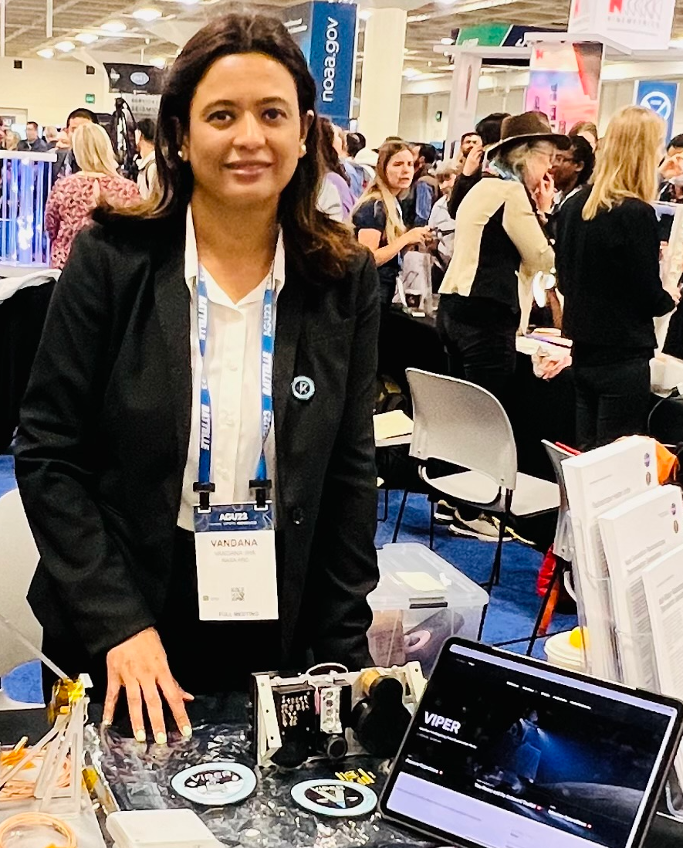
Vandana Jha
Space Scientist and Flight Instrument Engineer
Affiliation: NASA Ames Research Center (ARC) / MEI
Division: Space Science and Astrobiology Division (ST)
Branch: Planetary Systems Branch (STT)
Email: Vandana.jha@nasa.gov
Phone: 669-666-4630
Professional Biography
Dr. Jha is a scientist and flight instrument engineer at NASA Ames Research Center (ARC), with over fifteen years of experience in cloud physics, cloud dynamics, and climate modeling for both Earth and Mars. She started at ARC in 2016 as a NASA Postdoctoral Program (NPP) Fellow, where she evaluated global model predictions of dust–water cycle interactions on the Martian surface and investigated how cloud formation processes influence dust deposition, vertical transport, and lifting.
In 2019, Dr. Jha joined the NASA ARC Flight Instrument Group (FIG), contributing to the development of the first version of the Nephelometer instrument. She has since supported the design, development, and testing of several flight and research instruments, including the RGB Depth Sensor, Mars Sonic Anemometer, Atmospheric Structure Instrument, Doppler Wind and Thermal Sounder, and FEMTO. Her work spans writing test and assembly procedures, supporting instrument integration and development, executing environmental qualification tests (thermal vacuum and vibration), and participating in engineering and science technical reviews. She also regularly presents mission results and technology advancements at scientific conferences and engages in public outreach.
Dr. Jha’s role extends to Mission Operations for the Volatiles Investigating Polar Exploration Rover (VIPER) mission, where she is trained to operate the Near-IR Volatile Spectrometer System (NIRVSS) instrument payload.
Education
Ph.D. Atmospheric Sciences, Colorado State University, May 2016
M.S Atmospheric Sciences, University of Nevada, Reno, August 2012
M.S Electrical Engineering, University of Nevada, Reno, December 2010
Research Interests
Instrumentation, in situ data collection, analysis and interpretation.
Dust lifting and transport, cloud radiative feedback and dust and water cycle interactions.
Cloud microphysics, cloud dynamics, dust, and aerosol pollution, CCN, GCCN and IN
Select Conference Publications
- Jha, V., Colaprete, A., White, B., Cook, A., Banfield, D., Rademacher, A.M., Shimada, J., Quigley, E., Mazmanian, E., and, Rustemeyer, N., 2025: Atmospheric Structure Investigation and NephEx 2.0: Planetary in situ measurements of clouds/aerosols, differential atmospheric pressure and temperature. Earth and Planetary Cloud Workshop 2025, Caltech, Pasadena, June 25-27, 2025.
- Jha, V., Banfield, D., Colaprete, A., Cook, White, B., Garrett, M. P., Rademacher, Dave, A.M., Agrawal, P., and Stotzky, O., 2023: NASA Ames Flight Instrument Group – MARS Exploration Efforts Overview, Bay Area Planetary Science Conference, Santacruz, September 19, 2023.
- Jha, V., Garrett, M.P, White, B., Shimada, J., A., Cook., Colaprete, A., Heldmann, J.K., A. M., Dave, A., Paige, C., Ward, F., Ekblaw, A., Auffinger, S., Newmann, D., Mitchell, M., Meyen, F., Brokaw, B., Wagner, V., and Justadt, B., 2022: Ruggedizing a Microsoft Kinect for the Moon, American Geophysical Union, Fall Meeting 2022, Chicago, IL, December 12-16, 2022.
- Jha, V., Colaprete, A., Cook, A., White, B., and Bendek, E., 2019: Laser Nephelometer for in-situ particle detection in planetary atmospheres, International Planetary Probe Workshop, Oxford, UK, July 8 -12, 2019.
- Jha, V., and Kahre, M., 2017: Effects of radiatively active clouds on wind stress dust lifting during Northern Summer on Mars, Sixth International Workshop on the Mars Atmosphere: Modeling and Observations, Granada, Spain; Jan 17-20.
- Jha, V., Cotton, W.R., Carrió, G.G., and Pierce, J., 2016: Examination of The Potential Impacts of Dust and Pollution Aerosol Acting as Cloud Nucleating Aerosol on water resources in the Colorado River Basin. The 17th International Conference on Clouds & Precipitation (ICCP), Manchester, England, Jul 24-29, 2016.
Select Publications
- White, R., Chowdhary, R., Cheng, T., Fisher, B., Huckaby, J., Banfield, D., Colaprete, A., Cook, A., Dave, A., Jha, V., Rademacher, A., Shimada, J., White, B., Yoder, C., Neeson, I., Merrison, J., and Iversen, J., 2024: Flow Testing of a Digital Sonic Anemometer for Martian and Stratospheric Environments AIAA 2024-3933: doi.org/10.2514/6.2024-3933.
- Development and Testing of an RGB and Depth Camera and Concept of Operations for a Low-Cost for a Lunar South Polar Mission, C. Paigea, D. D. Haddad, F. Ward, A. Cook, V. Jha, A. N. Deutsch, J. Shimada, A. Colaprete, J. Heldmann A. Ekblaw, and D. Newman, 2025: Nature Microgravity (in press).
- Jha, V. and Kahre, M.A, 2024: Effects of radiatively active clouds on wind stress based dust lifting and maintaining background dust opacity during Northern Hemisphere Mars; Icarus (in prep).
- Jha, V., Cotton, W.R., Carrio., G.G., and Walko, R., 2020: Seasonal estimates of the impacts of aerosol and dust pollution on orographic precipitation in the Colorado River Basin, Journal of Physical Geography.
- Jha, V. and Kahre, M.A, 2017: Effects of radiatively active clouds on wind stress dust lifting during Northern Summer on Mars, Sixth International Workshop on the Mars Atmosphere: Modeling and Observations.
- Hudson, J.G., Noble, S. and Jha, V., 2012: Cloud droplet spectral width relationship to CCN spectra and vertical velocity, J. Geophys. Res., DOI: 10.1029/2012JD017546
- Hudson, J.G., Noble, S. and Jha, V., 2010: Comparisons of CCN with supercooled Clouds, J. Atmos. Sci., 67, 3006–3018.
Field Projects
- Ice in Clouds Experiment – Tropical (ICE-T), July 1–31, 2011, St. Croix, U.S. Virgin Islands (Caribbean): Flew thirteen research missions aboard the NSF/NCAR C-130 aircraft, collecting measurements from below cloud base to ~23,000 ft (7,000 m). Gathered cloud condensation nuclei (CCN) and ice nuclei (IN) to characterize aerosols and examine their dependence on temperature, particle size, and aging, with particular focus on dust and biological material.
- Physics of Stratocumulus Top (POST) Field Project, June 2007, Monterey, California: Collected cloud condensation nuclei data within stratocumulus clouds off the California coast from a CIRPAS Twin Otter aircraft operated by the Naval Postgraduate School, supporting detailed study of stratocumulus microphysics and boundary-layer processes.
NASA Missions
- VIPER – (Volatiles Investigating Polar Exploration Rover) https://science.nasa.gov/mission/viper/
Awards & Others
- APEX – NASA Ames Project Excellence Program Completion Certificate for mission concept development and maturation (2022-2023)
- NASA Certificate of Mission Instrument Delivery, in appreciation for the successful delivery of the Near Infrared Volatile Spectrometer System to VIPER for integration into the flight vehicle in Dec 2022
- NASA Group Achievement Award, VIPER for successful delivery of the VIPER mission plan from concept development to Mission Confirmation at VIPER’s Key Decision Point (KDP-C) DPMC (Sept 2021)
- NASA Postdoctoral Program fellowship award (2016-2019)
- Student Leadership, Involvement, and Community Engagement (SLICE) grant 2014 at CSU
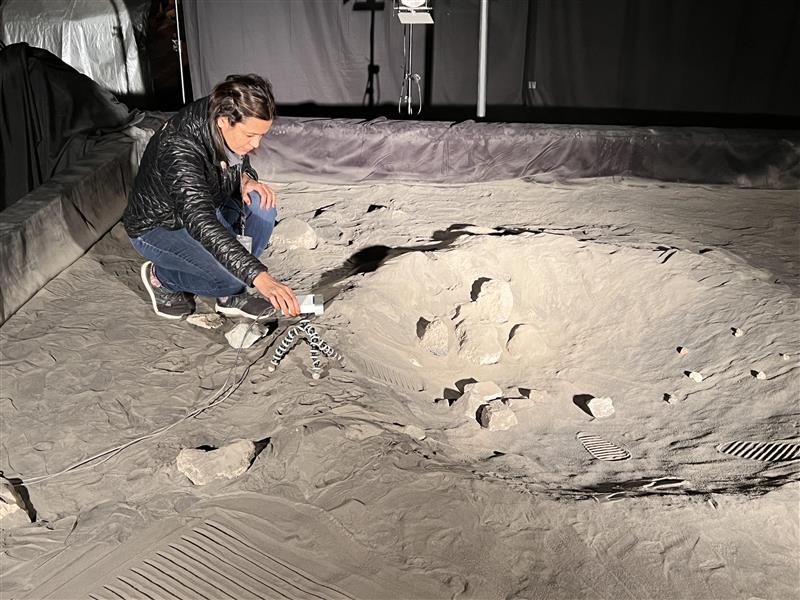
Vandana Jha testing the RGB Depth sensor at the Lunar Lab and Regolith testbed at NASA ARC.
https://www.nasa.gov/centers-and-facilities/ames/the-lunar-lab-and-regolith-testbeds/
https://www.nasa.gov/centers-and-facilities/ames/the-lunar-lab-and-regolith-testbeds/
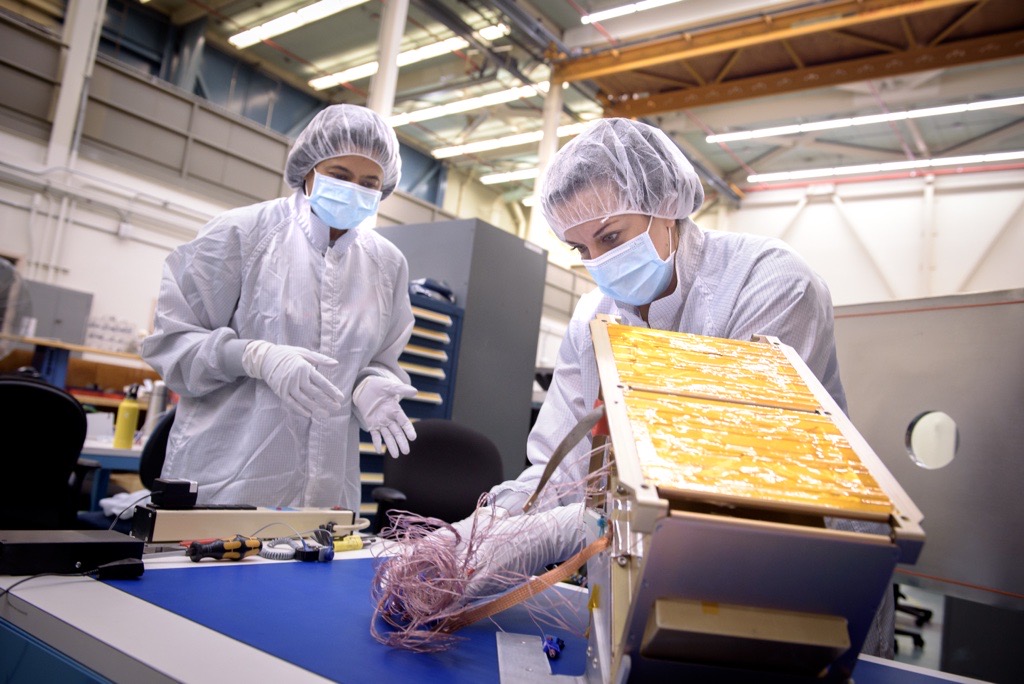
Vandana Jha and Amanda Cook working on the NIRVSS instrument during a flight qualification testing in ‘Engineering Evaluation Lab’ at NASA ARC.
https://www.nasa.gov/ames-engineering/engineering-evaluation-laboratory/