










This article is for students grades 5-8.
Supersonic flight is one of the four ranges of flight speeds. These ranges are known as the regimes of flight. The regimes of flight are subsonic, transonic, supersonic, and hypersonic.
Objects that fly at supersonic speeds are flying faster than the speed of sound. The speed of sound is about 768 miles per hour (1,236 kilometers per hour) at sea level.
In 1947, Air Force Capt. Charles E. “Chuck” Yeager became the first person to fly an aircraft faster than the speed of sound.
____________________________________________________________________________________________
Words to Know
(Speeds listed below are based on Earth’s atmospheric conditions.)
Mach: The ratio of the speed of an object to the speed of sound. Mach 1 equals the speed of sound.
subsonic flight: Less than Mach 1. This is the speed traveled by most of the commercial airplanes that carry people and cargo.
transonic flight: At or about Mach 1.
supersonic flight: Greater than Mach 1, but less than Mach 5.
hypersonic flight: Greater than Mach 5. This is more than five times the speed of sound. It is the speed traveled by rockets as they go into orbit.
____________________________________________________________________________________________
What Flies at Supersonic Speeds?
A bullet fired from a gun is an example of an object that flies at supersonic speeds. Military fighter aircraft also fly this fast. Space capsules fly at supersonic speeds during portions of their missions.
An airplane called the Concorde was the most notable passenger airplane to travel at supersonic speeds. The Concorde’s maximum speed was more than twice the speed of sound. It could fly people from London to New York in less than 3 1/2 hours. That is about half the amount of time it would take typical airliners to fly the same distance. The Concorde is no longer in use. It flew for the last time in 2003.
What Is a Sonic Boom?
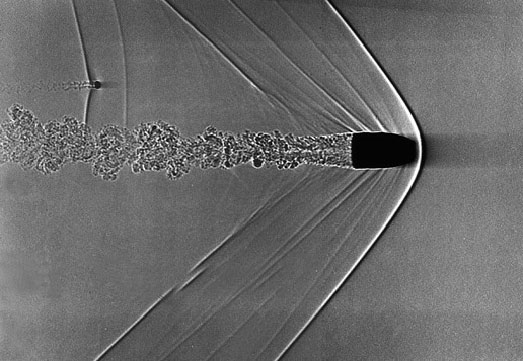
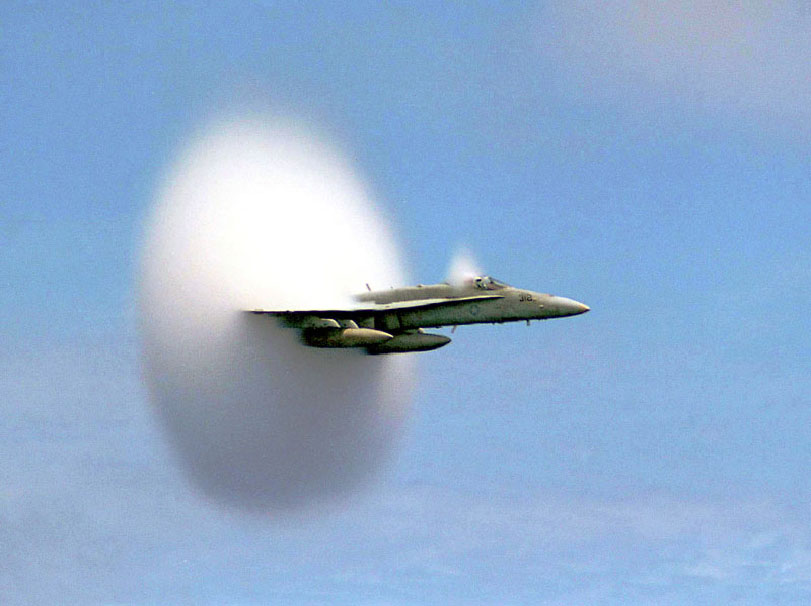
A sonic boom is a loud, thunder-like noise that is produced when an aircraft flies overhead at supersonic speeds. Air reacts like a fluid to supersonic objects. Air molecules are pushed aside with great force as objects travel through the air at high speeds. This force forms a shock wave, much like the wave created by the front of a boat moving through water.
The shock wave forms a cone of pressurized air. A sharp release of pressure after the buildup of a shock wave is heard as a sonic boom. It is similar to the sharp release of pressure when a pin pops a balloon and makes a loud noise.
Why Does NASA Study Supersonic Flight?
NASA studies supersonic flight as part of its aeronautics research. Aeronautics is the study of the science of flight. NASA studies flight in support of the nation’s air transportation system and the development of future air and space vehicles.
Learning more about supersonic flight helps NASA design aircraft to perform better at supersonic speeds. It can also help in the design of new vehicles used to explore space. Space vehicles fly at supersonic speeds, too.
Rockets fly at supersonic speeds after liftoff. From about 45 seconds after launch until about two minutes after launch, a rocket accelerates from Mach 1 to Mach 5. When they reach Earth’s upper atmosphere, they fly at hypersonic speeds – greater than Mach 5.
During atmospheric re-entry, spacecraft slow to supersonic speeds. Spacecraft like the SpaceX Dragon and Orion capsules fly at supersonic speeds when they reach the lower part of Earth’s atmosphere and slow down for landing.
How Does NASA Study Supersonic Flight?
NASA studies supersonic flight in three ways. NASA researchers can simulate supersonic flight by using small models of aircraft in wind tunnel experiments. Wind tunnels are tube-shaped facilities that move air over a vehicle as if it were flying. They help researchers to learn more about how an aircraft will fly and to test new designs.
Researchers also fly actual supersonic aircraft that have been modified for research experiments. NASA has been involved in supersonic flight experiments since the 1940s. NASA partners with the U.S. Air Force, U.S. Navy, and aircraft manufacturers to build experimental aircraft. These aircraft are called X-planes because the aircraft are used for experiments. X-planes test new designs and new technologies to improve flight.
In 1947, the first X-plane, called X-1, was the first aircraft to fly faster than the speed of sound. Nine years later, in 1956, the X-2 became the first aircraft to reach Mach 3, or three times the speed of sound. Aircraft such as the XB-70 (also called the Valkyrie) and the X-29 tested new wing designs. Other experimental aircraft tested new materials that could be used to make faster airplanes.
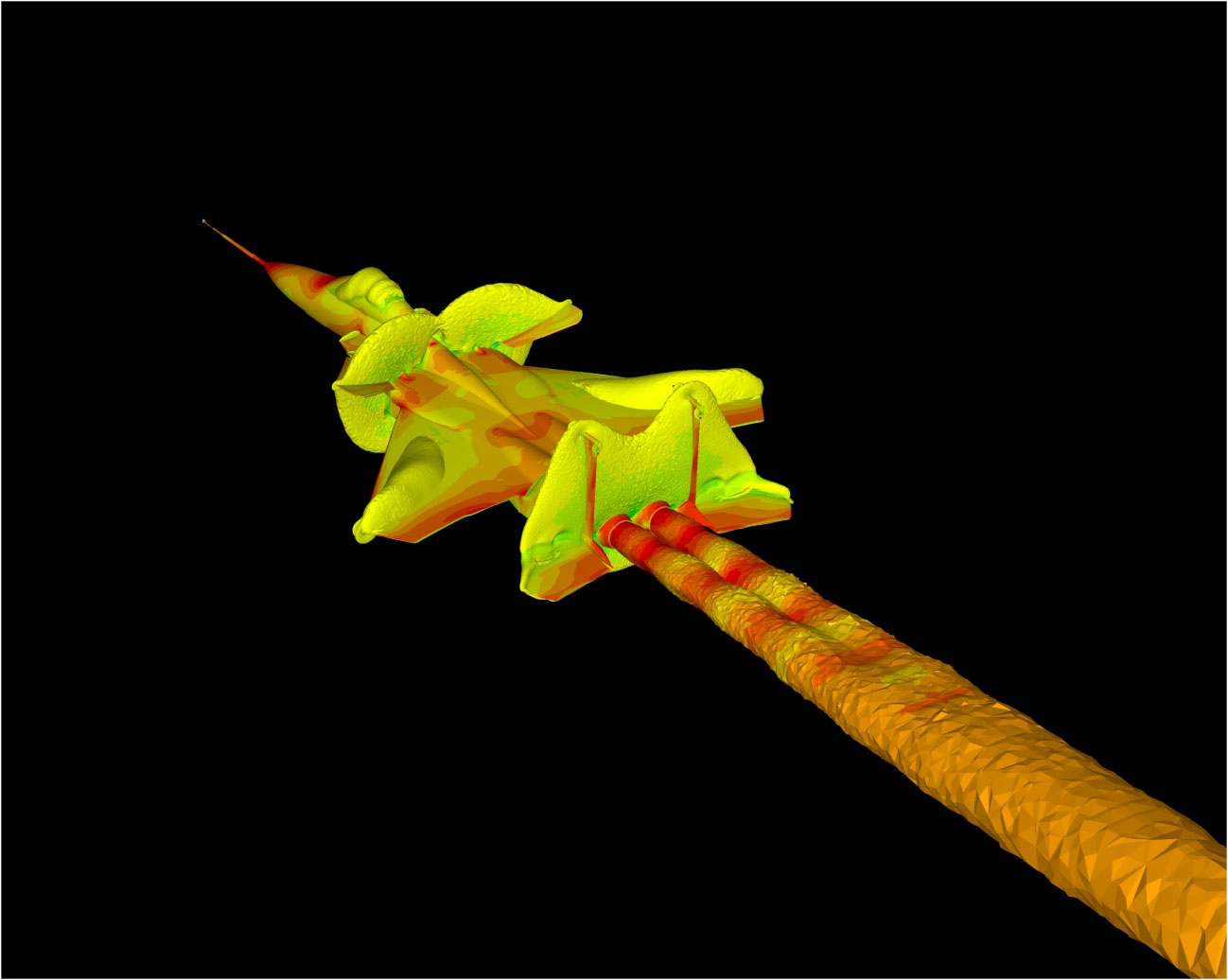
A third way NASA learns about supersonic flight is through computer simulations. The computerized simulations are commonly referred to as computational fluid dynamics, or CFD.
What Is the Quesst Mission?
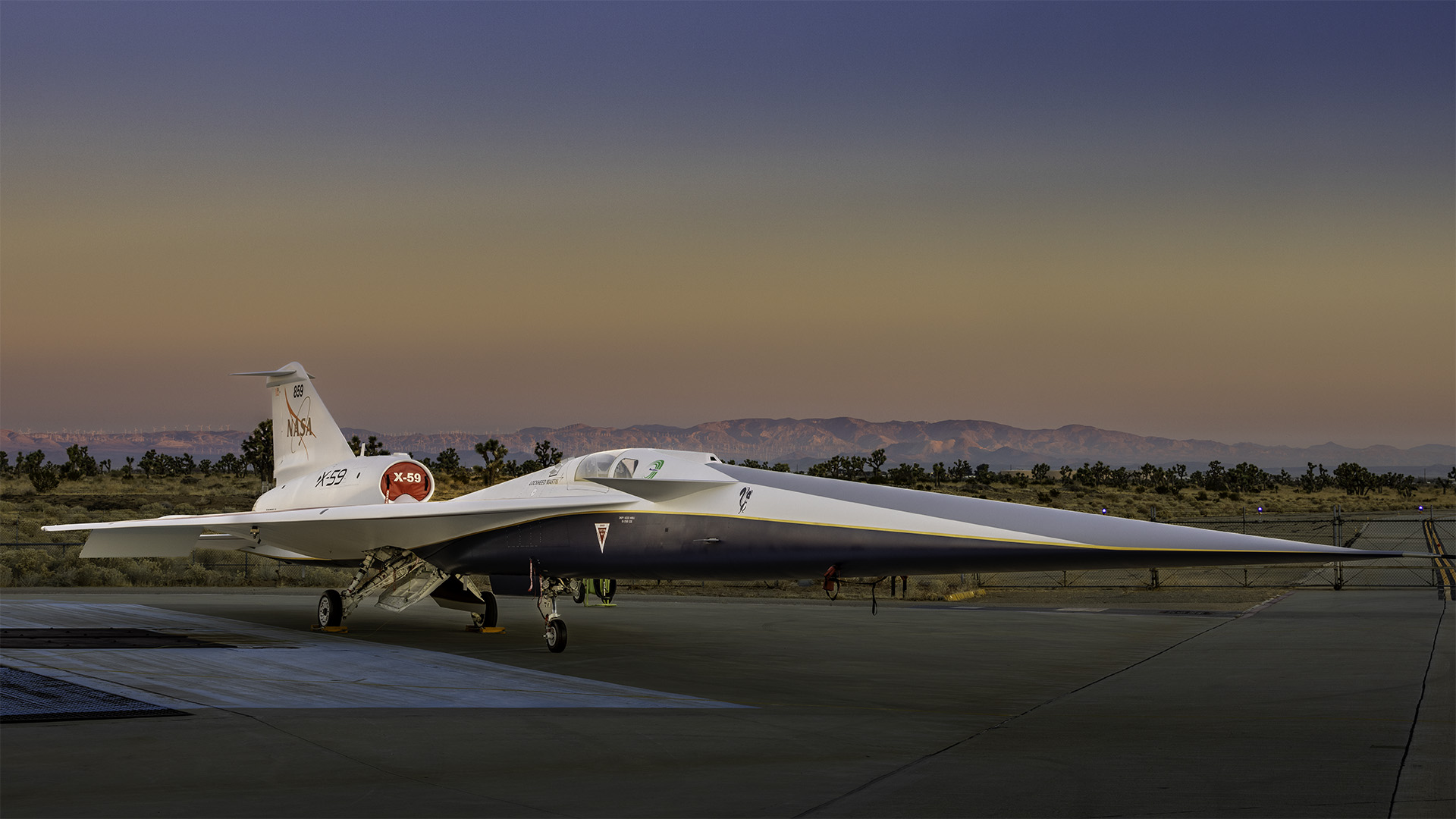
NASA’s Quesst mission features the one-of-a-kind X-59 aircraft. The shape of this supersonic airplane is specially designed to create a sonic thump instead of a sonic boom. NASA will test the X-59 to see how people respond to the quieter sonic thump as it flies faster than the speed of sound. This could lead to future supersonic flights over land again.
Career Corner
Are you interested in a career that is related to supersonic flight? Many different types of jobs make cutting-edge aviation possible. Here are a few examples:
Test pilot: These aircraft pilots have additional training that allows them to fly and evaluate new and experimental aircraft or those modified with new equipment. Test pilots typically get their start at military test pilot schools. They must have excellent decision-making skills and strong observational skills and remain calm in high-pressure situations.
Computational fluid dynamics engineer: These engineers use computer simulation tools to model and analyze fluid behavior in real-world situations. They might study airflow around car designs or explore ways to improve aircraft wing design. They need a strong background in engineering and the ability to analyze complex problems.
Manufacturing technician: Turning designs into reality takes skilled technicians. Fabrication and assembly of complicated aircraft parts requires precision and attention to detail. Being able to follow intricate instructions is key. Trade school training and skills such as operating forklifts and heavy machinery may be required.
More About Supersonic Flight
What Are Wind Tunnels?
NASA’s Quesst Mission
Watch Surprisingly STEM: Wind Tunnel Engineers
Read What Is Supersonic Flight? (Grades K-4)