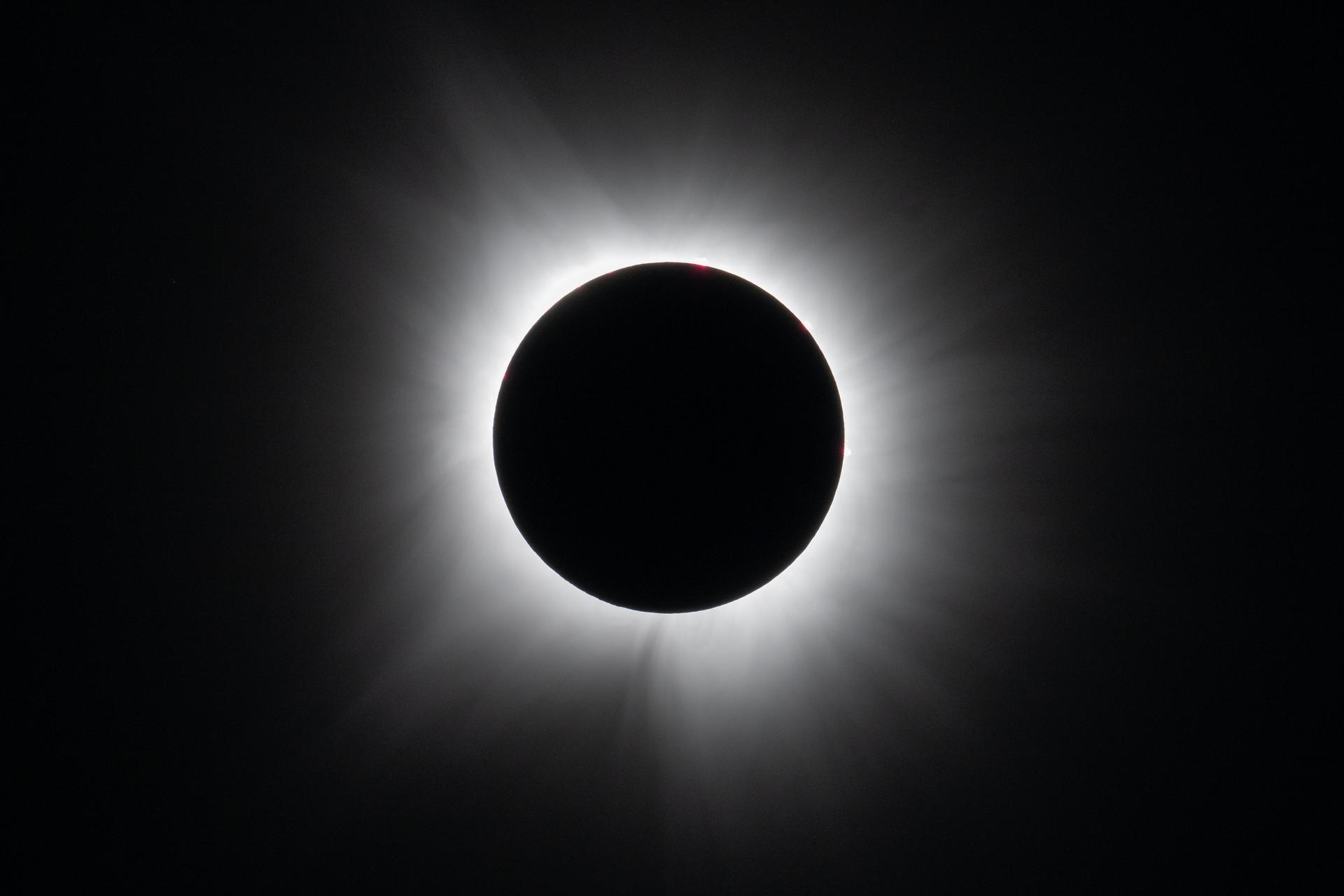







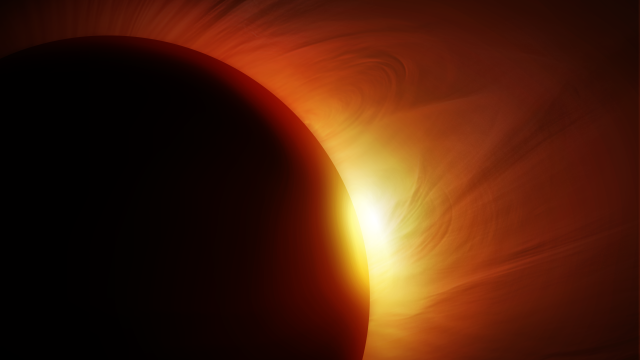

NASA Daily News Summary For Release: July 8, 1999 Media Advisory m99-137 Summary: News Release: Surf's Up: Historic Glenn Mission and SOHO Make Major Advance on 37-Year-Old Solar Mystery Video File for July 8 ********** Surf's Up: Historic Glenn Mission and SOHO Make Major Advance on 37-Year-Old Solar Mystery The high-speed portion of the solar wind achieves its unexpectedly high velocity--up to 500 miles per second--by "surfing" magnetic waves in the Sun's outer atmosphere, according to observations made by two spacecraft during John Glenn's return to space. For 37 years, solar scientists have been puzzled by the fact that the high-speed solar wind travels twice as fast as predicted by theory. Observations and theoretical analyses have discovered a surprising explanation for this mystery: magnetic waves. The observations were made using instruments aboard NASA's Spartan 201 spacecraft, deployed from the Space Shuttle during the STS-95 mission, and the international Solar and Heliospheric Observatory (SOHO). Contact at NASA Headquarters, Washington, DC: Donald Savage 202/358-1547. Contact at NASA Goddard Space Flight Center, Greenbelt, MD: Bill Steigerwald 301/286-5017. Full text of release: ftp://ftp.hq.nasa.gov/pub/pao/pressrel/1999/99-076.txt ---------- If NASA issues any news releases later today, we will e-mail summaries and Internet URLs to this list. Index of 1999 NASA News Releases: http://www.nasa.gov/releases/1999/index.html ********** Video File for July 8, 1999 Note: 2:00 pm - STS-93 Crew Briefing (replay from 7/7/99) Today's Video File: Item 1 - Surfing the Solar Winds (TRT: 13:06) Item 2 - STS-93 Mission Animation (TRT 5:15) (replay) Item 3 - Chandra Hardware B-roll (TRT 6:58) (replay) Item 4 - Chandra X-ray Animation (TRT 1:16) (replay) Item 5 - Apollo 11 30th Anniversary (TRT 18:42) (replay) ----- Item 1: Speedy Solar Wind Surfs Magnetic Waves Synopsis: The high-speed portion of the solar wind achieves its unexpectedly high velocity by 'surfing' magnetic waves in the Sun's outer atmosphere to reach speeds up to 500 miles per second, according to coordinated observations by two spacecraft made during John Glenn's return to space. a - Surfing the Solar Wind The outermost solar atmosphere, or corona, is normally visible only during a solar eclipse. Instruments aboard Spartan 201 and SOHO create artificial eclipses to view the accelerating solar wind of electrically charged particles. New observations of particles 'surfing' on waves in the corona have shed light on an ongoing mystery of why the solar wind flows as fast as it does. b - Wind Spiraling and Wave Damping Charged particles in the solar wind spiral around lines of magnetic force, and these lines oscillate back and forth to create outward-propagating waves. When the particles' spiraling frequencies match the wave frequencies, the particles can absorb the waves' energy; this spins up the particles into larger orbits, gives them an added outward boost, and damps out the waves. c - The Speedy Solar 'Wind' The solar wind comes in two varieties: high speed and low speed. The low speed solar wind moves at roughly a million miles per hour, while the high speed wind is even faster, moving at speeds as high as two million miles per hour. d - Effects of the Solar Wind on Earth As it flows past Earth, the solar wind changes the shape and structure of the Earth's magnetic field, which can damage satellites and disrupt communications and power systems. e - Source of the Solar Wind These combined images display UV light emitted by the solar corona over one full solar rotation (27 days) in August 1996. The inner images of the solar disk were taken by the EIT instrument aboard SOHO. The outer diffuse emission was observed by the UVCS instrument aboard SOHO, which creates an 'artificial eclipse' in ultraviolet light to observe the dim extended solar corona. The dark regions at the north and south poles are called 'coronal holes,' and they are thought to be the primary source regions of the high-speed solar wind. f - Solar Wind--Observations from LASCO Image of the solar corona--source of the solar wind--as recorded by SOHO's Large Angle and Spectrometric Coronagraph (LASCO) instrument. g - Sun Obserations by EIT Image of the full sun as seen by SOHO's Extreme ultraviolet Imaging Telescope (EIT). h - SOHO Animation Animation of the Solar and Heliospheric Observatory (SOHO). i - SPARTAN 201/STS-95 Mission Images of NASA's Spartan 201 spacecraft deployed from the space shuttle during the historic STS-95 mission during John Glenn's return to space. j - Spartan Animation k - Solar Scientists at Work NASA's Goddard Space Flight Center, Greenbelt, MD 20771 l - Interview Excerpts with Dr. Craig DeForest, Stanford University Contact at NASA Headquarters, Washington, DC: Donald Savage 202/358-1547. Contact at NASA Goddard Space Flight Center, Greenbelt, MD: Bill Steigerwald 301/286-5017. Item 2 - STS-93 Mission Animation (replay) TRT - 5:15 Compilation of computer animation used during the STS-93 mission overview briefing. Contact at NASA Johnson Space Center, Houston, TX: Kyle Herring 281/483-5111. Item 3 - Chandra Hardware B-roll (TRT 6:58) (replay) a - Astronauts at Telescope Assembly TRT - 3:28 Astronauts from the STS-93 crew visit the Chandra Telescope assembly. b - Chandra Readied for shipping TRT - 1:42 Chandra is bagged, put in a shipping container and readied for shipping to NASA's Kennedy Space Center. c - Chandra IUS arrival TRT - 1:11 Footage shows the Chandra X-ray telescope mating with the IUS Contact at NASA Headquarters, Washington, DC: Donald Savage 202/358-1727. Contact at NASA Marshall Space Flight Center, Huntsville AL: Dave Drachlis 256/544-6538. Item 4 - Chandra X-ray Animation (TRT 1:16) (replay) a - Mirror Comparison TRT - :37 Animation shows the refraction properties of the Chandra X- ray telescope. X-rays that strike a mirror head-on are absorbed. X-rays that hit a mirror at grazing angles are reflected like a pebble skipping across a pond. Thus, X-ray telescope mirrors are shaped like barrels rather than dishes. b - Deep Space Network TRT - :14 Animation shows the communication path between the satellite and the AXAF Science Center in Cambridge, MA. This communication is via NASA's Deep Space Network. c- Light Path TRT - :25 X-ray photons entering the telescope are reflected at grazing angles and focussed onto an electronic detector to make an image of a cosmic source. Contact at NASA Headquarters, Washington, DC: Donald Savage 202/358-1727. Contact at NASA Marshall Space Flight Center, Huntsville AL: Dave Drachlis 256/544-6538. Item 5 - Apollo 11 30th Anniversary (replay) TRT 18:42 a - The Apollo 11 Mission: Prior to Flight TRT - 5:47 Clips show various aspects of the Apollo 11 mission that sent Astronauts Michael Collins, Neil Armstrong, and Ed "Buzz" Aldrin to the Moon. The first set of clips includes the following: Crew photo Mission simulator LEM flight tests Suit-up Walkout b - The Apollo 11 Mission: Liftoff TRT - 5:44 Footage includes: Saturn V liftoff First and second stage separation Crew enroute to Moon Views of Earth from the Command module c - The Apollo 11 Mission: On the Moon TRT - 1:27 Footage includes: Lunar views LEM separates from command module LEM descends to the Moon Earth views d - The Apollo 11 Mission: From the Moon back to Earth TRT - 4:22 Footage includes: Armstrong steps on the Moon Walking on Moon Planting flag on Moon Crew retrieval from ocean and quarantine Contact at NASA Headquarters, Washington, DC: Ray Castillo 202/358-4555. ----- The NASA Video File generally airs at noon, 3 p.m., 6 p.m., 9 p.m. and midnight Eastern Time, but may be pre-empted by mission coverage or breaking news. NASA Television is available on GE-2, transponder 9C at 85 degrees West longitude, with vertical polarization. Frequency is on 3880.0 megahertz, with audio on 6.8 megahertz. Refer general questions about the video file to NASA Headquarters, Washington, DC: Ray Castillo, 202/358-4555, or Pam Poe, 202/358-0373. During Space Shuttle missions, you can access the full NASA TV schedule from: http://spaceflight.nasa.gov/realdata/nasatv/schedule.html For general information about NASA TV see: http://www.nasa.gov/ntv/ ********** Contract Awards Contract awards are posted to the NASA Acquisition information Service Web site: http://procurement.nasa.gov/EPS/award.html ********** The NASA Daily News Summary is issued each business day at approximately 2 p.m. Eastern time. Members of the media who wish to subscribe or unsubscribe from this list, please send e-mail message to: Brian.Dunbar@hq.nasa.gov ********** end of daily news summary