



|
MICHIGAN COMPANY TO ADAPT TECHNOLOGY
NASA Satellite Technology to Monitor Motor Vehicle
Pollution
Cities and states may soon have a
new high-tech tool in the battle against automotive air pollution,
thanks to NASA satellite technology originally developed to track
global greenhouse gases and the Earth's protective ozone layer.
As envisioned, NASA's
atmospheric remote sensing technology will be adapted to an
autonomous roadside system to monitor motor vehicle emissions. Cars
and trucks will pass through a low-power light beam, without
stopping or slowing down. Space-age sensor technology will
instantly analyze vehicle exhaust pollutants important to local and
state governments working to meet federally mandated air quality
standards.
"Taking an accurate reading of
several exhaust products as a car passes by is a formidable
challenge. We want to take a measurement of all the gases of
interest every one thousandth of a second over a period of a
half-second. Fortunately, our newest remote sensing technology has
that capability," said Glen Sachse, senior research scientist at
NASA Langley Research Center, Hampton, Va. Sachse is one of six
team members who invented the highly-sensitive electro-optical
system at the core of the technology.
Today, NASA Langley and SPX
Service Solutions, Warren, Mich., jointly announced that the
patented NASA technology has been exclusively licensed to SPX for
use in developing a new remote sensing device to monitor motor
vehicle exhaust.
"Remote testing of vehicle exhaust
will provide governments around the world with a fast, efficient
and low-cost method to identify and reduce motor vehicle air
pollution and greenhouse gases, which account for approximately
one-half of all air pollution," said Craig Rendahl, remote sensing
business leader for SPX Service Solutions.
"With the number of vehicles on
the road increasing every year, we believe there is a significant
global market for technology of this nature," said Rendahl. "SPX
will offer a basic unit which will be available at the end of 2000.
With the help of NASA, we expect to begin manufacturing a highly
enhanced remote sensing device before the end of 2001. This
second-generation product will contain many other features,
including the capability to test heavy-duty diesel vehicles."
The U.S. Clean Air Act mandates
that a certain percentage of the U.S. fleet of vehicles be measured
each year. The act allows for remote sensing as an option.
In a process called "clean
screening," drivers who formerly took their vehicles in for an
annual emissions inspection would receive a notice in the mail
certifying that their vehicle has passed twice in a 12-month period
and that they do not have to submit to an emissions test -- at
least that's the expected outcome for most drivers. As individual
roadside exhaust measurements are taken, the vehicle's license
plate would be photographed and the data would be transmitted to a
central collecting point.
Those drivers whose vehicles
passed would save both time and money. Drivers whose vehicles
failed or gave marginal readings would be identified for additional
testing and possible emissions-related repairs.
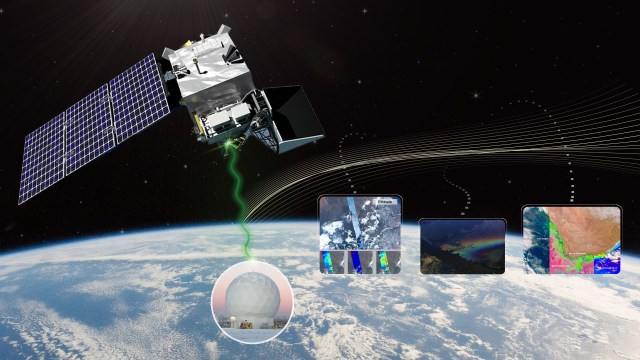
In space, NASA uses remote sensing
devices mounted on satellites and backlighting from the sun to take
global atmospheric measurements as part of its Earth Science
Enterprise program. The program is aimed at expanding knowledge of
the Earth's environment in order to provide the scientific basis
for sound policy decisions on environmental matters.
Service Solutions, a unit of SPX
Corporation (NYSE: SPW), provides special service tools, equipment
program management, electronic diagnostics, emissions testing
equipment and technical information services for the global motor
vehicle industry. SPX Corporation is a global provider of technical
products and systems, industrial products and services, service
solutions and vehicle components.
- end -
Editor's Note: For more information or still
images contact Keith Henry at h.k.henry@larc.nasa.gov.
B-roll and soundbite video is available that includes animation of
a vehicle and the light beam, and the technology's original space
application. For video, contact Kim Land at 757/864-9885 or k.w.land@larc.nasa.gov.
|