







Teachers Become Certified Rocketeers
07.20.06
When Marshall Space Flight Center education specialists Julie Clift and Dawn Mercer helped organize and guide this year's NASA Student Launch Initiative, an educational program encouraging students to design and build their own rockets, the former teachers ended up turning the tables on themselves and became students of rocketry.
Image to right: Marshall education specialists Julie Clift, left, and Dawn Mercer show off the rocket they built and its passenger, both named "Gumby," during the design review portion of last month's Student Launch Initiative. Credit: Doug Stoffer, MSFC
The annual Initiative, hosted and sponsored by the Marshall Center in Huntsville, Ala., challenges high school students from around the United States not only to design and build a rocket, but also create a scientific payload and test the vehicle. This yearlong process culminated last month in a design review and rocket fair at Marshall and the official rocket launch in Manchester, Tenn.
Caught up in the students' excitement they'd witnessed in previous years, Clift and Mercer, who support Marshall's Academic Affairs Office as employees of AI Signal Research, Inc., decided to take on the same challenges the students faced. "We wanted to understand the basics of what is important when it comes to building a rocket and why, so we conducted our own hands-on lesson," Mercer said. "We wanted to see what these students go through."
They unveiled their surprise to the students, who gathered May 4 in Morris Auditorium at Marshall for the design review and presentations: a model rocket Clift and Mercer spent weekends building and would launch with the student-built rockets during the launch event.
Image to left: Building the rocket gave Dawn Mercer, left, and Julie Clift the same experience that students participating in their program have. Credit: Chuck Pierce, MSFC
"We wanted to learn for ourselves what steps student teams had to take to build a rocket," said Clift, a former elementary school teacher. "We couldn't build one as intricate or complex as the students', but we knew we could build a basic one to grasp the program challenges we ask students to face. We wired our rocket with an altimeter to measure how high the rocket reached, and attached our payload. Then we painted it pink."
Mercer and Clift used an I161 model engine in their 5-foot-4-inch project. With the launch, the pair became officially certified by the National Association of Rocketry, the world's oldest and largest sport rocketry organization. Certification is granted when applicants conduct a safe and successful flight with two members of the association present as witnesses.
"Along with the 11 student rocketry teams, we had six members of the Huntsville Area Rocketry Association witness the launch," said Mercer, who taught high school science in Marietta, Ga., and Huntsville for eight years before joining Marshall in 2000. "Now we just need to send off the paperwork. I'm excited to become an official certified rocketeer."
Jim Ellis, manager of Marshall's Academic Affairs Office, is impressed with the work Clift and Mercer do.
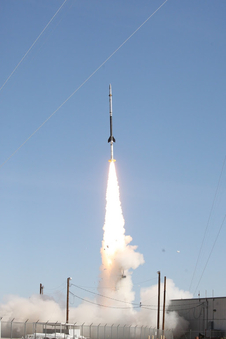
Image to right: Clift and Mercer launched their rocket with the rest of the SLI participants. Credit: Christena Shepherd, MSFC
"Dawn and Julie took their experience with the Student Launch Initiative that extra step, so they could learn from the event and get more directly involved with the students," Ellis said. "Their initiative and their continued effort to improve as leaders of the Student Launch Initiative will make the program stronger. I am very proud of them. They have a special ability to inspire the participants to want to pursue science and math educations. I have no doubt that some of the students participating in the launch initiative will be designing, building and launching future NASA systems."
Their pink rocket was called "The Gumby" because it carried the small, green, bendable toy made famous in cartoons in the late 1950s. "The Gumby" rocket and its green passenger didn't quite reach the one-mile altitude goal set for the students, but it did soar to 2,725 feet, a little over half a mile, before falling back to Earth.
"Which was fine for us," Clift said. "We just wanted to make sure it could get off the ground and have a good flight."
Mercer agreed. "It wasn't just about putting the rocket together. As it flew, the excitement for us came from the anticipation of the parachute deployment. The chute proved we had a successful flight and could recover the rocket and payload. Plus, the kids got a big kick out of seeing us get involved and get just as excited as they do."
Bill Hubscher/MSFC